
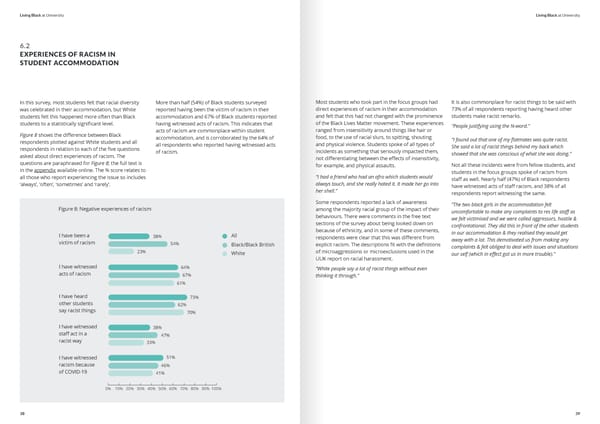
Living Black at University 38 Living Black at University 39 In this survey, most students felt that racial diversity was celebrated in their accommodation, but White students felt this happened more often than Black students to a statistically significant level. Figure 8 shows the difference between Black respondents plotted against White students and all respondents in relation to each of the five questions asked about direct experiences of racism. The questions are paraphrased for Figure 8 ; the full text is in the appendix available online. The % score relates to all those who report experiencing the issue so includes ‘always’, ‘often’, 'sometimes’ and ‘rarely’. More than half (54%) of Black students surveyed reported having been the victim of racism in their accommodation and 67% of Black students reported having witnessed acts of racism. This indicates that acts of racism are commonplace within student accommodation, and is corroborated by the 64% of all respondents who reported having witnessed acts of racism. 6.2 EXPERIENCES OF RACISM IN STUDENT ACCOMMODATION 0% 10% 20% 30% 40% 50% 60% 70% 80% 90% 100% All Black/Black British White 23% 54% 73% 62% 70% 38% 47% 33% 51% 46% 41% 38% 64% 67% 61% I have been a victim of racism I have witnessed acts of racism I have heard other students say racist things I have witnessed staff act in a racist way I have witnessed racism because of COVID-19 Figure 8: Negative experiences of racism Most students who took part in the focus groups had direct experiences of racism in their accommodation and felt that this had not changed with the prominence of the Black Lives Matter movement. These experiences ranged from insensitivity around things like hair or food, to the use of racial slurs, to spitting, shouting and physical violence. Students spoke of all types of incidents as something that seriously impacted them, not differentiating between the effects of insensitivity, for example, and physical assaults. “I had a friend who had an afro which students would always touch, and she really hated it. It made her go into her shell.” Some respondents reported a lack of awareness among the majority racial group of the impact of their behaviours. There were comments in the free text sections of the survey about being looked down on because of ethnicity, and in some of these comments, respondents were clear that this was different from explicit racism. The descriptions fit with the definitions of microaggressions or microexclusions used in the UUK report on racial harassment. “White people say a lot of racist things without even thinking it through.” It is also commonplace for racist things to be said with 73% of all respondents reporting having heard other students make racist remarks. “People justifying using the N-word.” “I found out that one of my flatmates was quite racist. She said a lot of racist things behind my back which showed that she was conscious of what she was doing.” Not all these incidents were from fellow students, and students in the focus groups spoke of racism from staff as well. Nearly half (47%) of Black respondents have witnessed acts of staff racism, and 38% of all respondents report witnessing the same. “The two black girls in the accommodation felt uncomfortable to make any complaints to res life staff as we felt victimised and we were called aggressors, hostile & confrontational. They did this in front of the other students in our accommodation & they realised they would get away with a lot. This demotivated us from making any complaints & felt obliged to deal with issues and situations our self (which in effect got us in more trouble).”
 Living Black at University Page 21 Page 23