
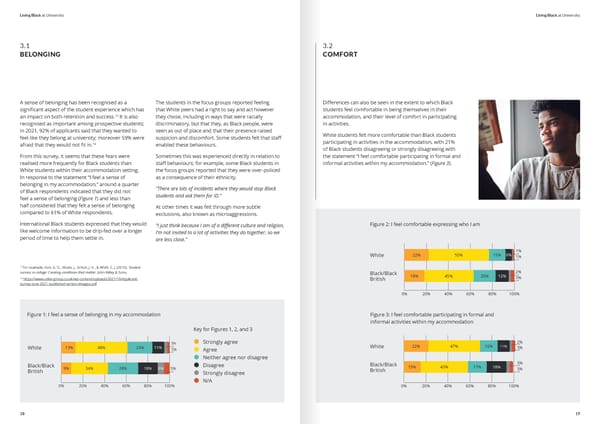
Living Black at University 18 Living Black at University 13 For example, Kuh, G. D., Kinzie, J., Schuh, J. H., & Whitt, E. J. (2010). Student success in college: Creating conditions that matter . John Wiley & Sons. 14 https://www.unite-group.co.uk/wp-content/uploads/2021/10/Applicant- survey-June-2021-published-version-images.pdf A sense of belonging has been recognised as a significant aspect of the student experience which has an impact on both retention and success. 13 It is also recognised as important among prospective students; in 2021, 92% of applicants said that they wanted to feel like they belong at university; moreover 59% were afraid that they would not fit in. 14 From this survey, it seems that these fears were realised more frequently for Black students than White students within their accommodation setting. In response to the statement “I feel a sense of belonging in my accommodation,” around a quarter of Black respondents indicated that they did not feel a sense of belonging ( Figure 1 ) and less than half considered that they felt a sense of belonging compared to 61% of White respondents. International Black students expressed that they would like welcome information to be drip-fed over a longer period of time to help them settle in. The students in the focus groups reported feeling that White peers had a right to say and act however they chose, including in ways that were racially discriminatory, but that they, as Black people, were seen as out of place and that their presence raised suspicion and discomfort. Some students felt that staff enabled these behaviours. Sometimes this was experienced directly in relation to staff behaviours; for example, some Black students in the focus groups reported that they were over-policed as a consequence of their ethnicity. “There are lots of incidents where they would stop Black students and ask them for ID.” At other times it was felt through more subtle exclusions, also known as microaggressions. “I just think because I am of a different culture and religion, I’m not invited to a lot of activities they do together, so we are less close.” 19 Differences can also be seen in the extent to which Black students feel comfortable in being themselves in their accommodation, and their level of comfort in participating in activities. White students felt more comfortable than Black students participating in activities in the accommodation, with 21% of Black students disagreeing or strongly disagreeing with the statement “I feel comfortable participating in formal and informal activities within my accommodation.” ( Figure 3 ). 3.2 COMFORT 3.1 BELONGING 0% 20% 40% 60% 80% 100% Black/Black British Key White 13% 9% 23% 28% 11% 18% 48% 34% 6% 5% 3% 1% Strongly agree Figure 1: I feel a sense of belonging in my accommodation Key for Figures 1, 2, and 3 0% 20% 40% 60% 80% 100% Black/Black British Key White 13% 9% 23% 28% 11% 18% 48% 34% 6% 5% 3% 1% Disagree Strongly disagree N/A Strongly agree Agree Neither agree nor disagree Figure 2: I feel comfortable expressing who I am 0% 20% 40% 60% 80% 100% 22% 18% 15% 20% 6% 12% 55% 45% 3% 1% 2% 1% Black/Black British White Figure 3: I feel comfortable participating in formal and informal activities within my accommodation 0% 20% 40% 60% 80% 100% 22% 15% 16% 11% 17% 18% 47% 43% 3% 2% 3% 3% Black/Black British White
 Living Black at University Page 11 Page 13