
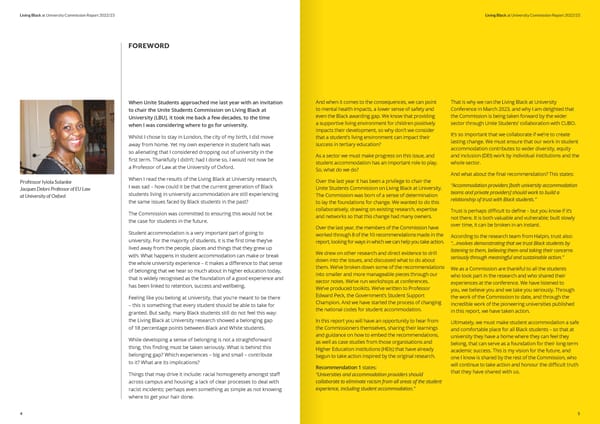
Living Black at University Commission Report 2022/23 4 Living Black at University Commission Report 2022/23 5 When Unite Students approached me last year with an invitation to chair the Unite Students Commission on Living Black at University (LBU), it took me back a few decades, to the time when I was considering where to go for university. Whilst I chose to stay in London, the city of my birth, I did move away from home. Yet my own experience in student halls was so alienating that I considered dropping out of university in the first term. Thankfully I didn’t; had I done so, I would not now be a Professor of Law at the University of Oxford. When I read the results of the Living Black at University research, I was sad – how could it be that the current generation of Black students living in university accommodation are still experiencing the same issues faced by Black students in the past? The Commission was committed to ensuring this would not be the case for students in the future. Student accommodation is a very important part of going to university. For the majority of students, it is the first time they’ve lived away from the people, places and things that they grew up with. What happens in student accommodation can make or break the whole university experience – it makes a difference to that sense of belonging that we hear so much about in higher education today, that is widely recognised as the foundation of a good experience and has been linked to retention, success and wellbeing. Feeling like you belong at university, that you’re meant to be there – this is something that every student should be able to take for granted. But sadly, many Black students still do not feel this way: the Living Black at University research showed a belonging gap of 18 percentage points between Black and White students. While developing a sense of belonging is not a straightforward thing, this finding must be taken seriously. What is behind this belonging gap? Which experiences – big and small – contribute to it? What are its implications? Things that may drive it include: racial homogeneity amongst staff across campus and housing; a lack of clear processes to deal with racist incidents; perhaps even something as simple as not knowing where to get your hair done. FOREWORD And when it comes to the consequences, we can point to mental health impacts, a lower sense of safety and even the Black awarding gap. We know that providing a supportive living environment for children positively impacts their development, so why don't we consider that a student’s living environment can impact their success in tertiary education? As a sector we must make progress on this issue, and student accommodation has an important role to play. So, what do we do? Over the last year it has been a privilege to chair the Unite Students Commission on Living Black at University. The Commission was born of a sense of determination to lay the foundations for change. We wanted to do this collaboratively, drawing on existing research, expertise and networks so that this change had many owners. Over the last year, the members of the Commission have worked through 8 of the 10 recommendations made in the report, looking for ways in which we can help you take action. We drew on other research and direct evidence to drill down into the issues, and discussed what to do about them. We’ve broken down some of the recommendations into smaller and more manageable pieces through our sector notes. We’ve run workshops at conferences. We’ve produced toolkits. We’ve written to Professor Edward Peck, the Government’s Student Support Champion. And we have started the process of changing the national codes for student accommodation. In this report you will have an opportunity to hear from the Commissioners themselves, sharing their learnings and guidance on how to embed the recommendations, as well as case studies from those organisations and Higher Education institutions (HEIs) that have already begun to take action inspired by the original research. Recommendation 1 states: “Universities and accommodation providers should collaborate to eliminate racism from all areas of the student experience, including student accommodation.” That is why we ran the Living Black at University Conference in March 2023, and why I am delighted that the Commission is being taken forward by the wider sector through Unite Students’ collaboration with CUBO. It’s so important that we collaborate if we’re to create lasting change. We must ensure that our work in student accommodation contributes to wider diversity, equity and inclusion (DEI) work by individual institutions and the whole sector. And what about the final recommendation? This states: “Accommodation providers [both university accommodation teams and private providers] should work to build a relationship of trust with Black students.” Trust is perhaps difficult to define – but you know if it’s not there. It is both valuable and vulnerable; built slowly over time, it can be broken in an instant. According to the research team from Halpin, trust also: “...involves demonstrating that we trust Black students by listening to them, believing them and taking their concerns seriously through meaningful and sustainable action.” We as a Commission are thankful to all the students who took part in the research and who shared their experiences at the conference. We have listened to you, we believe you and we take you seriously. Through the work of the Commission to date, and through the incredible work of the pioneering universities published in this report, we have taken action. Ultimately, we must make student accommodation a safe and comfortable place for all Black students – so that at university they have a home where they can feel they belong, that can serve as a foundation for their long-term academic success. This is my vision for the future, and one I know is shared by the rest of the Commission, who will continue to take action and honour the difficult truth that they have shared with us. Professor Iyiola Solanke Jacques Delors Professor of EU Law at University of Oxford
 Living Black at University Commission Report web Page 2 Page 4