
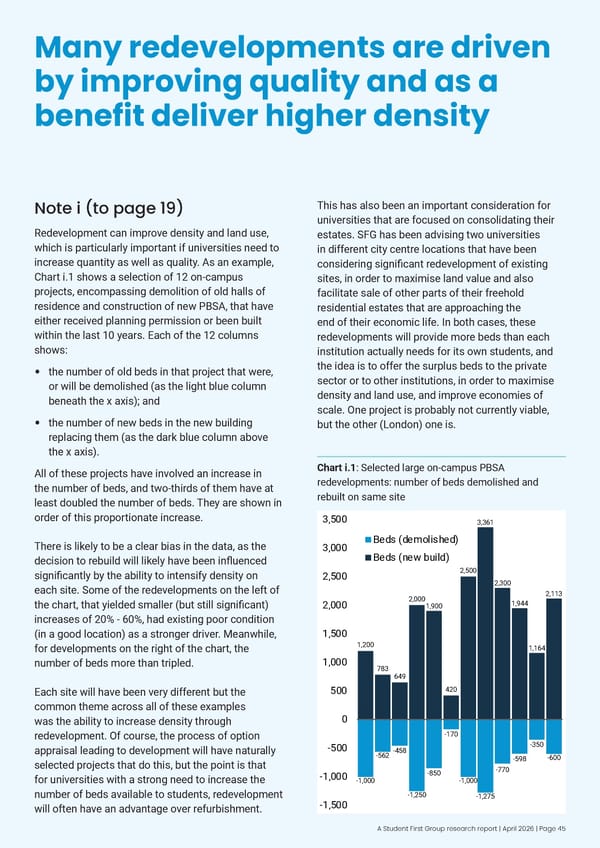
Many redevelopments are driven by improving quality and as a benefit deliver higher density Note i (to page 19) Redevelopment can improve density and land use, which is particularly important if universities need to increase quantity as well as quality. As an example, Chart i.1 shows a selection of 12 on-campus projects, encompassing demolition of old halls of residence and construction of new PBSA, that have either received planning permission or been built within the last 10 years. Each of the 12 columns shows: • the number of old beds in that project that were, or will be demolished (as the light blue column beneath the x axis); and • the number of new beds in the new building replacing them (as the dark blue column above the x axis). All of these projects have involved an increase in the number of beds, and two-thirds of them have at least doubled the number of beds. They are shown in order of this proportionate increase. There is likely to be a clear bias in the data, as the decision to rebuild will likely have been influenced significantly by the ability to intensify density on each site. Some of the redevelopments on the left of the chart, that yielded smaller (but still significant) increases of 20% - 60%, had existing poor condition (in a good location) as a stronger driver. Meanwhile, for developments on the right of the chart, the number of beds more than tripled. Each site will have been very different but the common theme across all of these examples was the ability to increase density through redevelopment. Of course, the process of option appraisal leading to development will have naturally selected projects that do this, but the point is that for universities with a strong need to increase the number of beds available to students, redevelopment will often have an advantage over refurbishment. This has also been an important consideration for universities that are focused on consolidating their estates. SFG has been advising two universities in different city centre locations that have been considering significant redevelopment of existing sites, in order to maximise land value and also facilitate sale of other parts of their freehold residential estates that are approaching the end of their economic life. In both cases, these redevelopments will provide more beds than each institution actually needs for its own students, and the idea is to offer the surplus beds to the private sector or to other institutions, in order to maximise density and land use, and improve economies of scale. One project is probably not currently viable, but the other (London) one is. Chart i.1 : Selected large on-campus PBSA redevelopments: number of beds demolished and rebuilt on same site -1,000 -562 -458 -1,250 -850 -170 -1,000 -1,275 -770 -598 -350 -600 1,200 783 649 2,0001,900 420 2,500 3,361 2,300 1,944 1,164 2,113 -1,500 -1,000 -500 0 500 1,000 1,500 2,000 2,500 3,000 3,500 Beds (demolished) Beds (new build) A Student First Group research report | April 2026 | Page 45
 Meeting demand for modernised university accommodation Page 46 Page 48