
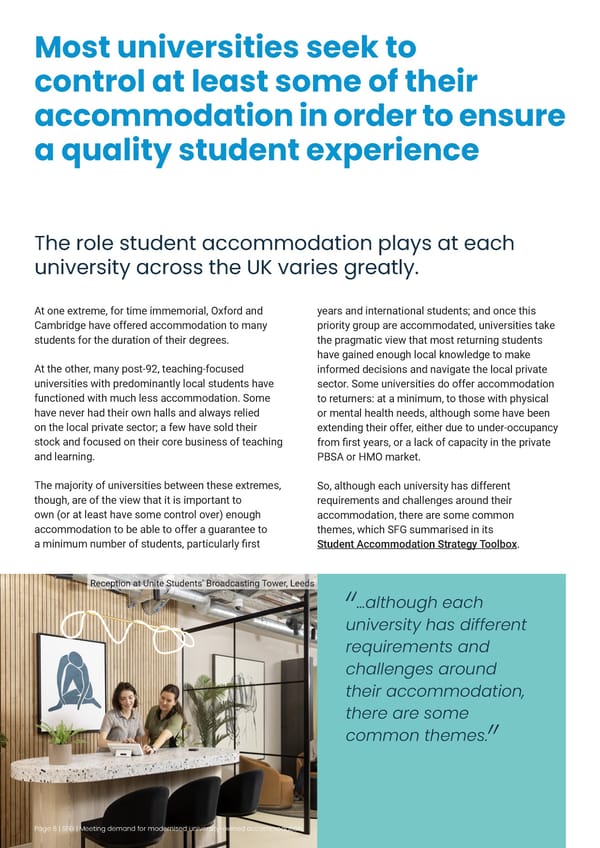
Most universities seek to control at least some of their accommodation in order to ensure a quality student experience The role student accommodation plays at each university across the UK varies greatly. At one extreme, for time immemorial, Oxford and Cambridge have offered accommodation to many students for the duration of their degrees. At the other, many post-92, teaching-focused universities with predominantly local students have functioned with much less accommodation. Some have never had their own halls and always relied on the local private sector; a few have sold their stock and focused on their core business of teaching and learning. The majority of universities between these extremes, though, are of the view that it is important to own (or at least have some control over) enough accommodation to be able to offer a guarantee to a minimum number of students, particularly first years and international students; and once this priority group are accommodated, universities take the pragmatic view that most returning students have gained enough local knowledge to make informed decisions and navigate the local private sector. Some universities do offer accommodation to returners: at a minimum, to those with physical or mental health needs, although some have been extending their offer, either due to under-occupancy from first years, or a lack of capacity in the private PBSA or HMO market. So, although each university has different requirements and challenges around their accommodation, there are some common themes, which SFG summarised in its Student Accommodation Strategy Toolbox . ...although each university has different requirements and challenges around their accommodation, there are some common themes. Reception at Unite Students’ Broadcasting Tower, Leeds Page 8 | SFG | Meeting demand for modernised university-owned accommodation
 Meeting demand for modernised university accommodation Page 9 Page 11