
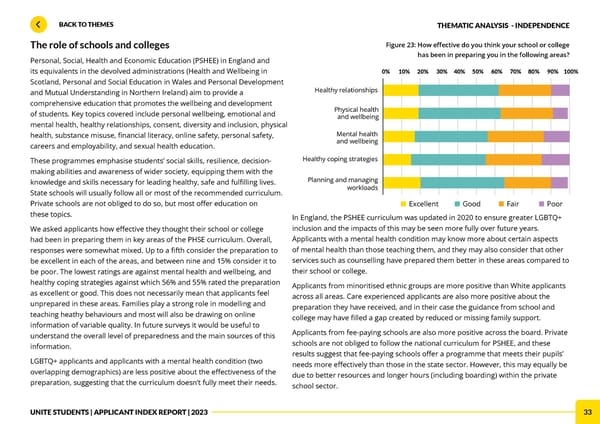
33 BACK TO THEMES U NITE STUDENTS | APPLICANT INDEX REPORT | 2023 33 BACK TO THEMES The role of schools and colleges Personal, Social, Health and Economic Education (PSHEE) in England and its equivalents in the devolved administrations (Health and Wellbeing in Scotland, Personal and Social Education in Wales and Personal Development and Mutual Understanding in Northern Ireland) aim to provide a comprehensive education that promotes the wellbeing and development of students. Key topics covered include personal wellbeing, emotional and mental health, healthy relationships, consent, diversity and inclusion, physical health, substance misuse, financial literacy, online safety, personal safety, careers and employability, and sexual health education. These programmes emphasise students’ social skills, resilience, decision- making abilities and awareness of wider society, equipping them with the knowledge and skills necessary for leading healthy, safe and fulfilling lives. State schools will usually follow all or most of the recommended curriculum. Private schools are not obliged to do so, but most offer education on these topics. We asked applicants how effective they thought their school or college had been in preparing them in key areas of the PHSE curriculum. Overall, responses were somewhat mixed. Up to a fifth consider the preparation to be excellent in each of the areas, and between nine and 15% consider it to be poor. The lowest ratings are against mental health and wellbeing, and healthy coping strategies against which 56% and 55% rated the preparation as excellent or good. This does not necessarily mean that applicants feel unprepared in these areas. Families play a strong role in modelling and teaching heathy behaviours and most will also be drawing on online information of variable quality. In future surveys it would be useful to understand the overall level of preparedness and the main sources of this information. LGBTQ+ applicants and applicants with a mental health condition (two overlapping demographics) are less positive about the effectiveness of the preparation, suggesting that the curriculum doesn’t fully meet their needs. In England, the PSHEE curriculum was updated in 2020 to ensure greater LGBTQ+ inclusion and the impacts of this may be seen more fully over future years. Applicants with a mental health condition may know more about certain aspects of mental health than those teaching them, and they may also consider that other services such as counselling have prepared them better in these areas compared to their school or college. Applicants from minoritised ethnic groups are more positive than White applicants across all areas. Care experienced applicants are also more positive about the preparation they have received, and in their case the guidance from school and college may have filled a gap created by reduced or missing family support. Applicants from fee-paying schools are also more positive across the board. Private schools are not obliged to follow the national curriculum for PSHEE, and these results suggest that fee-paying schools offer a programme that meets their pupils’ needs more effectively than those in the state sector. However, this may equally be due to better resources and longer hours (including boarding) within the private school sector. ■ Excellent ■ Good ■ Fair ■ Poor Healthy relationships Physical health and wellbeing Mental health and wellbeing Healthy coping strategies Planning and managing workloads Figure 23: How effective do you think your school or college has been in preparing you in the following areas? THEMATIC ANALYSIS - INDEPENDENCE 0% 100% 80% 50% 20% 90% 60% 30% 70% 40% 10%
 Unite Applicant Index Report 2023 Page 32 Page 34