
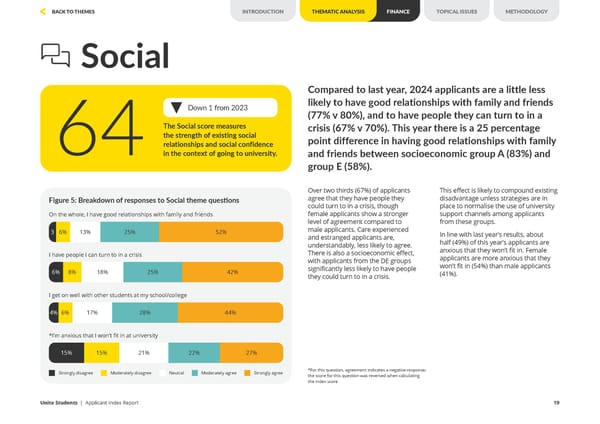
Social Over two thirds (67%) of applicants agree that they have people they could turn to in a crisis, though female applicants show a stronger level of agreement compared to male applicants. Care experienced and estranged applicants are, understandably, less likely to agree. There is also a socioeconomic effect, with applicants from the DE groups significantly less likely to have people they could turn to in a crisis. This effect is likely to compound existing disadvantage unless strategies are in place to normalise the use of university support channels among applicants from these groups. In line with last year’s results, about half (49%) of this year’s applicants are anxious that they won’t fit in. Female applicants are more anxious that they won’t fit in (54%) than male applicants (41%). *For this question, agreement indicates a negative response; the score for this question was reversed when calculating the index score On the whole, I have good relationships with family and friends 6% 13% 25% 52% I have people I can turn to in a crisis I get on well with other students at my school/college 6% 17% 28% 44% *I’m anxious that I won’t fit in at university 15% 21% 22% 27% Strongly disagree Moderately disagree Neutral Moderately agree Strongly agree Figure 5: Breakdown of responses to Social theme questions The Social score measures the strength of existing social relationships and social confidence in the context of going to university. Down 1 from 2023 64 Compared to last year, 2024 applicants are a little less likely to have good relationships with family and friends (77% v 80%), and to have people they can turn to in a crisis (67% v 70%). This year there is a 25 percentage point difference in having good relationships with family and friends between socioeconomic group A (83%) and group E (58%). 3 6% 8% 18% 25% 42% 4% 15% Unite Students | Applicant Index Report 19 INTRODUCTION THEMATIC ANALYSIS FINANCE METHODOLOGY TOPICAL ISSUES BACK TO THEMES
 Unite Applicant Index Report 2024 Page 18 Page 20