
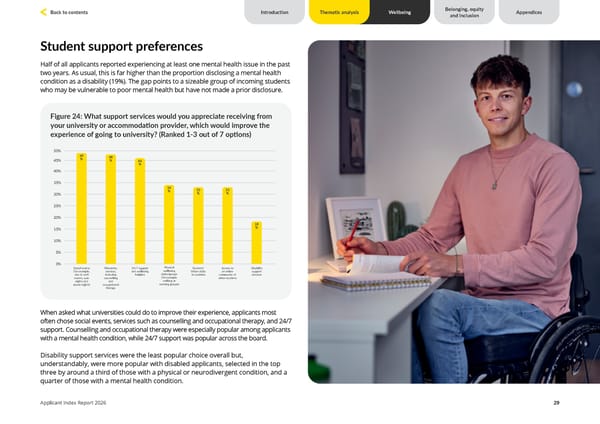
29 Appendices Introduction Wellbeing Thematic analysis Applicant Index Report 2026 Student support preferences Half of all applicants reported experiencing at least one mental health issue in the past two years. As usual, this is far higher than the proportion disclosing a mental health condition as a disability (19%). The gap points to a sizeable group of incoming students who may be vulnerable to poor mental health but have not made a prior disclosure. Figure 24: What support services would you appreciate receiving from your university or accommodation provider, which would improve the experience of going to university? (Ranked 1-3 out of 7 options) 45% 0% 5% 10% 15% 20% 25% 30% 35% 40% Social events (for example, arts & craft events, quiz nights and movie nights) 49 % University services, including counselling and occupational therapy 48 % 24/7 support and wellbeing helpline 46 % Physical wellbeing clubs/groups (for example walking or running groups) 34 % Students’ Union clubs or societies 33 % Access to an online community of other students 33 % 50% Disability support services 18 % When asked what universities could do to improve their experience, applicants most often chose social events, services such as counselling and occupational therapy, and 24/7 support. Counselling and occupational therapy were especially popular among applicants with a mental health condition, while 24/7 support was popular across the board. Disability support services were the least popular choice overall but, understandably, were more popular with disabled applicants, selected in the top three by around a third of those with a physical or neurodivergent condition, and a quarter of those with a mental health condition. Belonging, equity and inclusion Back to contents
 Unite Students Applicant Index 2026 Page 28 Page 30