
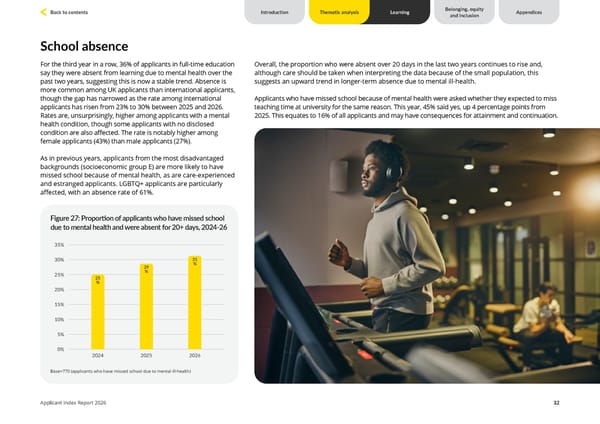
32 Appendices Introduction Learning Thematic analysis Applicant Index Report 2026 School absence For the third year in a row, 36% of applicants in full ‑ time education say they were absent from learning due to mental health over the past two years, suggesting this is now a stable trend. Absence is more common among UK applicants than international applicants, though the gap has narrowed as the rate among international applicants has risen from 23% to 30% between 2025 and 2026. Rates are, unsurprisingly, higher among applicants with a mental health condition, though some applicants with no disclosed condition are also affected. The rate is notably higher among female applicants (43%) than male applicants (27%). As in previous years, applicants from the most disadvantaged backgrounds (socioeconomic group E) are more likely to have missed school because of mental health, as are care‑experienced and estranged applicants. LGBTQ+ applicants are particularly affected, with an absence rate of 61%. Figure 27: Proportion of applicants who have missed school due to mental health and were absent for 20+ days, 2024-26 0% 5% 10% 15% 20% 25% 30% 35% 2024 25 % 2025 29 % 2026 31 % Base=770 (applicants who have missed school due to mental ill ‑ health) Overall, the proportion who were absent over 20 days in the last two years continues to rise and, although care should be taken when interpreting the data because of the small population, this suggests an upward trend in longer ‑ term absence due to mental ill ‑ health. Applicants who have missed school because of mental health were asked whether they expected to miss teaching time at university for the same reason. This year, 45% said yes, up 4 percentage points from 2025. This equates to 16% of all applicants and may have consequences for attainment and continuation. Belonging, equity and inclusion Back to contents
 Unite Students Applicant Index 2026 Page 31 Page 33