
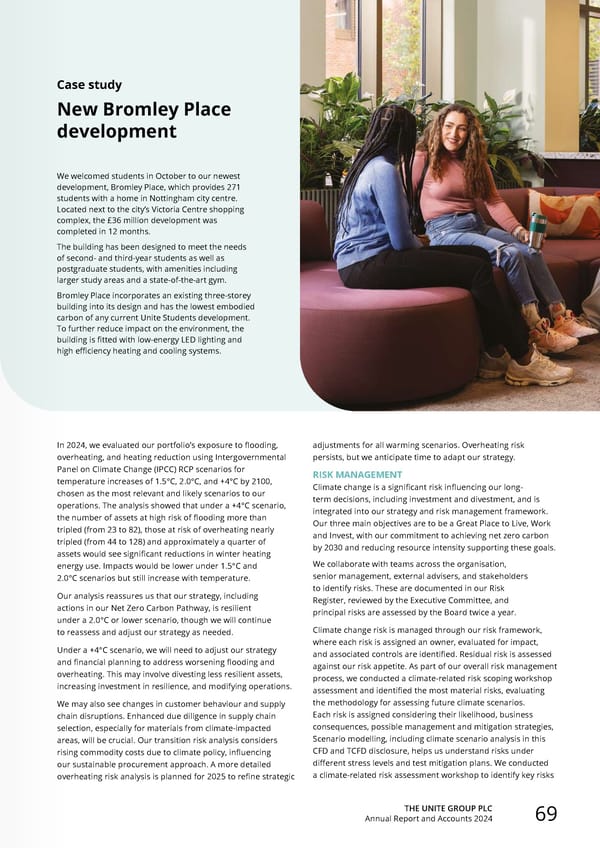
THE UNITE GROUP PLC Annual Report and Accounts 2024 69 In 2024, we evaluated our portfolio’s exposure to flooding, overheating, and heating reduction using Intergovernmental Panel on Climate Change (IPCC) RCP scenarios for temperature increases of 1.5°C, 2.0°C, and +4°C by 2100, chosen as the most relevant and likely scenarios to our operations. The analysis showed that under a +4°C scenario, the number of assets at high risk of flooding more than tripled (from 23 to 82), those at risk of overheating nearly tripled (from 44 to 128) and approximately a quarter of assets would see significant reductions in winter heating energy use. Impacts would be lower under 1.5°C and 2.0°C scenarios but still increase with temperature. Our analysis reassures us that our strategy, including actions in our Net Zero Carbon Pathway, is resilient under a 2.0°C or lower scenario, though we will continue to reassess and adjust our strategy as needed. Under a +4°C scenario, we will need to adjust our strategy and financial planning to address worsening flooding and overheating. This may involve divesting less resilient assets, increasing investment in resilience, and modifying operations. We may also see changes in customer behaviour and supply chain disruptions. Enhanced due diligence in supply chain selection, especially for materials from climate-impacted areas, will be crucial. Our transition risk analysis considers rising commodity costs due to climate policy, influencing our sustainable procurement approach. A more detailed overheating risk analysis is planned for 2025 to refine strategic adjustments for all warming scenarios. Overheating risk persists, but we anticipate time to adapt our strategy. RISK MANAGEMENT Climate change is a significant risk influencing our long- term decisions, including investment and divestment, and is integrated into our strategy and risk management framework. Our three main objectives are to be a Great Place to Live, Work and Invest, with our commitment to achieving net zero carbon by 2030 and reducing resource intensity supporting these goals. We collaborate with teams across the organisation, senior management, external advisers, and stakeholders to identify risks. These are documented in our Risk Register, reviewed by the Executive Committee, and principal risks are assessed by the Board twice a year. Climate change risk is managed through our risk framework, where each risk is assigned an owner, evaluated for impact, and associated controls are identified. Residual risk is assessed against our risk appetite. As part of our overall risk management process, we conducted a climate-related risk scoping workshop assessment and identified the most material risks, evaluating the methodology for assessing future climate scenarios. Each risk is assigned considering their likelihood, business consequences, possible management and mitigation strategies, Scenario modelling, including climate scenario analysis in this CFD and TCFD disclosure, helps us understand risks under different stress levels and test mitigation plans. We conducted a climate-related risk assessment workshop to identify key risks 00 Case study New Bromley Place development We welcomed students in October to our newest development, Bromley Place, which provides 271 students with a home in Nottingham city centre. Located next to the city’s Victoria Centre shopping complex, the £36 million development was completed in 12 months. The building has been designed to meet the needs of second- and third-year students as well as postgraduate students, with amenities including larger study areas and a state-of-the-art gym. Bromley Place incorporates an existing three-storey building into its design and has the lowest embodied carbon of any current Unite Students development. To further reduce impact on the environment, the building is fitted with low-energy LED lighting and high efficiency heating and cooling systems.
 Home for Success: Unite Students Annual Report 2024 Page 70 Page 72