
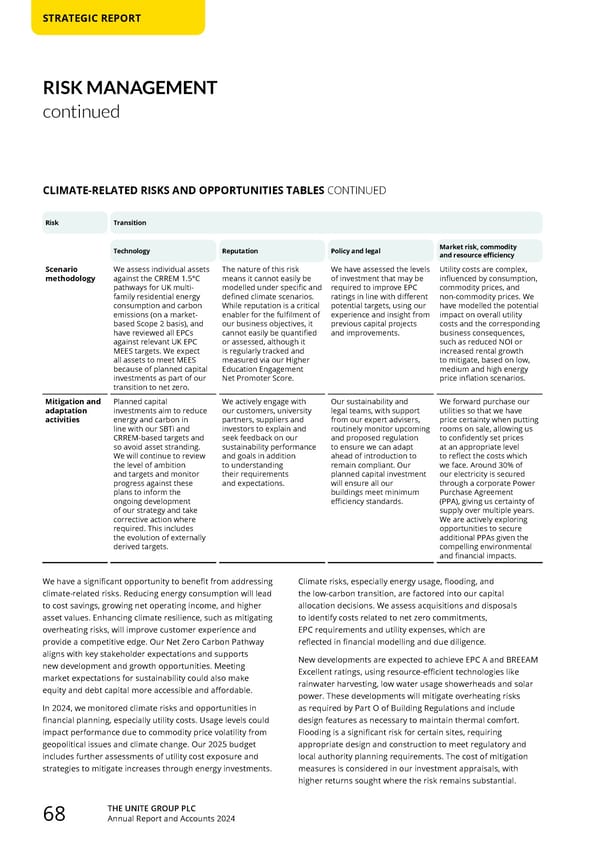
THE UNITE GROUP PLC Annual Report and Accounts 2024 68 CHIEF EXECUTIVE’S REVIEW continued STRATEGIC REPORT Risk Transition Technology Reputation Policy and legal Market risk, commodity and resource efficiency Scenario methodology We assess individual assets against the CRREM 1.5°C pathways for UK multi- family residential energy consumption and carbon emissions (on a market- based Scope 2 basis), and have reviewed all EPCs against relevant UK EPC MEES targets. We expect all assets to meet MEES because of planned capital investments as part of our transition to net zero. The nature of this risk means it cannot easily be modelled under specific and defined climate scenarios. While reputation is a critical enabler for the fulfilment of our business objectives, it cannot easily be quantified or assessed, although it is regularly tracked and measured via our Higher Education Engagement Net Promoter Score. We have assessed the levels of investment that may be required to improve EPC ratings in line with different potential targets, using our experience and insight from previous capital projects and improvements. Utility costs are complex, influenced by consumption, commodity prices, and non-commodity prices. We have modelled the potential impact on overall utility costs and the corresponding business consequences, such as reduced NOI or increased rental growth to mitigate, based on low, medium and high energy price inflation scenarios. Mitigation and adaptation activities Planned capital investments aim to reduce energy and carbon in line with our SBTi and CRREM-based targets and so avoid asset stranding. We will continue to review the level of ambition and targets and monitor progress against these plans to inform the ongoing development of our strategy and take corrective action where required. This includes the evolution of externally derived targets. We actively engage with our customers, university partners, suppliers and investors to explain and seek feedback on our sustainability performance and goals in addition to understanding their requirements and expectations. Our sustainability and legal teams, with support from our expert advisers, routinely monitor upcoming and proposed regulation to ensure we can adapt ahead of introduction to remain compliant. Our planned capital investment will ensure all our buildings meet minimum efficiency standards. We forward purchase our utilities so that we have price certainty when putting rooms on sale, allowing us to confidently set prices at an appropriate level to reflect the costs which we face. Around 30% of our electricity is secured through a corporate Power Purchase Agreement (PPA), giving us certainty of supply over multiple years. We are actively exploring opportunities to secure additional PPAs given the compelling environmental and financial impacts. We have a significant opportunity to benefit from addressing climate-related risks. Reducing energy consumption will lead to cost savings, growing net operating income, and higher asset values. Enhancing climate resilience, such as mitigating overheating risks, will improve customer experience and provide a competitive edge. Our Net Zero Carbon Pathway aligns with key stakeholder expectations and supports new development and growth opportunities. Meeting market expectations for sustainability could also make equity and debt capital more accessible and affordable. In 2024, we monitored climate risks and opportunities in financial planning, especially utility costs. Usage levels could impact performance due to commodity price volatility from geopolitical issues and climate change. Our 2025 budget includes further assessments of utility cost exposure and strategies to mitigate increases through energy investments. Climate risks, especially energy usage, flooding, and the low-carbon transition, are factored into our capital allocation decisions. We assess acquisitions and disposals to identify costs related to net zero commitments, EPC requirements and utility expenses, which are reflected in financial modelling and due diligence. New developments are expected to achieve EPC A and BREEAM Excellent ratings, using resource-efficient technologies like rainwater harvesting, low water usage showerheads and solar power. These developments will mitigate overheating risks as required by Part O of Building Regulations and include design features as necessary to maintain thermal comfort. Flooding is a significant risk for certain sites, requiring appropriate design and construction to meet regulatory and local authority planning requirements. The cost of mitigation measures is considered in our investment appraisals, with higher returns sought where the risk remains substantial. RISK MANAGEMENT continued CLIMATE-RELATED RISKS AND OPPORTUNITIES TABLES CONTINUED
 Home for Success: Unite Students Annual Report 2024 Page 69 Page 71