
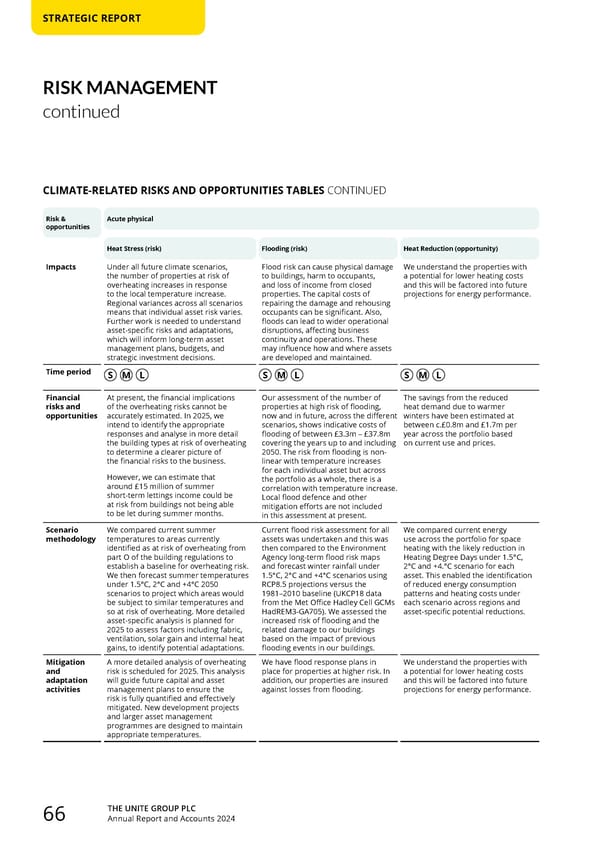
THE UNITE GROUP PLC Annual Report and Accounts 2024 66 CHIEF EXECUTIVE’S REVIEW continued STRATEGIC REPORT Risk & opportunities Acute physical Heat Stress (risk) Flooding (risk) Heat Reduction (opportunity) Impacts Under all future climate scenarios, the number of properties at risk of overheating increases in response to the local temperature increase. Regional variances across all scenarios means that individual asset risk varies. Further work is needed to understand asset-specific risks and adaptations, which will inform long-term asset management plans, budgets, and strategic investment decisions. Flood risk can cause physical damage to buildings, harm to occupants, and loss of income from closed properties. The capital costs of repairing the damage and rehousing occupants can be significant. Also, floods can lead to wider operational disruptions, affecting business continuity and operations. These may influence how and where assets are developed and maintained. We understand the properties with a potential for lower heating costs and this will be factored into future projections for energy performance. Time period S M L S M L S M L Financial risks and opportunities At present, the financial implications of the overheating risks cannot be accurately estimated. In 2025, we intend to identify the appropriate responses and analyse in more detail the building types at risk of overheating to determine a clearer picture of the financial risks to the business. However, we can estimate that around £15 million of summer short-term lettings income could be at risk from buildings not being able to be let during summer months. Our assessment of the number of properties at high risk of flooding, now and in future, across the different scenarios, shows indicative costs of flooding of between £3.3m – £37.8m covering the years up to and including 2050. The risk from flooding is non- linear with temperature increases for each individual asset but across the portfolio as a whole, there is a correlation with temperature increase. Local flood defence and other mitigation efforts are not included in this assessment at present. The savings from the reduced heat demand due to warmer winters have been estimated at between c.£0.8m and £1.7m per year across the portfolio based on current use and prices. Scenario methodology We compared current summer temperatures to areas currently identified as at risk of overheating from part O of the building regulations to establish a baseline for overheating risk. We then forecast summer temperatures under 1.5°C, 2°C and +4°C 2050 scenarios to project which areas would be subject to similar temperatures and so at risk of overheating. More detailed asset-specific analysis is planned for 2025 to assess factors including fabric, ventilation, solar gain and internal heat gains, to identify potential adaptations. Current flood risk assessment for all assets was undertaken and this was then compared to the Environment Agency long-term flood risk maps and forecast winter rainfall under 1.5°C, 2°C and +4°C scenarios using RCP8.5 projections versus the 1981–2010 baseline (UKCP18 data from the Met Office Hadley Cell GCMs HadREM3-GA705). We assessed the increased risk of flooding and the related damage to our buildings based on the impact of previous flooding events in our buildings. We compared current energy use across the portfolio for space heating with the likely reduction in Heating Degree Days under 1.5°C, 2°C and +4.°C scenario for each asset. This enabled the identification of reduced energy consumption patterns and heating costs under each scenario across regions and asset-specific potential reductions. Mitigation and adaptation activities A more detailed analysis of overheating risk is scheduled for 2025. This analysis will guide future capital and asset management plans to ensure the risk is fully quantified and effectively mitigated. New development projects and larger asset management programmes are designed to maintain appropriate temperatures. We have flood response plans in place for properties at higher risk. In addition, our properties are insured against losses from flooding. We understand the properties with a potential for lower heating costs and this will be factored into future projections for energy performance. RISK MANAGEMENT continued CLIMATE-RELATED RISKS AND OPPORTUNITIES TABLES CONTINUED
 Home for Success: Unite Students Annual Report 2024 Page 67 Page 69