
Home for Success: Unite Students Annual Report 2025
This document is the 2025 annual report and accounts for The Unite Group PLC, focusing on their student accommodation services.
THE UNITE GROUP PLC Annual Report and Accounts 2025 Home for Success
STRATEGIC REPORT 2 Who we are 4 Market overview 8 Business model and stakeholder value 12 Investment case 14 Key performance indicators 16 Chief Executive’s review 23 Performance review 52 Risk management CORPORATE GOVERNANCE 74 Chair’s introduction to governance 76 Board of Directors 80 Board statements 83 Board leadership and purpose 88 Division of responsibilities 90 Section 172 93 Board activities 100 Nomination Committee 103 Audit & Risk Committee 108 Sustainability Committee 110 Health & Safety Committee 113 Remuneration Committee 132 Directors’ report 135 Statement of Directors' responsibilities FINANCIAL STATEMENTS 138 Independent auditor’s report 147 Consolidated income statement 147 Consolidated statement of comprehensive income 148 Consolidated balance sheet 149 Company balance sheet 150 Consolidated statement of changes in shareholders’ equity 151 Company statement of changes in shareholders’ equity 151 Consolidated statement of cash flows 152 Notes to the financial statements 205 Financial record OTHER UNAUDITED INFORMATION 204 Alternative performance measures 209 Financial record 210 Glossary Cover Company information Financial highlights Operational highlights EPRA NTA per share 955p (2024: 972p) Adjusted earnings per share 47.5p (2024: 46.6p) IFRS diluted earnings per share 19.9p (2024: 96.1p) Total accounting return 2.1% (2024: 9.6%) Dividend per share 37.7p (2024: 37.3p) IFRS NAV per share 968p (2024: 982p) 46k students using our sector-leading app each month Finalised joint venture with Newcastle University Customer satisfaction score of +49 Record Higher Education trust score of +40 Offered to acquire Empiric Student Property plc (completed January 2026) Opened Avon Point in Bristol and Burnet Point in Edinburgh
STRATEGIC REPORT “The business has delivered a robust performance in 2025, with strong trading across the majority of our portfolio.” JOE LISTER CHIEF EXECUTIVE THE UNITE GROUP PLC Annual Report and Accounts 2025 01
WHO WE ARE Our purpose: Home for Success We are the UK’s leading student accommodation provider. Our purpose goes beyond providing accommodation – it’s about creating spaces where young people can grow, belong and be themselves. Everything we do is driven by this purpose. We believe young people should have the opportunity to get the best out of life. All our residents have access to round-the-clock support, should they need it. We partner with the UK’s leading universities to build a brighter future for students. 2025 ranking by number of beds City Number of beds London 12,578 Manchester 5,639 Liverpool 5,340 Birmingham 4,986 Bristol 4,488 Leeds 4,421 City Number of beds Newcastle 3,762 Cardiff 3,224 Portsmouth 2,706 Edinburgh 2,636 Glasgow 2,277 Sheffield 2,198 City Number of beds Nottingham 1,460 Leicester 1,443 Oxford 1,367 Loughborough 1,347 Medway 1,106 Southampton 671 City Number of beds Durham 692 Coventry 676 Bath 646 Bournemouth 519 Unite Students properties City Number of beds Manchester 789 Glasgow 534 Cardiff 519 Bristol 461 Liverpool 452 York 441 City Number of beds Birmingham 430 Leicester 382 Exeter 339 Nottingham 337 Falmouth 335 Leeds 323 City Number of beds Edinburgh 313 Sheffield 304 Huddersfield 277 Portsmouth 242 St Andrews 233 Bath 232 City Number of beds Southampton 214 Lancaster 207 Aberdeen 179 Newcastle 152 Empiric properties* *Unite Group completed its purchase of Empiric Student Property (Empiric) on 28 January 2026. THE UNITE GROUP PLC Annual Report and Accounts 2025 02 STRATEGIC REPORT
208 Number of properties: Unite Students 142 Empiric 66 72k Number of beds: Unite Students 64,000 Empiric 7,700 No.1 The largest provider of purpose-built student accommodation across the UK Unite as One Challenge the Ordinary Lead with Heart Stay on Point Guided by our values GREAT PLACE TO WORK A values-led culture inspiring consistent delivery and collaboration. Employee experience enhanced through learning and development and investment in technology. Belonging embedded in business strategy to drive performance and support long-term ambitions. A disciplined approach to financial management to ensure sustainable growth and resilience through a tougher market cycle. Predictable recurring income model continues to deliver solid returns, supported by a clear focus on capital allocations and maintaining portfolio quality. Commitment to long- term sustainable growth, underpinned by key strategic opportunities including the acquisition of Empiric. GREAT PLACE TO INVEST Located in the cities close to the UK’s leading universities to drive preference for our brand. Consistently high performance ratings from both our students and university partners. Active management of assets including investment in digital upgrades. GREAT PLACE TO LIVE Total figures include Empiric numbers following acquisition by Unite Group on 28 January 2026. THE UNITE GROUP PLC Annual Report and Accounts 2025 03
MARKET OVERVIEW Market trends A record number of UK 18-year-olds started university in September 2025, reflecting the continued value young adults place on Higher Education and the life experience and opportunities it offers. 1 Growing demand for Higher Education Demographic growth will increase the number of 18-year-olds and supports continued growth in demand for university places to 2030. The strongest universities continue to grow market share at the expense of the lower ranked. Students are increasingly focused on employment outcomes and earnings potential of their courses, with a growing proportion studying at lower-ranked universities choosing to live at home to reduce the overall cost of university. This has caused a concentration of demand around the strongest universities with reduced demand for accommodation aligned to lower-ranked institutions. Our market size is directly influenced by structural trends within Higher Education and the student accommodation sector. Demand for purpose-built student accommodation (PBSA) is underpinned by a range of structural drivers that determine student numbers for UK Higher Education, as explored in more detail in the following tables. The outlook for our business is influenced by structural trends and cyclical factors. WHAT IT MEANS FOR UNITE STUDENTS • Increased demand for PBSA from students and university partners at the strongest universities. • We will increase the alignment of the portfolio to the strongest universities through an increased disposal programme of £300–400 million p.a. Concurrently, cyclical factors affect prevailing economic conditions, the cost and availability of funding for the business, and the level of investment in student accommodation. These combined structural and cyclical factors shape the outlook for our business, informing our strategy and the Group’s long-term growth prospects. THE UNITE GROUP PLC Annual Report and Accounts 2025 04 STRATEGIC REPORT
Government more supportive of Higher Education WHAT IT MEANS FOR UNITE STUDENTS • Potential for stronger growth in student numbers for those universities and cities delivering high-quality teaching, strong employment prospects for graduates and internationally recognised research. • We will grow our alignment to high-ranked universities to 80% of the portfolio from 67% today, aligning to universities which have the strongest outlook for student recruitment and demand for accommodation. • Further opportunities for strategic university partnerships for on- and off-campus development as well as the transfer of existing accommodation stock, requiring investment and repositioning. Focus on quality, sustainable housing The Building Safety Act (BSA), which addresses the safety of new residential accommodation, came into effect in 2024, adding three approval gateways to the design, construction and occupation of new high-rise residential buildings. This is adding around 12 months to delivery timelines as the new process becomes established. BSA Gateway 3 clearance is required ahead of occupation for our Hawthorne House project in Stratford for the 2026/27 academic year. The UK’s commitment to achieve net zero carbon by 2050 will require significant reductions in energy use from domestic properties. This includes potentially increasing Minimum Energy Efficiency Standards (MEES), requiring rental properties to achieve EPC ratings of at least B by 2030. The Government has a target to deliver 1.5 million new homes during this Parliament, built to the highest sustainability standards, and PBSA can make a contribution. The Renters’ Rights Act will increase tenants’ rights and aims to improve the standard of privately rented housing. It excludes PBSA from almost all of the new protections, when the landlord is accredited by a recognised code of practice. 2 3 WHAT IT MEANS FOR UNITE STUDENTS • Growing regulation, MEES and taxation of the HMO sector may result in more private landlords seeking to exit the market, creating the opportunity for the PBSA sector to capture a growing share of students requiring accommodation. • Extended development programmes have increased the delivery risk for new off-campus development. We will require a nomination agreement and higher returns in order to commit to new projects. The Government is focused on universities delivering high-quality education and value-for-money, and expects to see growing specialisation of universities in research and teaching. From 2027, a reduction in the post- study work visa from 24 to 18 months is expected to have a modest impact on international student numbers. The International Education Strategy reaffirmed the commitment to sustainable recruitment of high- quality international students and targets 25% growth in the value of education exports over four years. The new £925 p.a., per student, international fee levy will take effect from 2028 and is intended to fund grants for lower-income students. This will support access to university, with the strongest universities best placed to navigate the change. At the same time, other leading destinations for students are restricting access for international students, making the UK a relatively more attractive place to study. UK Higher Education Policy recognises the global standing of the UK’s universities which attract students from all over the world, conduct vital research, and contribute £42 billion to the UK economy and benefit our society. The Government increased tuition fees for the 2025/26 academic year for the first time since 2017/18 and expects to grow them in line with inflation going forward. This increase will help universities balance budgets in the face of rising staff and other costs. The Government’s Higher Education White Paper was supportive of the sector and recognised its importance in delivering the Government’s industrial strategy. THE UNITE GROUP PLC Annual Report and Accounts 2025 05
Economic and financial conditions have remained challenging over the past year. Demand for Higher Education and student accommodation has historically proven to be well insulated from the economic cycle and the business mitigates the impact of rising costs through rental growth and its risk management approach. Inflation has returned to close to target levels and interest rates have begun to gradually reduce. The outlook is subdued with modest economic growth expected over the coming years, an increased tax burden and interest rates expected to remain elevated compared to the 2010s. Unemployment has risen, with a reduction in the number of graduate jobs available. The sector remains attractive to lenders, albeit at higher costs as underlying interest rates remain elevated. Higher rates were partially mitigated by tighter credit spreads, though new funding remains at a premium compared to the late 2010s. 4 Economic outlook WHAT IT MEANS FOR UNITE STUDENTS • A weaker jobs market will cause students to further focus on the quality of their university and course. It may also lead to an increase in postgraduate study as students seek to differentiate themselves from their peers. This will support recruitment at the strongest universities which we are increasingly aligned to. • Slowing inflation will be reflected in lower annual uplifts in our multi-year nomination agreements and a moderating rate of overall rent and cost growth. • We will monitor the affordability of our accommodation to ensure we continue to offer value-for- money accommodation. Continued investment in our assets and service supports value-for-money and sustainable rental growth. Universities have responded to changing international demand since 2024 by increasing recruitment of UK students. This is most stark at Higher Tariff universities where UCAS acceptances increased by 8% for the 2025/26 academic year, compared to 2% growth at Medium Tariff and a 2% reduction at Low Tariff providers. Changing student recruitment patterns resulted in weaker demand in a handful of regional cities and contributed to our 95.2% occupancy for the 2025/26 academic year. UK students are focused on value-for- money, with a growing trend of those at lower-ranked universities likely to live at home. The most enduring accommodation demand is at the strongest universities, where we are increasing our alignment. International students are increasingly focused on quality of education and alternatives outside of the traditional leading study destinations. This is mitigated by the UK’s more settled international student policy and openess compared to the US, Australia and Canada. WHAT IT MEANS FOR UNITE STUDENTS • We will accelerate the alignment of our portfolio to the strongest universities which have the best prospects for student recruitment and demand for accommodation. • Shifting demand underlines the value of our nomination agreements and relationships with universities, which underpins sales each academic year. • Universities needing new accommodation to grow are increasingly seeking to partner with the private sector, including Unite Students, creating opportunities for new nomination agreements and university joint ventures. 5 University recruitment THE UNITE GROUP PLC Annual Report and Accounts 2025 06 STRATEGIC REPORT
There has been a steady slowdown in new supply of PBSA from a peak of 30,000–35,000 beds p.a. in 2017-2019 to around 10,000 beds delivered in 2025 net of beds leaving the market. This reflects delays to development deliveries resulting from planning and regulatory backlogs as well as more restrictive funding conditions for developers. Weekly rents now need to be in excess of £230 for new development to be viable, concentrating new supply in a handful of markets. We have updated our capital allocation framework in response to the trends seen in the 2025/26 sales cycle. We will focus on delivering university partnerships ahead of traditional off- campus development and accelerate capital recycling through £300–400 million p.a. of disposals. We expect to generate £100–200 million p.a. of surplus capital which will be allocated to university partnerships and share buybacks. This approach will deliver attractive total accounting returns, be accretive to earnings and maintain a robust balance sheet. Our cost of capital has increased as reduced visibility over lettings performance has been reflected in increased risk premia. Increased letting risk and extended development programmes have made new off-campus developments hard to justify without an improvement in financial returns and university support through a nomination agreement. Universities are focusing their investment on their academic estates and deferring spend on accommodation in the face of tighter funding restrictions. To meet their accommodation guarantees to UK first year and international students, universities need new accommodation to grow their student numbers and increasingly see availability of accommodation as a barrier to growth. The stock of student housing in the HMO sector is also expected to reduce as a result of increasing regulation for private landlords through the Renters’ Rights Act. Rising stamp duty land tax, income tax and capital gains taxes will also reduce financial returns available for landlords in the sector. This will result in additional costs for HMO landlords which we expect to be reflected in higher rents for students living in HMOs and may see some choose to exit the market. WHAT IT MEANS FOR UNITE STUDENTS • Limited new supply increases visibility of the supply and demand ratio in our cities. New deliveries may take time to stabilise in more fully supplied markets. • Universities increasingly looking to partners, including Unite Students, to meet their accommodation needs. • Lower supply of HMO properties and increasing costs for tenants in the HMO sector create an opportunity to retain more customers who might otherwise move into the HMO sector. WHAT IT MEANS FOR UNITE STUDENTS • We will optimise value from developments where we own the land but have not started construction. • University joint ventures remain an attractive and significant growth opportunity and we are targeting one new partnership each year. • We will accelerate our disposal programme to £300–400 million p.a. and increase our alignment to the highest- quality universities to 80%. • We will generate surplus capital from disposals and consider share buybacks where they offer an opportunity to grow earnings while maintaining the strength of our balance sheet. 6 Competing supply 7 Capital allocation THE UNITE GROUP PLC Annual Report and Accounts 2025 07
Manage BUSINESS MODEL How we do it We are differentiated by our operating platform, long-standing university partnerships, our development expertise and our values. Best-in-class operating platform We provide a ‘Home for Success’ for the students who live with us, where they can make the most of their time at university. Our best-in-class welfare support and operational teams are dedicated to delivering on this promise. We drive superior rental growth and improve the environmental performance of our buildings through targeted refurbishments, which enhance the customer experience and support our value-for- money proposition. We have a range of refurbishment options available, which are tailored for each property according to the needs of the relevant customer segment and demand levels within each city. Improve We partner with leading UK universities through nomination agreements. Partnerships enable us to support universities in delivering their accommodation guarantee to first year and international students and provide a significant level of income visibility each year. We are exploring further strategic partnership opportunities for on-campus development or stock transfer. Partner Provide We manage two co-investment vehicles, the Unite UK Student Accommodation Fund (USAF) and the London Student Accommodation Joint Venture (LSAV), which provide recurring fee income and access to additional capital. We adopt a consistent sales and operating model across our entire portfolio, regardless of fund ownership. Our joint ventures with Newcastle University and Manchester Metropolitan University will add to our assets under management as they are delivered from 2028. THE UNITE GROUP PLC Annual Report and Accounts 2025 08 STRATEGIC REPORT
Portfolio enhancement We appraise and selectively acquire single assets and portfolios which enhance portfolio quality and financial performance, where there is clear alignment to the strongest universities. Acquire We aim to dispose of £300–400 million p.a. assets to improve the quality of our portfolio, increasing our alignment to the strongest universities with the best prospects for demand for student accommodation. This capital recycling provides funding to invest in new university partnerships, improvements to our existing portfolio and share buybacks, while maintaining the strength of our balance sheet. Recycle We develop high-quality PBSA in the most attractive university markets, where demand is strongest. Our off- campus pipeline includes two development schemes, totalling 1,650 beds and, once complete, the projects will add a combined £21 million to net operating income from the academic year 2027/28. On-campus partnerships with universities represent our key strategic growth opportunity over the next 5–10 years. These collaborations deliver high-quality, affordable accommodation directly on campus, supported by joint venture partners who share in our business objectives. Our target is to secure one new partnership agreement each year. Develop THE UNITE GROUP PLC Annual Report and Accounts 2025 09
Stakeholder value How we engaged Our property teams engage with students on a day-to-day basis, supplemented by peer-to-peer engagement and social activities provided by our Resident Ambassadors. We partner with Endsleigh Insurance to provide 24/7 access to counsellors and other support services. We also engage with students using our upgraded MyUnite app and social media channels, including pre-arrival support and networking opportunities. Throughout their stay we promote campaigns, such as Personal Safety Week and Winter Wellbeing, and signpost to our Support for You web page. This is complemented by our customer research programme which includes surveys on specific issues. Value created in 2025 • Provided access to a 24/7 student wellbeing helpline and digital therapy services. • Upgraded 10 buildings, including new bedrooms, kitchens and amenity spaces. • Supported the award of accommodation scholarships to 70 students through the Unite Foundation and an additional 60 free one-year tenancies. • Launched our new resident experience app to further enhance customer service. • Signed the Care Leaver Covenant. Priorities for 2026 We will upgrade bedrooms, kitchens and amenity spaces in our refurbishment projects. We will further enhance the experience of our students by improved capture of additional needs prior to arrival and continue to be responsive to the differing needs of under-represented students, and those with additional challenges relating to the transition into student accommodation. We are also investing to upgrade our technology platform to deliver an improved end-to-end experience for students from the point of booking, through their time with us and ultimately when they leave. Students Key issues • Value-for-money • Customer service • Safety and welfare support Our people Key issues • Learning and development • Diversity, equity and inclusion • Health, safety and wellbeing Universities Key issues • Student experience and welfare • Operational performance • Health and safety How we engaged We meet monthly with our employee engagement forum, Culture Matters, and connect face-to-face twice a year, with Non- Executive Director Angela Jain in attendance. This valuable feedback has shaped key people policies, including this year’s launch of our ‘Transitioning at Work’ guidance, ensuring inclusivity and support for all colleagues. We hold regular ‘Unite Live’ sessions with our CEO and key senior leaders to provide business updates with the opportunity to ask questions, and we hosted local ‘Class of ‘25’ sessions with our teams. Our biannual employee engagement surveys give us a temperature check of where we are, and how our people are feeling. Our managers are trained on taking action, and lead conversations with their teams following the survey to ensure we’re setting focus areas that matter most to our people. Value created in 2025 • 3.2% average pay award, with city teams receiving the greatest uplifts in line with our commitment to the Real Living Wage. • Enhanced our performance enablement framework helping our teams to have more meaningful development conversations. • Brought our senior leaders together to connect and share our vision for the new strategy. • Our Academy platform was upgraded to a new system enabling our colleagues to more easily access learning and development opportunities. Priorities for 2026 Our focus is to create a Great Place to Work. We will focus on welcoming new colleagues following the acquisition of Empiric, embedding our new Academy platform, making it easier to access what’s needed to succeed in a role and clear on how to grow. We will also move to a new head office in Bristol, giving our teams a high-quality workplace to come together and collaborate. How we engaged Through our Higher Education Engagement team, we meet regularly with leaders across the UK university sector. We engage at various levels in institutions for discussions ranging from strategic planning to day- to-day operational requirements. In addition, we engage actively in the wider Higher Education sector, presenting at conferences and contributing to Higher Education research. We continue to support Living Black at University Commission, to help black students more easily acclimatise to life at university. Value created in 2025 • Provided 37,000 beds to universities for the 2025/26 academic year. • Provided new insight on the class of 2025 through our Applicant Index research. • Agreed Manchester Metropolitan University joint venture (JV) to redevelop their Cambridge Halls site. Priorities for 2026 We will continue to support the growth ambitions of our university partners through nomination agreements and opportunities to deepen strategic partnerships. Continuing our research programme in partnership with universities to better understand each cohort of students. Creating value for our stakeholders THE UNITE GROUP PLC Annual Report and Accounts 2025 10 STRATEGIC REPORT
How we engaged 2025 was a year of maximising the potential of our operational supply chain and extending our procurement approach into where we spend our capital funds. We also launched our Next Generation product specification – upgrading the quality and features of our standard room offering to students. Products were tested to ensure quality and fit with student needs, and sourced to ensure sustainable and affordable products that last. We see our suppliers as instrumental to the successful delivery of our ambitions. Communicating with and listening to our key suppliers and partners is therefore invaluable, and we have continued to seek feedback and share our objectives and roadmap through a combination of 1-to-1 meetings, our annual supplier conference, and supply chain focus groups. Value created in 2025 • Spent £283 million with suppliers through our procurement function. • Delivered higher quality service from suppliers, with a specific focus on specification and services during the summer maintenance period. • Reduced risk through an enhanced supplier vetting process and increased attention to managing supplier quality and performance. Priorities for 2026 We will further expand our procurement processes into asset management and new developments, as well as continuing to mitigate the macro cost pressures evident in our operational and estates supply chain. A review of our supply chain – not just those we contract directly with – has commenced, and we expect to see the result of this during 2026. How we engaged The availability of housing is a key issue for our local communities. We are focused on supporting the growth of our university partners through the delivery of new, high-quality and affordable student homes, which increase housing supply and help free up more traditional housing for families and young professionals. We also engage actively with local stakeholders for our development projects to ensure the design of our buildings, public spaces and community facilities meet their needs. Our Positive Impact programme encourages participation and includes awards for projects undertaken by employees aimed at delivering measurable benefits in their local communities. Value created in 2025 • We delivered 1,000 new beds in our local communities. • Employment for 1,266 people in our local communities. • Invested £6.9m million in initiatives to reduce our environmental impact. • 3,894 hours of employee volunteering in the year, a participation rate of 36%. Priorities for 2026 We aim to increase community engagement through our Positive Impact programme, via initiatives delivered by local teams in our properties. In addition, we will continue to engage with local authorities and local communities around new development activity, to explain how the community benefits from creating new, high-quality student accommodation. Delivery of a new sixth-form academy at our new development Hawthorne House, in East London. How we engaged We engaged regularly with investors around our financial results as well as through ad-hoc events, such as property tours, conferences and meetings. Key themes for engagement during the year were, changing university recruitment and international student numbers, the 2025/26 sales cycle, policy changes and the supply of new student accommodation. These discussions informed our decision to prioritise on-campus ahead of traditional off-campus developments. We engaged with investors ahead of our offer for Empiric Student Property plc to explain the opportunity to grow market share in the returning student segment which Empiric’s differentiated portfolio serves well. In November, we hosted an investor event in London, focused on the outlook for the Higher Education sector, a review of the 2025/26 sales cycle and updates to our capital allocation framework. Value created in 2025 • Delivered 95.2% occupancy and rental growth of 4.0%. • 2% growth in adjusted EPS. • Total accounting return of 2.1%. • Full year dividend per share of 37.7 p. Priorities for 2026 Delivering strong operational performance and sales for the 2026/27 academic year, while effectively managing our cost base. We will increase the run rate of disposals to £300–400 million p.a., deploying surplus capital into university partnerships and share buybacks. We will implement our business plan for Empiric, including starting to deliver £17 million of synergies. Communities Key issues • Trust and transparency • Housing availability • Local investment and job creation Suppliers Key issues • Quality and sustainable solutions • Value generation • Risk management Investors Key issues • Financial performance • Strategic direction • Sustainability and risk management THE UNITE GROUP PLC Annual Report and Accounts 2025 11
INVESTMENT CASE We are the UK’s largest owner, manager and developer of purpose-built student accommodation. Sustainable growth Structurally growing sector Demographic growth The UK’s 18-year-old population is set to grow by 6% by 2030, supporting demand for undergraduate study at UK universities. 1 High-quality portfolio Growing alignment to the strongest universities Over the medium term, we will grow alignment to the strongest universities from 67% to 80%. This is where we see the strongest prospects for student number growth. We have increased our targeted run-rate of disposals to £300–400 million p.a. to support this approach. Value-for-money We offer students a high-quality and value-for- money living experience, with support on hand when it is needed. Our pricing is inclusive of utilities, Wi-Fi, contents insurance and maintenance. Our pricing is comparable to HMOs when allowing for the services included within our rent. We offer a range of price-points in each of our cities, catering to different groups of students. Investing to enhance our operational estate There is a multi-year opportunity to enhance rents and reduce operational costs through refurbishment projects and energy efficiency measures which improve the student experience and reduce resource use in our buildings. 2 Rising Higher Education participation 2025/26 saw a record number of UK 18-year- olds starting university, demonstrating young people’s recognition of the opportunities and life experience that university provides. Graduates earn £200,000–£300,000 more over their lifetime than non-graduates, and young graduates are 15% more likely to be employed than non-graduates, underlining the substantial value of university education. Students are increasingly focused on the value of their studies and employment outcomes. The strongest growth in student numbers has also been seen at higher-ranked universities, with numbers reducing at the lower-ranked, where students are increasingly likely to live at home. Growing attractiveness of UK Higher Education The Government is supportive of the Higher Education sector and sees it as a fundamental pillar of the UK’s industrial strategy. The international Education Strategy reaffirmed commitment to sustainable recruitment of high-quality international students and targets 25% growth in the value of education exports over four years. The Post-16 Education and Skills white paper supports the sector and focuses on quality of provision, increased specialisation of institutions and is supportive of international students coming to the UK which contrasts with the introduction of restrictions by the United States, Australia and Canada on student numbers, three leading competitors for international students. THE UNITE GROUP PLC Annual Report and Accounts 2025 12 STRATEGIC REPORT
Responding to change Market share gains from returner market One million students live in houses of multiple occupancy, providing a significant opportunity to attract new customers as the availability of HMOs reduces. Increasing our alignment to the strongest universities We are targetting 60% of beds to be let through nomination agreements over the medium- term, rising from around 53% allowing for Empiric’s lower proportion of nominated beds. Nominations with high-quality universities strengthen our relationships and provide high- quality recurring income, with good visibility and built-in price increases in multi-year agreements. New university partnerships Opportunities for new developments on-campus as well as partnerships for the transfer of universities’ existing accommodation stock continue to offer attractive risk-adjusted returns and we are targeting one new joint venture each year. Best-in-class operating platform Resilient and sustainable business Net zero carbon Becoming a net zero carbon business for both our operations and developments by 2030, based on Science Based Targets intiative (SBTi)-validated targets. Resilient and flexible balance sheet We maintain a strong balance sheet with robust credit metrics. We nurture strong relationships with our shareholders, co-investment partners and debt providers to ensure continued access to capital. Unite Foundation Through our financial commitment, the charity we founded provides scholarships for estranged and care-experienced students throughout the course of their studies by addressing housing fragility. Over 60 university partnerships We are the partner of choice for a large number of the UK’s leading universities, reflecting our track record, focus on student support and our high- quality, affordable offering. 3 4 Returning to growth Occupancy recovery and rental growth Returning to historic occupancy levels and maintaining rental growth in the portfolio are key enablers of a return to growth in 2027 and we are focused on delivering our operational targets for the 2026/27 sales cycle. Stable dividends and EPS As a real estate investment trust (REIT), we target sustainable dividends for our investors. We will distribute 79% of our recurring earnings per share for 2025 and expect to hold this amount flat in 2026 by increasing the payout ratio. We expect adjusted earnings of 41.5-43.0p in 2026. Attractive total returns of 8–10% p.a. before yield movement Achieved through recurring earnings, rental growth and development profits. 5 6 Passionate frontline teams Service excellence is delivered by our passionate city teams of 1,266 employees. This brings together our experience of 35 years of operating in the student accommodation sector. Sector-leading operating margins We drive cost efficiencies through our operational scale at a UK and city level, which enables us to in-source key activities as well as enhancing processes through the roll-out of new technology platforms. Management fees from joint ventures and funds also cover around two-thirds of our annual overheads. THE UNITE GROUP PLC Annual Report and Accounts 2025 13
Link to remuneration Bonus and LTIP. Measure Total accounting return measures the net tangible asset (NTA) in EPRA NTA per share plus dividends paid as a percentage of opening EPRA NTA per share. 2025 performance Dividends paid in the year partially offset a 2% reduction in NTA which drove our TAR performance. Future priorities Deliver attractive total accounting returns over the medium term through dividends and NTA growth. KEY PERFORMANCE INDICATORS Financial KPIs 47.5 46.6 44.3 37.7 37.3 35.4 Adjusted earnings per share 1 (p) 47.5p IFRS diluted earnings per share 19.9p Total accounting return 1 2.1% Dividend per share 37.7p Link to remuneration Bonus and long-term incentive plan (LTIP). Measure Adjusted earnings per share measures the recurring profit delivered by operating activities on a per share basis. 2025 performance Adjusted EPS grew 2% to 47.5p year-on-year. Lettings performance for the 2024/25 and 2025/26 academic years supported growth in adjusted EPS, more than offsetting increases in operating and finance costs. Future priorities After declining in 2026, we are focused on returning to adjusted EPS growth, supported by growing income and tight cost discipline. Link to remuneration Bonus and LTIP (indirectly). Measure IFRS diluted earnings per share measures IFRS earnings on a per share basis taking account of dilutive potential ordinary shares – share options. 2025 performance The reduction in EPS reflects a decrease in the value of the Unite Group’s property portfolio, losses from our development pipeline, fire safety costs and earnings from the operational portfolio. Future priorities Grow EPS through rental growth, asset management and development profits, while continuing to maintain the portfolio and remedy fire safety defects. Link to remuneration Bonus and LTIP. Measure The amount of annual earnings distributed to shareholders. 2025 performance The total dividend for 2025 is proposed to be 37.7p, representing 79% of the final adjusted EPS. Future priorities We expect to hold the dividend flat in 2026, increasing the payout ratio to offset lower adjusted earnings. 1. The financial statements are prepared in accordance with International Financial Reporting Standards (IFRS). The Unite Group uses Alternative Performance Measures (APMs) which are not defined or specified under IFRS. These APMs, which are not considered to be a substitute for IFRS measures, provide additional helpful information and are based on European Public Real Estate Association (EPRA) best practice recommendations. The metrics are also used internally to measure and manage the business and to align to the performance-related conditions for Directors’ remuneration. See the glossary for definitions and note 8 for calculations and reconciliations. 2025 2024 2023 2025 2024 2023 2025 2024 2023 2025 2024 2023 2.1 9.6 2.9 19.9 96.1 24.6 THE UNITE GROUP PLC Annual Report and Accounts 2025 14 STRATEGIC REPORT
75 74 70 Link to remuneration Bonus. Measure Independent, anonymous surveys are undertaken by an external provider among our employees to gain regular and insightful feedback on how they feel and how we can improve. 2025 performance Employee engagement for 2025 was 75, a 1-point improvement on 2024. This score highlights the progress we’ve made by launching our new values and embedding them across the business – our culture in action. Future priorities Embedding our values into the way we hire, celebrating our new Academy platform, and amplifying our employee networks – ensuring the voices of our people continue to be heard. Operational KPIs 5 1 40 37 32 Safety (number of accidents) 5 Link to remuneration Taken into consideration. Measure The number of RIDDOR reportable accidents in operations each year, acting as an indicator of health and safety management. 2025 performance There were five operational RIDDOR-reportable incidents during the period, equating to an accident frequency rate of 0.13. Slips and trips remained the predominant cause. Future priorities Further strengthen safety culture through improved competency, clearer accountability, and increased workforce empowerment to proactively identify, report, and control workplace hazards, with a specific focus on preventing slips and trips. Employee engagement 75 Higher Education trust NPS +40 Link to remuneration Bonus. Measure The Higher Education (HE) NPS provides a measure of how we have met the needs of our HE partners and their perception of Unite Students. 2025 performance The 3-point increase this year is another great build on our 2024 performance and is a record score for us. Universities consistently highlighted the strength of their relationships with local teams and the importance of strong student wellbeing support. Future priorities Continue to build our reputation within the HE community with research and thought leadership. Continue to develop and strengthen our partnerships with universities. 49 50 42 Link to remuneration Bonus. Measure Customer Net Promoter Score (NPS) provides a customer experience measure, based on an annual check-in survey. 2025 performance A score of +49 is just one point below our all-time high for student arrivals, reinforcing the success of our summer turnaround and the impact of our CARE customer service principles. Future priorities Focus on resident experience, including after the six-week welcome programme and in real time for critical interactions like maintenance requests, which are proven drivers of satisfaction. Customer satisfaction +49 2025 2024 2023 2025 2024 2023 2025 2024 2023 2025 2024 2023 5 THE UNITE GROUP PLC Annual Report and Accounts 2025 15
CHIEF EXECUTIVE’S REVIEW Delivering our plan Demand for UK Higher Education sector remains strong, underpinned by demographic growth, high participation rates and the quality and global reputation of the UK’s universities. Higher-tariff universities continue to capture an increased share of student numbers, driving increased housing need in the strongest cities and locations. This is coming at the expense of lower-tariff universities where housing demand has also been impacted by growing numbers of students choosing to live at home. The majority of our portfolio is delivering strong levels of occupancy and rental growth, but we have experienced challenges from weaker demand and higher supply in some cities. We are responding to this change through a renewed focus on operational excellence and optimal capital allocation. During the year, we increased our alignment to high-tariff universities from 64% to 67% and are targeting 80% as we align our portfolio even more closely with the strongest universities. The acquisition of Empiric’s high-quality 7,700- bed portfolio across 66 properties, which is 81% aligned to high-tariff universities, completed towards the end of January 2026 allows us to better serve the attractive Returner market segment. GROWING EARNINGS AND DIVIDEND Lettings performance for the 2024/25 and 2025/26 academic years supported growth in adjusted earnings to £232.3 million and adjusted EPS of 47.5p, up 9% and 2% respectively year-on-year. The growth in adjusted EPS also reflects the increased share count following our capital raise in July 2024. IFRS profit reduced to £97.6 million and diluted EPS to 19.9p (2024: £441.9 million and 96.1p), reflecting a valuation decrease for our property portfolio compared to the prior year. We have proposed a final dividend of 24.9p which, if approved, takes the total dividends to 37.7p for the year, representing a year-on-year increase of 1%. Total accounting returns for the year were 2.1%, reflecting dividends paid in the year and a 2% reduction in EPRA NTA per share to 955p due to a 0.5% decline in LfL property valuations. Our net debt: EBITDA and LTV ratios increased to 6.1x and 27% respectively, reflecting an increase in net debt during the year. GROWING HIGHER EDUCATION DEMAND IN A MORE COMPETITIVE LEASING MARKET Financial highlights 1 2025 2024 Adjusted earnings £232.3m £213.8m Adjusted EPS 47.5p 46.6p IFRS profit £97.6m £441.9m IFRS diluted EPS 19.9p 96.1p Dividend per share 37.7p 37.3p Total accounting return 2.1% 9.6% EPRA NTA per share 955p 972p IFRS net assets per share 968p 982p Net debt: EBITDA 6.1x 5.5x Loan to value 27% 24% 1. See glossary for definitions and note 7 for alternative performance measure calculations and reconciliations. A reconciliation of profit before tax to EPRA earnings and adjusted earnings is set out in note 7 of the financial statements. THE UNITE GROUP PLC Annual Report and Accounts 2025 16 STRATEGIC REPORT
Adjusted earnings £232.3m (2024: £213.8m) Dividend per share 37.7p (2024: 37.3p) Adjusted earnings per share 47.5p (2024: 46.6p) “ Unite Students delivered a robust performance in 2025, with strong trading across the majority of our portfolio.” JOE LISTER CHIEF EXECUTIVE OFFICER THE UNITE GROUP PLC Annual Report and Accounts 2025 17
The ability for students to exit HMO tenancies with two months’ notice will also reduce income security for private landlords. HMO supply has fallen by 9% over the last four years and we expect this trend to continue. DELIVERING OUR STRATEGY At our investor event in November, we set out how we are responding to changes in our market. Our focus is on delivering operational excellence from our best-in-class platform and ensuring optimal capital allocation to deliver the strongest risk-adjusted returns for shareholders. We will focus on six priorities to help deliver on these objectives. Operational excellence • High-quality, growing income – We are targeting 97%+ occupancy in our core cities and above-inflation rental growth, in line with our long-term performance. This is underpinned by our target to grow university nomination agreements to 60% of beds from 54% (including Empiric) which will be achieved by delivering our university joint ventures, winning share from competitors and exiting assets with lower university demand. • Taking action on costs – We are being proactive in right- sizing our cost base to reflect more challenging market conditions and ensure that we deliver efficiencies from our recent investment in new technology platforms. • Deliver our business plan for Empiric – There is a significant opportunity to improve occupancy across the Empiric portfolio over the next two years, alongside delivery of our cost synergies, which supports earnings accretion from the acquisition from 2027. Optimal capital allocation • Increase alignment to the strongest universities – We expect the UK’s strongest universities to outperform and capture a growing share of student numbers in the next 5-10 years. Our committed and future investment activity aims to increase the portfolio’s weighting to high- tariff universities from 67% currently to 80% over the medium-term leading to a more focused, higher-quality portfolio with a presence in 18-20 cities. This realignment is a key enabler of our return to 97% occupancy. • Grow university partnerships – Our first two university joint ventures with Newcastle University and Manchester Metropolitan University are now formed and will see us deliver 4,300 new beds on-campus at affordable rents over the next five years. Building on the strength of CHIEF EXECUTIVE’S REVIEW continued A record number of UK 18-year-olds started university in 2025/26 with 2% growth in the number of new undergraduates. Growth was particularly strong at high-tariff universities where acceptances grew 7%, while medium- tariff providers saw 2% growth and low-tariff experienced a 2% reduction. This growth supported an increase in the proportion of beds let to universities through nomination agreements to 59% (2024/25: 57%) but was offset by weaker sales to international postgraduate students and an increase in students choosing to live at home, which particularly impacted lower-ranked universities. Overall, our portfolio delivered 95.2% occupancy and rental growth of 4.0% for the 2025/26 academic year (2024/25: 97.5% and 8.2% respectively). The majority of our portfolio performed strongly with 19 of 22 cities averaging 97% occupancy. Vacancies were concentrated in three regional cities (Leicester, Nottingham and Sheffield), where weaker demand combined with high levels of existing and new supply. We also saw lower occupancy in new buildings or buildings where we delivered large capital projects, which were slower to let in a more competitive leasing environment. HOUSING SUPPLY REMAINS CONSTRAINED New supply of PBSA is down 50% on pre-pandemic levels, with around 17,000 new beds expected in 2026, reflecting viability challenges created by higher costs of construction and funding, as well as the time required to secure planning and Building Safety Regulator (BSR) approvals. Weekly rents now need to be at least £230 for new PBSA development outside of London to be viable, meaning there is little prospect of new PBSA supply in many markets. Build-to-Rent (BTR) is a source of growing competition in larger regional cities, particularly for international students, but new supply of BTR faces many of the same viability issues. Obsolescence of older university accommodation continues to impact supply, with 5,000-10,000 beds being removed from the market each year due to building age and the need to operate buildings more sustainably. Over half of students who need term-time accommodation live in HMOs where many private landlords are choosing to leave the sector due to rising mortgage costs and increasing regulation. The Renters’ Rights Act introduces new regulations for HMO landlords and rights for tenants from which PBSA is exempt. From May 2026, entering tenancy agreements more than six months before the start date will be banned, disrupting HMO lettings to students early in the 2027/28 sales cycle. THE UNITE GROUP PLC Annual Report and Accounts 2025 18 STRATEGIC REPORT
our university relationships, we aim to secure one new university partnership per year from our pipeline of active opportunities, including new development and stock transfer. • Deploy capital at the best risk-adjusted returns – An increased rate of disposals and lower development capex will see the Group move from net investor to net seller, generating £100-200 million p.a. of surplus capital. We will allocate capital to the opportunities offering the strongest risk-adjusted returns, which are currently expected to be new university partnerships and share buybacks while maintaining the strength of our balance sheet. Progress since our investor event We have made good early progress in delivering against our priorities since our investor event in November. Before the year end, we implemented a c.20% reduction in our central staff costs and have increased our annual cost synergy target for Empiric to £17 million. Since December, we have formed our two university joint ventures with Newcastle University and Manchester Metropolitan University, which will see us deliver 4,300 new beds on-campus between 2028 and 2030. In January, we launched a £100 million share buyback programme to return surplus capital to shareholders. This was funded through reduced off-campus development activity, having chosen to defer delivery of our Freestone Island project in Bristol and exit our TP Paddington development in London. The acquisition of Empiric’s high-quality 7,700-bed portfolio completed towards the end of January 2026. The portfolio is 81% aligned to high-tariff universities, overlapping with our portfolio in 15 cities, and broadens our product offer for returning students. We are also today announcing the disposal of St Pancras Way in London to USAF for £186 million (Unite share: £126 million), which forms part of the Group’s target to accelerate disposals to £300-400 million p.a. (Unite share). ACQUISITION OF EMPIRIC STUDENT PROPERTY The acquisition of Empiric, which completed following the year end, brings a high-quality 7,700-bed PBSA portfolio enables us to better meet the needs of the attractive Returner student segment. The acquisition delivers a significant increase in Unite’s addressable market, enabling the Group to attract and retain more students throughout their academic journey including the c.35,000 first-year students currently living with Unite. Returning students want a more independent experience, living in smaller groups and with a less institutional feel, which Empiric’s portfolio offers through the Hello Student brand. For the 2025/26 academic year, sales performance has been weaker than expected, with occupancy at 89% and rental growth of 4.5%. We are now just over three weeks post- completion and our priority is enhancing Empiric’s commercial performance, with our central commercial team and local teams engaged with Empiric to support sales. We are moving at pace to open our sales channels to Empiric properties, including our significantly larger international agent network and China sales office, in advance of full integration later this year which will benefit the 2027/28 sales cycle. We continue to see significant potential in the business, which we are well placed to unlock through our quality university relationships, best-in-class technology platform. We are also confident in our ability to deliver cost synergies from the acquisition and have validated many of our pre- acquisition assumptions, which support and increase to our annual synergy target to £17 million from 2027. MORE SUPPORTIVE GOVERNMENT POLICY FOR HIGHER EDUCATION Higher Education (HE) contributes over £250 billion to the UK economy, creates new opportunities and life experiences for young people, and provides global influence through the soft power of education. The International Education Strategy published in January 2026 details ambitious plans to increase the UK HE sector’s international standing, grow international recruitment and the value of education exports by 20% over the next five years. The HE sector also plays a key part in increasing skill levels in support of the Government’s mission to kickstart economic growth. The Government has increased UK tuition fees for the 2025/26 academic year by 3.1% and confirmed it intends to increase tuition fees for each of the next two academic years by around 2.75%. Government policy is increasingly supportive of international students with the new International Education Strategy targeting a c.25% growth in the export value of UK education by 2030. The UK’s recent return to the Erasmus+ programme will also strengthen ties with the European Union. We expect these measures to improve the global competitiveness of UK universities at a time when a number of competing global destinations are increasing restrictions on international student numbers. Universities are long-standing and adaptable institutions, and many are making changes to their cost bases to improve their financial sustainability. We expect these financial conditions to create new partnership opportunities with universities as they seek to deliver cost efficiencies and release funding for reinvestment into their academic programmes. CURRENT TRADING Student numbers UCAS undergraduate data for the 2026/27 academic year shows 5% growth in UK 18-year-old applicants, our key customer demographic. Student demand remains strongest for the high-tariff universities to which we have aligned our portfolio, where applicants are up by 6%. International undergraduate applicants are 5% up for 2026/27, with 10% growth from China. As expected, there has been a further modest increase in students intending to live at home, increasing 1ppt to 28% of applications from UK school leavers. Given growth in overall applications, we expect c.3% growth in the undergraduate intake living away from home this September. THE UNITE GROUP PLC Annual Report and Accounts 2025 19
Q: WHAT MAKES THE EMPIRIC ACQUISITION SIGNIFICANT? A: The purpose-built student accommodation (PBSA) sector is growing up and student demand and choices are changing. Students are seeking a more independent living experience in their second and third year. This is what makes the Empiric acquisition so exciting, as it broadens our offering and means we’re able to support students all the way through their university journey. We believe there’s a huge amount of value we can unlock from Empiric by leveraging our position as the UK’s largest PBSA provider, as well our market leading technology and operating platform. Our deep sales expertise and extensive network of international agents also gives us the opportunity to reach a much larger customer base. Q: WHAT OPPORTUNITIES DOES THE ACQUISITION CREATE FOR THE BUSINESS? A: It will enable us to attract more students across the university lifecycle and retain those who are already living with us. There are around one million students living in traditional Houses of Multiple Occupancy (HMOs) and the sector continues to face significant pressure from changes in policy and regulation. The acquisition gives us the ability to target that market in a meaningful way. The overall quality of the Empiric portfolio is very high, properties are full of character, and there’s an opportunity for us to convert some of our existing buildings into homes for second- and third-year students. The two portfolios complement each other extremely well and we’ll be able to drive operating synergies of £17 million through our best-in-class operating platform and 35 years’ worth of experience managing and operating student accommodation. We are supporting students throughout their university journey. “ Greater uncertainty around the supply and availability of privately rented homes means universities want viable alternatives for second- and third-year students.” Q&A with Katherine Grafton, Group Finance Director THE UNITE GROUP PLC Annual Report and Accounts 2025 20
Q: TO WHAT EXTENT, WILL THE ACQUISITION BENEFIT OUR UNIVERSITY PARTNERS? A: We have predominantly supported university partners to meet their accommodation guarantee to first-year students, via our nominations agreements, further freeing up homes in local communities for families to use. The benefit of the Empiric acquisition is that we’re now able to provide their students with a home that is tailored to their needs while studying in their second or third year. The pressure on the HMO market means there is also greater uncertainty surrounding the supply and availability of privately rented homes for students, so knowing there are viable alternatives is important for universities. Our proven track record in providing high-quality student housing and delivering expert welfare support, will give universities confidence that we support students throughout their academic journey. Q: WHAT IS THE STRATEGIC PRIORITY FOR THE BUSINESS OVER THE NEXT 12 MONTHS? A: We will continue to invest in new and existing student homes. Our focus next year is on delivering another university partnership to follow the joint ventures we have finalised with Newcastle University and Manchester Metropolitan University. We’ll also continue to align our portfolio with the strongest universities and the cities showing the greatest demand for student accommodation. Finally, through the acquisition of Empiric, we’ll be able to provide the dedicated offer for returning students, another fundamental part of our long-term growth strategy. The purchase of Empiric Student Property plc strengthens our presence in leading UK university cities, complementing our existing portfolio with high-spec properties aimed at returning (second- and third-year), postgraduate and international students. Key facts: • Geographical footprint: Properties are located across 22 UK university cities, including Edinburgh, Cardiff, Birmingham, Manchester and Bristol. • Bed numbers: 7,700. The acquisition strategic rationale was driven by quality and central locations, which complements our existing offer to first-year students. We anticipate it delivering c.£17 million in synergy savings post integration. Empiric acquisition THE UNITE GROUP PLC Annual Report and Accounts 2025 21
International postgraduate demand has reduced in the past two years following changes in visa policies and increased competition from alternative study destinations, despite the strength of the UK’s HE offering. We expect universities to respond by increasing recruitment of international undergraduates to mitigate reduced postgraduate demand. Letting progress Across the Group’s portfolio (excluding Empiric), 68% of rooms are now sold for the 2026/27 academic year (2025/26: 71%). We expect the booking trends experienced in the 2025/26 sales cycle to continue for 2026/27, with more students choosing to book later and accommodation demand increasingly concentrated at the strongest universities. Nomination agreements account for 55% of beds for 2026/27 (2025/26: 59%), with some, predominantly low-tariff universities choosing not to renew or holding off committing to new agreements as they look to balance security of accommodation for their students with their financial commitment to beds early in the cycle. Engagement with university partners has been positive in recent weeks, reflecting strong undergraduate applications, and we typically secure further nomination agreements through the remainder of the sales cycle. Encouragingly, direct-let sales in recent weeks have been ahead of last year with pricing adjustments helping to stimulate sales in those markets with lower occupancy in 2025/26.] In keeping with last year, we are seeing students delay their purchasing decisions, following discounting and increased use of incentives by our competitors late in the past two sales cycles. Like-for-like rental growth on rooms sold to date is 2.4% with growth through nomination agreements offsetting the impact of modest price reductions on direct-let sales. 2026/27 income guidance Based on our current rate of sale and future nominations pipeline, we expect to deliver occupancy and rental growth towards the lower end of our guidance ranges for 93-96% and 2-3% respectively for the 2026/27 academic year. This translates to like-for-like income growth of 0.2% (previously 0-4%). Across the Empiric portfolio, 22% of rooms are now sold for the 2026/27 academic year. The slower sales performance reflects a delayed start to the sales cyle following a technology upgrade and the more cautious leasing behaviour seen in the Unite portfolio. Based on our initial assessment, we anticipate Empiric’s letting performance to be in line with our direct-let portfolio for the 2026/27 acadmic year. The full benefit of our sales platform to Empiric will be realised for the 2027/28 sales cycle. Earnings guidance We expect to deliver adjusted EPS of 41.5-43.0p in 2026 (2025: 47.5p), principally reflecting the impact of lower Empiric income and occupancy. Empiric’s lower than expected income for 2025/26 will impact performance in 2026, particularly in H1, resulting in a c.1.0-1.5p reduction in adjusted EPS net of initial cost synergies. Thereafter, we expect an improvement in Empiric’s income performance as we integrate it into our platform and realise the full benefit of cost synergies from 2027. Outlook Demand for UK Higher Education remains strong, underpinned by growing domestic demand and increasing mobility of international students. Together with constrained housing supply, this supports sustainable growth in our rents and earnings over the long term. There is greatest demand and most enduring appeal for the residential experience at the UK’s strongest universities and our strategy is focused on increasing our alignment to these universities. We are uniquely positioned to meet university needs thanks to our best- in-class operating platform, providing the opportunity to grow and extend our already strong partnerships. We have made early progress in delivery of the strategic plan set out at the end of 2025, focusing on our priorities of operational excellence and optimal capital allocation. We will build on this momentum during 2026 as we also begin to realise value from our acquisition of Empiric. Delivering on these priorities provides a strong platform for 2027 and beyond. CHIEF EXECUTIVE’S REVIEW continued THE UNITE GROUP PLC Annual Report and Accounts 2025 22 STRATEGIC REPORT
The strength of our relationships with universities, the quality and affordability of our portfolio and focus on UK customers saw lettings outperform the wider PBSA sector, where occupancy averaged around 86%. Annual rents increased by 4.0% on a like-for-like basis for the 2025/26 academic year (2024/25: 8.2%), with 4.6% growth across our nominated beds. This reflected our success in agreeing increased rental levels on renewals of single-year and new multi- year nomination agreements, where our university partners recognise the value our accommodation provides. Rents for direct-let tenancies increased by 3.6%, partly impacted by a reduction in average tenancy length of around 0.5 weeks to 47.6 weeks. UK universities attract young people from around the world for the quality of learning and life experience they offer. This demand for university education and our accommodation is supported by demographic growth, with the UK population of 18-year-olds forecast to grow 6% (50,000) by 2030, and strong PERFORMANCE REVIEW Operations review Stronger cities continue to deliver KARAN KHANNA CHIEF OPERATING OFFICER We achieved occupancy of 95.2% across our portfolio for the 2025/26 academic year (2024/25: 97.5%) as changing student behaviour at lower-ranked universities and slower leasing following major projects impacted lettings. Occupancy 95.2% (2024: 97.5%) Rental growth 4.0% (2024: 8.2%) Beds under nomination agreements 59% (2024: 57%) THE UNITE GROUP PLC Annual Report and Accounts 2025 23
PERFORMANCE REVIEW Operations review continued participation rates. We are also seeing a more stable policy environment for international recruitment following publication of the Government’s new International Education Strategy. Strongest universities taking market share Overall, the undergraduate intake for 2025/26 increased by 2% to 578,000 (2024/25: 565,000), with a record number of UK 18-year-olds starting courses. We have been deliberate in aligning our portfolio to high- and medium-tariff universities, where the number of accepted applicants grew by 7% and 2% respectively for the 2025/26 academic year. In contrast, lower-tariff universities saw a 2% reduction in acceptances, marking an acceleration of the trend of the past decade where higher-tariff universities have captured a growing share of student demand. In response to this trend, our investment activity aims to increase our portfolio's weighting to high-tariff universities from 67% currently to 80% over the medium-term. International demand broadly stable Recruitment of international students stabilised in 2025 after the 14% fall in student visa issuance in 2024 following visa policy changes and a review of the Graduate Route. The proportion of our 2025/26 customers from outside the UK was stable at 28% (2024/25: 28%), with more bookings from international undergraduates offsetting fewer bookings from Chinese postgraduates. Recent data indicates broadly stable international student numbers, with 5% growth in international applicants through UCAS for the 2026/27 academic year balanced by fewer study visa applications in recent months. Students seeking value from university Students are increasingly selective when choosing where to study, with a growing focus on graduate outcomes and earnings potential as they seek to ensure they achieve value for money from their time at university. This is supported by data showing that the average Russell Group student enjoys a c.£350,000 lifetime earnings premium over a non-graduate, with the premium reducing materially for lower-ranked courses. The highest-quality universities continue to see healthy accommodation demand as the enduring appeal of the UK’s top universities attracts students from around the world. At lower-tariff providers, an increasing proportion of students are choosing to live at home as an alternative to the traditional residential experience. At these universities, around half of students now choose to live at home to reduce the overall cost of university, compared to only 15% at high-tarrif providers. New supply impacting some cities New supply is taking longer to reach stabilised occupancy in a more competitive leasing market, with our new openings in 2025 65% occupied on completion. These new deliveries accounted for around a third of the increase in vacancy within our portfolio in 2025/26. It is typical to see a period of lower occupancy and rental growth while a city adjusts to an increase in new supply, with Nottingham particularly impacted in 2025. We expect a reduction in new supply over the coming years as viability remains challenging for new development, reducing the impact of new openings outside of the strongest cities. Continuing demand from universities We have maintained a high proportion of income let to universities, with 37,660 beds (59% of total) provided under nomination agreements for 2025/26 (2024/25: 38,326 and 57%). The increase in the percentage of beds under nomination agreements reflects universities’ growing reliance on private providers to meet their accommodation needs and our position as the partner of choice. We saw further improvement in our University Trust Score to +81 (2024: +80), recognising the strength of our partnerships, sector-leading student welfare offer, and thought leadership in the sector. The unexpired term of our nomination agreements increased to 6.1 years for 2025/26 (2024/25: 5.8 years) reflecting the strength of our relationships and universities’ willingness to commit to high-quality accommodation. A balance of nomination agreements and direct-let beds provides the benefit of having income secured by universities, as well as the ability to offer rooms to re-bookers and postgraduates and determine market pricing on an annual basis. We are targeting an increase in beds under nomination agreements to 60% going forward, aided by our university joint ventures and new developments as well as planned disposals. 83% of our nomination agreements, by income, are multi-year and therefore benefit from annual fixed or inflation-linked uplifts based on RPI or CPI (2024/25: 67%). The remaining agreements are single year, and we achieved a renewal rate of 77% with universities for 2025/26 where we sought to renew (2024/25: 81%). THE UNITE GROUP PLC Annual Report and Accounts 2025 24 STRATEGIC REPORT
Case study Ask for Angela We are the first UK student accommodation provider to embed into resident safety and wellbeing services the nationally recognised Ask for Angela safety initiative. This follows a successful pilot of the scheme in our properties in Manchester, Birmingham and London in 2025. Also last year, all our student-facing staff received specialist training to help them recognise unsafe situations and intervene discreetly and confidently. The initiative was integrated into the Unite Students’ app, used by 46,000 students each month, making it even easier to access support. Ask for Angela is already widely recognised as a phrase to use if you feel vulnerable or unsafe, including in pubs, bars and clubs, to alert others that you need help. THE UNITE GROUP PLC Annual Report and Accounts 2025 25
Agreement length Beds 2025/26 % Income 2025/26 Single year 6,039 17% 2-5 years 14,659 40% 6-10 years 4,151 12% 11-20 years 6,728 16% 20+ years 6,083 15% Total 37,660 100% UK students account for 72% of our customers for 2025/26 (2024/25: 72%), making up a large proportion of the beds under nomination agreements with universities. This represents a significant increase in our weighting to UK students over recent years, compared to 60% immediately prior to the pandemic, and reflects our success in growing the proportion of beds under nomination agreements and retaining second- and third-year students who might have historically moved into the HMO sector. Postgraduates make up 16% of our customer base and non- first year undergraduates accounted for a further 21% of our bookings for the 2025/26 academic year (2024/25: 17% and 27%), reflecting the greater proportion of beds let through nomination agreements which predominantly house first- year students and fewer sales to returning UK students. The acquisition of Empiric broadens our offering to postgraduate and non-first year undergraduate students, who typically seek greater independence, and supports our strategy of increasing the segmentation of our customer offer to capture market share from the traditional HMO sector. Occupancy by type and domicile by academic year Direct-let Nominations UK China EU Non-EU Total 2022/23 52% 24% 14% 2% 7% 99% 2023/24 53% 24% 13% 2% 8% 100% 2024/25 57% 22% 13% 1% 5% 98% 2025/26 59% 17% 12% 1% 6% 95% ACQUISITION OF EMPIRIC Empiric’s Hello Student brand delivered occupancy of 89% for the 2025/26 academic year and rental growth of 4.5%. This letting performance was below our expectations at the time of appraising the acquisition, reflecting more challenging recent leasing conditions. As a result, the Empiric portfolio is expected to contribute lower income and earnings in the first half of FY2026. We are working closely with the Empiric team to drive performance across the portfolio. We have started marketing Hello Student properties to our customers in the 15 cities where our portfolios overlap and added their properties to our international distribution channels. Our priority is to return the Empiric portfolio to full occupancy over the next two sales cycles. We expect leasing performance for Empiric to be broadly in line with the Unite Students direct-let portfolio for 2026/27. TAKING ACTION ON COSTS Property operating costs increased by 10% in 2025 (2024: 8%), principally driven by higher staff costs, increased marketing activity and additional central and other costs. Higher staff costs reflect our commitment to the Real Living Wage, resulting in an average 5% pay increase for city operations staff, as well as increases to employer’s National Insurance contributions. Marketing costs increased due to higher costs of acquisition in a more competitive sales environment. Utility costs were broadly flat compared to the prior year, with increases in charges and levies offset by a reduction in consumption through our continued investment in energy efficiency initiatives. Other cost increases reflected higher council tax costs as a result of lower occupancy in certain cities and increased building insurance premiums. At the end of the year, we reduced our central team costs by approximately 20%, responding to lower income for the 2025/26 academic year. We will maintain an appropriate cost base to reflect the operational performance of the business. These changes support our expectation for flat property and central costs in 2026 for the Unite business (excluding Empiric). Property operating expenses breakdown 2025 £m 2024 £m Change Staff costs (37.2) (34.0) 10% Utilities (30.7) (30.5) 1% Summer cleaning (5.5) (5.3) 4% Marketing (8.3) (7.0) 19% Central costs (20.1) (18.0) 12% Other (32.3) (27.1) 19% Property operating expenses (134.2) (121.9) 10% Technology enhancing customer experience and margins Our technology upgrade programme delivered significant milestones in 2025 as we launched a new customer management system, finance system and learning platform for our people. The final phase of delivery in 2026 will deliver new booking and property management platforms. We expect to incur a further £10 million of costs in 2026 as the programme concludes. We expect to achieve a payback on our investment through enhanced utilisation of our portfolio and cost efficiencies, which will increase our EBIT margin by around 1% over the medium term, including £7 million p.a. of cost savings. PERFORMANCE REVIEW Operations review continued THE UNITE GROUP PLC Annual Report and Accounts 2025 26 STRATEGIC REPORT
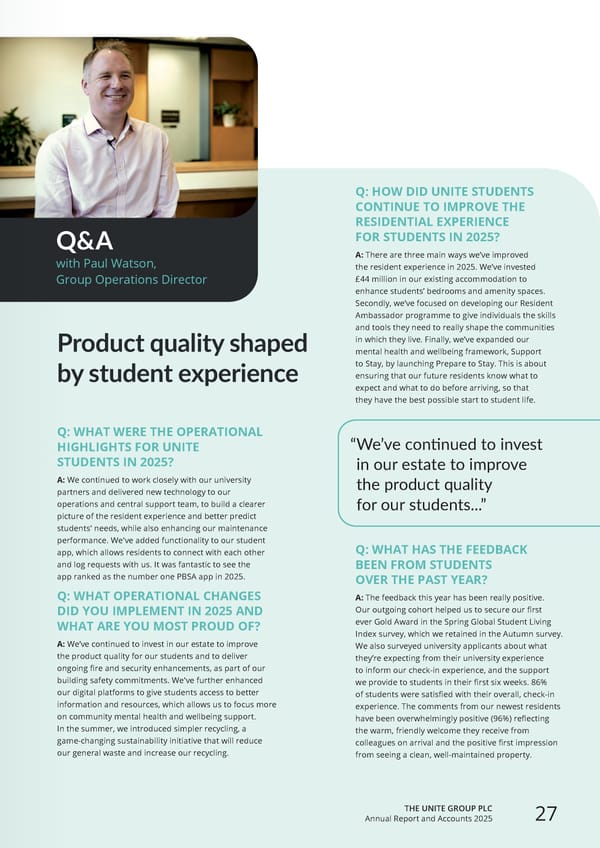
Q: WHAT WERE THE OPERATIONAL HIGHLIGHTS FOR UNITE STUDENTS IN 2025? A: We continued to work closely with our university partners and delivered new technology to our operations and central support team, to build a clearer picture of the resident experience and better predict students' needs, while also enhancing our maintenance performance. We've added functionality to our student app, which allows residents to connect with each other and log requests with us. It was fantastic to see the app ranked as the number one PBSA app in 2025. Q: WHAT OPERATIONAL CHANGES DID YOU IMPLEMENT IN 2025 AND WHAT ARE YOU MOST PROUD OF? A: We’ve continued to invest in our estate to improve the product quality for our students and to deliver ongoing fire and security enhancements, as part of our building safety commitments. We've further enhanced our digital platforms to give students access to better information and resources, which allows us to focus more on community mental health and wellbeing support. In the summer, we introduced simpler recycling, a game-changing sustainability initiative that will reduce our general waste and increase our recycling. Q: HOW DID UNITE STUDENTS CONTINUE TO IMPROVE THE RESIDENTIAL EXPERIENCE FOR STUDENTS IN 2025? A: There are three main ways we’ve improved the resident experience in 2025. We’ve invested £44 million in our existing accommodation to enhance students’ bedrooms and amenity spaces. Secondly, we’ve focused on developing our Resident Ambassador programme to give individuals the skills and tools they need to really shape the communities in which they live. Finally, we’ve expanded our mental health and wellbeing framework, Support to Stay, by launching Prepare to Stay. This is about ensuring that our future residents know what to expect and what to do before arriving, so that they have the best possible start to student life. Q: WHAT HAS THE FEEDBACK BEEN FROM STUDENTS OVER THE PAST YEAR? A: The feedback this year has been really positive. Our outgoing cohort helped us to secure our first ever Gold Award in the Spring Global Student Living Index survey, which we retained in the Autumn survey. We also surveyed university applicants about what they’re expecting from their university experience to inform our check-in experience, and the support we provide to students in their first six weeks. 86% of students were satisfied with their overall, check-in experience. The comments from our newest residents have been overwhelmingly positive (96%) reflecting the warm, friendly welcome they receive from colleagues on arrival and the positive first impression from seeing a clean, well-maintained property. Product quality shaped by student experience “ We’ve continued to invest in our estate to improve the product quality for our students...” Q&A with Paul Watson, Group Operations Director THE UNITE GROUP PLC Annual Report and Accounts 2025 27

This is a modal window.
PERFORMANCE REVIEW Operations review continued Case study Flagship developments open in cities with student housing shortages Avon Point, Bristol and Burnet Point, Edinburgh opened in autumn 2025, adding more than 1,000 new beds to our portfolio. These flagship schemes significantly improve the supply of high- quality, affordable bedrooms for students in these cities, freeing up much-needed privately rented homes for families and young professionals. Avon Point is next to the University of Bristol’s new Temple Quarter Campus and half of the 623 rooms are let to the university under a long- term nomination agreement. It combines stylish living spaces, group study areas and high-quality amenities with public arts units and improvements to landscaping and public space in the area. In Edinburgh, our Burnet Point development is unique and includes a number of bedroom types. The £59million development has 298 student bedrooms in a mix of cluster and studio flats alongside 66 one-, two- and three-bedroom flats, including 17 affordable units. Residents benefit from thoughtfully designed communal spaces, including landscaped roof terraces and panoramic views of the Edinburgh skyline. Sustainability was central to the design, with low-carbon concrete and timber-composite materials featured throughout. THE UNITE GROUP PLC Annual Report and Accounts 2025 28 STRATEGIC REPORT
Total Pipeline 5,964 beds Total pipeline development cost £710 million (2024: £1.5bn) New beds delivered for 2025/26 1,000 The see-through net initial yield of the portfolio was 5.2% at 31 December 2025 (31 December 2024: 5.1%), which reflects like-for-like yield expansion of 11 basis points in the year. Investment activity in the UK student accommodation sector remains strong, with around £4 billion traded in 2025. Private equity and institutional investors have remained active in the sector, attracted by a positive outlook for rental growth, which reflects strong demand and constrained supply in many cities. Investor demand is greatest for newly-built assets and older assets, with value-add opportunities in strong markets. Our property portfolio saw a 0.1% decrease in valuations on a like- for-like basis during the year (Unite share: 0.5% decrease), as increases in property yields and capital expenditure offset rental growth. PERFORMANCE REVIEW Property review Increasing alignment to the strongest universities TOM BREWERTON GROUP DEVELOPMENT DIRECTOR THE UNITE GROUP PLC Annual Report and Accounts 2025 29
93% by value of the portfolio is income generating (31 December 2024: 93%) and properties under development remained at 7% (31 December 2024: 7%) with the impact of new openings from the development pipeline balanced by capital expenditure for on-site projects during the year. The PBSA investment portfolio, inclusive of Empiric, is 32% weighted to London by value on a Unite share basis and expected to remain around this level on a built-out basis following completion of our committed development pipeline. Limited new supply Supply of PBSA grew by around 10,000 beds in 2025, net of beds leaving the market, equivalent to 1.5% growth in PBSA supply (Source: Cushman and Wakefield). This remains significantly below levels of new supply in the period prior to the pandemic. Weekly rents of around £230 are now required to make development viable outside London, above market rents in 85% of our regional cities. In response to increasing costs, new supply is increasingly focused on higher price studio accommodation and is targeting a different market segment to our predominantly cluster-flat portfolio. Positively, we saw build cost inflation moderate during the year, although the availability of skilled labour remains tight, and build costs remain around 50% higher than five years ago. The Building Safety Act has added three approval gateways to the design, build and occupation of new buildings adding 6-12 months to development programmes. During the year we were pleased to secure three pre-construction approvals from the Building Safety Regulator for our university partnership and uncommitted off-campus development projects. We expect the combination of complex planning, increasing regulation, and higher build and funding costs to restrict the delivery of new supply for several years. We expect new supply in 2026 to maintain 2025 levels, before slowing significantly from 2027. INCREASING ALIGNMENT TO THE STRONGEST UNIVERSITIES University joint ventures Strengthening our partnerships with universities through joint ventures for on-campus accommodation has been an objective of the business for several years and has the potential to be a significant source of growth in the years to come. Our first two university joint ventures in Newcastle and Manchester will deliver 4,300 beds by 2030 and contribute a combined £47 million (Unite share: £29 million) to net operating income, delivering a blended 7.4% yield-on-cost including recurring management fees. The projects will deliver high-quality accommodation at a range of price points, underpinned by demand from our university partners. At our Castle Leazes joint venture in Newcastle, planning was granted in the first half and construction is now underway. This supports delivery of the first phase of the 2,000-bed project for 2028/29 academic year. PERFORMANCE REVIEW Property review continued LIKE-FOR-LIKE CAPITAL GROWTH 1 £m Valuation 31 Dec 2025 Rental growth Yield movement Capital expenditure 3 Total Wholly owned 4,233 101 (89) (52) (40) USAF 2,844 127 (64) (45) 18 LSAV 2,083 105 (80) (15) 10 Total (Gross) 9,160 333 (233) (112) (12) Total (Unite share) 6,123 (30) % capital growth Wholly owned 2.5% (2.2)% (1.3)% (1.0)% USAF 4.6% (2.3)% (1.6)% 0.7% LSAV 5.1% (3.9)% (0.7)% 0.5% Total (Gross) 3.8% (2.6)% (1.3)% (0.1)% Total (Unite share) 3.3% (2.5)% (1.3%) (0.5)% 1 . Excludes leased properties and fire safety expenditure costs. THE UNITE GROUP PLC Annual Report and Accounts 2025 30 STRATEGIC REPORT
In Manchester, following the grant of planning permission and pre-construction approvals, construction is underway for the development of 2,300 new beds at Cambridge Halls for Manchester Metropolitan University. The first phase of the project targets delivery for the 2029/30 academic year. The partnership will redevelop the university’s 770-bed halls, which is over 30 years old and no longer meets student needs. The joint venture will include over 400 beds based on a new cluster- flat design with a larger communal kitchen, allowing us to offer these rooms at a c.15% lower rent than standard designs. We are in active discussions with a range of high-quality universities for further partnerships, which we are looking to progress over the next 12-18 months. These include discussions around stock transfer and refurbishment of existing university accommodation, as well as new development both on- and off- campus. We aim to secure one further joint venture per year, recognising the scale and complexity of these projects. Completed schemes During the year, we delivered over 1,000 new beds for 2025/26 academic year with 623 beds at Avon Point in Bristol and 402 beds at Burnet Point in Edinburgh. Avon Point is well-located for University of Bristol’s new Temple Quarter campus and the university has nominated 54% of beds for an initial 14-year term. At Burnet Point, we delivered 298 beds in cluster-flats as well as 104 beds in two- and three- bed clusters in a separate block. These smaller flats are let to postgraduate students, university staff and other young professionals. In the current sales environment, new openings have been slower to lease-up due to increased availability in the wider market. We expect our 2025 openings to deliver a meaningful improvement in occupancy for the 2026/27 academic year with the benefit of a full leasing cycle. Off-campus development We have increased our return requirements for new investment to reflect higher funding costs and increased delivery and leasing risks in the current environment. We are now seeking development yields on new direct-let schemes in excess of 8% in regional markets and 7% in London. These hurdles assume a university nominating a significant portion of the beds. Our focus is now on successfully delivering our on-site schemes and seeking opportunities for further university joint ventures, including on-campus projects and stock transfer, building on our successes over the past year. We are committed to two off-campus development schemes, totalling 1,650 beds in London and Glasgow. The projects have £109 million remaining costs to complete and will add a combined £21 million to net operating income from the 2027/28 academic year. Construction is progressing well at our 719-bed Hawthorne House project in Stratford, which includes a new academy school. Construction will complete in June, and the project requires transitional approval from the Building Safety Regulator in advance of occupation in September. We are working with the Regulator and our supply chain to secure approval in line with our target completion date. 51% of the beds are nominated to University of the Arts London under a long-term agreement. At Central Quay in Glasgow, we have started construction of the 934-bed project, supporting delivery for the 2027/28 academic year. The scheme is well located for University of Glasgow, a QS Global Top 100 university, with whom we have a long-standing relationship. SECURED DEVELOPMENT AND PARTNERSHIPS PIPELINE Type 1 Target delivery Secured beds/units No. Total completed value £m Total devel. costs £m Capex in period £m Capex remaining £m Forecast NTA remaining 5 £m Forecast yield on cost % Off-campus pipeline Hawthorne House, Stratford 2 ³ Noms 2026 719 248 196 53 21 30 6.1% Central Quay, Glasgow Noms/DL 2027 934 161 125 18 88 30 7.4% Total off-campus pipeline 1,653 409 321 71 109 60 6.6% University JV Castle Leazes, Newcastle 3 JV 2028/29 2,009 318 267 27 240 33 7.2% Cambridge Halls, Manchester 4 JV 2029/30 2,302 465 367 10 357 72 7.5% Total on-campus pipeline 4,311 783 634 37 597 105 7.4% Total committed pipeline 5,964 1,191 955 108 706 165 7.1% Total committed pipeline (Unite share) 891 710 91 478 127 7.0% 1. Direct-let (DL), Nominated (Noms) and Joint Venture ( JV) 2. Yield on cost assumes the sale of academic space for c.£45 million 3. Unite share 51%. Yield on cost includes management fees in NOI and deducts development management fee from costs 4. Unite share 69%. Yield on cost includes management fees in NOI and deducts development management fee from costs 5. Unite share THE UNITE GROUP PLC Annual Report and Accounts 2025 31
PERFORMANCE REVIEW Property review continued Future off-campus pipeline Our future pipeline includes an additional 2,900 beds for schemes where we have optionality on whether to proceed based on the risk-adjusted returns of projects relative to other investment opportunities. We will be disciplined when committing further capital to these projects, which will likely require a nomination underpin from a university for a significant portion of the beds. We own three consented development sites, of which 83% by value is in London. We are reviewing options for these projects to deliver best value for shareholders, including disposal or potential third-party funding. While we explore options, we have deferred delivery of our 500-bed Freestone Island project in Bristol. Our Meridian Square and King’s Place projects in London have also been delayed following an extended timeline to secure necessary approvals prior to construction. We have also decided not to proceed with our TP Paddington development in London. This follows the grant of planning permission on appeal, which fulfilled our contractual commitment to the landowner. The 605-bed project was not financially viable based on our increased return requirements and an extended delivery programme. We have recognised a c.£10 million write- off of planning costs, which has been excluded from adjusted earnings and have no further commitments to the landowner. Disposals We continue to enhance the quality of the portfolio and manage our balance sheet leverage by recycling capital through disposals. During the year, we completed the sale of 10 properties in Aberdeen, Leicester, Leeds, Nottingham and Sheffield for £214 million (Unite share: £140 million). This included the sale of a portfolio of nine properties for £212 million at a blended yield of 6.4% and priced c.1% below December 2024 book value, which completed in August 2025. The proceeds will be recycled into university joint ventures and asset management activity in our strongest markets. We will continue to recycle capital from disposals to maintain net debt: EBITDA in the 6-7x range and LTV around c.30- 35% on a built-out basis. We will target future disposals of around £300-400 million p.a. (Unite share), which will release £100-200 million p.a. of surplus capital for reinvestment. Disposals will be made up from a combination of lower growth assets, similar to those sold in 2025, stabilised assets in core markets, and lower-yielding or non-income producing assets. These disposals will enhance portfolio quality and be accretive to earnings as proceeds are reinvested. Following the year end, we agreed the sale of St Pancras Way, a 571-bed asset in central London, to USAF for £186 million (Unite share: £126 million), subject to technical due diligence. The building was developed by Unite in 2014 and is undergoing a light refurbishment to the common areas. The transaction will be USAF funded by existing cash headroom in USAF and the issue of new USAF Units (the 'New Units') to be fully underwritten by Unite. Unite will receive minimum net proceeds of £115m in cash and increase its ownership of USAF to 32% subject to USAF investors choosing to take-up their pre-emption rights. Asset management In the year, investment in asset management and refurbishment activity totalled £44 million (Unite share: £30 million), delivering a yield on cost of 8.1%. The 10 projects included full refurbishment of existing rooms, upgrades to common spaces and enhancements to the environmental performance of the properties. FIRE SAFETY Fire safety is a critical part of our health and safety strategy, and we have a track record of leading the sector on fire safety standards through our proactive approach. During the period, we completed fire safety improvements on eight properties across our estate and spent £66 million (Unite share: £36 million) on fire safety capex during the year. Our year-end balance sheet includes committed fire safety spend of £80 million (Unite share: £46 million), the costs for which will be incurred over the next two years. During the year, we reached agreement with contractors for recovery of £14 million of remediation costs (Unite share: £8 million) in relation to 10 properties. In total, we have now agreed settlements totalling £86 million (Unite share: £59 million). We expect to recover 50-75% of total cladding remediation costs through claims from contractors, although the settlement and recognition of these claims is likely to lag costs incurred to remediate properties. We anticipate the remediation programme to complete by 2031 with net spend reducing materially over time. THE UNITE GROUP PLC Annual Report and Accounts 2025 32 STRATEGIC REPORT
Q: HOW DO YOU REFLECT ON 2025 FOR THE UK’S HIGHER EDUCATION SECTOR? A: It was a busy year for the Higher Education sector, which continued to respond to financial challenges. There was a lot of uncertainty surrounding Government policy and funding at the start of the year. The picture has become less uncertain as the year's gone on, with an inflation- linked rise in tuition fees giving clarity and confidence to the sector, enabling it to plan for the future. There are further changes to come, such as the re-introduction of the maintenance grant from 2028, and universities continuing to demonstrate their resilience and ability to adapt to new conditions. The fundamentals remain very strong for the Higher Education sector, thanks to strong demand from UK and international students for its world-class provision. Q: HOW HAVE WE SUPPORTED UNIVERSITIES TO MEET THEIR ACCOMMODATION NEEDS THIS YEAR? A: We work with more than 60 universities and supply beds through nomination agreements, helping them to fulfil their accommodation guarantee for first year and international students. We've continued to invest in new properties, adding new beds where they are needed most and also investing in our existing properties to ensure we're delivering quality and value for students. Our engagement scores rose, reflecting the positive impact of these initiatives. Q: HOW IMPORTANT ARE UNIVERSITY PARTNERSHIPS TO OUR LONG-TERM GROWTH STRATEGY? A: University partnerships are fundamental to our growth strategy and our ambition is to add to our pipeline of on-campus developments by securing another new joint venture partnership in 2026. There’s significant demand from universities to co- invest in new student housing on their campuses, as they have a number of financial challenges to solve and a scarce amount of capital. They have academic estates to maintain and develop and existing accommodation that often needs to be refreshed or completely rebuilt, as well as sustainability targets to meet. There’s real competition for capital at universities, and we can play a significant role in helping them to meet these challenges. Q: WHAT ARE YOU LOOKING FORWARD TO IN 2026? A: After finalising the formation of our joint ventures with Newcastle University and Manchester Metropolitan University, we’re really looking forward to seeing extensive construction activity on site. We’re able to start realising those two projects and envisaging them as exciting homes for students of the future. We're continuing to work on the pipeline of opportunities for other on-campus joint ventures and will be progressing conversations which have been underway for some time. We are targeting the announcement of one additional joint venture by the end of 2026. We'll be opening Hawthorne House in Stratford in London, where we are working in partnership with University of the Arts London to provide more than 50% of the beds for their students. The £185 million development will combine PBSA and the London Academy of Excellence Stratford, a sixth-form college. It's set to be a big year with plenty of demand and lots of conversations. Supporting universities in a changing landscape Q&A with Simon Jones, Group Higher Education Director THE UNITE GROUP PLC Annual Report and Accounts 2025 33


This is a modal window.
PERFORMANCE REVIEW Property review continued Case study Student and university satisfaction In the competitive student accommodation market, understanding the drivers of student satisfaction is vital to help us tailor our buildings and the services to meet evolving expectations. In the Spring 2025 GSLI (Global Student Living Index) we were certified Gold for the first time, with an NPS of +21, well above our target of +11 and ahead of our competitors. In the Autumn GSLI, we retained our Gold certification and saw increased scores in Environmental Impact and achieved a Platinum rating for our Internet. Through our annual check-in survey, customer satisfaction held strong at 86% and 96% of student comments said how friendly, helpful and positive our teams were. At check-in in September 2025, 93% said they felt welcome while 88% agreed that our buildings met their expectations. The hard work of our teams meant that 29% of our city clusters maintained or improved their score, with Cardiff, Durham and Nottingham recording the highest NPS scores at 75.9, 65.8 and 62.1 respectively. The universities we work with also expressed satisfaction. Our 2025 Higher Education satisfaction score was +40, our highest on record and +3-point increase from 2024. Our trust score, based on five trust metrics, such as providing excellent services and a high standard of accommodation also improved +1 point (it was 81 in 2025, 80 in 2024). THE UNITE GROUP PLC Annual Report and Accounts 2025 34 STRATEGIC REPORT
PERFORMANCE REVIEW Financial review NOI growth more than offset higher overhead and finance costs when compared to the prior year. Adjusted EPS grew 2% to 47.5p (2024: 46.6p), reflecting the growth in adjusted earnings and increased share count following our July 2024 equity raise. IFRS profit attributable to owners of the parent company reduced to £97.6 million in the year (2024: £441.9 million), reflecting the increase in adjusted earnings of £18.5 million, a revaluation loss of £73.7 million (2024: £239.6 million gain) and a £22.5 million loss for the valudation of interest rate swaps and cancellation costs (2024: £3.5 million loss). Note: The Group uses alternative performance measures (APMs) which are not defined or specified under IFRS. These APMs, which are not considered to be a substitute for IFRS measures, provide additional helpful information and include, among others, measures based on the European Public Real Estate Association (EPRA) best practice recommendations.The metrics are used internally to measure and manage the business. We delivered a robust operating performance in 2025, with adjusted earnings increasing by 9% to £232.3 million (2024: £213.8 million), driven by growth in like-for-like rental income and investment activity. MIKE BURT CHIEF FINANCIAL OFFICER Adjusted EPS 47.5p (2024: 46.6p) Total Accounting Return 2.1% (2024: 9.6%) Loan-to-value ratio 27% (2024: 24%) Robust operating performance THE UNITE GROUP PLC Annual Report and Accounts 2025 35
PERFORMANCE REVIEW Financial review continued 2025 £m 2024 £m Adjusted earnings 232.3 213.8 SaaS implementation costs (14.6) (11.9) EPRA earnings 217.7 201.9 Valuation gains/(losses) and profit/(loss) on disposal¹ (73.7) 239.6 Changes in valuation of interest rate swaps and debt break costs (22.5) (3.5) Non-recurring costs² (9.7) - Non-controlling interest and other items 14.2 6.0 IFRS profit before tax 97.6 444.0 Adjusted earnings per share 47.5p 46.6p IFRS diluted earnings per share 19.9p 96.1p 1. Includes TP Paddington abortive costs 2. Includes restructuring costs and Empiric acquisition costs to date A reconciliation of profit before tax to adjusted earnings and EPRA earnings is expanded in section 7 of the financial statements. 2025 £m 2024 £m Rental income 428.2 398.0 Property operating expenses (134.2) (121.9) Net operating income (NOI) 294.0 276.1 NOI margin 68.7% 69.4% Management fees 17.4 17.3 Overheads (48.4) (38.4) Finance costs (46.7) (44.0) Development costs and other items 1.6 (9.1) EPRA earnings 217.7 201.9 SaaS implementation costs 14.6 11.9 Adjusted earnings 232.3 213.8 Adjusted EPS 47.5p 46.6p EPRA EPS 44.5p 44.0p EBIT margin 65.9% 68.1% A reconciliation of profit after tax to EPRA earnings and adjusted earnings is set out in note 2.2b to the financial statements. RENTAL GROWTH AND PROFITABILITY Rental income increased by £30.2 million to £428.2 million, up 8% compared to 2024. Like-for-like rental income, excluding the impact of major refurbishments, acquisitions, disposals and development completions, increased by 5% during the year, reflecting strong rental growth but modestly lower occupancy for the year. Non-like-for-like income grew by £15.3 million with additional rental income from development completions and asset management schemes exceeding the impact of income forgone through disposals. Property operating expenses increased by 9% for like-for-like properties, primarily driven by higher staff costs due to the 5% increase in the Real Living Wage and higher Employer’s National Insurance contributions. Marketing costs increased due to higher costs of acquisition in a more competitive sales environment. Other cost increases included higher council tax as a result of lower occupancy in certain cities, and increased building insurance premiums. THE UNITE GROUP PLC Annual Report and Accounts 2025 36 STRATEGIC REPORT
FY 2025 FY 2024 YoY change £m Wholly- owned Share of Fund/JV Total Wholly- owned Share of Fund/JV Total £m % Rental income Like-for-like properties 236.4 82.7 319.1 227.4 76.8 304.2 14.9 5% Non-like-for-like properties 71.2 37.9 109.1 54.6 39 .2 93. 8 15.3 16% Total rental income 307.6 120.6 428.2 282.0 116.0 398.0 30.2 8% Property operating expenses Like-for-like properties (77.1) (24.7) (101.8) (70.4) (23.3) (93.7) (8.1) 9% Non-like-for-like properties (22.3) (10.1) (32.4) (16.8) (11.4) (28.2) (4.2) 15% Total property operating expenses (99.4) (34.8) (134.2) (87.2) (34.7) (121.9) (12.3) 10% Net operating income Like-for-like properties 159.3 58.0 217.3 157.0 53.5 210.5 6.8 3% Non-like-for-like properties 48.9 27.8 76.7 37.8 27.8 65.6 11.1 17% Total net operating income 208.2 85.8 294.0 194.8 81.3 276.1 17.9 6% Management fee income from joint ventures remains broadly unchanged at £17.4 million (2024: £17.3 million), with the benefit of higher income and property valuations offset by the impact of redemptions in USAF over the past two years. Overheads increased by £10.1 million to £48.45 million (2024: £38.4 million). During the year, Software as a Service (SaaS) implementation costs relating to our technology upgrade programme totalled £19.4 million, for which a deferred tax credit of £4.8 million was recognised (2024: £15.9 million and £4.0 million). Excluding SaaS implementation costs, overheads increased by £6.6 million driven by a £2 million increase in central staff costs, £1.2 million of dual running costs from relocation of offices and £1.7 million lower VAT recovery due to increased costs relating to property letting activity and £1,2 million inflationary increase across the remainder of the cost base. £m Diluted pence per share EPRA NTA as at 31 December 2024 4,758 972 Investment portfolio 116 24 Yield movement (148) (30) Development portfolio (18) (4) Fire safety capex net of claims (15) (3) Other (8) (4) EPRA NTA as at 31 December 2025 4,685 955 Our EBIT margin reduced to 65.9% (2024: 68.1%) due to cost growth outpacing rental increases as a result of lower occupancy. Finance costs increased to £46.7 million in 2025 (2024: £44.0 million) reflecting an increase in our average cost of debt to 3.9% (2024: 3.6%) due to refinancing activity and higher rates on new debt. Capitalised interest linked to our development pipeline increased to £26.8 million (2024: £15.5 million) in line with increased levels of development activity. Development costs and other items include a £4.2 million non-recurring Newcastle University joint venture fee. We are targeting to hold costs flat in 2026 for the Unite business (excluding Empiric), reflecting the reduction in our central overhead at the end of 2025 and discipline around other cost lines. Together, this resulted in a 6% increase in net operating income to £294.0 million (2024: £276.1 million) or 3% on a like-for-like basis. EPRA NTA EPRA net tangible assets (NTA) per share, our key measure of NAV, decreased by 2% to 955p at 31 December 2025 (31 December 2024: 972p). EPRA net tangible assets were £4,685 million at 31 December 2025, a £73 million decrease from £4,758 million in the prior year. The main drivers of the £73 million decrease in EPRA NTA and 17p decrease in EPRA NTA per share were an increase in property valuation yields and capital expenditure, which were partially offset by rental growth. THE UNITE GROUP PLC Annual Report and Accounts 2025 37
PERFORMANCE REVIEW Financial review continued IFRS net assets decreased by 2% in the year to £4,734 million (31 December 2024: £4,812 million), principally driven by net valuation movements and retained profits. On a per share basis, IFRS NAV decreased by 1% to 968p (31 December 2024: 982p). PROPERTY PORTFOLIO The valuation of our property portfolio at 31 December 2025, including our share of property assets held in USAF, LSAV and the Newcastle University joint venture, was £6,628 million (31 December 2024: £6,375 million). The £253 million increase in portfolio value reflects the valuation movements outlined above, capital expenditure and interest capitalised on developments. SUMMARY BALANCE SHEET 31 December 2025 31 December 2024 £m Wholly- owned £m Share of Fund/JV £m Total £m Wholly- owned £m Share of fund/JV £m Total £m Rental properties 1 4,221 1,890 6,111 4,025 1,827 5,852 Rental properties (leased) 60 - 60 72 - 72 Properties under development 438 19 457 451 - 451 Total property 4,719 1,909 6,628 4,588 1,827 6,375 Net debt (1,221) (532) (1,753) (989) (521) (1,510) Lease liability (74) - (74) (73) - (73) Other assets/(liabilities) (56) (60) (116) 1 (35) (34) EPRA net tangible assets 3,368 1,317 4,685 3,487 1,271 4,758 IFRS NAV 3,417 1,317 4,734 3,547 1,265 4,812 LTV 27% 24% 1. Rental properties (owned) includes assets classified as held for sale in the IFRS balance sheet RETURN ON EQUITY (TOTAL ACCOUNTING RETURN) Dividends paid of 37.7p (2024: 36.0p), together with growth in EPRA NTA, resulted in a total accounting return of 2.1% in the year (2024: 9.6%). Our adjusted EPS yield (measured against opening EPRA NTA) decreased to 4.9% in the year (2024: 5.1%), reflecting NTA growth in the prior year. CASH FLOW AND NET DEBT During the year, net debt increased to £1,753 million (2024: £1,510 million). The key components of the movement in net debt were an inflow from operational cash of £189 million, disposals of £142 million, offset by total capital expenditure of £349 million and dividend payments of £175 million. In 2026, we expect see-through net debt to be broadly stable as planned capital expenditure on investment and development activity will offset anticipated property disposals. THE UNITE GROUP PLC Annual Report and Accounts 2025 38 STRATEGIC REPORT
Q: WHAT WERE THE HIGHLIGHTS FOR THE PEOPLE TEAM IN 2025? A: We launched Grow with US, our new learning hub to bring together performance, learning and goal setting into one easy-to-use place. We also began embedding our values into everything we do, from performance conversations to the Big Welcome, which is our new Company induction. We’ve also seen strong engagement with My Impact, a new performance-enabled framework which we launched last year. Around 80% of our community is engaging with conversations around what they're delivering and how they're delivering. Finally, we opened a new London office this year, which is sparking collaboration, connection and high performance. Q: WHAT CHANGES HAS UNITE STUDENTS MADE TO LEARNING AND DEVELOPMENT IN 2025? A: This year we've made a number of changes to our learning and development offering, not just through structured development programmes but through real conversations about growth and career opportunities. We've put a big focus this year on our managers, because 70% of the experience that we have at work relates to our managers. We’ve really focused on building up their confidence to lead brilliantly, to give and receive feedback and to lead through change, and that’s supporting a culture of positive engagement and continuous learning. Q: HOW IMPORTANT HAS UNITE STUDENTS’ PEOPLE AND CULTURE BEEN TO ITS SUCCESS THIS YEAR? A: Our people and culture remain pivotal to our success. We’re committed to building an organisation that’s fit for the future and we’ve restructured the business to help achieve that. By working together this year, we’ve co-created new values, reshaped how we talk about performance and launched new policies that matter, from hybrid working to menopause support. Our people have also driven record high NPS scores, proving that when our people thrive, we're able to deliver outstanding experiences for the tens of thousands of students who choose to live with us each year. Q: WHAT ARE THE KEY PRIORITIES FOR THE PEOPLE TEAM IN 2026? A: Evolving our technology platforms and ways of working to ensure that work is easy and fun for our people. We'll be launching a new wellbeing network, we'll continue to support our managers on their journey, and we'll expand career opportunities for our people. We’re also excited to to have moved to a new Bristol office, which we hope will further enhance our ability to connect with each other, to collaborate and get stuff done. Building an organisation fit for the future “ Our people and culture remain pivotal to our success. Working together, we've co-created new values and reshaped how we talk about performance.” Q&A with Amy Round, Group People Director THE UNITE GROUP PLC Annual Report and Accounts 2025 39


This is a modal window.
PERFORMANCE REVIEW Financial review continued DEBT FINANCING AND LIQUIDITY We are focused on maintaining a strong and flexible balance sheet and use debt to support our growth and enhance risk- adjusted returns. We manage our financing risk by ensuring we have a diversified range of funding sources, well-laddered debt maturities and appropriate hedging of future interest rates. We closely monitor our interest cover and net debt to EBITDA ratios. In 2025, interest cover decreased to 6.0x (2024: 6.2x) and net debt to EBITDA increased to 6.1x (2024: 5.5x), reflecting the impact of increased borrowing. We aim to maintain an ICR ratio of 3.5-4.0x and a net debt to EBITDA ratio of 6-7x. KEY DEBT STATISTICS (UNITE SHARE BASIS) 31 December 2025 31 December 2024 See-through net debt £1,753m £1,510m LTV 27% 24% Net debt: EBITDA ratio 6.1x 5.5x Interest cover ratio 6.0x 6.2x Average debt maturity 4.0 years 3.8 years Average cost of debt 3.9% 3.6% Proportion of investment debt at fixed rate 100% 100% Funding activity As at 31 December 2025, the wholly-owned Group had £651 million of cash and debt headroom (31 December 2024: £1,024 million), comprising £36 million of cash balances and £615 million of undrawn debt (2024: £274 million and £750 million respectively). In June, USAF refinanced its £395 million 2025 bonds through a new £400 million eight-year secured loan with Rothesay Life. The new facility completes refinancing activity in USAF with no maturities now due before 2029. In December, the Group refinanced its £750 million RCF with five existing relationship banks into a new three-year facility, extendable by up to two further years. Following this refinancing, the SMBC £150 million unsecured term loan was repaid in advance of its maturity in March 2027. In December, the Group entered into a joint venture with Newcastle University (Unite share: 51%) supported by a £150 million development facility with Rothesay Life. Debt drawdowns are expected to commence in May 2027. In January 2026, the Group entered into a joint venture with Manchester Metropolitan University (Unite share: 69%) supported by a £236 million development facility with PIMCO. Debt drawdowns are expected to commence in October 2027. Interest rate hedging arrangements and cost of debt Our average cost of debt increased to 3.9% in the year (2024: 3.6%) as new debt was issued at higher prevailing rates. At the year-end, 100% of the Group’s debt was subject to fixed or capped interest rates (31 December 2024: 100%), providing protection against future changes in interest rates. We expect our average cost of debt to increase to 4.3% for 2026 and 4.5% for 2027 based on our hedging position, forecast future drawings, planned refinancing events and market interest LTV increased to 27% at 31 December 2025 (31 December 2024: 24%), reflecting increased net debt and a more modest increase in our property valuations. We expect to maintain LTV between 30-35% on a built-out basis, while maintaining healthy leverage metrics on a cashflow basis. We remain committed to active portfolio management through capital recycling and are targeting disposals of around £300-400 million p.a. (Unite share). At the end of the year, Standard & Poor's affirmed The Unite Group credit rating at BBB+, reflecting our leverage targets, robust capital position and track record. THE UNITE GROUP PLC Annual Report and Accounts 2025 40 STRATEGIC REPORT
rate expectations. We expect a reduction in capitalised interest in 2026 to around £10-15 million (2025: £26.8 million), driven by a reduced level of development activity. The Group’s average debt maturity has remained broadly unchanged at 4.0 years (31 December 2024: 3.8 years). DIVIDEND We are proposing a final dividend payment of 24.9p per share (2024: 24.9p), totalling 37.7p for the full year (2024: 37.3p) and representing a 1% increase compared to 2024. This represents a payout ratio of 79% of adjusted EPS. The final dividend will be fully paid as a Property Income Distribution (PID) of 24.9p, which will fully satisfy our PID requirement for the 2025 financial year. Subject to approval at Unite’s Annual General Meeting on 15 May 2026, the dividend will be paid on 29 May 2026 to shareholders on the register at close of business on 17 April 2026. During 2025, scrip elections were received for 5% and 10% of shares in issue for the 2024 final dividend and 2025 interim dividend respectively. The Company does not intend to offer a scrip alternative for the 2025 final dividend. The Company intends to maintain a stable dividend payout in 2026, distributing 37.7p for the financial year,balancing confidence in the medium-term outlook with the expected reduction in adjusted EPS for the year ahead. TAX AND REIT STATUS The Group holds REIT status and is exempt from tax on its property business. During the year, we recognised a corporation tax charge of £3.1 million (2024: £4.8 million charge) with the decrease primarily due to lower taxable profits from interest income. FUNDS AND JOINT VENTURES The table below summarises the key financials at 31 December 2025 for our co-investment vehicles USAF and LSAV. Property assets £m Net debt £m Other liabilities £m Net assets £m Unite share of NTA £m Total return Maturity Unite share USAF 2,844 (697) (35) 2,112 614 3.3% Infinite 30% LSAV 2,083 (647) (50) 1,386 685 4.3% 2032 50% Property valuations increased by 0.7% for USAF and 0.5% in LSAV over the year, on a like-for-like basis, with rental growth more than offsetting the impact of increases to property yields. Property yields increased by 12bps for USAF and 18bps for LSAV to a weighted average yield of 5.3% and 4.7% respectively. During the year, £117 million of USAF redemption requests were cleared, with £105 million traded on the secondary market at an average 2% discount to NAV and £12 million paid to unitholders out of disposal proceeds. Unite’s ownership of USAF increased by 0.7% to 29.8% following redemptions paid to unitholders during the year. USAF has capital available to invest, which will part fund the acquisition of St Pancras Way from Unite for £186 million, increasing USAF’s portfolio weighting to London. MANAGEMENT FEES During the year, the Group recognised net fees of £17.4 million from its fund and asset management activities (2024: £17.3 million), which remained unchanged in the year. The benefit of increased fees from higher income and property valuations were offset by lower fees following redemptions in USAF over the past two years. 2025 £m 2024 £m USAF asset management fee 12.3 12.4 LSAV asset and property management fee 5.0 4.9 Total fees 17.43 17.3 THE UNITE GROUP PLC Annual Report and Accounts 2025 41
RESPONSIBILITY STATEMENT OF THE DIRECTORS IN RESPECT OF THE ANNUAL FINANCIAL REPORT We confirm that to the best of our knowledge: • The financial statements, prepared in accordance with the relevant financial reporting framework, give a true and fair view of the assets, liabilities, financial position and profit or loss of the company and the undertakings included in the consolidation taken as a whole • The strategic report includes a fair review of the development and performance of the business and the position of the company and the undertakings included in the consolidation taken as a whole, together with a description of the principal risks and uncertainties that they face • The annual report and financial statements, taken as a whole, are fair, balanced and understandable and provide the information necessary for shareholders to assess the Group’s position and performance, business model and strategy. Joe Lister Mike Burt Chief Executive Chief Financial Officer 24 February 2026 PERFORMANCE REVIEW Financial review continued THE UNITE GROUP PLC Annual Report and Accounts 2025 42 STRATEGIC REPORT
Case study Joint ventures to unlock on-campus potential Through our joint ventures with two leading universities, we are a step closer to making next- generation student living a reality in two cities. The arrangements will help them to attract students and address a shortage of student housing. With Newcastle University, we have started work on-site after being granted planning permission to redevelop student accommodation, built in the 1960s, replacing it with a modern, sustainable living space for 2,000 students. Designed with sustainability at its core and to meet diverse student requirements, the Castle Leazes development will benefit the local economy and job market and make a vital contribution to the city’s housing strategy by alleviating pressure on the private rental market. Phase one (788 beds) is scheduled to open for the start of the 2028/29 academic year. Phase two (1,221 beds) is expected to be ready for the 2029/30 academic year. Through our joint venture with Manchester Metropolitan University (MMU), we have been granted planning permission for a £390 million development for 2,300 beds at the university’s Cambridge Halls site in Manchester city centre. As well as improving the supply and quality of on-campus accommodation, the development will provide new spaces for community use. We will act as developer, asset manager and operator of Cambridge Halls, enabling MMU to continue its focus on delivering an outstanding student experience and outcomes. THE UNITE GROUP PLC Annual Report and Accounts 2025 43
Creating a Great Place to Live, Work and Invest requires sustainable growth. We aim to achieve this by factoring environmental and social considerations into every decision we make. Our sustainability framework helps us do this, by setting out four areas where we strive to make a positive impact. PERFORMANCE REVIEW Sustainability SUSTAINABILITY REPORT https://www.unitegroup.com/ sustainability-report-2025 Making a positive impact is JAMES TIERNAN HEAD OF SUSTAINABILITY THE UNITE GROUP PLC Annual Report and Accounts 2025 44 STRATEGIC REPORT
2025 progress against flagship targets 10% cut in operational energy consumption by 2030 FOCUS AREA 1. Transitioning to net zero carbon operations and developments 2. Cutting energy, water, resource use and waste 3. Working with suppliers to reduce supply chain impact 6.2% 0 10% 3,894 hours 15,000 hours volunteered to support good causes by 2030 FOCUS AREA 1. Contributing to local communities 2. Impactful volunteering and charity partnerships 3. Supply chain social impacts 0 3,750 7,500 11,250 15,000 £3.05 million £15 million invested in supporting young people by 2030 FOCUS AREA 1. Helping our residents thrive at university 2. Championing inclusion and success for disadvantaged student groups 3. Providing early career enhancement and development opportunities 0 5 10 15 Gold Award achieved Achieve Investor in People Platinum by 2030 FOCUS AREA 1. A diverse, future-ready workforce that’s clear on purpose 2. Support and growth opportunities that are right 3. A values-led culture shaped by our people, where every voice matters YOUNG PEOPLE Championing inclusion, wellbeing and success for those in Higher Education. COMMUNITIES Making a real contribution where we operate. THE ENVIRONMENT Tackling climate change and reducing our environmental impact. OUR COLLEAGUES Creating a diverse and inclusive workplace where people feel valued, supported and empowered to grow, knowing they belong. THE UNITE GROUP PLC Annual Report and Accounts 2025 45
PERFORMANCE REVIEW Sustainability continued Ambition Making a positive impact for young people Making a positive impact for communities Making a positive impact for the environment Making a positive impact for our people Targets • £15 million invested in supporting young people by 2030. • Maintain support to the Unite Foundation charity. • 100% of properties to have Resident Ambassadors. • Meet our commitments under the Care Leaver Covenant. • 15,000 hours volunteered to support local communities by 2030. • All teams achieve Bronze award or higher in our Positive Impact sustainability engagement programme. • 30% of all employees participate in volunteering in 2025. • 10% cut in operational energy consumption by 2030 vs. 2025. • Net zero carbon by 2030, see our net zero carbon pathway, www. unitegroup.com/sustainability/ our-net-zero-pathway. • 56% cut in Scope 1 & 2 market-based emissions by 2030 vs. 2019. • CRREM-aligned target of 28% reduction in energy intensity by 2030 vs. 2019. • 100% renewable electricity by 2030. • 35kWh/m² operational energy intensity for new developments by 2030. • 625kgCO 2 e/m² of total embodied carbon (A1-A5, B1-B5, C1-C4) for new developments by 2030. • EPC A and BREEAM Excellent for all new builds. • We remain committed to transitioning to net zero, investing over £5 million in energy and carbon reduction across our estate in 2025 and achieving our lowest ever embodied carbon for a new building at Avon Point in Bristol. Investors in People Platinum by 2030. • Employee engagement score of 79 by 2030. • Employee belonging score of 77 by 2030. • Retention rate of 82% by 2030. • 40% women in senior leadership by 2030. • Zero reportable accidents and incidents. • Maintain Real Living Wage accreditation. • 12% ethnic minority representation in management and senior leadership by 2030. Key progress in 2025 • Five internships linked to the Interns Foundation, and eight industrial placements. • 70 new Unite Foundation scholars at the start of the 2025/26 academic year. • New six-week welcome programme with Resident Ambassadors and interns shaping and delivering a programme of meaningful and inclusive events. • Over 90% of student- facing employees completed new student support training under our Support to Stay programme. • 6% increase in number of properties with Resident Ambassadors. • 77% of teams achieving a Positive Impact Gold award for local community projects, with the remaining achieving a Silver award. • Passed a cumulative total of £2.5 million of donations from our properties to British Heart Foundation over eight years. • 5% increase in volunteering participation rate, up from 31% in 2024, to 36% in 2025. • £6.9 million invested in energy, water and carbon reduction in 2025. • 57.0% reduction in total Scope 1 & 2 market-based emissions vs. 2019. • 100% of electricity backed by renewable energy certificates. • Signed new corporate power purchase agreement for Three Maids solar farm commencing supply in 2026. • Achieved total embodied carbon of (A1-A5, B1-B5, C1- C4) of 768 and 603kgCO 2 e/ m² at new openings in year. • 91.2% A-B rated EPC by floor area. • Continued to pay the Real Living Wage. • Maintained Gold Investors in People accreditation. • Ranked 7th in the Best 50 Small-Medium Sized Placement Schemes for our Early Careers programme. • Launched My Impact framework to help drive employee performance. • Made progress towards our 40% target of women in senior leadership roles with 37% representation achieved. SUSTAINABILITY TARGETS AND KEY PROGRESS IN 2025 THE UNITE GROUP PLC Annual Report and Accounts 2025 46 STRATEGIC REPORT
Description of the business model Details of who we are, can be found on page 2. Details of how we operate and the value we create, can be found of page 8. Stakeholder engagement You can read more about Board stakeholder engagement during 2025 in our Section 172 Statement on page 90. Employees Our Diversity, Equity, Inclusion, Belonging and Wellbeing strategy is focused on providing opportunities for all, see pages 101 and at www.unitegroup.com/sustainability/diversity-and-inclusion. Developed alongside our Disability Network, Culture Matters and our colleagues who identify as disabled and / or neurodivergent, we introduced Supporting Our People guidance, which serves as a practical resource designed to help navigate accessibility and reasonable adjustments at work. The Academy provides learning opportunities to enhance knowledge, skills and development, see www.unitegroup.com/about-us/people-and-culture. Our employee engagement forum, Culture Matters, puts the employee voice front and centre, giving employees a direct channel to senior management and helping them to shape business strategy and policy, see pages 84. The Board receives updates and oversees our Whistleblowing Policy which enables employees, suppliers or anyone else to raise a concern in confidence, see page 84 or www.unitegroup.com/sustainability/policies-documentation. Our full Gender Pay Gap report can be found on our website www.unitegroup.com/?s=gender+pay. Further details of gender split are also on page 48. We are a certified Real Living Wage employer. Our Board Diversity Policy seeks to enhance the overall diversity of the Board and ensures an appropriate and diverse mix of skills, experience and knowledge, see page 101. Anti-bribery and corruption We have a zero-tolerance approach to bribery and corruption, with employee responsibilities outlined in our Anti-Bribery Policy. Our Gifts and Hospitality Policy sets out the rules for accepting gifts and hospitality. Our Code of Ethics ensures employees adhere to the highest business and personal ethics. Our policies can be found on our website www.unitegroup.com/sustainability/policies-documentation-2. Modern slavery and human rights We are fundamentally opposed to slavery and undertake due diligence on third parties within our supply chain. The Board is informed about modern slavery risks and performance and is tasked with oversight of our modern slavery policies. You can read our Modern Slavery Statement, Human Rights Policy and Supplier Code of Conduct at www.unitegroup.com/sustainability/policies-documentation-2. Principal risks Our Audit & Risk Committee monitor and oversee risk management, including our risk management framework and risk review process as set out on page 103. We conduct regular reviews of our principal risks and uncertainties, considering both internal and external risks, the potential impact and details of risk mitigation. You can read more on page 52. Our viability statement considers the viability of the Group for the next three years, page 62. Non-financial KPIs relevant to the Company’s business on page 14. NON-FINANCIAL AND SUSTAINABILITY INFORMATION STATEMENT The table below summarises how we comply with non-financial and sustainability performance reporting requirements in line with The Companies Act 2006, and Climate-related Financial Disclosure Regulations 2022. We undertake regular reviews of our policies to ensure we continue to identify and manage key risks and carry out due diligence. The policies included in this non-financial statement contain further details (as cross-referenced herein) of the policy and outcomes. The relevant policies and statements are available online at www.unitegroup.com . Unite Students is not in scope of the EU CSRD but expect to report in line with the proposed UK Sustainable Reporting Standard in due course. Further details are set out in our separate Sustainability Report. THE UNITE GROUP PLC Annual Report and Accounts 2025 47
PERFORMANCE REVIEW Sustainability continued Male Male % Female Female % Total Board 6 60% 4 40% 10 Management 43 65.2% 23 34.8% 66 All other employees 1,030 53.3% 901 46.7% 1,931* Total 1,073 53.7% 924 46.3% 1,997 GENDER SPLIT SUSTAINABILITY REPORTING Our Sustainability Report includes detailed data in line with the European Public Real Estate Association Sustainability Best Practice Reporting Guidelines (EPRA sBPR) and in 2025 we retained a Silver EPRA sBPR award for FY24 reporting. Climate- related risks are disclosed in line with TCFD and CFD on page 63. We also disclose to CDP, earning an A rating in 2025, see www.cdp.net/en/data/scores, and to the Global Real Estate Social matters Our Resident Ambassador programme provides peer-to-peer support for students www.unitegroup.com/ articles/resident-ambassadors-student-community. Our Positive Impact programme encourages our people and teams to work with local stakeholders on community impact initiatives www.unitegroup.com/sustainability. Market overview focuses on social trends, page 4. The Unite Group is the principal supporter of the Unite Foundation, the only charity that provides a home at university for estranged and care-experienced students, https://www.unitegroup.com/sustainability/the- unite-foundation and a signatory of the Care Leaver Covenant www.unitegroup.com/articles/unite-students- care-leaver-covenant. Support to Stay, our innovative student support framework is designed to align with universities’ processes for supporting students with mental health and wider wellbeing, www.unitegroup.com/articles/student- support-to-stay-unite-students. NON-FINANCIAL AND SUSTAINABILITY INFORMATION STATEMENT CONTINUED Environmental matters The Sustainability Committee oversees our sustainability framework, which sets out clear objectives and our progress in respect of environmental, social and governance matters. It also considers our supply chain network. You can read more on page 45 and at www.unitegroup.com/sustainability. TCFD and CFD page 63. Our Net Zero Carbon Pathway sets out our approach and commitments to transitioning to net zero carbon, www.unitegroup.com/sustainability/our-net-zero-pathway. Our energy and carbon reporting aligns with requirements of the Streamlined Energy & Carbon Reporting, page 49. For wider environmental impact details of other environmental performance metrics, targets and activity, see www.unitegroup.com/sustainability. Our sustainable construction framework sets out our approach to the sustainable design and construction of new purpose-built student accommodation, refurbishments and retrofits. It will also inform how we procure new net-zero developments, see www.unitegroup.com/building-sustainably. EPRA and sBPR Further environmental, social and governance performance is also reported in line with EPRA sBPR guidelines in our separate Sustainability Report https://www.unitegroup.com/sustainability-report-2025 . Health and Safety The Health & Safety Committee monitor our Health & Safety performance and oversee our Health & Safety strategy to help keep people safe and secure across our operational buildings and development sites, page 110. Sustainability Benchmark (GRESB), retaining our 4-star GRESB rating for standing-assets and achieved a 5-star rating for new development. Our GRESB scorecard is available at www. unitegroup.com/sustainability/policies-documentation-2. We are outside of scope of EU CSRD reporting and expect to report in line with the proposed UK Sustainability Reporting Standard S1 and S2 in due course as required. THE UNITE GROUP PLC Annual Report and Accounts 2025 48 STRATEGIC REPORT
STREAMLINED ENERGY AND CARBON REPORTING The following tables summarise energy consumption and greenhouse gas (GHG) emissions in line with the Companies Act 2006 (Strategic Report and Directors’ Reports) Regulations 2013 and the Companies (Directors’ Report) and Limited Liability Partnerships (Energy and Carbon Report) Regulations 2018, Energy consumption The table below summarises energy consumption. Energy consumption Units 2019 base year 2023 2024 2025 Change from 2024–2025 Electricity absolute consumption kWh 167,593,224 149,704,305 144,685,326 132,165,870 -8.7% Natural gas absolute consumption kWh 57,414,070 56,121,430 58,836,198 55,332,232 -6.0% District heat absolute consumption kWh 11,775,682 12,090,049 10,261,075 13,084,885 +27.5% Total energy absolute consumption kWh 236,782,976 217,915,784 213,782,599 200,582,987 -6.2% Total energy intensity kWh/bed 3,233.0 3,100.8 3,085 2,994 -2.9% kWh/m 2 122.6 111.9 111.5 108.0 -3.1% Electricity from renewable sources % 61.1 99.9 99.9 100 +0.1% Energy data reported is predominantly half-hourly metered data (98.1% and 96.9% respectively for electricity and gas), with the remainder being billing data (1.8% and 3.1%) with no estimated data. District heating is 100% billing data with no estimates. Greenhouse gas emissions The table below summarises absolute GHG emissions for the last three years. Absolute GHG emissions Units 2019 base year 2023 2024 2025 Change from 2024–2025 Scope 1 Tonnes CO 2 e 10,669 10,410 10,914 10,266 -5.9% Scope 2 Location-based Tonnes CO 2 e 44,910 33,172 31,800 25,687 -19.2% Market-based Tonnes CO 2 e 18,833 2,218 1,867 2,409 +29.0% Scope 1 & 2 Location-based Tonnes CO 2 e 55,579 43,582 42,715 35,953 -15.8% Market-based Tonnes CO 2 e 29,502 12,628 12,781 12,675 -0.8% Scope 3 Tonnes CO 2 e 148,279 84,876 74,166 82,000 +8.0% Bed numbers (pro rata for sites only open part of year) 73,240 70,277 69,292 66,986 -3.3% Floor area (pro rata for sites only open part of year) m 2 1,931,148 1,947,292 1,918,164 1,857,883 -3.1% The table below summarises building-related GHG emissions intensity per m 2 (gross internal floor area) and per lettable-bed regardless of occupancy. GHG emissions intensity Units 2019 base year 2023 2024 2025 Change from 2024–2025 Scope 1 & 2 by floor area Location-based kgCO 2 e/m² 28.8 22.4 22.3 19.4 -13.1% Market-based kgCO 2 e/m² 15.3 6.5 6.7 6.8 +2.4% Scope 1 & 2 by bed numbers Location-based kgCO 2 e/bed 758.9 620.1 616.4 536.7 -12.9% Market-based kgCO 2 e/bed 402.8 179.7 184.4 189.2 +2.6% and in accordance with the Streamlined Energy and Carbon Reporting (SECR). Reporting periods are January to December. More comprehensive data is in our Sustainability Report and Net Zero Carbon Pathway which set out our 2030 energy and carbon targets. Total energy consumption fell by 6.2% driven by reductions in electricity and gas consumption despite increased district heat consumption. When disposals and new openigns are removed, like-for-like consumption fell by 3%. Reductions in electrictiy and gas follow the investment of £10 million in 2024 and £6.9 million during 2025 into energy efficiency measures, including the latest THE UNITE GROUP PLC Annual Report and Accounts 2025 49
PERFORMANCE REVIEW Sustainability continued PERFORMANCE AGAINST TARGETS Our 2030 net zero carbon target requires us to achieve a 30.5% reduction in market-based Scope 1 & 2 absolute emissions for 2025 vs. 2019 base year. Our 2025 market-based Scope 1 & 2 emissions of 12,675 tonnes CO 2 e represented a reduction of 57.0% vs 2019, putting us ahead of the target. This is driven by a combination of ongoing reductions in energy consumption and electricity supply de-carbonisation since 2019. The reductions in energy consumption achieved, combined with the impact of disposals and new openings during 2025, mean that energy intensity per m² fell by 3.1% vs. 2024 in absolute terms (3.0% on a like-for-like basis). This puts it 11.9% lower than our 2019 base year, leaving us slightly behind the planned trajectory to our 2030 target of a 28% reduction vs. 2019 levels. This lag is due to slower than planned implementation of energy efficiency measures and changes to student behaviour and occupancy that have increased energy demand. The adjacent chart shows energy intensity compared to our current CRREM-based target and the updated CRREM v2 pathway. The increased cost of capital, ongoing investment in safety critical projects like cladding remediation, and the wider operating climate mean that capital investment in energy efficiency is likely to continue to fall short of our original ambition of c.£10–15 million per year. However, we will continue to focus on the most significant opportunities, and plan to invest around £5 million on energy efficiency and decarbonisation across our existing estate during 2026. We have signed a new PPA for a recently constructed solar farm in southern England which will commence in 2026, replacing our existing power purchase agreement which expired in September 2025. Through 2025, we continued to purchase 100% REGO (renewable energy guarantee of origin certificate) backed renewable power in line with our RE100 commitment. The embodied carbon of new builds continues to fall, outperforming our targets under the RIBA Climate Challenge, including a 48% reduction in total embodied carbon (stages A1-A5, B1-B5, and C1-C4) by 2030, equating to 625kgCO 2 / m 2 . We are focusing on site selection, building design optimisation, materials selection and cutting construction site impacts to enable our new build to achieve this target. generation LED lighting, solar PV panels and improved heating controls. Increases in district heating consumption reflect changing occupancy habits and challenges of managing networks and relationships with network operators. These reductions in gas and electrictiy consumption, combined with significant reductions in UK grid electricity carbon intensty in 2025 and the impact of disposals in year, mean total location-based Scope 1 & 2 emissions fell by 15.8%. However, the increase in district heat consumption means that market-based Scope 1 & 2 emissions reduced by just 0.8%. Scope 3 emissions rose due to two new builds opening vs. just one in 2024. 35000 30000 25000 20000 15000 10000 5000 0 2019 2020 2021 2022 2023 2024 2025 2026 2027 2028 2029 2030 SBTi validated trajectory Actual performance to date Scope 1 + Scope 2 (market-based) absolute GHG emissions CO 2 e/yr 2019 2020 2021 2022 2023 2024 2025 2026 2027 2028 2029 2030 2022 2023 2024 2025 Unite Energy Intensity vs CRREM pathways New build total embodied carbon (stages A1-A5, B1-B5, C1-C4) kgCO 2 /m 2 kWh/m 2 /yr 160 140 120 100 80 60 40 20 - 1000 900 800 700 600 500 400 300 200 100 0 Performance 1.5 o C, Residential buildings, multi family, UK (v1.093) ENERGY INTENSITY kWh/m 2 /yr 1.5 o C, Residential buildings, multi family, UK (v2.01) ENERGY INTENSITY kWh/m 2 /yr Unite Students project embodied carbon actual RIBA embodied carbon target THE UNITE GROUP PLC Annual Report and Accounts 2025 50 STRATEGIC REPORT
CALCULATION METHODOLOGY GHG emissions are calculated in accordance with the UK Government’s Environmental Reporting Guidelines: including streamlined energy and carbon reporting March 2019 and the GHG Protocol’s A Corporate Accounting and Reporting Standard including recent updates on Scope 2 reporting. The UK Government emission conversion factors for greenhouse gas company reporting (2025 data set) have been used to convert data from sources including utilities meters, business travel mileage, and water consumption into CO 2 e. Location- based Scope 2 emissions are calculated using the UK national average grid emissions factor. Market-based Scope 2 emissions are calculated on an emissions factor of zero for all electricity purchased under our Unite Group supply contract which is 100% certified renewable including power purchased via a corporate Power Purchase Agreement (cPPA). Further details of which reporting are in our standalone Sustainability Report. REPORTING BOUNDARIES We report 100% of energy use and GHG emissions for 100% of properties under our operational control, including properties owned by Unite Group plc and subsidiaries, and by joint ventures regardless of equity share. This includes all PBSA assets (98.4% of total energy consumption), all common areas of build-to-rent (BTR) assets (1.3% of total energy consumption), and all head office buildings (0.3% of total energy consumption). All assets are in the UK and constitute 100% of our global energy use and GHG emissions. Energy data is 91.3% metered data, and 8.6% billing data, and has not been normalised or adjusted for any factors such as occupancy or weather. Student residents pay a single all-inclusive bill, and are not charged for any energy, heat or hot water they consume; hence, all energy used in our buildings contributes directly towards Scope 1 & 2 GHG emissions, rather than falling into Scope 3 emissions. Consequently, our most significant source of Scope 3 emissions is embodied carbon in new developments. INDEPENDENT VERIFICATION Energy consumption and Scope 1 & 2 greenhouse gas emissions have been externally verified by SGS to a reasonable level in line with ISO 14064-3:2019. Due to data availability, a portion of Scope 3 emissions have been verified to a limited level assurance. Other environmental KPIs are undergoing verifcation to a limited level of assurance in line with ISAE 3000 (Revised). SGS’s opinion statements can be viewed on our website. Case study Widening university access for care-experienced and estranged students We are the first PBSA provider to join the government- backed Care Leaver Covenant. The network of organisations strives to widen access and participation in Higher Education, apprenticeships and employment for care-experienced young people. We are contributing by offering a guarantor waiver to eligible students in a trial which starts for the 2026/27 academic year. Not having a guarantor can be a major stumbling block for care leavers and estranged young people when booking university accommodation. Through the Unite Foundation, the charity we founded in 2012, we are continuing to support care leavers and estranged students by providing record numbers of free tenancies. To celebrate signing the covenant we have given 60 students free one-year tenancies during the 2025/26 academic year. This is in addition to the 70 students who received rent-free accommodation for up to three years through the Unite Foundation accommodation scholarship. Since the charity started, Unite Students has donated over £18 million to support the charity’s scholarships, building student communities, research and work advocating for care-experienced and estranged students within the Higher Education sector. Since 2012, more than 880 students have been awarded a Unite Foundation scholarship. More information about our involvement in the Care Leaver Covenant and Unite Foundation: www.unitegroup. com/articles/unite-students-care-leaver-covenant THE UNITE GROUP PLC Annual Report and Accounts 2025 51
RISK MANAGEMENT GOVERNANCE The Board maintains oversight of risk. It maintains a robust risk management framework and internal control system. The Audit & Risk Committee supports the Board by receiving assurance reporting on risk to our objectives from Group Internal Audit twice yearly, reviewing the effectiveness of risk management and internal control processes. Our risk management framework enables the Board to clearly identify both opportunities and risks, assess our risk profile and set risk appetite, ensuring risks are managed and mitigated transparently and effectively. This includes being agile and resilient to macroeconomic and geopolitical impacts. A challenging macroeconomic environment with emerging risks within the PBSA and HE sector has required a flexible approach to managing risk. This agile approach has enabled us to make the most of opportunities. MIKE BURT CHIEF FINANCIAL OFFICER Navigating uncertainty with a proactive and resilient approach THE UNITE GROUP PLC Annual Report and Accounts 2025 52 STRATEGIC REPORT
These external factors impact our risk profile to varying degrees, and we have seen an impact in certain areas such as the cost of funding and the number of international students, while others are still emerging. We have seen increasing risk profiles within both the development and PBSA & HE markets; these short-term increases are outside our risk appetite, but remain within tolerance. We anticipate the acquisition of Empiric will broaden our customer base and reduce risk as we move through 2026, and our focus on joint ventures with universities to develop on campus will reduce these risks. Our year-end assessment of risk considered how these external factors have impacted us and the action we are taking to mitigate them. OUR RISK APPETITE The Group’s risk appetite is a core element of the Board’s strategy and annual budgeting process. It reflects our commitment to being a responsible, resilient business that delivers value to our customers, employees, and universities, while generating attractive returns for shareholders. The Board reviews and evaluates our risk appetite twice a year, focusing primarily on the business’s resilience and agility. This review considers both potential threats and opportunities, as well as broader macroeconomic and sector-specific risks affecting PBSA, HE, the property market, and the wider economy. We allow flexibility in risk tolerance across different objectives, but overall, the Group maintains a cautious risk appetite consistent with the previous financial year. Despite inflationary pressures easing gradually, ongoing macroeconomic uncertainties and political factors persist, prompting the Board to continue adopting a prudent and balanced approach to managing risk and opportunity. STRESS TESTING/SCENARIO PLANNING AND OUR STRATEGIC PLAN Each year, the Board updates and refines the Group’s Strategic Plan, grounded in detailed three-year strategic and financial projections supported by scenario planning. Beyond this period, the plan extends for an additional two years using broader assumptions. The Board aligns our strategic objectives with our risk profile, identifying potential risk events that could hinder or delay the achievement of these goals. Recognising that risks often occur in combination rather than isolation, the Board conducts stress tests on these projections against various combinations of identified risks. This rigorous process results in both a base case and a stress-tested Strategic Plan. Throughout 2025, scenario planning remained a key focus, with the Board exploring a wide range of scenarios and stress tests to evaluate our readiness and resilience against challenging market conditions. RISK MANAGEMENT Our risk management approach combines a top-down strategic analysis with a bottom-up operational view. The output is a number of strategic risks under nine principal categories. The Board conducts a twice-yearly dedicated risk review. As part of this, it undertakes an assessment of the principal Group risks, including those emerging risks that would threaten our business model, future performance, solvency or liquidity as well as the Group’s strategic objectives. The Board considers both internal and external factors when assessing our risks. Alongside this, the Board also considered emerging risks and their potential impact upon the business. Looking ahead to 2026: • Geopolitical instability, including the ongoing war in Ukraine and political uncertainty during the current US presidential term. • Levels of inflation remaining above the Bank of England’s target, delaying reductions in interest rates in the short to medium term. • The health of the wider HE sector and the impact of government policies towards international students. • A weak labour market with low rising level of unemployment and decreasing numbers of job vacancies. Reflecting on 2025 Have successfully launched our new financial systems and core systems. Navigated the impacts of macroeconomic factors on our operational performance. Demonstrated a sustained performance and clear governance around investment decisions, including the acquisition of Empiric to broaden our market offer. Invested in leadership, engagement, belonging and technology to enhance the employee experience and foster a culture that drives performance. Our priorities for 2026 Integrate the acquisition of Empiric into our systems and processes. Build upon our new technologies to increase efficiency. Continue to assess the impacts of macroeconomic factors and the performance of the HE sector on our operational performance. THE UNITE GROUP PLC Annual Report and Accounts 2025 53
RISK MANAGEMENT continued Integrated risk management approach STRATEGIC OPERATIONAL Internal audit Assure risk management effectiveness and internal control testing Executive Committee, Customer and Property Leadership teams Identify principal risks, including emerging risks Deliver actions in line with risk appetite Monitor risk indicators Consider completeness and adequacy of risk identification and mitigation actions, and risk exposure aggregation Business units Execute actions Report on risk indicators Report current and emerging risks Identify, evaluate and mitigate operational risks Board, Audit & Risk, Sustainability and Health & Safety Committees Review external environment Assess risks (including emerging risks) Set risk appetite and determine actions Assess risk management and internal control systems Report on risks and uncertainties FRAUD RISK We consider the risk to asset misappropriation, fraudulent statements and corruption, alongside the Failure to Prevent Fraud Act (effective 1 September 2025). The Group’s internal controls and risk management processes work in tandem to minimise the likelihood of fraud within the business. The controls in place are designed to minimise the opportunity, motivation and rationalisation for individuals to find opportunities to commit fraud. We are focused on ensuring our IT and financial systems are designed with appropriate segregation of duties to ensure individuals cannot override management controls of end-to-end processes. Internal audit undertakes independent audits across both operational and financial aspects of the business to independently verify that controls are operating effectively and would report any instances of fraud. CREATING THE RIGHT CULTURE FOR EFFECTIVE RISK MANAGEMENT The Group’s risk management framework systematically identifies principal and emerging risks, ensuring they are closely monitored, controlled, and assigned clear ownership for necessary actions. Emerging risks are tracked based on the speed of change in their risk scores. Recognising the speed of change in the PBSA market, we have reviewed this emerging risk and added it to our principal risks. The organisation fosters an open and accountable culture led by an experienced leadership team that recognises risk as an inherent part of doing business. This culture promotes a transparent and proactive approach to risk management. By evaluating risks through the lens of our strategic objectives, the Group takes a forward-looking and preventative stance, going beyond mere compliance to actively manage risk. THE UNITE GROUP PLC Annual Report and Accounts 2025 54 STRATEGIC REPORT
Our risk management framework The Board has the overall responsibility for the governance of risks and ensures there are adequate and effective systems in place. It does this in various ways. THE BOARD Risks and opportunities assessed as part of strategy setting, annual budget and risk oversight. Owned by the Board and its Committees. Twice-yearly formal risk review and ongoing monitoring of risk integral to Board meetings. PEOPLE AND CULTURE Embedded risk management culture. Openness, transparency and clear ownership of risk management (supported by risk registers) cascades through the organisation. RISK MANAGEMENT Risk management and assurance framework overseen by the Audit & Risk Committee. Detailed risk trackers are developed and regularly updated by our four Performance teams. The Executive Committee reviews and challenges these risk trackers and related risk and opportunities; it considers emerging risks that the Group is facing or should consider and brings these to the Board for detailed assessment of risks. POLICIES AND CONTROLS Policies and controls underpin our risk management framework (such as Capital Operating Guidelines, Treasury Policy, Investment Committee and the internal control frameworks). Risk assurance is provided through internal audit and external advisers, as well as specialist third-party assurance, where appropriate. Our key risk indicators GREAT PLACE TO WORK Employee engagement Staff retention levels GREAT PLACE TO LIVE Operational compliance audits Customer satisfaction HE trust GREAT PLACE TO INVEST Gross asset value Asset age Occupancy Rental growth Percentage of beds under nomination agreements THE UNITE GROUP PLC Annual Report and Accounts 2025 55
RISK MANAGEMENT continued PRINCIPAL RISKS SUMMARY HEATMAP High Medium Low Very Low Critical INHERENT RISK LEVEL High Medium Low Very Low Critical RESIDUAL RISK LEVEL RISK APPETITE Flexible Cautious Minimal Averse Open The attractiveness and stability of the HE sector directly affects student demand for accommodation, creating both opportunity and risk for occupancy and rental growth. The Group fails to deliver operational processes, projects or resources to deliver consistent safety levels, service quality and efficiency, potentially impacting costs, quality of service and reputation. We are unable to secure sites that deliver a suitable return on investment, and delays, cost overruns, or shifts in student demand during development further impact a development’s financial performance and returns. Ineffective allocation or recycling of capital within the portfolio may limit returns and growth potential. Loss of talent and capability, lack of strategic leadership capability and meeting changing diversity and inclusion requirements. Failure to deliver on our sustainability commitments and to effectively mitigate or adapt to the impacts of climate change, resulting in non-compliance with regulatory requirements, reputational damage, and reduced long-term resilience. Significant loss of personal or confidential data, disruption to corporate systems either through cyber-attack or internal theft/error. Inability to secure funding within risk appetite or exposure to rapidly rising borrowing costs, adversely impacting financial sustainability and investment capacity. Driven by the geopolitical landscape, fluctuations in monetary and fiscal policy, changes in the macroeconomic environment, present both opportunity and risk to the Group as financing and property markets adjust accordingly. RISK 1 RISK 2 RISK 3 RISK 4 RISK 5 RISK 6 RISK 7 RISK 8 RISK 9 Increased Decreased Risk outlook No change THE UNITE GROUP PLC Annual Report and Accounts 2025 56 STRATEGIC REPORT
Events that may trigger the risk • Immigration policy changes affecting international students. • Travel restrictions placed on international students by their own government. • Increasing propensity for students to live at home, particularly for mid- and low-tariff universities. • Challenges to university finances and a reduction in course or in-person learning. • Well funded competitors improving their offer and service. • Unite Students fails to invest in its brand. • Unite Students does not keep pace with customer expectations. Potential impact • Loss of income through lower occupancy and rental growth. • Increased costs in acquiring customers. • Reduction in demand affecting property values. • Reduced viability for new development projects. How we monitor and mitigate • Diversifying into a new market sector with the acquisition of Empiric. • Government dialogue. • Ongoing monitoring of Government HE and immigration policy. • Develop markets for international students. • Disciplined investment approach to markets with supply/demand imbalance. • Increased alignment to the best universities with our new developments secured with nomination agreements. • Geographically diverse portfolio. • Broad range of product and price offerings. • Long-term partnership arrangements with universities. • Actively driving differentiation through our brand investment and promises. • Differing strategies for B2C and B2B to mitigate against the different challenges in each market. • Asset management of our properties, with our Estate team working alongside our Asset Management Initiative to identify and improve the experience for students. • Estates five-year strategy to review our portfolio to ensure we have a quality portfolio, appropriately sized and in the right locations. SUMMARY OF PRINCIPAL RISKS AND UNCERTAINTIES The tables that follow describe the Group’s principal risks and uncertainties, and explains how these are managed or mitigated. PRINCIPAL RISK PBSA market and HE sector Events that may trigger the risk • Lack of staff training, leading to poor working standards. • Failure of third parties to deliver contracted services. • Catastrophic fire, flood or other incident at a property. • Incident at construction site involving Unite Students employees or third-party contractors. Potential impact • Fatality or serious injury. • Disruption to occupation of buildings. • Reputational damage and loss of trust in Unite Students as a reliable partner. How we monitor and mitigate • Tailored training packages for roles across the business. • Independent review of training compliance. • Business continuity plans. • Board supervised Health & Safety Committee in place. • Highly skilled and experienced H&S team in place. • Operational Performance team focus on H&S. • Expert external assurance on development safety risk. • Visible leadership for safety and wellbeing driven by our senior leaders. • Use of audits and external consultants. • Cladding programme to replace façades where appropriate. • Asset management of our properties, to identify and improve the student experience. • Monitoring of KPIs in supplier contracts • Performance reviews of key suppliers. OBJECTIVE: Deliver consistent, high standards across our operational and project teams. RISK: The group fails to deliver operational processes, projects or resources to deliver consistent safety levels, service quality and efficiency, potentially impacting costs, quality of service and reputation. PRINCIPAL RISK Operational delivery 2 1 OBJECTIVE: Build and maintain a sector-leading offer for our customers, maintaining a diverse customer base to reduce our exposure in key demographic sectors. RISK: The attractiveness and stability of the HE sector directly affects student demand for accommodation, creating both opportunity and risk for occupancy and rental growth. 1 See page 53 for information on risk appetite. THE UNITE GROUP PLC Annual Report and Accounts 2025 57
RISK MANAGEMENT continued Events that may trigger the risk • Challenging planning environment, including increased regulation in construction design. • Land scarcity and increased competition for the best sites. • Further increases in borrowing costs. • Fundamental changes to the HE sector, including students choosing to study from home. • Build cost inflation due to input cost pressures and constrained supply chain capacity. • Delivery delays relating to labour/ materials coming from outside the UK. • Physical, regulatory and transactional risks associated with climate change and the environmental impact of our development activity. Potential impact • Lost revenue where schemes are delayed while consents are agreed. • Reputational impact of delivering a scheme late, leaving students without accommodation. • NTA and EPS affected by deferred schemes and/or reduced financial returns, with cash tied up in development. • Increases in construction costs as we seek to reduce the carbon intensity of our developments and comply with building regulations. How we monitor and mitigate • Consult and lobby at a national and local level to promote the benefits of student accommodation. • Cautious control of external fees, converting any subject to planning deals to options may allow sites and consents to continue. • Comprehensive due diligence is completed on unconditional sites prior to purchase, including seeking a pre-application assessment from the relevant local authority. • Clear planning and stakeholder consultation programme. • Using mixed use sites strategically to gain positive outcomes. • Experienced development team with strong track record of delivery. • Strong relationships with construction partners. • Group Board approval for commitments above a certain threshold. • Financial investment in schemes carefully managed prior to grant of planning. • Detailed due diligence before site acquisition. • Build cost inflation regularly appraised and refreshed. • Mid-sized framework contractors used and longer-term relationships established. • Engagement with our supply chain regarding future reductions in embodied carbon through our development activity programme and project level governance, reporting and oversight. • Focus on delivering joint ventures with universities to develop on campus. OBJECTIVE: Deliver profitable new developments aligned to the strongest universities. RISK: We are unable to secure sites that deliver a suitable return on investment, and delays, cost overruns, or shifts in student demand during development further impact a development’s financial performance and returns. PRINCIPAL RISK Development 3 Events that may trigger the risk • Lack of investment in the quality of our product offering. • Increases in commuter students with more students living at home. • Increased regulation over rents. • Rapid changes in the macroeconomic environment driven by geopolitical factors. Potential impact • NTA and EPS affected by reduced financial returns. • Failure to deliver planned disposals may result in a deteriorating net debt position and negatively impact our ability to commit to future investments. How we monitor and mitigate • Five-year capital investment plan. • Disposal strategy to ensure we recycle capital effectively. • Disciplined investment approach to markets with demand/supply imbalance. • Long-term partnership arrangements with universities. • Geographically diverse portfolio. OBJECTIVE: Invest in or divest assets within our portfolio to ensure suitable returns and recycle capital. RISK: Ineffective allocation or recycling of capital within the portfolio may limit returns and growth potential. PRINCIPAL RISK Property portfolio 4 Increased Decreased Risk outlook No change See page 53 for information on risk appetite. THE UNITE GROUP PLC Annual Report and Accounts 2025 58 STRATEGIC REPORT
Events that may trigger the risk • Lack of leadership development. • Lack of managed succession planning and opportunity for career advancement. • Ad hoc/ uncoordinated training plans. • Lack of or poor performance management. • An insufficient pool of diverse and capable people. • Cost of living crisis driving wage inflation, inhibiting recruitment and staff wellbeing impacts. • Changes to legislation surrounding diversity and inclusion. Potential impact • Inability to deliver Unite Student’s strategy. • Reduced employee engagement. • High attrition rates, increasing costs. • Increased recruitment and wage costs. • Reputational impact of not meeting diversity and inclusion targets. • Loss of capability and knowledge from the business impacting on service levels. How we monitor and mitigate • Highly skilled and experienced people leadership team. • Academy providing; training coordination and centralised tracking to ensure consistency. • Performance framework refreshed and relaunched. • Culture Matters engagement forum providing direct feedback from employees. • Talent review process for succession planning for key roles. • Biannual employee engagement survey and action plans. • My Impact one-to-one feedback sessions with all colleagues. OBJECTIVE: Retain a high performing workforce with suitable succession plans and a focus upon diversity, equality, inclusivity, belonging and wellbeing goals. RISK: Loss of talent and capability, lack of strategic leadership capability and meeting changing diversity and inclusion requirements. PRINCIPAL RISK People Events that may trigger the risk • Lack of understanding of the commitment made and the component parts. • Lack of awareness or understanding of regulatory requirements. • No clear plan to deliver the required outputs. • Lack of engagement from stakeholders on delivery of the commitments. • Extreme weather events (flooding, high wind, heat waves). • Increasing legislative burden. • Further reporting requirements leading to an increasing reporting burden. • Increasing, volatile and unpredictable energy, carbon and water costs. Potential impact • Non-compliance with regulations – regulatory action or fines/penalties may follow. • Reputational damage with resultant loss of revenue. • Loss of investor confidence/trust. • Potential reduction in Group credit ratings. • Damage to property. • Injury to people. • Disruption to supply chain. • Increased capital and insurance costs. • Potential for compensation payments to students. • Regulatory action or fines/penalties. • Asset stranding or value write-downs; inability to dispose of assets that do not meet regulatory compliance standards. How we monitor and mitigate • Formal business policies in place and updated regularly. • Effective communication and reporting internally to increase engagement and track progress, and externally to keep stakeholders appraised of ambition and progress. • Ongoing stakeholder consultation and dialogue to ensure strategy and reporting are aligned. • Well-established sustainability strategy and Group Sustainability Committee. • Governance structure in place with clear Board oversight for climate-related issues. • Monitor performance against key ESG frameworks (GRESB, TCFD). • Procurement decisions consider environmental and climate change performance. • Utilities purchasing strategy to purchase only 100% REGO-backed renewable electricity. • Incident management plan in place to react to extreme weather incidents efficiently and effectively. • Active horizon scanning for updates and changes to legislation. • Governance structure in place with clear Board oversight for climate-related issues. OBJECTIVE: To meet external public commitments and regulatory requirements and to prepare for the impact of climate-related physical and transition risks. RISK: Failure to deliver on our sustainability commitments and to effectively mitigate or adapt to the impacts of climate change, resulting in non-compliance with regulatory requirements, reputational damage, and reduced long-term resilience. PRINCIPAL RISK Sustainability (more information about our Climate and Sustainability risks is included in on page 63) 5 6 THE UNITE GROUP PLC Annual Report and Accounts 2025 59
RISK MANAGEMENT continued Events that may trigger the risk • Threat actors attempting to compromise systems through social engineering, prolonged remote attacks or physical access. • Changes to operational design, bringing requirements for improvements to digital infrastructure. Potential impact • Significant loss of personal or confidential data or disruption to the corporate systems. • Reputational and/or financial damage with increased scrutiny including sanctions and fines. • Reduced benefits from operational efficiencies. How we monitor and mitigate • Defined governance structure for Information Security. • Technical security controls aligned to SANS CIS Critical Security Controls. • Penetration testing. • Security Operations Centre and Security Incident & Event Management. • Full suite of awareness and training activities. • Agreed Information Security Strategy & Technical Security Roadmap. • Information Security and Data protection policies in place. • Scheduled Internal Phishing campaigns. • Mimecast intercepts potentially harmful emails. • Monitoring of emerging cyber threats. • Information Security Incident Management procedures in place. • Programme and project-level governance, reporting and oversight. • Periodic consideration of Information Security by Audit & Risk Committee and Board. OBJECTIVE: Maintain and enhance a robust and secure IT environment that discourages attacks and informs us when issues have been detected and provides us with greater operational capacity. RISK: Significant loss of personal or confidential data, disruption to corporate systems either through cyber-attack or internal theft/error. PRINCIPAL RISK Technology 7 Increased Decreased Risk outlook No change THE UNITE GROUP PLC Annual Report and Accounts 2025 60 STRATEGIC REPORT
Events that may trigger the risk • Geopolitical factors influencing market sentiment. • Reduced access to capital markets due to external factors e.g. global financial crisis. • Significant reduction in revenue or other adverse business event affecting the market’s perception of Unite Students risk and future performance. • Significant reduction in property valuations or increase in debt. Potential impact • Increased financing costs leading to reduced profitability and property values. • Possible forced asset sales at below valuation. • Slowdown in development activity. • Breach of covenant could lead to an event of default followed by repayment demand. How we monitor and mitigate • Movements in interest rates and the impact of different outcomes are considered at the Treasury Committee. • Hedging strategy is approved by the Board annually. • Minimum hedge ratio of 75% is defined in the Capital Operating Guidelines (COGs); most debt is fixed rate or hedged with swaps or caps. • Revolving Credit Facility to provide liquidity headroom. • Maintain good relationships with lenders. • We manage the balance sheet ratios defined in COGs. • Funding Strategy periodically approved by the Board. • Monitoring of covenants across a range of income scenarios and risks. 8 OBJECTIVE: Manage our balance sheet liquidity within tolerable levels and maintain compliance with our debt covenants. RISK: Inability to secure funding within risk appetite or exposure to rapidly rising borrowing costs, adversely impacting financial sustainability and investment capacity. PRINCIPAL RISK Financial Events that may trigger the risk • Geopolitical factors influencing market sentiment. • Increasing inflation rates leading to increases in interest rates. • Changes in government or policy. • Global conflict. • Natural disaster. • Pandemics. Potential impact • Loss of income. • Reduction in demand affecting property valuations. • Potential impact on rental growth and occupancy. • Reduced revenue and increased costs associated with part-filled accommodation. • Slowdown in development activity. • Higher cost of funding. How we monitor and mitigate • We regularly assess our strategy, considering the broader macroeconomic environment, and adjust priorities, capital allocation and risk appetite accordingly. • We use suitable scenario models to test our resilience to impacts of the macroeconomic environment, as individual and combination scenarios. • Movements in interest rates and the impact of different outcomes are considered at the Treasury Committee. • Revolving Credit Facility to provide liquidity headroom. • Maintain good relationships with lenders. OBJECTIVE: Ensure we can respond in a resilient manner to changes in the macroeconomic environment. RISK: Driven by the geopolitical landscape, fluctuations in monetary and fiscal policy and changes in the macroeconomic environment, present both opportunity and risk to the Group as financing and property markets adjust accordingly. PRINCIPAL RISK Macroeconomic 8 9 THE UNITE GROUP PLC Annual Report and Accounts 2025 61
VIABILITY STATEMENT The Directors have assessed the viability of the Group over a five-year period to December 2030, taking account of the Group’s current position and the potential impact of its principal risks. The Directors consider the five-year lookout period to be the most appropriate as this aligns with the Group’s own strategic planning period combined with the levels of planning certainty that can be derived from the development pipeline. The viability assessment has been prepared including the impact of the Group’s acquisition of Empiric Student Property plc in January 2026. The Directors believe that high tariff UK universities will continue to experience strong demand from students as UK 18-year-old demographic growth becomes increasingly favourable and UCAS acceptances rise. The Group has an annual business planning process, which comprises a Strategic Plan, a financial forecast for the current year and a financial projection for the forthcoming five years (which includes stress testing, scenario planning and covenant adherence). This plan is reviewed each year by the Board as part of its strategy setting process. Once approved by the Board, the plan is cascaded across the Group and provides a basis for setting all detailed financial budgets and strategic actions that are subsequently used by the Board to monitor performance. The forecast performance outlook is also used by the Remuneration Committee to establish the targets for the annual and longer-term incentive schemes. To stress test the viability of the business, a viability scenario was prepared using the Group’s Strategic Plan as a base. The key viability assumptions were: • Income growth reduced to 1% p.a., reflecting principal risks 1 and 4. • Cost growth of 5% p.a., allowing for further sustained increases in utility and other costs. • Yield expansion of 75bps, approximately a 15% decline in asset values, reflecting principal risk 8. • Interest costs of 7% on all new and refinancing activity, reflecting principal risk 9. • No further development commitments, disposals or acquisitions, reflecting principal risks 3 and 4. The result of this scenario showed a significant deterioration in forecast performance, with earnings and NTA significantly reduced (to 37.9p and 787p respectively) in 2030 while LTV increased substantially to 42%. Despite the significant contraction in the size of the business over the forecast period, the business would remain viable under such a scenario. We considered whether the Group’s climate change principal risk would impact our assessment of the Group’s viability but concurred that as we have an ongoing programme of capital investment to achieve our science-based net zero target by 2030, this mitigated the risk sufficiently for this viability assessment. Following recent visa policy changes aimed at reducing net migration, the UK is less attractive for international postgraduate taught students who can no longer bring dependent family members to the UK, however we have experienced limited impact from the changes as our rooms are single occupancy. In addition, Home Office data shows 7% growth in applications for study visas in the year to August 2025, and the outlook for international demand remains encouraging thanks to growing student mobility and the increasing attractiveness of the UK as a study destination as competitor markets introduce more restrictive policies. The Group achieved 95% occupancy for the 2025/26 academic year and has a strong outlook for 2026/27. International student demand is not expected to impact the longer-term viability of the Group. The financing risks of the Group are considered to have the greatest immediate potential impact on the Group’s financial viability. The three principal financing risks for the Group are: • short-term debt covenant compliance • the Group’s ability to arrange new debt/ replace expiring debt facilities • any adverse interest rate movements. To hedge against the potential of adverse interest rate movements the Group manages its exposure with a combination of fixed rate facilities and using interest rate swaps for its floating rate debt. During the year, the Group has complied with all covenant requirements attached to its financing facilities and expects to continue to do so. The outlook and future prospects beyond the viability period for the business remain strong, reflecting the underlying strength of student demand, our alignment to the strongest universities and the capabilities of our best-in-class operating platform. There are significant growth opportunities for the business created by the ongoing shortage of high quality and affordable PBSA, universities needing to deliver an exceptional student experience through their accommodation and the growing awareness of the benefits of PBSA among non-first-year students. Emerging risks to the outlook and prospects are identified and assessed through our broader risk management process. Based on their assessment and the mitigating actions available, the Directors have a reasonable expectation that the Group will be able to continue in operation and meet its liabilities as they fall due over the period to December 2030. RISK MANAGEMENT continued THE UNITE GROUP PLC Annual Report and Accounts 2025 62 STRATEGIC REPORT
CLIMATE-RELATED FINANCIAL DISCLOSURES COMPLIANCE STATEMENT Although Unite Students is exempt from the TCFD disclosure requirement as Listing Rule 6.6.6R (8) explicitly excludes closed-ended investment companies, the Group fully supports the recommendations and voluntarily discloses its alignment. This constitutes our response to the Task Force on Climate-related Financial Disclosures (TCFD) recommendations, applying the TCFD Annex where relevant. We remain closely engaged with the FCA’s consultation on UK Sustainability Reporting Standards (incorporating ISSB IFRS S1 and S2) to ensure our reporting evolves in line with emerging best practice and future regulatory expectations. TCFD pillar Recommended disclosure Consistency level Page reference Climate-related Financial Disclosure (Companies Act 2006 414CA and 414CB) 1. Governance a. Describe the Board’s oversight of climate-related risks and opportunities. consistent 64 a. A description of the Company’s governance arrangements in relation to assessing and managing climate- related risks and opportunities. b. Describe management’s role in assessing and managing climate- related risks and opportunities. consistent 64 2. Strategy a. Describe the climate-related risks and opportunities the organisation has identified over the short, medium and long term. consistent 65 to 66 d. A description of: i. The principal climate-related risks and opportunities arising in connection with the Company’s operations. ii. The time periods by reference to which those risks and opportunities are assessed. b. Describe the impact of climate- related risks and opportunities on the organisation’s businesses, strategy and financial planning. consistent 67 to 69 e. A description of the actual and potential impacts of the principal climate-related risks and opportunities on the Company’s business model and strategy. c. Describe the resilience of the organisation’s strategy, taking into consideration different climate- related scenarios, including a 2°C or lower scenario. developing 70 f. An analysis of the resilience of the Company’s business model and strategy, taking into consideration different climate-related scenarios. 3. Risk management a. Describe the organisation’s processes for identifying and assessing climate-related risks. consistent 70 b. A description of how the Company identifies, assesses and manages climate- related risks and opportunities. b. Describe the organisation’s processes for managing climate-related risks. consistent 70 c. Describe how processes for identifying, assessing, and managing climate- related risks are integrated into the organisation’s overall risk management. consistent 70 c. A description of how processes for identifying, assessing and managing climate-related risks are integrated into the Company’s overall risk management process. 4.Metrics and targets a. Disclose the metrics used by the organisation to assess climate-related risks and opportunities in line with its strategy and risk management process. consistent 70 h. A description of the key performance indicators used to assess progress against targets used to manage climate-related risks and realise climate-related opportunities and of the calculations on which those key performance indicators are based. b. Disclose Scope 1, Scope 2 and, if indicators are based. appropriate, Scope 3 greenhouse gas (GHG) emissions and the related risks. developing 71 c. Describe the targets used by the organisation to manage climate- related risks and opportunities and performance against targets. developing 71 g. A description of the targets used by the Company to manage climate-related risks and to realise climate-related opportunities, and of performance against those targets. THE UNITE GROUP PLC Annual Report and Accounts 2025 63
RISK MANAGEMENT continued CHIEF EXECUTIVE AND EXECUTIVE COMMITTEE Meet at least quarterly, typically weekly. The Chief Executive is ultimately responsible for managing climate risk, realising climate opportunities and implementing the sustainability framework with support from the Executive Committee. The Executive Committee reviews the annual business plan and long-term Strategic Plan for Unite Group, which covers all aspects of performance including climate risks and opportunities, ahead of recommending it to the Board. On a monthly basis, the Executive Committee reviews actual and forecast performance, including climate-related performance, as appropriate, taking action to improve wherever necessary and reports this progress to the Board. UNITE GROUP PLC BOARD • Ultimate responsibility for setting Unite Group strategy, prioritisation of activities and capital allocation. • Provides challenge to management on target setting and performance. • Ensures Unite Group maintains an effective risk management framework, including climate-related risks and opportunities . PORTFOLIO PERFORMANCE TEAM INVESTMENT PERFORMANCE TEAM OPERATIONS PERFORMANCE TEAM • Chaired by the Chief Operating Officer (on an interim basis). • Manages climate risk and opportunities in investment decisions, such as improving EPC ratings and energy performance of existing properties. • Manages sustainability investment performance against budgets for the Unite Group, including consideration of climate-related risks and issues in investment opportunities. • Chaired by the Group Development Director, responsible for new property-related investment. • Manages climate risk and opportunities with regards to potential development sites. • Tasked with reducing embodied carbon and improving operational energy performance of developments, in line with our 2030 net zero carbon target. • Chaired by the Group Operations Director, responsible for operating the investment property portfolio. • Address climate risks and opportunities through improved operational management of buildings and education of student customers. • Ensures plant is properly maintained to operate at designed energy efficiency. • Identifies opportunities to secure low-carbon energy through Power Purchase Agreements. • Reviews, monthly, detailed financial performance relating to energy use, taking actions to mitigate variance from approved budget. SUSTAINABILITY COMMITTEE REMUNERATION COMMITTEE AUDIT AND RISK COMMITTEE • Four meetings in 2025. • Oversees development and implementation of our sustainability framework and recommends any changes to the Board. • Reports progress to the Board quarterly with input from across the Group. • Receives updates on best practice, market expectations and climate-related developments from internal and external experts, including advisers, investors and supply chain partners. • Chaired by Dame Shirley Pearce with two Non-Executive Director members. • Attended by Group Chair, CEO, CFO, Head of Sustainability and Group People Director. • Three meetings in 2025. • Chaired by Nicky Dulieu with three Non-Executive Director members. • Engages with shareholders to inform target setting, including climate-related objectives. • Supports the sustainability framework by aligning remuneration and incentive targets to the strategy. These form part of the employee-wide bonus scheme, the Executive Director’s bonus scheme and Senior Managers’ long-term incentive plan (LTIP). as detailed in the Remuneration Committee Report on page 113, which covers performance against 2025 bonus targets. • Four meetings in 2025. • Chaired by Ross Paterson with three other Non-Executive Director members. • Ensures climate-related risks and opportunities are identified, assessed, then effectively mitigated and managed as part of overall risk management framework. • Oversees preparation of Unite Group’s financial disclosures, including TCFD and the Annual Report. SUSTAINABILITY TEAM • Led by the Head of Sustainability, a dedicated team with operational responsibility for coordinating the implementation of the sustainability framework. • Head of Sustainability regularly reports progress to the Portfolio and Operations Performance teams, Executive Committee and attends Sustainability Committee meetings. • Responsible for developing asset transition plans, implementing energy and carbon reduction capital projects, ensuring EPC and wider energy and climate-related compliance. • Produces reporting on climate- and sustainability-related performance. I R R R R I I I 1. GOVERNANCE 1A. BOARD OVERSIGHT Our Chief Executive has overall responsibility for climate-related risks and opportunities, with the Sustainability Committee, a sub-committee of the Board, overseeing climate-related issues. The Committee meets quarterly, reviewing progress towards our 2030 net zero carbon target, climate risk and operational performance (see the Sustainability Committee Report on page 108.) The Board conducts a formal risk review twice a year (see page 53), which includes climate-related risks. These risks and opportunities are integrated into business planning and investment cases brought to the Investment Committee, Executive Committee, and Sustainability Committee. This ensures management and the Board are aware of risks and can incorporate them into their planning, budgeting and decision making. Full responsibilities for managing climate-related risks are outlined below. 1B. MANAGEMENT’S ROLE Informing Key Reporting I R THE UNITE GROUP PLC Annual Report and Accounts 2025 64 STRATEGIC REPORT
2. STRATEGY 2A. CLIMATE-RELATED RISKS AND OPPORTUNITIES IDENTIFIED We utilise the structured scenarios outlined below from The Network for Greening the Financial System (NGFS) to assess Group- level climate-related risks and opportunities under different policy and temperature outcomes. The Too Little, Too Late scenario, within the diagram at the bottom of this page, is included as a conceptual quadrant rather than a fully parameterised scenario. Climate - related risks are identified by the Sustainability team using scientific models aligned to our industry and geography. Impacts from hazard events which have actually occurred within the business (e.g. flooding, overheating, energy volatility) are used to refine the forward - looking assumptions. Further insights are drawn from internal Public Affairs and Legal teams, as well as local councils, universities, industry working groups, and external research from major UK real - estate, insurance, and facilities - management businesses. Orderly Transition (1.5°C Scenario): Early, coordinated climate policies tighten gradually, enabling a smooth transition. Both physical and transition risks are more subdued. Disorderly Transition (≈1.5–2°C): Delayed or fragmented policy action until 2030 triggers abrupt, stringent measures. Transition risks spike due to sudden adjustments, while physical risks stay moderate as warming is limited below 2°C. Hot House World (≥4°C): Insufficient global action leads to severe warming. Transition risks are minimal as few new policies are introduced, but physical risks escalate dramatically, driving systemic impacts. Our timelines used to assess climate-related risks and opportunities remain unchanged, aligning with the group Risk Management framework. Except for Policy & Legal, all stated risks and opportunities identified below are expected to materialise over the short, medium and long-term, with varying degrees of magnitude dependant on the temperature scenario realised. Overheating continues to be the risk developing most rapidly across our properties. Scale of climate risks and opportunities overlaid into NGFS scenario model Short term: 0–3 years – Our highest confidence forecasts including the detailed annual budget and subsequent two years where we have significant visibility in our Business Plan. Medium term: 3–10 years – Covers the period to our 2030 net zero carbon target, asset transition plans and other regulatory deadlines such as EPC B in 2030 and the useful life of building fit out. Long term: 10–30 years – The period beyond our forecasting and planning horizon and the age where PBSA can begin to face obsolescence without investment. Time periods ~£15m (per annum) ~£3.3m – £37.8m: 2025-2050 Flooding Heat stress Reduced heating costs (opportunity) Market risk, commodity & resource efficiency Reputation M L ~£10m (per annum, OPEX) Transition risks Physical risks £10–12m (per annum, CAPEX) Technology Policy & Legal ≈1.5-2°C 1.5°C ≥4°C ‘Too Little, Too Late’ ~£0.8m – £1.7m (pa) Note: Detailed overviews on methodo- logical assumptions can be found within each corresponding risk/opportunity statement. Where financial impact is yet to be modelled, we have indicated 'L' 'M' or 'H' for Low, Medium, or High. Further statistical analysis due in 2026. Bubble size denotes rough scale of estimated impact. THE UNITE GROUP PLC Annual Report and Accounts 2025 65
CLIMATE-RELATED RISKS AND OPPORTUNITIES The following table summarises our approach to scenario modelling risk and opportunity areas. RISK MANAGEMENT continued Risk/opportunity area Approach Scenarios assessed Rationale Heat stress Compared current summer temperatures to Part O risk zones; projected future overheating under NGFS-aligned 1.5°C, 2°C, and +4°C scenarios. Asset-level analysis planned for 2026 which will consider factors such as building fabric, ventilation, solar gain and internal heating loads. 1.5°C, 2°C, +4°C Extreme heat can significantly impact building performance, occupant comfort and energy demand. Assessing multiple warming scenarios ensures resilience planning for future regulatory compliance and operational risk mitigation. Flooding Baseline flood risk assessed against Environment Agency maps; modelled increased risk using UKCP18 rainfall projections under 1.5°C, 2°C, and +4°C scenarios versus 1981–2010 baseline data, then overlaying known financial implications from previous flood events in our buildings. 1.5°C, 2°C, +4°C Flood risk escalates most significantly under higher warming; however, using all three scenarios ensures robust planning for asset protection and insurance considerations. Heating energy use (opportunity) Analysed current heating demand vs. projected heating degree days under each scenario to estimate energy and cost reductions. 1.5°C, 2°C, +4°C Temperature changes directly affect heating demand; while our ambition remains the mitigation of higher temperature scenarios, modelling across potential outcomes supports energy efficiency and cost planning under the varying climate futures. Market, policy & legal Assessed EPC compliance and CRREM 1.5°C pathways; modelled capital investment needs and utility cost impacts under low/medium/ high price scenarios. 1.5°C pathway Regulatory and market responses are tied to global temperature targets; a 1.5°C scenario reflects the most stringent compliance trajectory. Reputation Monitored via Higher Education engagement NPS; qualitative assessment only. Not scenario-based Not scenario-based because reputational risk is driven by stakeholder perception rather than physical climate outcomes, however we anticipate that a lack of perceived action in line with maintaining 1.5–2°C trajectories are more likely to be reputationally damaging as stakeholders carry an expectation on decarbonisation responsibility. Technology & resource efficiency Evaluated retrofit potential and cost implications for energy efficiency improvements. 1.5°C pathway 1.5°C pathway aligns with net-zero commitments and informs investment in efficiency measures under the most ambitious transition scenario. THE UNITE GROUP PLC Annual Report and Accounts 2025 66 STRATEGIC REPORT
CLIMATE-RELATED RISKS AND OPPORTUNITIES CONTINUED Risk Category Impact Potential financial impact (aligned with Group financial risk thresholds) Mitigation and adaption activities Heat stress Physical- Chronic Under all scenarios, we may experience an increase in the frequency and severity of overheating. Without significant adaptations (such as reducing solar gain, modifying the building fabric or altering building services), this could necessitate temporary measures such as additional ventilation or cooling, providing alternative accommodation for the most affected customers, or even closing some rooms during these events. Historical data from past heatwave events indicates that overheating could pose a material financial risk to the portfolio. Under a 4°C scenario, hotel relocation could result in costs exceeding £84 million in London and £40 million in the East Midlands, with additional impacts across other regions. Furthermore, up to £15 million of summer short- term lettings income may be at risk if properties become uninhabitable during peak heat periods. These figures underscore the need for asset-level sensitivity analysis and targeted adaptation measures to mitigate escalating financial exposure. In 2026, we plan to undertake detailed heat exposure analysis for regions most at risk of higher temperatures and summer heatwaves, identified via both quantitative inputs and qualitative insights via our Regional Property Managers. This will likely include London, the Southeast, Southwest, East of England, and the Midlands, as well as regions with high bed counts such as the Northwest and Yorkshire and Humber. The analysis will be conducted at a 12 km resolution for each asset/city and will incorporate sensitivity assessments to determine individual property resilience to heatwaves. Factors considered will include building characteristics (e.g. façade colour), solar shading options, ventilation systems, and other design elements. These insights will inform targeted adaptation measures and investment planning to enhance climate resilience across our portfolio. Flooding Physical- Acute Given that many of the assets within our portfolio are situated near riverbanks and within heavily urbanised areas, flooding has been deemed a key material risk to the portfolio, potentially causing temporary operational disruptions, asset damage, and, in severe cases, the need for closure and occupant relocation. Beyond direct impacts, flooding in other regions can also affect our operations by disrupting supply chains or communications. Across all climate scenarios (1.5°C, 2°C, and +4°C), both the likelihood and severity of flooding are projected to increase. Flooding represents a significant financial risk to our portfolio, with 23 of our properties facing an 87% probability of flooding by 2050 under a high temperature scenario. Based on regional worst-case scenarios, potential costs range from £3.3 million to £37.8 million through to 2050, excluding local flood defence measures. These costs reflect direct damage repairs, rehousing expenses, and income loss from property closures, alongside wider operational disruptions that could affect business continuity and future investment decisions. We will use regional climate projections to identify areas experiencing faster increases in flood-related hazards, including precipitation intensity. Assets located in regions flagged through this initial screening will be prioritised for detailed, asset-level flood exposure assessments using high-resolution modelling (likely 1–30 metres), paired with sensitivity analyses. Regions with faster projected precipitation increases, particularly in the South of England, will also undergo deeper analysis. Flood response plans have already been developed for new high-risk properties, and will be expanded across the portfolio, supported by business continuity planning. Additionally, climate risk considerations will be integrated into design guidance for new developments and refurbishments, ensuring resilience measures are tailored to the specific physical risks faced by each asset. Priority regions for further assessment include Southwest England, East Midlands, West Scotland, Yorkshire and Humber, and Northwest England. Technology Transitional There is a risk that individual assets may not improve sufficiently or quickly enough to meet the demands of transitioning to a low- carbon economy. Failure to comply with evolving regulatory standards, such as future Minimum Energy Efficiency Standards (MEES) for EPCs, or market and shareholder expectations, including decarbonisation in line with CRREM pathways, could negatively affect our rental income, operating costs, asset value, and liquidity.This creates uncertainty around whether supply-side and building-level technologies can keep pace with both regulatory and operational requirements. Our 2020 Net Zero Carbon Pathway identified the need to invest approximately £10–15 million per annum to achieve our 2030 ambition. Through 2025, challenging conditions meant around £6.9 million was deployed on energy efficiency improvements, with an estimated payback period of around 10 years through utility savings. Without continued investment, assets risk experiencing a brown discount in the next 3 to 5 years if they fail to meet EPC MEES requirements and investor expectations for energy and carbon performance. Planned capital investments aim to reduce energy and carbon emissions in line with our SBTi and CRREM-based targets, mitigating the risk of asset stranding. To address the risk of technology lag, we are actively engaging with peers through the PBSA ESG Working Group and internally via our Estates, Tech & IT, and Supply Chain teams to monitor and accelerate technology innovations. A notable example is the development of Prefect’s IRUS Utility Meter, created through collaborative problem- solving with Unite. The IRUS building management system (BMS) offers versatile and accurate metering solutions for student accommodation, PBSA, build-to-rent, co- living, and hotel properties. We will continue to review ambition levels, monitor progress, and integrate emerging technologies into our strategy to ensure resilience against both regulatory and technological risks. 2B. IMPACT OF CLIMATE-RELATED RISKS AND OPPORTUNITIES THE UNITE GROUP PLC Annual Report and Accounts 2025 67
RISK MANAGEMENT continued Risk Category Impact Potential financial impact Mitigation and adaption activities Reputation Transitional Failing to support stakeholders or meet expectations during the low carbon transition could see adverse reputational impacts and challenge our ability to form lasting partnerships with university partners, students and investors. Failing to meet stakeholder expectations could harm our business performance in various ways, including our ability to secure nomination agreements with universities and facing increased financing costs, but this isn’t currently quantifiable with existing data. We actively engage with customers, university partners, suppliers, and investors to communicate our sustainability performance and goals, while seeking feedback to align with their expectations and ensure they’re brought on the journey with us. Policy and legal Transitional Regulations and government policies will continue to evolve, raising minimum standards for building performance and other requirements to accelerate the transition to net zero carbon. There is a risk that changes in government policy reduce financial support for key technologies, driving a requirement for increased investment. The UK Government’s legally binding 2050 net zero target currently doesn’t include industry-specific decarbonisation pathways and investment requirements. However, we expect to spend c.£5–10 million p.a. on energy efficiency investment, supporting our transition to net zero carbon and ensuring that our portfolio complies with EPC standards. Failing to achieve this could potentially lead to loss of earnings and enforcement fines. Our sustainability and legal teams, with support from our expert advisers, routinely monitor upcoming and proposed regulation to ensure we can adapt ahead of introduction to remain compliant. Proactive investments also help us mitigate future energy costs without relying solely on funding enabled by regulatory levies. Following recent investments, 91.7% of our floor area is now EPC A or B rated, and our planned capital investment will ensure all our buildings meet minimum efficiency standards. Market risk, commodity and resource efficiency Transitional We are exposed to market risk from energy price volatility and rising costs if we do not mitigate consumption through efficiency investments. Utilities represent our second-largest operating expense after staff costs, with annual spend of approximately £40 million. Ongoing market fluctuations complicate forecasting and pricing strategies. There is also a systemic risk that resource constraints such as grid capacity pressures driven by electrification and emerging technologies could amplify cost volatility and supply challenges. We target a 10-year payback on energy efficiency investments. If utility prices remain high, the potential savings from these investments will increase. Conversely, failure to act could expose the portfolio to significant cost escalation and margin compression. We forward-purchase utilities to secure price certainty when rooms are released for sale, enabling accurate pricing and cost control. Approximately 30% of our electricity is currently secured through a corporate Power Purchase Agreement (PPA), providing multi-year supply stability. We are actively exploring additional PPAs to strengthen resilience and deliver both environmental and financial benefits. Alongside procurement strategies, we continue to invest in energy efficiency measures to reduce demand and mitigate exposure to market volatility. THE UNITE GROUP PLC Annual Report and Accounts 2025 68 STRATEGIC REPORT
Case study Our approach to thought leadership Now in its fourth year, the Unite Students Applicant Index, produced in partnership with HEPI, provides our business, universities and the wider Higher Education sector with valuable insight into the attitudes and confidence levels in students before they arrive at university. This helps us work in partnership to evolve the support and services available to students, particularly during the transition to student living and independence. According to the Index, this year’s intake is the most independent cohort since it was launched, with 74% saying that they feel confident about living independently at university (up from 67% in 2024). This is backed up with responses which show increasing confidence with budgeting, resolving issues with living and studying, and a willingness to take an active part in the student community. https://www.unitegroup.com/ applicant-index-report This year, we also commissioned independent research looking at transition to university from the perspective of parents. The Empty Nester Survey 2025, commissioned by Unite Students and undertaken by Censuswide in September, showed that two thirds (67%) of parents use an app to digitally track their child’s location once they leave for university – demonstrating how parenting in this hyper-connected age now continues beyond school life. We published a Guide to Empty Nesting, in partnership with Dr Dominique Thompson, former GP, a young people’s mental health expert and member of the Government's Higher Education Mental Health Taskforce. Her expert tips offer practical advice for parents navigating and adjusting to this new chapter in their lives. www.unitegroup.com/articles/two- thirds-of-parents-admit-to-tracking-their- childs-location-while-at-university Opportunity Category Impact Potential financial impact Correlative action Reduced heating demand Physical Rising winter temperatures driven by climate change are expected to reduce energy use for space heating across all future climate scenarios. Warmer winters will lessen the need to maintain comfortable indoor conditions, with the greatest reductions likely in regions that currently experience colder climates, such as northern parts of the UK. The savings from the reduced heat demand due to warmer winters have been estimated at between c.£0.8 million and £1.7 million per year across the portfolio (based on current use and prices). While we more proactively prepare for energy cost savings to be realised because of low-carbon technology improvements, we also understand which of our properties have the potential for lower heating costs in the event of milder winters, and this will be factored into future projections for energy performance. Reputation Transitional Our leadership in sustainability may be acknowledged by our customers and partners, leading to additional business opportunities or income benefits. Recognition of sustainability leadership can create tangible financial benefits through enhanced brand reputation, stronger university partnerships, and increased student demand. This may lead to additional nomination agreements, higher occupancy rates, and improved pricing power. It can also reduce financing costs by improving access to green loans and sustainability-linked funding. While not easily quantifiable, these benefits can translate into incremental revenue and margin improvements over time. To capture these opportunities, we actively engage with stakeholders, including university partners, investors and students, through transparent reporting and collaborative forums. Our Positive Impact programme encourages our people and teams to work with local stakeholders on community impact initiatives. Through engagement with local communities, the programme has helped our people better understand sustainability and social responsibility. THE UNITE GROUP PLC Annual Report and Accounts 2025 69
2C. RESILIENCE OF THE BUSINESS STRATEGY Our Net Zero Carbon Pathway aligns with stakeholder expectations and enables growth through sustainable development. Real Estate is uniquely positioned to accelerate the low-carbon transition. By addressing the climate- related risks outlined above, this in turn creates significant opportunities. Reducing energy consumption lowers our operating costs, improves net operating income and enhances asset value. Enhanced due diligence for suppliers (particularly in climate-impacted regions), and sustainable procurement strategies helps mitigate transition risks, including rising commodity costs. Meanwhile, strengthening our climate resilience by mitigating overheating and flood risks, supports our customer wellbeing and provides a competitive advantage. Climate considerations are integrated across our financial planning and capital allocation through a range of mechanisms: • Utility costs: We monitor commodity price volatility and usage trends, incorporating mitigation strategies such as energy efficiency investments into budgets. • Acquisitions and disposals: Due diligence evaluates costs linked to net zero commitments, EPC compliance, and utility exposure, reflected in pricing and financial modelling. • New developments: Designed to achieve EPC A and BREEAM Excellent ratings, incorporating resource-efficient technologies (e.g. rainwater harvesting, low-flow fixtures, solar power) and measures to meet Part O overheating requirements. Flood resilience is factored into design and investment appraisals, with higher returns sought where risk remains substantial. 3. RISK MANAGEMENT 3A. PROCESSES FOR IDENTIFYING AND ASSESSING CLIMATE-RELATED RISKS Climate change is a principal risk influencing our long-term decisions, including investment and divestment, and is embedded within our enterprise risk framework. Our objectives, to be a Great Place to Live, Work and Invest are supported by our commitment to achieve net zero carbon by 2030 and reduce resource intensity. We identify and manage climate-related risks through our established governance process. Risks are documented in the Risk Register, assigned to owners, and reviewed by the Executive Committee, with principal risks assessed by the Board twice annually. Portfolio-level assessments • Scenario analysis: We model physical and transition risks under 1.5°C, 2°C, and +4°C scenarios using UKCP18 data and CRREM pathways to test resilience and inform strategic planning. • Regulatory and policy monitoring: The Energy and Environment team tracks climate-related legislation (e.g. MEES, EPC standards) and market trends to ensure compliance and guide transition plans. • Investment & divestment due diligence: Sustainability risks are considered in acquisition and disposal decisions, including location-specific physical hazards and capital requirements for net zero alignment. Asset-level assessments Existing assets: Annual reviews assess: • Transition risks: Energy performance, CRREM 1.5°C pathways, EPC compliance, and retrofit needs. • Physical risks: Flooding and overheating exposure based on UKCP18 projections and historical data. • Reputation risk: Tracked qualitatively through Higher Education engagement metrics, as it cannot be easily modelled under defined climate scenarios. 3B. PROCESSES FOR MANAGING CLIMATE-RELATED RISKS Scenario analysis informs mitigation strategies, such as adaptation measures for physical risks and capital investment planning for transition risks. Mitigation strategies are developed for new developments and acquisitions are reflected in pricing adjustments. Opportunities, including reduced heating demand and utility costs under lower Heating Degree Days scenarios, are also evaluated. 3C. INTEGRATION INTO OVERALL RISK MANAGEMENT Assessment & controls: Each risk is evaluated for likelihood, impact, and residual exposure against our risk appetite. Climate- risk is subject to the same governance, annual review process and management attention as other risks recorded on our Group Risk Register page 56. 4. METRICS AND TARGETS 4A. METRICS USED TO ASSESS CLIMATE- RELATED RISKS AND OPPORTUNITIES Our 2030 net zero carbon commitment, set out in our 2021 Net Zero Pathway, aligns with the Paris Agreement and UK Government goals. This is underpinned by SBTi-approved science-based targets and our RE100 pledge to source 100% renewable electricity by 2030. As we provide all-inclusive rent, customer energy use is included in our Scope 1 and 2 emissions, RISK MANAGEMENT continued THE UNITE GROUP PLC Annual Report and Accounts 2025 70 STRATEGIC REPORT
KPI 2019 base year 2023 2024 2025 2024-25 change Investment in energy efficiency (£ million) £2.2 million £8.2 million £10.2 million £6.9 million -32% Scope 1+2 (market-based) absolute emissions (tonnes CO 2 e/yr) 29,502 12,628.0 12,781 12,675 -0.8% Average energy intensity (kWh/m²/year) 122.6 111.9 111.5 108.0 -3.1% Water consumption per m² floor area (m³/ bed) 41.5 39.1 39.4 38.2 -3.0% % of electricity from renewable sources 61.1% 99.9% 99.9% 100% +0.1% GRESB rating 72 (three star) 86 (four star) 85 (four star) 86 (four star) +1 point EPC ratings by floor area 2019 2023 2024 2025 2024-25 change A-B 41.2% 92.3% 91.7% 91.2% -0.5% C 19.7% 7.4% 7.98% 8.5% 0.5% D-G 39.1% 0.3% 0.34% 0.3% 0% Total A-C 60.9% 99.7% 99.7% 99.7% 0% creating a unique opportunity to reduce both ours and their environmental impact; unlike most real estate businesses where tenant energy use falls under Scope 3. Performance against these targets is embedded in governance as the senior leadership’s LTIP is linked to energy intensity, and Executive bonuses are tied to GRESB scores, which include net zero transition and sustainability performance. Our existing Net Zero Carbon Pathway includes the following climate-related targets, which we use as proxies to assess climate-related risks and opportunities: • Reduce absolute carbon emissions (Scope 1 and market-based Scope 2), perfomance to date demonstrates -57.4% based on 2025 full-year data. • Achieve 625 kgCO²e/m² embodied carbon for new developments by 2030, in line with the RIBA 2030 Climate Challenge. • Reduce energy intensity per m² by 28% by 2030 compared to 2019. • Source 100% of energy from renewable sources by 2030, in line with RE100. 4B. SCOPE 1, 2 AND 3 EMISSIONS AND RELATED RISKS Energy consumption and Scope 1 & 2 greenhouse gas emissions, calculated in line with the Greenhouse Gas Protocol, have been externally verified by SGS to a reasonable level of assurance in line with the requirements of ISO 14064-3:2019. Environmental performance data has undergone external assurance by SGS to a limited level of assurance in line with requirements of ISAE 3000 (Revised): Assurance Engagements Other than Audits or Reviews of Historical Financial Information. The table below sets out some of the key performance indicators that are linked to our 2025 sustainability targets on page 45, and the climate related risks and opportunities set out in this chapter. More detail on Scope 3 emissions relating to capital goods, purchased goods and services, and our wider value chain are set out in our separate Sustainability Report. Trend analysis against our KPIs is included in the Sustainability section of this report. As we evolve and develop our Net Zero Carbon Pathway during 2026, we will evaluate options such as the adoption of an internal carbon price, and use of carbon offset credits, in accordance with the SBTi Net-Zero Corporate Standard guidance to assess how they could most effectively be used as part of our transition to net zero. 4C. CLIMATE-RELATED TARGETS AND PERFORMANCE Following the acquisition of Empiric, all climate and resilience initiatives will be reviewed and progressed on a consolidated, Group-wide basis. The integration of the expanded portfolio is being embedded into our modelling, capital planning and risk assessment processes to ensure consistency of approach, regulatory alignment and long-term asset resilience. This includes: • c.£5 million capital investment in energy efficiency, such as LED lighting, air source heat pumps and improved heating controls. • Update of our Net Zero Carbon Transition Plan and targets, incorporating the full enlarged portfolio (including Empiric assets) and aligning with the most recent frameworks and regulatory expectations. • Asset level surveys across the consolidated estate to identify further opportunities for energy efficiency and decarbonisation. • Explore options to expand purchase of renewable electricity via corporate Power Purchase Agreements (cPPAs), reflecting the enlarged Group demand profile and enabling greater purchasing leverage to support grid additionality and long-term price stability. • Further research to understand specific overheating/flooding risks across the combined portfolio, and the necessary adaptions for each asset; whether this falls within the domain of Unite Group mandated adaptations or via local infrastructure such as flood defences. This will help improve long-term asset management plans, budgets, and strategic investment decisions. • A detailed overheating and flood risk analysis for the full integrated estate across all temperature scenarios, refining adaptation strategies, resilience planning and futureproofing of both legacy and Empiric assets. The strategic report on pages 1–71 was approved on 24 February 2026 by the Board and is signed on its behalf by: Joe Lister Chief Executive Officer THE UNITE GROUP PLC Annual Report and Accounts 2025 71
GOVERNANCE “The Board and our Committees govern the business focused on our customers, people and investors and our strategic objectives.” RICHARD HUNTINGFORD CHAIR THE UNITE GROUP PLC Annual Report and Accounts 2025 72
CORPORATE GOVERNANCE 74 Chair’s introduction to governance 76 Board of Directors 80 Board statements 83 Board leadership and purpose 88 Division of responsibilities 90 Section 172 93 Board activities 100 Nomination Committee 103 Audit & Risk Committee 108 Sustainability Committee 110 Health & Safety Committee 113 Remuneration Committee 132 Directors’ Report 135 Statement of Directors’ responsibilities THE UNITE GROUP PLC Annual Report and Accounts 2025 73
CHAIR’S INTRODUCTION TO GOVERNANCE Delivering a Great Place to Live is at the heart of our business and drives our Home for Success purpose. The safety and wellbeing of our customers is key to our ongoing success, and the Board and Health & Safety Committee have through 2025 continued their oversight of fire safety and cladding remediation, as well as the wider safety, security and wellbeing of our customers, recognising that for many this is their first time living away from their family home. The Board continues to oversee our investment in technology to drive operational and financial Overseeing our strategy The Board and our Committees govern the business focused on our customers, people and investors and our strategic objectives. When doing so, the Board understands the importance of balancing in-year operational and financial performance with longer-term sustainable and responsible performance. RICHARD HUNTINGFORD CHAIR THE UNITE GROUP PLC Annual Report and Accounts 2025 74 GOVERNANCE
the increased alignment of our portfolio with the strongest universities. With this focus on capital allocation and risk-adjusted returns, the Board has overseen progress on our university partnerships. This led to the signing of our first university joint venture in December 2025, with construction now underway at Castle Leazes in Newcastle and the first phase on track for delivery in 2028, and the signing of our second joint venture in January 2026 with Manchester Metropolitan University. Through 2025, the Board also progressed our plans to expand into the returner student segment with the acquisition of Empiric Student Property plc (Empiric) which successfully completed at the end of January 2026. We are now working on integration and delivering on our business plan for Empiric, as part of our wider focus on operational excellence and our return to growth. The Board continues its focus on cost, margin and improving operational efficiency, leading to a restructuring at the end of 2025, which is expected to deliver a c.20% saving in our head office staff costs and further opportunities for cost savings through 2026 with efficiencies from technology investment and the realisation of cost synergies from the Empiric acquisition. The Board’s oversight of capital allocation and careful balance of risk-adjusted returns led to a revised capital allocation framework towards the end of 2025, with surplus capital to be deployed at the strongest risk-adjusted returns into university partnerships and share buybacks. This led to the Board approving the launch of a share buyback programme in early January 2026 funded through surplus capital from deferred development activity. Through 2026, the Board will continue to oversee our ongoing disposals and development programme, and the generation of further surplus capital alongside maintaining our high-quality balance sheet, and how this should be deployed for the strongest risk-adjusted returns. The Board continues to see demand for student accommodation, notwithstanding a slower start to the 2026/2027 sales cycle, with supply constrained due to slowing and more costly development and increasing regulation in the HMO sector. Affordability and safety continue to be key for students, parents and universities and the Board continues to oversee how we deliver safe, high-quality, value-for-money homes for our customers and our university partners. The following pages explain how our governance has supported us through 2025 and how it will continue to support us in the longer-term. R ichard Huntingford Chair 24 February 2026 Board focus in 2025 Great Place to Live affordability; safety and wellbeing; fire safety and cladding remediation Great Place to Work performance management and reward; learning and development; diversity and inclusivity Great Place to Invest financial performance; capital allocation and risk-adjusted returns; University partnerships efficiencies, ensuring the ongoing delivery of high- quality and affordable homes for our customers. Delivering a Great Place to Live for our customers, requires the ongoing dedication of our teams working closely and collaboratively with our university partners. The Board oversees how we make Unite Students a Great Place to Work, with investment in our people through increased learning and development by the Unite Academy and our ongoing commitment to the Real Living Wage. During 2025, Angela Jain, our Designated Non-Executive Director for Workforce Engagement, attended meetings of Culture Matters, our employee forum, helping shape people policies and hearing directly from our employees. Through the Board’s engagement, we ensure performance is appropriately recognised and incentivised with a more diverse workforce that is increasingly representative of our customers. Along with ensuring delivery of a Great Place to Live and Work, the Board oversees how we deliver a Great Place to Invest and returns for our shareholders. Through 2025, the Board has focused on optimising our capital allocation while ensuring the ongoing delivery of operational excellence and the quality, location and scale of our portfolio. Through the year, the Board has considered our capital allocation and risk-adjusted returns, carefully balancing progressing new developments, deferring or not proceeding with them, alongside driving disposals to ensure THE UNITE GROUP PLC Annual Report and Accounts 2025 75
BOARD OF DIRECTORS Richard joined the Board on 1 December 2020, became Chair on 1 April 2021 and Chair of the Nomination Committee on the same date. Relevant skills, experience and contribution A chartered accountant with over 35 years of plc board experience including as Chief Executive of Chrysalis Group plc between 2000 and 2007 and as a Non-Executive Director of Virgin Mobile Holdings (UK) plc. Chair roles have included Wireless Group plc (formerly UTV Media plc), Future plc and Crown Place VCT plc. His FTSE chair experience and wider Non-Executive and Executive experience helps us ensure best practice in Board effectiveness and corporate governance. Experience in public company governance and leadership, corporate finance, investment, business development, investor relations and media helps us drive our strategy development and effective engagement with our wider stakeholders. External appointments None RICHARD HUNTINGFORD CHAIR JOE LISTER CHIEF EXECUTIVE OFFICER MIKE BURT CHIEF FINANCIAL OFFICER Joe Lister became Chief Executive Officer on 1 January 2024. He joined Unite Students in 2002 and held a variety of roles before becoming Chief Financial Officer in 2008. Relevant skills, experience and contribution Played an integral role in the design and delivery of the Group’s strategy, sustainable growth and financial performance with deep experience of our business and sector. Now leading the development, implementation and communication of the Group’s strategy and ongoing performance with our investors. External appointments None Mike became Chief Financial Officer on 1 January 2024. He was previously Investment Director and joined the business in 2019. Relevant skills, experience and contribution A wealth of financial experience in corporate finance across a range of sectors. Prior to joining Unite Students, he spent ten years as a research analyst covering real estate companies, most recently at Exane BNP Paribas. A strong track record of leading our investor relations, sustainability commitments, and as a member of the Executive team. Prior to his appointment as Chief Financial Officer, Mike was responsible for our investment strategy and asset management. External appointments None N H S THE UNITE GROUP PLC Annual Report and Accounts 2025 76 GOVERNANCE
Nicky joined the Board on 1 September 2022 and was appointed Senior Independent Director and Chair of the Remuneration Committee in March 2023. Relevant skills, experience and contribution A chartered accountant and a proven business leader with an established plc track record and extensive experience in consumer facing markets, including as CEO of Hobbs between 2008 and 2014. Also, the Finance Director of Marks & Spencer’s Food Division in a career at the retailer spanning 1982–2005. Non-Executive Director experience includes chairing Remuneration and Audit Committees and as a Senior Independent Director. In this role, she supports the Chair in the effective running of the Board. External appointments • Barratt Redrow Plc (Senior Independent Non-Executive Director) NICKY DULIEU SENIOR INDEPENDENT DIRECTOR N A R ROSS PATERSON NON-EXECUTIVE DIRECTOR Ross joined the Board in September 2017 and became the Audit Committee Chair in January 2018. Relevant skills, experience and contribution A former Chief Financial Officer of Stagecoach Group and Non-Executive Director of Virgin Rail Group Holdings Limited. Ross has experience in finance, business development and legal, gained from his finance role at Stagecoach Group. Contributes many years’ experience of managing finance in a complex operational business and valued insights to innovation, as we continue to enhance our service offer for customers. His financial and broader business experience is particularly valuable as Chair of the Audit & Risk Committee, where he helps oversee the Group’s financial rigour and delivery. External appointments • Bytes Technology Group plc (Non-Executive Director) • Tracsis plc (Non-Executive Director) • Institute of Chartered Accountants of Scotland (Business Policy Panel member) Composition of the Board Chair 1 Executive Directors 2 Non-Executive Directors 7 Gender diversity Female 4 Male 6 Non-Executive Director Independence Non-independent 1 Independent Non-Executive Director 6 Committee key Nomination Committee member Audit & Risk Committee member Remuneration Committee member N A R H Health & Safety Committee member Sustainability Committee member Committee chair S N A R S THE UNITE GROUP PLC Annual Report and Accounts 2025 77
BOARD OF DIRECTORS continued Ilaria joined the Board in December 2018. Relevant skills, experience and contribution Ilaria brings over 30 years of experience in real estate, including investment, development, asset management and lending in commercial and operational businesses. Ilaria was previously CEO of Frasers Property UK, and a member of the executive leadership team of Frasers Property, the Singapore listed global real estate group. She was also formerly CEO of GE Capital UK, a regulated Bank and corporate lender and led GE Capital Real Estate UK, a commercial real estate investor, developer and lender. External appointments • Frasers Property UK (Advisor) Dame Shirley joined the Board in November 2019 and Chairs our Sustainability Committee. Relevant skills, experience and contribution A wealth of experience in Higher Education, health and policing, including as Vice Chancellor of Loughborough University from 2006–2012, as a Board member at the Higher Education Funding Council for England, the Universities and Colleges Employers Association, and the Healthcare Commission. Non-Executive Director roles at Health Education England and the Norfolk, Suffolk and Cambridgeshire Strategic Health Authority. She was appointed CBE in 2005 for services to education in the NHS and in 2014 appointed DBE for services to Higher Education. Dame Shirley brings her wide-ranging and hands-on experience in the Higher Education sector to the Board, which is especially critical at a time of ongoing change in the sector. External appointments • Higher Education Quality Assurance Panel for the Ministry of Education in Singapore • Royal Anniversary Trust (Trustee) • HCA (Advisory Board member) • London Academy of Music and Dramatic Art (Trustee) Thomas joined as a Non-Executive Director in November 2019 following the Group’s acquisition of Liberty Living from Canada Pension Plan Investment Board (CPPIB). Relevant skills, experience and contribution Thomas is Managing Director and Head of Real Estate Europe at CPP Investments, responsible for real estate investments across Europe and the UK. He is also a member of CPP Investment’s Global Real Estate Investment Committee, where he has been instrumental in building the European, UK and Indian real estate portfolio. Thomas was previously a Vice President in the real estate investment banking team at Macquarie bank and focused on M&A transactions within the UK and European public and private real estate companies. His international experience is invaluable for the Board, providing a wider perspective on real estate. External appointments • CPP Investments (Managing Director, Head of Real Estate Europe) ILARIA DEL BEATO NON-EXECUTIVE DIRECTOR DAME SHIRLEY PEARCE NON-EXECUTIVE DIRECTOR THOMAS JACKSON NON-EXECUTIVE DIRECTOR N A R N N S H S THE UNITE GROUP PLC Annual Report and Accounts 2025 78 GOVERNANCE
Professor Sir Steve joined the Board on 1 April 2020 and has Chaired our Health & Safety Committee since July 2020. Relevant skills, experience and contribution A wealth of experience in the Higher Education sector, including as Vice-Chancellor and Chief Executive of the University of Exeter from 2002 to August 2020. President of Universities UK (UUK) (2009–2011), Chair of UCAS (2012– 2019), served on the Boards of UUK and the Russell Group, and was Chair of the UUK International Policy Network (2014–2020). Between 2007 and 2010, led for Higher Education on the Prime Minister’s National Council of Excellence in Education, providing advice to government. Sir Steve was knighted in 2011 for services to Higher Education locally and nationally. His Higher Education sector experience helps the Board navigate a changing Higher Education sector, particularly through the development of strong university partnerships. External appointments • Trustee for Fulbright Programme • UK Government International Education Champion • UK Government Special Representative to Saudi Arabia for Education • Member of the Board of the Lee Kuan Yew School of Public Policy, National University of Singapore Chris became Company Secretary and Group Legal Director in 2013. Relevant skills, experience and contribution Prior to Unite Students, Chris held General Counsel roles at GE, MTV Networks and other multinationals. He was previously an M&A/corporate and commercial lawyer at Clifford Chance and Baker McKenzie. Chris uses his general counsel and corporate/ commercial legal experience to ensure our corporate and risk governance is aligned with our business activity. External appointments • The West of England Friends Housing Society (Board Trustee) PROFESSOR SIR STEVE SMITH NON-EXECUTIVE DIRECTOR CHRIS SZPOJNAROWICZ COMPANY SECRETARY N A R H Committee key Nomination Committee member Audit & Risk Committee member Remuneration Committee member N A R H Health & Safety Committee member Sustainability Committee member Committee chair S Angela joined the Board in August 2023 and became our Designated Non-Executive Director for Workforce Engagement in January 2025. Relevant skills, experience and contribution Angela works in the commercial television industry and has held senior executive roles at ITV including as Director of Unscripted UK television and is currently Head of Content at Disney+. Angela brings strong insights into the broader business community, government and key stakeholders through previous positions on the Boards of BusinessLDN and ITN. Her experience with younger audiences, particularly relating to wellbeing and safeguarding, she contributes to the Board’s better understanding of the needs, wants and behaviours of our customers. External appointments • The Walt Disney Company (Disney + EMEA), Head of Content ANGELA JAIN NON-EXECUTIVE DIRECTOR N H THE UNITE GROUP PLC Annual Report and Accounts 2025 79
THE UNITE GROUP PLC Annual Report and Accounts 2025 80 BOARD STATEMENTS Board statements Under the UK Corporate Governance Code, the Board is required to make a number of statements. These statements are set out below: Requirement The Unite Group plc is listed on the London Stock Exchange and is subject to the requirements of the UK Corporate Governance Code 2024 (the “Code”). The Board is required to apply the principles of the Code and to either comply with the provisions of the Code or, where it does not, explain the reasons for non-compliance. The code is available at www.frc.org.uk . Board statement The Board considers that the Company has, throughout the year ended 31 December 2025, applied the principles and complied with the provisions set out in the Code. The Board acknowledges the progress made in response to the requirements of Provision 29 of the Code, which apply from 1 January 2026. More information Details on how the Company has applied the principles and complied with the provisions can be found throughout this Corporate Governance section of the Annual Report. The table on page 82 details where disclosure against the principles of the Code can be found in this Corporate Governance Report. Compliance with the Code Requirement In accordance with the requirements of UK Listing Rule 6.6.6R(9), the Board is required to provide a statement as to whether it has met certain targets related to gender and ethnic diversity at Board level. Board statement The Board confirms that as at 31 December 2025, all three diversity targets were met: 1. 40% of the Board were women. 2. One of the senior Board positions (the Senior Independent Director) was held by a woman. 3. One Director was from an ethnic minority background. More information More details on the Company’s compliance with the UK Listing Rules relating to Board diversity amongst the Board and Executive management can be found on pages 102. UK Listing rule – Board diversity GOVERNANCE
THE UNITE GROUP PLC Annual Report and Accounts 2025 81 Requirement The Board is required to confirm that the Group has adequate resources to continue in operation for the foreseeable future. Board statement After making enquiries and having considered forecasts and appropriate sensitivities, the Directors have formed a judgement, at the time of approving the financial statements, that there is a reasonable expectation that the Group has adequate resources to continue in operational existence for the foreseeable future, being at least 12 months from the date of these financial statements. More information More details on the going concern statement, in accordance with the requirements of UK Listing Rule 6.6.6R(3), can be found on pages 152 and 153. Going concern Requirement The Board is required to assess the viability of the Company taking into account the current position and the potential impact of the principal risks and uncertainties set out on pages 52 - 71. Board statement Taking account of the Company’s current position and principal risks, the Directors have a reasonable expectation that the Group will be able to continue in operation and meet its liabilities as they fall due over the five-year period to December 2030. More information More details can be found in the viability statement in accordance with the requirements of UK Listing Rule 6.6.6R(3) found on page 62. Viability statement Requirement The Board is required to confirm that it has carried out a robust assessment of the principal and emerging risks facing the Company and include a description of these principal risks, what procedures are in place to identify emerging risks, and an explanation of how these are being managed or mitigated. Board statement A robust assessment of the principal and emerging risks facing the Company was undertaken during the year, including those arising from climate change and those that would threaten its business model, future performance, solvency or liquidity, together with an assessment of the procedures to identify emerging risks. More information Information around key risks and risk management processes and how they are being managed or mitigated can be found on pages 52 - 71 and on page 106 of the Audit & Risk Committee Report. Principal and emerging risks facing the Group Requirement In accordance with Provision 29 of the Code (as applicable to the year ending 31 December 2025) the Board is required to monitor the Company’s risk management and internal control systems and, at least annually, carry out a review of their effectiveness and report on that review in the Annual Report. Board statement A Board review of the effectiveness of internal controls, supported by internal audit and their reports to the Audit & Risk Committee. Areas for improvement were highlighted through these reports. We are working on action plans to strengthen the control framework. More information Details on the systems of risk management and internal control and the review of their effectiveness can be found on page 106. Risk management and internal control Requirement In accordance with Provision 27 of the Code the Board should confirm that it considers the Annual Report, taken as a whole, is fair, balanced and understandable and provides the information necessary for shareholders to assess the Company’s position and performance, business model and strategy. Board statement The Directors consider that the Annual Report, taken as a whole, is fair, balanced and understandable and provides the information necessary for shareholders to assess the Company’s position and performance, business model and strategy. More information See the Audit & Risk Committee Report on pages 103. Fair, balanced and understandable
THE UNITE GROUP PLC Annual Report and Accounts 2025 82 BOARD STATEMENTS continued Compliance with the Code The Company’s disclosures on its application of the principles of the Code can be found in the table below: Board leadership and Company purpose A. Long-term sustainable success and contribution B. Purpose, values and culture C. Board decisions and outcomes D. Engagement with shareholders and stakeholders E. Workforce policies and practices Page Pages 10 and 90 Pages 83 - 86 Pages 86 and 90 Pages 90 - 92 Pages 10 and 86 Division of responsibilities F. Board leadership G. Board composition and responsibilities H. Role and commitment of Non-Executive Directors I. Board effectiveness Page Pages 83 and 87 Pages 88 and 89 Pages 88 and 89 Page 99 Composition, succession and evaluation J. Board appointments, succession plans and diversity K. Board experience, skills and knowledge L. Board evaluation Page Pages 100 - 102 Pages 76 and 88 Page 99 Audit, risk and internal control M. Internal and external audit – independence and effectiveness N. Fair, balanced and understandable O. Risk management and internal controls framework Page Pages 106 and 107 Page 105 Pages 52 and 106 Remuneration P. Remuneration policies and practices – long-term strategy and success Q. Development of policy on remuneration R. Judgement and discretion Page Pages 113 - 131 Pages 115 and 129 Pages 113 GOVERNANCE
BOARD LEADERSHIP AND PURPOSE The Board is responsible for establishing the Company’s purpose, strategy and values, promoting its culture, overseeing its conduct and affairs, for promoting the long-term sustainable success and generating value for shareholders and contributing to wider society. OUR PURPOSE – HOME FOR SUCCESS The Board has defined our common purpose. Our purpose also describes our shared commitment, motivation and contribution to the delivery of our strategic objectives, informing the development of our business model and strategy, operating practices, approach to risk and how we engage with our stakeholders. The Board oversees our service proposition and how we provide a Great Place to Live, which is safe and enables students to thrive. Our operating model provides 24/7 round-the-clock support, 365 days a year across all our properties. Our student assistance programme offers 24/7 access to our Student Wellbeing Helpline, a counsellor-led triage service providing in-the-moment support. Our purpose informed the Board’s commitment for the Group to remain a Real Living Wage employer during 2025. The Board also supported the continued commitment to the Unite Foundation and care leavers, becoming the first purpose-built-student accommodation provider to sign the UK Government-backed Care Leaver Covenant, to help widen access and participation in Higher Education. This further emphasises our commitment to our values and undertaking to make a positive impact for students and young people. Home for Success is also about ensuring we are the right partner for our university partners. As a trusted member of the Higher Education community, we support our university partners to build a brighter future for students everywhere. Our nomination agreements with universities cover over half of our beds for the 2025/26 academic year and it is through our longstanding relationships that we have been able to secure multi-year agreements and support additional demand. During 2025, we also agreed a new joint venture with Newcastle University to redevelop their Castle Leazes site. We regularly engage with our university partners to understand their long- term aspirations, accommodation requirements and evolving expectations around student welfare. This means our offer is built around the priorities of students and universities alike. By placing people at the heart of our business, the Board’s focus on creating a Home for Success is also about ensuring a Great Place to Work. This means an environment where our employees can grow, develop, succeed and belong. The Board is driven by our commitment to develop diverse and inclusive teams, filled with support, positive energy and new ideas. Our values-led culture offers growth, inspires consistent delivery and collaboration with a range of career opportunities available to all. We remain focused on ongoing investment in leadership and technology to enhance the employee experience and foster a culture that drives performance. We remain committed to being an employer of choice. The Board has ultimate responsibility to shareholders for all the Group’s activities as well as a broader responsibility to consider the views of other key stakeholders including our customers, universities, employees and the communities we operate in, as well as considering environmental and social issues when making decisions. OUR VALUES, PEOPLE AND CULTURE Through the Board’s oversight, during 2025 we continued to embed our refreshed values: Challenge the Ordinary, Lead with Heart, Unite as One and Stay on Point. These values guide us in delivering our Home for Success purpose. Our values connect us and help shape our culture, empowering our people to create a positive impact and build a strong culture that drives long-term success. This goes beyond regulatory compliance and relates to all aspects of the business including the impact on our people and communities. Through our Culture Matters employee forum, our employees’ voice remains front and centre, ensuring dialogue between the Board and the wider business. The relationships built within the forum have allowed for meaningful and open conversations as well as direct actions taken to contribute to creating a Home for Success. During the year, Angela Jain, our Non-Executive Director for Workforce Engagement, attended forum meetings where she demonstrated the commitment of the Board through supportive and informative dialogue. Feedback provided to the Board helps to inform its decision-making such as how we develop a more diverse workforce (more details on Angela’s role and activities during 2025 can be found on page 86). THE UNITE GROUP PLC Annual Report and Accounts 2025 83
BOARD LEADERSHIP AND PURPOSE continued HOW THE BOARD MONITORS OUR CULTURE Our values define what makes Unite Students a Great Place to Work and a great company to do business with, and this forms the fundamental basis for our governance. During the year, the Board received regular updates on our People strategy and Culture Matters forum, including the significant progress made in respect of employee engagement, receiving our highest-ever engagement score during 2025, and talent management initiatives such as My Impact which continue to be well received by employees. The Board is supportive of our new belonging framework and will continue to oversee and evolve our approach to belonging, talent and reward. The Board continues to monitor corporate culture by interaction and dialogue with our people through our Designated Non-Executive Director for Workforce Engagement and through regular employee engagement surveys and site visits. The Board also meets the wider business when visiting properties and seeing our operations, helping ensure our values and culture are well understood and giving our people the opportunity for frank and open feedback and the sharing of different views. During 2025, this included the Board visiting properties and meeting with local teams in Bristol, Birmingham, Edinburgh and Glasgow. The Board reviews our employee surveys, which help measure engagement through participation rates as well as the feedback received across the broad range of topics surveyed. During the year, our DEIB and Wellbeing survey helped the Board to identify areas for improvement and feedback on the environment which our employees want to create for themselves and our customers. Our Higher Education trust score monitors how universities view us and provides insight on our culture from our external stakeholders. BOARD OVERSIGHT The Board discharges some of its responsibilities directly and others through Committees and senior management. Terms of reference for the Committees are available in our Governance Framework, published on www.unitegroup.com/ about-us/corporate-governance. To discharge their broader responsibility effectively, the Group operates in an open and transparent manner, ensuring open communication between the Board and the business and its stakeholders. During 2025, the Board listened and heard directly from the leadership team, wider senior leaders and our stakeholders. The Board engaged with our employees and stakeholders on the impact of employee and student wellbeing and support, as well as our environmental and social impact. The Board receives updates on business performance from our leadership team, including the Chief Operating Officer, Group Development Director, Group People Director, Group Safety Director, Head of Sustainability, Higher Education Engagement Director and Group Legal Director & Company Secretary (among others). The Board is also responsible for: • Assessing, monitoring and promoting the Company’s culture, and ensuring that this closely aligns with its purpose, values and strategy. • Ensuring the necessary resources are in place for the business to meet its strategic objectives. • Establishing workplace policies and business practices that align with the Company’s culture and values and support its strategy (see page 86). • Overseeing the implementation of a robust controls framework to allow effective management of risk, with this oversight delegated to the Audit & Risk Committee (see pages 103-107). • Effective succession planning for key senior personnel, much of which is delegated to the Nomination Committee (see pages 100-102). The Board has ultimate responsibility to Unite Group’s shareholders for all the Group’s activities, as well as a broader responsibility to consider the views of other key stakeholders. These include our customers, universities, employees, suppliers and the communities we operate in, as well as considering environmental and social issues when making decisions. All of the Board’s significant decisions are considered having regard to Section 172 of the Companies Act 2006 and specifically the likely consequences of these decisions in the long term and their impact on our stakeholders. Pages 90-92 highlight how the Board has sought to effectively consider and engage with our shareholders and wider stakeholders. While the above summarises the key areas of Board responsibility, it is not intended to be exhaustive. Whistleblowing programme Our whistleblowing programme and the nature of concerns raised are reviewed annually. Our Whistleblowing Policy, and a clear explanation of how employees can raise a concern in confidence, is readily available and published on our intranet. This includes raising a concern via an independent third-party if someone feels this is necessary. Concerns raised are investigated and escalated as appropriate. THE UNITE GROUP PLC Annual Report and Accounts 2025 84 GOVERNANCE
Board Committees The Board has delegated certain responsibilities to its Committees, as detailed on the following pages. The terms of reference for each Committee are reviewed annually. The current membership of each Committee of the Board is set out in the chart below: © Committee Chair The Nomination Committee reviews the structure, size, composition, skills and experience of the Board and focuses on succession planning with due regard to diversity. © Richard Huntingford Ilaria del Beato Nicky Dulieu Ross Paterson Dame Shirley Pearce Professor Sir Steve Smith Thomas Jackson Angela Jain Nomination Committee N SEE COMMITTEE REPORT P100 The Health & Safety Committee oversees the performance of the Group’s health and safety and helps drive the Group’s commitment to safety. © Professor Sir Steve Smith Joe Lister Dame Shirley Pearce Angela Jain Health & Safety Committee H The Audit & Risk Committee oversees the financial reporting, risk management and internal control procedures. Audit & Risk Committee A © Ross Paterson Ilaria del Beato Nicky Dulieu Professor Sir Steve Smith SEE COMMITTEE REPORT P103 SEE COMMITTEE REPORT P110 The Sustainability Committee oversees the implementation of the sustainability framework and helps ensure Unite Students is a responsible, resilient and sustainable business. © Dame Shirley Pearce Joe Lister Ross Paterson Ilaria del Beato Sustainability Committee S SEE COMMITTEE REPORT P108 The Remuneration Committee determines the Remuneration Policy in consultation with shareholders for the remuneration of the Board and the implementation of this policy. © Nicky Dulieu Ross Paterson Professor Sir Steve Smith Ilaria del Beato Remuneration Committee R SEE COMMITTEE REPORT P113 THE UNITE GROUP PLC Annual Report and Accounts 2025 85
BOARD LEADERSHIP AND PURPOSE continued HOW THE BOARD OPERATES AND STAKEHOLDER ENGAGEMENT The Board meets eight times per year with an agenda of items for the forthcoming year built around our strategic objectives. The Board’s meetings are split between strategy (considered in light of principal and emerging risks, opportunities and the approval of specific investments and disposals above certain thresholds, as well as ESG and longer-term sustainability) and routine operational, property and financial updates (providing context for the strategic discussions as well as governance oversight of in-year activity). Meetings are held in person with the flexibility of hybrid meetings to allow for increased participation from across the business, including senior leaders who regularly attend meetings and present to the Board. These meetings provide the Board, and in particular the Non-Executive Directors, with direct and open access to leaders throughout the Group and helps build a culture of openness and directness. In addition, subject matter experts are also invited to present to the Board to give the Directors a broader and independent perspective and to increase knowledge and development. During the year, the Board also visited a number of operational cities throughout the UK, meeting our people and learning about their experience and the culture at Unite Students. WORKFORCE ENGAGEMENT AND THE ROLE OF OUR DESIGNATED NON-EXECUTIVE DIRECTOR The Board has designated one of its Non-Executive Directors (Angela Jain) to help ensure the views and concerns of the workforce are brought to the Board and taken into account following the framework of listen, reflect and represent. With Angela’s young person-focused media experience, she is in touch with the needs, wants and behaviours of young people and brings a detailed understanding of the current challenges faced by employees. Her role includes: • attending the Culture Matters forum to understand concerns and share these with the Board, so appropriate steps are taken to evaluate the impact on the workforce of proposals and developments • monitoring employee engagement surveys and actions • soliciting employee views on remuneration structures and processes • collaborating with our Group People Director, the Head of People Development & Experience and the wider People team. This chosen engagement mechanism continues to be the subject of feedback from the workforce in determining that it is an appropriate and effective mechanism for engagement and is included in the annual agenda of the Culture Matters forum. Workforce engagement continues to shape the Board’s decision- making which primarily focused on engagement & belonging, safety & wellbeing and career opportunities during 2025. Our engagement resulted in the following: • Renewed our gender and ethnicity targets and the creation of a new belonging framework which will be rolled out in 2026 • Expanded investment in leadership and training programmes for employees, with 39,314 training hours logged in 2025 • Increased investment in technology to enhance employee experience and foster a culture that drives performance • Continued support for our five Employee Networks: Unite Women; Race, Ethnicity and Cultural Heritage; Disability and Neurodiversity; Keeping US Well and Unite LGBTQ • Improved our employee benefits offering from 2026. The Board, through the detailed work of the Remuneration Committee, also monitors pay and practices across the wider workforce with the Group People Director attending these meetings to update on workforce initiatives and offer an employee perspective to the Committee’s deliberations. See more on page 113. The Board also considers diversity, equity, inclusion, belonging and wellbeing across the workforce, by considering (among other things) our gender and ethnic diversity throughout the Group as well as our gender pay gap. How we engage with our investors The Board values effective communication with shareholders and other providers of capital to the business and welcomes their views on the Group’s approach to corporate governance. The Board creates sustainable value for our three types of investors: institutional, retail and debt investors. THE UNITE GROUP PLC Annual Report and Accounts 2025 86 GOVERNANCE
ENGAGEMENT WITH OUR INVESTORS INSTITUTIONAL INVESTORS Investors attend our year-end and half-year results presentations. After the announcement of our results in February and July 2025, our Executive Directors held meetings with investors to ensure their views were taken into consideration as we continue to develop our strategy; to help them understand the ongoing performance of the business and our approach to dividends. We held an investor day in November in London. The event included meeting with our largest investors and focused on current market dynamics, strategic priorities for the business, capital allocation and financial guidance for 2026. We also engage with investors throughout the year on various aspects of environmental, social and governance matters. The Board is made aware of the views of major shareholders concerning the Company through, among other means, regular analyst and broker briefings and shareholder feedback. These will continue throughout 2026. The Chair, Richard Huntingford, also reaches out to the top 20 shareholders each year. RETAIL INVESTORS Our 2025 Annual General Meeting was held in person and allowed shareholders the opportunity to attend and to raise questions of the Board. In addition, shareholders were invited to ask questions via email in advance of the meeting. All resolutions put to the 2025 Annual General Meeting (AGM) received overwhelming support from our shareholders. The results of voting are available at: www.unitegroup.com/ investors/agm . There were no resolutions with less than 80% voting in favour and therefore Code Provision 4 did not apply. Scrip scheme The Company continues to offer a scrip dividend alternative to shareholders, which enables them to opt for shares rather than cash with no dealing costs or stamp duty. The scheme, with modified terms and conditions to offer an enhanced scrip dividend alternative, was approved and renewed for a further three years at the 2024 Annual General Meeting. DEBT INVESTORS Bond holders Bond holders are periodically invited to meet with senior management and Treasury to update them on performance and business strategy. Other discussions are held with bond holders on specific topics as required, such as ESG and our sustainability framework. Lenders Regular dialogue is maintained with our key relationship lenders, through meetings or conference calls with our CFO and Treasury team. Our Treasury team also actively engages with new and potential lenders. During 2025, engagement with our lenders focused on addressing our financing commitments more generally. Credit rating Agencies During the year, business and financial updates were provided by our Treasury team to Standard & Poor’s and Moody’s. Our Standard & Poor’s investment grade corporate rating remains at BBB+ and Moody’s investment grade corporate rating remains at Baa1, both with a stable outlook. THE UNITE GROUP PLC Annual Report and Accounts 2025 87
DIVISION OF RESPONSIBILITIES COMPOSITION OF THE BOARD The composition of the Board is set out in the table on page 77. The Board currently consists of the Chair, two Executive Directors and seven Non-Executive Directors. All of the Directors offer themselves for election or re-election at the Annual General Meeting, to be convened this year on 15 May 2026, in accordance with the requirements of the Code. Brief biographies of all the Directors and their skills, experience and contribution to the long-term sustainable success of the Company, are set out on pages 76-79. Following the individual performance evaluations of each of the Directors, it is confirmed that the performance of each of these Directors continues to be effective and that they each demonstrate commitment to the role and add value and relevant experience to the Board. INDEPENDENCE The Board considers six of its seven Non-Executive Directors to be independent. Thomas Jackson is not considered to be independent, having been nominated as a Director of the Company by its largest shareholder Canada Pension Plan Investment Board (CPPIB) pursuant to a Relationship Agreement signed as part of the Liberty Living acquisition. Accordingly, the Company meets the requirement of the Code that at least half of the Board (excluding the Chair) is made up of independent Non-Executive Directors. In addition the Chair, Richard Huntingford, was considered independent on his appointment to the role. ROLES The Chair and the Non-Executive Directors constructively challenge and help develop proposals on strategy, and bring strong, independent judgement, knowledge and experience to the Board’s deliberations. The roles of the Chair and CEO are clearly separated. Summaries of the responsibilities of the Chair, CEO and Senior Independent Director are set out in the tables to the right. The terms and conditions of appointment of the Non-Executive Directors are available for inspection at the Company’s registered office and at the Annual General Meeting. ROLE: CHIEF EXECUTIVE ROLE: SENIOR INDEPENDENT DIRECTOR ROLE: CHAIR Joe Lister has responsibility: • establishing, in conjunction with the Chair, the strategic objectives of the Group, for approval by the Board • implementing the Group’s business plan and annual budget • the overall operational and financial performance of the Group. As Senior Independent Director, Nicky Dulieu’s principal responsibilities are: • act as Chair of the Board if the Chair is conflicted • act as a conduit to the Board for the communication of shareholder concerns if other channels of communication are inappropriate • ensure that the Chair is provided with effective feedback on his performance. Richard Huntingford’s principal responsibilities are: • to establish, in conjunction with the Chief Executive, the strategic objectives of the Group for approval by the Board • to organise and oversee the business of the Board • to enhance the standing of the Company by communicating with shareholders, the financial community and the Group’s stakeholders generally. The terms and conditions of appointment of the Non-Executive Directors are available for inspection at the Company’s registered office and at the Annual General Meeting. THE UNITE GROUP PLC Annual Report and Accounts 2025 88 GOVERNANCE
Board tenure Each of the Executive Directors has a rolling contract of employment with a 12-month notice period, while Non-Executive Directors are, subject to re-election by shareholders, appointed to the Board for a term of approximately three years. The adjacent chart shows the current tenure of the Non-Executive Directors (rounded up to the nearest year). 1 0 3 5 7 9 2 4 6 8 NED Tenure TIME COMMITMENT Non-Executive Directors are expected to commit approximately 20 days per annum to the business of the Group. We have reviewed the responsibilities of all Directors and are satisfied that they can fully fulfil this commitment. It is the Board’s policy to allow Executive Directors to accept directorships of other unconnected companies so long as the time commitments do not have any detrimental impact on the ability of the Director to fulfil his or her duties. It is considered this will broaden and enrich the business skills of Directors. Any such directorships must be undertaken with prior approval of the Board. PROFESSIONAL ADVICE AND TRAINING Directors are given access to independent professional advice at the Company’s expense when the Directors deem it necessary in order for them to carry out their responsibilities. The Directors also have regular dialogue with, and direct access to, the advice and services of the Company Secretary, who ensures that Board processes and good corporate governance practices are followed. The Board considers it important that the Committee Chairs continue to receive sector and relevant functional training (such as on accounting, sustainability, corporate governance and Executive remuneration reporting developments) and, accordingly the Committee Chairs attend relevant external seminars. The Board as a whole receives ongoing training on corporate governance and other relevant developments. BOARD INDUCTION On appointment to the Board, each Director takes part in a comprehensive and personalised induction programme. This induction is also supplemented with ongoing training throughout the year to ensure the Board is kept up to date with key legal, regulatory and industry updates. Any Director on appointment undertakes an induction programme following this framework: • the business and operations of the Group and the Higher Education sector • the role of the Board and matters reserved for its decisions • the terms of reference and membership of Board Committees and powers delegated to those Committees • the Group’s corporate governance practices and procedures and the latest financial information about the Group • the legal and regulatory responsibilities as a Director and, specifically, as a Director and Chair of a listed company. As part of the induction programme, they meet with key senior leaders, so from the outset they have access to people throughout the organisation to help them form their own independent views on the Group, its performance and the sector we operate in. In addition, they meet with representatives of the Company’s key advisers. Arrangements are made for each Director to visit key locations to see our business operations and properties first-hand and the Higher Education institutions with which we partner. Richard Huntingford Ilaria del Beato Nicky Dulieu Ross Paterson * Dame Shirley Pearce Tom Jackson Professor Sir Steve Smith Angela Jain *Ross Paterson will reach nine years on the Board in September 2026. As announced on 24 February 2026, Duncan Cooper will join the Board on 1 June 2026 and takeover as Chair of the Audit & Risk Committee when Ross Paterson steps down from the Board on 31 August 2026 at the end of his tenure. THE UNITE GROUP PLC Annual Report and Accounts 2025 89
OUR SECTION 172 STATEMENT Meeting the needs and expectations of our stakeholders is fundamental to delivery of our purpose, creating a Home for Success. The Board of Directors makes this statement in accordance with Section 172 (1)(a) to (f) of the Companies Act 2006. This statement sets out how the Board of Directors has acted to promote the success of the Company for the benefit of the members, having regard to the interest of stakeholders in their decision-making, as further detailed below for the year ended 31 December 2025. ACTING IN THE LONG-TERM INTEREST OF THE BUSINESS AND FOR ALL OUR STAKEHOLDERS IS CENTRAL TO THE BOARD’S DECISION-MAKING PROCESS To help the Board understand our wider stakeholder relationships and inform the Board’s decision-making, the Board receives regular updates from the Executive team, as well as the wider senior leadership team. In all decision-making, the potential impact on our stakeholders is taken into account, together with the likely consquences of these decisions in the long term and also the desirability of the Company in maintaining a reputation for high standards of business conduct. The Board maintains oversight of the Company’s performance and reserves matters for approval, including significant new strategic initiatives and major decisions relating to capital raising and allocation. Through measurement against long-term objectives, the Board monitors how management is acting in accordance with the Board’s agreed strategy and the long-term interests of our key stakeholders. The Board recognises that acting fairly in the interests of all shareholders increases investor confidence, reduces our cost of capital and ensures good governance. This also supports the ability of the business to invest and grow through access to capital when it is required. We provide all investors with equal access to information through our public reporting of financial results and trading statements, as well as additional disclosures in areas such as sustainability through our corporate website. We have highlighted some key decisions demonstrating how the Board has taken Section 172 matters into account in decision-making during 2025. THE UNITE GROUP PLC Annual Report and Accounts 2025 90 GOVERNANCE
The Board recognises that acting fairly in the interests of all shareholders increases investor confidence, reduces our cost of capital and ensures good governance. This also supports the ability of the business to invest and grow through access to capital when it is required. The Board reviews our Net Promoter Score from our student surveys which help the Board understand where to invest in our customer offer, to ensure we deliver value- for-money and a Great Place to Live. The Board recognises the importance of our people and the role they play in delivering our success. They receive regular feedback to understand the issues that matter most to our teams and take that into account in Board-level decision-making. Employees Investors Customers Our Annual General Meeting provides an opportunity for all shareholders to have their say. We engage regularly with investors throughout the year and the Chair of the Board engages with shareholders on governance matters. We engaged with investors ahead of our offer for Empiric Student Property plc to explain the opportunity to grow in the returning student segment. Regular employee engagement surveys – highest engagement score of 75 during the year – page 15. Unite Live sessions held with our senior leadership team – page 10. Regular feedback through our Non-Executive Director for Employee Engagement, Angela Jain, who attends Culture Matters, our employee engagement forum – page 84. Rolling programme of city visits where Board members visit operational properties and development sites in selected cities. Regular customer surveys – increased engagement score of +49. You can read more – page 15. Oversight of our wellbeing offering to customers, providing a 24/7 student helpline and digital therapy services. Supported the upgrade of 10 buildings, including bedrooms and kitchens. Board oversight and engagement Board oversight and engagement Board oversight and engagement THE UNITE GROUP PLC Annual Report and Accounts 2025 91
OUR SECTION 172 STATEMENT continued University partners Suppliers Communities and the environment University partners are key strategic stakeholders, directly accounting for around half of our reservations each year under nomination agreements and the other half indirectly through their students who book directly with us. The Board is regularly updated on trends in the Higher Education sector in the UK and globally, which inform the Group’s strategy around the universities with which it seeks to partner over the long term. We seek to play an active role in local communities and build trusted, long-term relationships with community partners. As a Great Place to Live, Work and Invest, we proactively manage environmental, social and governance risks. The Board recognises the importance of supplier relationships and is provided with regular updates throughout the year. Annual Higher Education engagement survey increased +40. You can read more – page 15. With oversight from the Board, our Higher Education Engagement team and Student Support team meet regularly with university leaders and teams to discuss this strategic planning as well as day-to-day operational requirements. Board oversight of a new joint venture with Newcastle University. Board oversight and engagement Through the Sustainability Committee, the Board has oversight of our sustainable procurement framework and receives regular updates. During 2025, the Board monitored the ongoing implementation and progress of our sustainable procurement framework - pages 11 and 109. Board oversight and engagement The Board and Sustainability Committee received regular updates on our Positive Impact programme. Through the Sustainability Committee, the Board has oversight of our environmental impact through continued review of our sustainability framework - pages 83 and 109. During 2025, the Board supported our commitment to deliver 1,000 new beds in our local communities. Board oversight and engagement THE UNITE GROUP PLC Annual Report and Accounts 2025 92 GOVERNANCE
Richard Huntingford 8 3 Joe Lister 8 4 4 Mike Burt 8 Ross Paterson 8 4 3 3 4 Ilaria del Beato 8 4 3 3 4 Dame Shirley Pearce 8 3 4 4 Professor Sir Steve Smith 8 4 3 3 4 Nicky Dulieu 8 4 3 3 Angela Jain* 7 3 3 Thomas Jackson 8 3 Board Number of meetings 8 Audit & Risk Committee Number of meetings 4 Remuneration Committee Number of meetings 3 Nomination Committee Number of meetings 3 Health & Safety Committee Number of meetings 4 Sustainability Committee Number of meetings 4 Directors’ attendance at meetings * Angela Jain was unable to attend the September 2025 Group Board and Health & Safety Committee meetings due to exceptional circumstances. BOARD ACTIVITIES IN 2025 THE UNITE GROUP PLC Annual Report and Accounts 2025 93
2025 March January February May BOARD ACTIVITIES continued G Setting 2025 forward agenda S Strategy review Public affairs strategy Data and technology review F Financial market update P Employee engagement update Remuneration review S Development update Disposals update F IR review and feedback Financial market review O Commercial and market review G Approval of Annual Report S Strategy update Data and technology review F Preliminary results Final dividend G Annual General Meeting S Group strategy review Data and technology update F Financial market review THE UNITE GROUP PLC Annual Report and Accounts 2025 94 GOVERNANCE
Link to key activities Governance Strategy Financial & risk management G S F P People Operational & commercial O July November September December S Social impact review Technology update F Interims feedback P People strategy update O Development update University partnership update G Whistleblowing review Board & Committee performance feedback Committee terms of reference review S Strategy update Annual tax strategy review Cyber security update F Principal and emerging risks review Budget 2026 approval P Pay award and bonus scheme O Higher Education update Development update G Regulatory review F Interim results and interim dividend Principal and emerging risk review P People and culture review O Crisis management and response S Strategy-focused day F Budget 2026 and themes and preview O University partnerships review and approval Development update THE UNITE GROUP PLC Annual Report and Accounts 2025 95
STRATEGIC OBJECTIVE Great Place to Live Board’s governance role Link to principal risk What the Board did in 2025 and its decision-making Safety, health and wellbeing. Governance to ensure the health, safety, wellbeing and security of our customers is paramount. Fire safety and security remained priorities during 2025. Operational risk Major health and safety incident in a property or a development site. Read more p57 The Board reviews the safety of our students, visitors and employees, as well as contractors at our development sites, at each Board meeting. Fire safety: the Board and the Health & Safety Committee review and challenge our fire safety programme, a critical part of our health & safety strategy. The Board is committed to the business being a leader in fire safety standards through a proactive, risk- based approach embedded across the business and ensuring that students and our employees are kept safe. The Board also oversees our cladding remediation programme and related spending. The Board and Health & Safety Committee maintain oversight of the Building Safety Act 2022, which has been fully embedded into day-to-day workings of the business. Security: the safety of our students and employees is paramount and through oversight of the Board and the Health & Safety Committee, we continued to progress with the full review of security across the entire estate and implement additional security measures where needed. Planned improvements to security will continue into 2026. Read more in the Health & Safety Committee Report p110 Ensuring our product is affordable and provides good value-for- money for our customers. Market risks Demand reduction: driven by value-for-money/affordability. Read more p57 During 2025, Board analysis of the Higher Education accommodation sector to ensure we continue to offer an affordable and value-for-money product in a more challenging market. Board analysis of our customer offer and how we service undergraduate first-year students through lettings to universities under nomination agreements. The Board also considered the opportunities to tailor our customer proposition to better meet the needs of returning students seeking greater independence and postgraduate and international students who may be willing to pay a premium for a higher level of service. Read more about Operations review p23 Governance to ensure our operating platform delivers for our customers and university partners. Market risks Supply and demand. Read more p57 Through our direct engagement with Vice Chancellors and other levels of management within universities, the Board is able to take into account the views of these stakeholders, as well as monitoring and measuring our performance. During 2025, the Board had oversight of the performance of our operating platform and continued improvements, including our investment in digital upgrades leading to increasing customer satisfaction. Read more about Operations review p23 Read more about Stakeholder engagement p90 Conducting our activities in a safe and secure manner extends to keeping our customers’ and employees’ personal data safe and secure. Technology risk Information security and cyber threat. Read more p60 Board review of our technology and information security and its governance. IT security, in particular cyber risks, were considered during 2025 in both Board and Audit & Risk Committee reviews. Read more about Audit & Risk Committee review p103 BOARD ACTIVITIES continued THE UNITE GROUP PLC Annual Report and Accounts 2025 96 GOVERNANCE
STRATEGIC OBJECTIVE Great Place to Work Board’s governance role Link to principal risk What the Board did in 2025 and its decision-making Employee wellbeing: Board governance to ensure the health, safety, wellbeing and security of our employees is paramount. The Board monitors progress against our values. People risks: Loss of talent and capability. Keeping pace with changes required to ensure we meet our 2030 people targets. Read more p59 The Board has designated one of its Non-Executive Directors to help ensure the views and concerns of the workforce are brought to the Board and taken into account. Through our Culture Matters forum, the Board monitors employee engagement and issues which are important to our employees. During 2025, the Board supported renewed base line targets and the new belonging framework which will be rolled out in 2026. Read more about employee wellbeing and workforce engagement p86 Leadership development and succession planning/talent pipeline. Market risk Supply and demand Read more p59 The Nomination Committee focuses on Board succession as well as our broader talent pipeline and leadership development. During 2025, succession plans for the Board remained an ongoing focus for the Nomination Committee, particularly the successor to the outgoing Audit & Risk Committee Chair in 2026. Read more about succession planning/talent pipeline p100 STRATEGIC OBJECTIVE Great Place to Invest Board’s governance role Link to principal risk What the Board did in 2025 and its decision-making Property/development pipeline: Board scrutiny of city and site selection for new developments against a backdrop of increasing competition for the best sites. Governance of developments/ acquisitions to ensure they run to budget and schedule and are earnings accretive. Property/development risk Read more p58 Board oversight of: Our joint venture with Newcastle University. This joint venture will provide 2,000 beds at the University’s Castle Leazes site in Newcastle, due for completion in 2028 and 2029. Our joint venture with Manchester Metropolitan University which will see the delivery of 2,302 beds at the University’s Cambridge Halls site which is due for completion in time for the 2029/30 academic year. Delivery of two flagship properties with over 1,000 beds in 2025: 623- bed Avon Point in Bristol, with a total development cost of £75 million and a £59 million mixed-use scheme at Burnet Point in Edinburgh. Read more in the Development and partnership activity p29 Disposals: Board governance of our portfolio recycling as we increase our alignment of our portfolio to the UK’s strongest university cities, while generating capital to invest in further development activity. Property/development risk Read more p58 Board oversight of the sale of ten properties, generating proceeds of £142 million. These funds will be recycled into investment activity, including new university partnerships and will be used to settle the remaining redemption requests in USAF. Read more in the Disposals p32 Dividend Policy: Board governance of our Dividend Policy. Financial risk Read more p61 Board focus on dividend payments with a payout ratio of 80% of adjusted EPS. THE UNITE GROUP PLC Annual Report and Accounts 2025 97
BOARD ACTIVITIES continued STRATEGIC OBJECTIVE Great Place to Invest (continued) Board’s governance role Link to principal risk What the Board did in 2025 and its decision-making Sustainability and ESG: as a listed plc and responsible/ trusted business, our wider stakeholders demand we proactively manage environmental, social and governance risks. The Board oversees the setting and implementation of our sustainability framework, which has the overarching ambition for Unite Students to clearly lead the living sector on sustainability issues and be in the leading pack of real estate companies in the wider sector. Sustainability risk Read more p59 The Board continued its oversight of our sustainability framework and Net Zero Carbon Pathway, built on science-based targets validated by the SBTi, to achieve our objective of becoming net zero carbon across both the Company’s operations and development activities by 2030. The Board also interrogated our ongoing ESG regulatory and reporting compliance. The Board considered the specific climate change risks, identifying them across: Regulatory risk; Physical risk; Transition risk; and Stakeholder risk. The Board considered the impact of these risks and oversees the assurance of the corresponding risk management. The Board was supportive of our ongoing commitment to the Unite Foundation and to care leavers. In September 2025, we signed the Care Leaver Covenant to help widen access and participation in Higher Education. Read more about sustainability p44 Fire safety: proactive Board oversight of improvements in fire safety and demonstrating leadership on cladding remediation. Operational risk Major health and safety incident in a property or a development site Read more p57 The Board continued to oversee the cladding remediation programme and ongoing investment plan. Covenants’ compliance: Group Board oversight of our Covenants’ compliance. Financial risk Read more p61 The Board monitors Covenants’ compliance across a range of income/ stress scenarios to ensure that if any risks emerge, the Board is ready to identify further action and work with lenders well in advance. Covenant compliance also has oversight in the Audit & Risk Committee and by the external audit review of our Covenant compliance through the Going Concern process. Read more in the Financial review p35 Capital structure: Group Board focus on a strong and flexible capital structure, which can adapt to market conditions, and reducing and diversifying the cost of funding. Financial risk Read more p61 During the year, the Board approved the acquisition of Empiric Student Property plc which completed in January 2026. The Board also approved the Company’s share buyback programme, launched in January 2026, to return up to £100 million of surplus capital to shareholders (representing approximately 3% of the Company’s issued share capital). Read more in the Financial review p35 THE UNITE GROUP PLC Annual Report and Accounts 2025 98 GOVERNANCE
2025 PERFORMANCE REVIEW Each year the performance of the Board, its Committees and Directors are reviewed, considering (among other things) the balance of skills, experience, independence and knowledge on the Board, its diversity, how it works together as a unit and other factors relevant to its performance. The Company’s Policy is to conduct an externally facilitated performance review every third year. During 2025, the review was conducted internally with the next external review expected during 2026. BOARD AND COMMITTEE PERFORMANCE REVIEW PROCESS The 2025 Board and its Committee reviews were compiled following completion of anonymous online questionnaires using Thinking Board, provided by Independent Audit Limited, that addressed a broad range of issues and which enabled comments on a range of matters. The questions covered Board and Committee performance, culture, the content and scope of topics covered at Board and Committee meetings, the nature and dynamics of Director contributions at meetings and Chair of the meetings. The questions set were consistent with previous years to provide comparative results. CONCLUSION FROM THIS YEAR’S BOARD AND COMMITTEE PERFORMANCE REVIEWS The Board and its Committees continue to operate effectively and fulfil their oversight and governance responsibilities to a high standard. Areas of strength included the balance of skills, background and expertise of the Non-Executive Directors to challenge and support the Executive team. The review concluded that the Board is effective in how it develops, and oversees the implementation of the Group’s strategy, while ensuring the views of stakeholders and wider issues around sustainability are taken into account. The Directors believe that the Board fulfils its role relating to strategy, risk, governance and oversight of operational and financial performance well. The Board’s decision- making continues to align with our purpose and values. The key areas where there are opportunities for further development include: • Strategy – continued focus on the Group’s longer-term Strategic Plan, with more consideration of our potential responses to longer-term structural threats to support the long-term growth ambitions of the business. • Technology and cyber risks – notwithstanding the improved awareness of cyber risks, develop an increased understanding of the challenges posed by IT in this dynamic area and understand how technology and innovation enables our strategy and delivers for customers. • Crisis preparation – understanding how the Board would respond in a crisis, in particular a serious IT problem. 2024 Board performance recommendations and progress PROGRESS AGAINST THE 2024 BOARD PERFORMANCE RECOMMENDATIONS 1. Impact of technology and cyber risks –Technology and strategy have been a Board focus in 2025 and this will continue in 2026 given the dynamic nature of this topic. IT security, in particular cyber risks, were reviewed by both Board and Audit & Risk Committee during 2025 and this will continue into 2026. 2. Monitoring performance and overseeing culture – the Board continued its oversight of our operational policies and procedures to ensure they are consistently implemented across the business. Good progress has been made with our People Strategy, Culture Audit and enhanced People performance management, which were regularly discussed in Board and Committee meetings during the year. 3. Succession planning – The Board and Nomination Committee continue to oversee succession plans with dedicated sessions throughout the year. Folloiwng a search led by the Nominations Committee, Duncan Cooper will join the Board as a Non-Executive Director on 1 June 2026 and takeover as Chair of the Audit & Risk Committee when Ross Paterson steps down from the Board on 31 August 2026 at the end of his tenure. THE UNITE GROUP PLC Annual Report and Accounts 2025 99
NOMINATION COMMITTEE People Governance NOMINATION COMMITTEE CHAIR’S OVERVIEW The Committee focused on Board succession planning with emphasis on growing the diversity of the Board and senior leadership. COMPOSITION The Committee consists of all the Non-Executive Directors. At the invitation of the Committee, other people may be invited to attend meetings of the Committee if considered desirable in assisting the Committee in fulfilling its role. ROLE OF THE NOMINATION COMMITTEE The role of the Committee is to: • Ensure that appropriate procedures are adopted and followed in the nomination, selection, training, evaluation and re-election of Directors and for succession planning, with due regard in all cases to the benefits of diversity on the Board. • Regularly review the structure, size, composition, skills and experience of the Board and to make recommendations with regard to any adjustments considered necessary. • When it is agreed that an appointment to the Board should be made, lead a selection process that is formal, rigorous and transparent. • Be responsible for identifying, reviewing and recommending candidates for appointment to the Board. The Committee focused on Board composition and succession planning during 2025. RICHARD HUNTINGFORD CHAIR THE UNITE GROUP PLC Annual Report and Accounts 2025 100 GOVERNANCE
DIVERSITY AND INCLUSION The Board recognises that diversity and inclusion is fundamental to the culture of the Group, our purpose of Home for Success and ultimately our long-term sustainability. With employees a key stakeholder and at the heart of our business, the Board’s focus is on creating a workplace where people feel they belong and are valued, supported and empowered to grow. The Board continues to oversee the development and growth of our employee forum, Culture Matters, to ensure the employee voice is front and centre and continues to shape our Great Place to Work strategy. BOARD DIVERSITY POLICY The Board and Nomination Committee drives the agenda for diversity across the business. We are making progress, but recognise we still need to do more. The objectives of the Board’s Diversity Policy are to ensure that Board and Committees of the Board appointments: (a) Are made on merit and relevant experience, while taking into account the broadest definition of diversity (which includes factors such as ethnicity, sexual orientation, disability and socio-economic background, as well as age, gender, education and professional background). (b) Ensure Unite Students has, on an ongoing basis, the most effective Board and leadership team to operate the business for the benefit of all its stakeholders. The Committee ensures that when making Board appointments, the retained search firm places an emphasis on putting forward candidates who would enhance the overall diversity of the Board and seeks to appoint search firms that are signatories to the Enhanced Voluntary Code of Conduct for Executive Search Firms where practicable. On an ongoing basis, the Committee keeps under review the tenure and experience of the Executive and Non-Executive Directors to ensure the Board, and the respective Committees, has an appropriate and diverse mix of skills, experience, knowledge and diversity. BOARD AND SENIOR LEADERSHIP DIVERSITY The Company reports our Board and Executive management diversity data, as at 31 December 2025, in accordance with the UK Listing Rules targets and associated disclosure requirements. As of 31 December 2025, the Board comprised 40% women, one of the four senior positions on the Board was held by a woman and there was one Director from an ethnic minority background. REVIEW OF SUCCESSION PLANNING During 2025, a dedicated sub-committee was created to oversee the search for a new Non- Executive Director and Chair of the Audit & Risk Committee. As announced on 24 February 2026, Duncan Cooper will join the Board on 1 June 2026 and takeover as Chair of the Audit & Risk Committee when Ross Paterson steps down from the Board on 31 August 2026 at the end of his tenure. This search was supported by external search consultancy, MWM Consultancy. MWM is a signatory to the Enhanced Voluntary Code of Conduct for Executive Search Firms and has no other connection with the Company or any individual Directors. The Committee believes the Board currently has the correct balance of skills, experience, independence and knowledge. During 2026, the Committee will focus on our wider senior leadership talent mapping and bench strength. Committee membership Richard Huntingford Chair of the Nomination Committee Nicky Dulieu Senior Independent Director Ross Paterson Non-Executive Director Ilaria del Beato Non-Executive Director Dame Shirley Pearce Non-Executive Director Thomas Jackson Non-Executive Director Professor Sir Steve Smith Non-Executive Director Angela Jain Non-Executive Director Number of meetings 3 THE UNITE GROUP PLC Annual Report and Accounts 2025 101
NOMINATION COMMITTEE continued The Board is fully committed to ensuring diversity at all levels of the Company and supports the 2023 Parker Review recommendations on ethnic diversity at senior levels. During 2025, the Company has set an updated target of 12% ethnic minority representation in senior leadership by 2030. As at 31 December 2025, ethnic minority representation in senior leadership stands at 9%. While progress has been made, we recognise there is more to do and are focused on strengthening the talent pipeline, leadership development and driving long-term sustainable progress at senior levels. GENDER IDENTITY AND ETHNICITY AS AT 31 DECEMBER 2025 Number of Board members Percentage of the Board Number of senior positions on the Board (CEO, CFO, SID and Chair) Number in Executive management Percentage of Executive management Men 6 60% 3 3 50% Women 4 40% 1 3 50% Not specified/prefer not to say 0 0% 0 0 0 ETHNICITY AS AT 31 DECEMBER 2025 White British or other White (including minority-white groups) 9 90% 4 5 83% Mixed/Multiple Ethnic Groups 0 0% 0 0 0% Asian/Asian British 1 10% 0 1 17% Black/African/Caribbean/Black British 0 0% 0 0 0% Other ethnic group 0 0% 0 0 0% Not specified/prefer not to say 0 0% 0 0 0% APPROACH TO DATA COLLECTION Gender and ethnicity data for the Board and Executive management is collected on an annual basis through a standardised process managed by the Company Secretary. Each Director and member of the Executive management team is asked to complete a standard form questionnaire on a confidential and voluntary basis, through which the individual self-reports on their ethnicity and gender identity (or can specify that they do not wish to provide such data). The criteria of the questionnaire are aligned to the definitions specified in the UK Listing Rules and set out in the tables above: • Self-reported gender identity – selection from (a) male, (b) female or (c) not specified/prefer not to say. • Self-reported ethnicity – selection from (a) White British or other white (including minority-white groups), (b) mixed/ multiple ethnic groups, (c) Asian/Asian British, (d) Black/ African/Caribbean/Black British, (e) other ethnic group or (f) not specified/prefer not to say. The Company’s approach to data collection is consistent for the purposes of all diversity-related reporting requirements under the Listing Rules and across all individuals in relation to whom data is being reported. Gender diversity for the purposes of the UK Corporate Governance Code. GENDER DIVERSITY As of 31 December 2025, the number of women in the Executive Committee and their direct reports (including the Company Secretary as required by the UK Corporate Governance Code) was 11 (out of a total of 35) representing 31% of this Group. Male Female Total Executive Committee (including Company Secretary) 4 3 7 Direct Reports 20 8 28 Total 24 11 35 Total (%) 69% 31% 100% Richard Huntingford Chair – Nomination Committee 24 February 2026 THE UNITE GROUP PLC Annual Report and Accounts 2025 102 GOVERNANCE
AUDIT & RISK COMMITTEE CHAIR’S OVERVIEW I am pleased to present the report for the year from the Audit & Risk Committee. During the year, the Committee provided Board oversight to reassure stakeholders that their interests are properly protected through the Group’s financial management and reporting. It worked to a structured programme of activities; agenda items coincided with the financial reporting cycle and the Board was regularly updated. The Committee follows the Audit Committees and the External Audit: Minimum Standard published by the UK Financial Reporting Council during 2023. The Audit & Risk Committee provides Board oversight of the Group’s financial reporting process, the audit process, the system of internal controls, and the identification and management of significant risks. Financial Governance ROSS PATERSON CHAIR OF THE AUDIT & RISK COMMITTEE Committee composition Ross Paterson Chair of the Audit & Risk Committee Ilaria del Beato Non-Executive Director Nicky Dulieu Non-Executive Director Professor Sir Steve Smith Non-Executive Director THE UNITE GROUP PLC Annual Report and Accounts 2025 103
The Committee has continued to monitor the integrity of the financial statements and supported the Board with its ongoing monitoring of the risk management and internal control systems. It determined internal audit activity, reviewed findings and considered progress by management in implementing recommendations. It challenged the approach to assess the Group’s ability to continue as a going concern and its loan covenant compliance, by reviewing various scenarios for future performance. During July, we reviewed the effectiveness of both the internal and external audit provision. Both we found to be effective and maintaining suitable levels of independence. Further improvements were suggested for both external and internal audit teams, refining their approach to use of technology and ensuring focus is maintained upon key business objectives, respectively. While oversight of internal audit and risk management is insourced, we consider the team independent of management, with a direct line of communication to the Chair of the Audit & Risk Committee. As is usual with an internal team, there are areas where it is appropriate to engage third parties to undertake specific pieces of work. The Board delegates certain duties, responsibilities and powers to the Audit & Risk Committee, so that these can receive focused attention. The Committee acts on behalf of the full Board, and the matters reviewed and managed remain the responsibility of the Directors as a whole. ROLE OF THE COMMITTEE The Audit & Risk Committee has delegated authority as set out in its written terms of reference. These take account of the recommendations of the Code and are available for inspection at the registered office, the AGM and on the Group website at www.unitegroup.com/about-us/ corporate-governance. The Committee’s key objectives are: • To provide effective governance and control over the integrity of the Group’s financial reporting and review significant financial reporting judgements. • To support the Board with its ongoing monitoring of the effective risk management and internal control framework. • To monitor the effectiveness of the Group’s internal audit function and review its material findings. • To oversee the relationship with the external auditor, including making recommendations to the Board on appointment and monitoring objectivity, effectiveness and independence. COMMITTEE COMPOSITION Committee members are all independent Non-Executive Directors appointed by the Board. The Chair is a chartered accountant with substantial experience in senior finance roles, including as Chief Financial Officer of a UK-listed company and as Audit Committee chairs of other listed and non-listed companies in the UK. The Committee as a whole has competence relevant to the sector in which the Group operates. Notably, Ilaria del Beato has extensive experience of the real estate sector and Professor Sir Steve Smith has extensive experience of Higher Education. MEETINGS The full Audit & Risk Committee meets four times a year and attendance is shown on page 93. Meetings are scheduled to coincide with key dates in the financial reporting cycle and agendas are agreed by the Committee and reviewed on an ongoing basis. During 2025, the Chair of the Board, the Chief Financial Officer, the Chief Executive Officer, Chief Operating Officer, Group Finance Director, Financial Controller, Director of Health and Safety, Technology and Digital Director, Head of Information Security and Resilience, Head of Corporate Communications, Head of Risk, and the Group Finance, Risk & Assurance Director attended by invitation. The external auditor, Deloitte, attended all meetings. The Committee regularly meets separately with Deloitte without others present. Deloitte meets the Group Finance Director to receive an update on any audit findings and how risks are being managed; Deloitte considers the impact of these. MAIN ACTIVITIES Committee meetings generally take place just prior to a Group Board meeting so that matters can be reported to the Board. The Committee reviewed the half-year and annual financial statements and the significant financial reporting judgements. As part of this review, the Audit & Risk Committee supported the Board by reviewing the financial viability and the basis for preparing the accounts on a going concern basis. This included challenging forecast cash headroom and reviewing scenarios, which were determined by management, to stress test the impact of a range of performance outcomes upon the viability of the business, in particular with regard to loan covenants. The Audit & Risk Committee also reviewed and challenged the external auditor’s report on these financial statements including how they met the agreed audit plan and the reasons for any changes, perceived audit risks and the work undertaken by themselves to address those risks. AUDIT & RISK COMMITTEE continued THE UNITE GROUP PLC Annual Report and Accounts 2025 104 GOVERNANCE
To aid our review, the Committee considers reports from the Group Finance team and reports from the external auditor on the outcomes of their half-year review and annual audit. We support Deloitte in displaying the professional scepticism its role requires. SIGNIFICANT ISSUES CONSIDERED After discussion with both management and the external auditor, the Committee determined that the key risk of misstatement of the Group’s 2025 financial statements related to property valuations. PROPERTY VALUATIONS The Group’s principal assets are investment properties and investment properties under development that are either owned on balance sheet or in USAF or LSAV. The investment properties are carried at fair value based on an appraisal by the Group’s external valuers, who carry out the valuations in accordance with the RICS Red Book valuation guide, taking into account transactional evidence during the year. The valuation of property assets involves significant estimation and changes in the core assumptions could have a material impact on the carrying value of these assets. Management discusses the underlying performance of each asset with the external valuers and provides detailed performance data including rents, university lease agreements, occupancy, property costs and costs to complete (for development properties). Management receives detailed reports from the valuers and performs a thorough review of the valuations to ensure that management considers the valuations to be appropriate. The valuation report is reviewed by the Chief Financial Officer prior to sign-off. The Committee considered the extent property valuations reflected anticipated future spend on properties, including to remediate cladding and fire safety. The Committee was satisfied that the Group’s valuers were appropriately qualified, had been rotated suitably and provided an independent assessment of the Group’s property valuations. We were also satisfied that an appropriate valuation process had taken place, the core assumptions used were reasonable and so the carrying value of investment and development properties in the financial statements was appropriate. The external auditor explained the audit procedures to test the valuation of investment and development properties and the associated disclosures. Based on the audit work, the external auditor reported no inconsistencies or misstatements that were material in the financial statements as a whole. Further analysis and details on asset valuations is set out on pages 36-38. The effectiveness of the external audit function was considered including the independence and objectivity of the external auditor; the appropriateness of any non-audit services provided by the external auditor to the Group; the make-up and quality of the audit team; the proposed audit approach and the scope of the audit; the execution of the audit and the quality of the audit report to the shareholders; and the fee structure. Reports from Group Risk & Assurance and its audit and assessment of the control environment were discussed. The Committee reviewed and proposed areas of focus for the internal audit programme to review, including how internal audit activity will continue to align to principal Group risks and business objectives. The upcoming changes to Provision 29 were monitored, including consideration of the impact from 1 January 2026. The Audit & Risk Committee has considered the frameworks that form our material controls and how we are assured they are operating effectively. The Audit & Risk Committee will continue to review the potential impact on the Group with management to ensure that suitable reporting is delivered. FINANCIAL REPORTING The primary focus of the Committee, to financial reporting for the year ended 31 December 2025, was to review with both management and the external auditor the appropriateness of the half-year and annual financial statements, concentrating on: • The quality and acceptability of accounting policies and practices – these policies are detailed from page 152. • The clarity of the disclosures and compliance with financial reporting standards and relevant financial and governance reporting requirements. • Material areas in which significant judgements have been applied or where there has been discussion with the external auditor. • Whether the Annual Report and Accounts, taken as a whole, is fair, balanced and understandable and provides the information necessary for shareholders to assess the Group’s position and performance, business model and strategy. The Committee’s assessment of the Annual Report was to ensure that it is fair, balanced and understandable and took into account the following considerations: • The high level of input from the Chief Executive Officer and Chief Financial Officer with early opportunities for the Board to review and comment on the Annual Report. • Ensuring consistency in the reporting of the Group’s performance and management information (as described on pages 14-15), risk reviews (as described from page 52), business model and strategy (as described on pages 8-9 and 4-7). • A cross-check between Board Minutes and the Annual Report is undertaken to ensure that reporting and messaging is balanced. • Whether information is presented in a clear and concise way, illustrated by appropriate KPIs and APMs to facilitate shareholders’ access to relevant information. THE UNITE GROUP PLC Annual Report and Accounts 2025 105
OTHER ISSUES CONSIDERED – ACCOUNTING FOR THE COST OF CLADDING AND FIRE SAFETY REMEDIATION The Group has provided for the estimated cost of remediating cladding and fire safety on properties where there is either a legal/regulatory requirement to do so or where the Group has a constructive obligation. The Committee reviewed, challenged and agreed the basis on which costs associated with the remediation of cladding and fire safety have been included in the financial statements. The Committee considered the appropriateness of where the estimated cost of remediating cladding and fire safety was provided for, versus where property valuations were adjusted to take account of anticipated future spend on properties, including to remediate cladding and fire safety. The Committee also reviewed, challenged and agreed the extent to which the Group had any legal or constructive obligations in respect of cladding and fire safety remediation. The Committee was comfortable with the process and controls adopted by management around the disclosures, and estimation of costs associated with cladding and fire safety remediation. RISK MANAGEMENT The Group’s risk assessment process and the way in which significant business risks are managed is a key area of focus for the Committee. The Committee assessed the approach to risk taken by the Group’s Executive Committee and senior leadership team. The Executive Committee is responsible for the delivery of the Group’s risk management framework. The Executive Committee and senior leadership team set the objectives for the Group and then assess what risks could prevent the Group from meeting these objectives. This assessment resulted in a number of principal and emerging risks being brought to the Board for a detailed assessment. The Committee considered and approved both the Group’s Risk Management Framework and the Group’s assessment of its principal risks and uncertainties, as set out on pages 52-71. Through these reviews, the Committee considered the risk management procedures within the business and was satisfied that the key Group risks were being appropriately managed. The risk assessment flags the importance of the internal control framework to manage risk and this forms a separate area of review for the Committee. The Board formally reviewed the Group’s principal risks at two meetings during the year. INTERNAL CONTROLS Led by the Group’s risk assessment process, we reviewed the process by which the Group evaluated its control environment. The Board has delegated responsibility to management for establishing effective risk management and maintaining adequate internal controls, although the Board retains oversight responsibility. This structure is fully detailed on page 55. Internal controls are designed to provide reasonable assurance regarding (among other things) the reliability of financial reporting and the preparation of the financial statements for external reporting purposes. A comprehensive strategic planning, budgeting and forecasting process is in place. Periodic financial information and performance insight is reported to the Board. INTERNAL AUDIT The Group used the internal Group Risk & Assurance team for internal audit services throughout the year. The team continued to undertake independent audits in our operations, utilising a framework of Operational Compliance Audits for our properties. The property audits focus on safety and, where there are gaps identified, action plans. The results are shared with our Operations Performance team, so best practice is shared to drive improvements. Also, the team completed four other pieces of internal audit work: • Compliance with Senior Accounting Officer requirements. • A follow-up on the progress of previously agreed management actions relating to internal audits from prior years. • A review of our debt collection process. • A review of estates statutory compliance. • Business continuity in information technology. The team also reviewed the principal risks and material control frameworks in preparation for the upcoming Provision 29 changes in the UK Corporate Governance Code. The Committee noted opportunities to strengthen business continuity planning in information technology, conscious of the wider macro risk environment in relation to cyber security, and following internal audit in the financial year. Opportunities have been identified to strengthen the control environment in this regard, with the Committee pleased to see remediation to provide comprehensive documentation promptly underway. The conclusion of all other audits was that there were no material issues and controls were well designed, but we noted there were some areas of improvement to be made to enhance controls and operational efficiency, which management is in the process of implementing. AUDIT & RISK COMMITTEE continued THE UNITE GROUP PLC Annual Report and Accounts 2025 106 GOVERNANCE
EXTERNAL AUDIT To satisfy the requirements of the Audit Committees and the External Audit: Minimum Standard, the Committee undertakes work throughout the year. We consider the effectivenness of the external audit process and how this is facilitated by appropriate audit risk identification at the start of the audit cycle which we receive from Deloitte in a detailed audit plan, identifying its assessment of these key risks. For the 2025 financial year, the significant risks identified were valuation of properties and management override of controls. These focus areas were discussed by the Committee and it was agreed that they should be the principal areas of focus as they represent the areas with the greatest level of judgement and materially impact the overall performance of the Group. These risks are tracked throughout the year and we challenged the work done by the auditor to test management’s assumptions and estimates around these areas. We assessed the effectiveness of the audit process in addressing these matters through the reporting we receive from Deloitte at both the half-year and year-end and reports from management on how these risks are being addressed. The Committee was satisfied that there had been appropriate focus and challenge on the primary areas of audit risk and assessed the quality of the audit process to be good. During private meetings with the external auditor we discussed: • The auditor’s assessment of business and financial statement risks and management activity. • The transparency and openness of interactions with management; confirmation that there has been no restriction in scope placed on them by management and the independence of its audit. • How it has exercised professional scepticism. EXTERNAL AUDITOR Each year, the Committee considers the reappointment of the external auditor (including the rotation of the audit partner which is required every five years). We assess independence on an ongoing basis. Deloitte was appointed as the Group’s external auditor in 2015, following a tender process. We undertook an external audit tender in late 2024 with consideration of a change of auditor for the year ended 31 December 2025. Following the tender, the Committee, and the Board recommended Deloitte’s reappointment as auditor. Under partner rotation rules, Sara Tubridy has assumed responsibility for the external audit function for 2025 onwards, attending the Committee meetings throughout the year. The audit of the 2025 financial statements was the 11th year that Deloitte conducted the audit. The Committee reviewed Deloitte’s audit work and determined that appropriate plans were in place to carry out an effective and high-quality audit. Deloitte confirmed to the Committee that it maintained appropriate internal safeguards to ensure its independence and objectivity. As part of the Committee’s assessment of the ongoing independence of the auditor, we receive details of any relationships between the Group and Deloitte that may have a bearing on their independence and confirmation that they are independent of the Group. The Committee also regularly considers when it next intends to complete a competitive tender process for the Company’s external audit. The Committee confirms compliance with the provisions of the Statutory Audit Services for Large Companies Market Investigation (Mandatory Use of Competitive Tender Processes and Audit & Risk Committee Responsibilities) Order 2014. NON-AUDIT SERVICES To further safeguard the objectivity and independence of the external auditor from becoming compromised, the Committee has a formal policy governing the engagement of the external auditor to provide non-audit services. No material changes have been made to this policy during the year. This precludes Deloitte from providing certain services, such as valuation work or the provision of accounting services. For certain specific permitted services (such as reporting accountant activities and compliance work), the Audit & Risk Committee has pre-approved that Deloitte can be engaged by management, subject to the policies set out above, and subject to specified fee limits for individual engagements and fee limits for each type of specific service. For all other services, or those permitted services that exceed the specified fee limits, I as Chair, or in my absence, another member of the Committee, can pre-approve permitted services. During the year, Deloitte was appointed to undertake non-audit services. Fees for non-audit work performed by Deloitte for the year ended 31 December 2025 were £0.1 million (2024: £0.2 million). The non-audit fees related to the work undertaken by Deloitte LLP in its role as external auditor to the Group for the review of the half-year report. Further disclosure of the non-audit fees incurred during the year ended 31 December 2025 can be found in note 2.6 to the consolidated financial statements on page 165. The Committee was satisfied that both the work performed by Deloitte LLP, and the level of non-audit fees paid to it, were appropriate and did not raise any concerns in terms of Deloitte LLP’s independence as auditor to the Group. The Committee approved the fees for audit services for 2025 after a review of the level and nature of work to be performed. AUDIT & RISK COMMITTEE EVALUATION The Audit & Risk Committee’s activities formed part of the Board performance review carried out during the year. Details of this process can be found under ‘Performance Review’. Ross Paterson Chair – Audit & Risk Committee 24 February 2026 THE UNITE GROUP PLC Annual Report and Accounts 2025 107
SUSTAINABILITY COMMITTEE Our sustainability framework was updated during the year with refreshed targets to support our key objectives of creating a positive impact across four key areas: young people, communities, the environment and our colleagues. SUSTAINABILITY COMMITTEE ACTIVITIES DURING THE YEAR YOUNG PEOPLE With encouragement from the Committee, Unite Students provided funding to the Unite Foundation for the 2025/26 academic year, providing estranged and care-experienced students with a safe and Sustainability Governance During the year, the Sustainability Committee regularly reviewed the Group’s performance against its targets and ambitions, to ensure Unite Students is a responsible and resilient business. DAME SHIRLEY PEARCE CHAIR OF THE SUSTAINABILITY COMMITTEE THE UNITE GROUP PLC Annual Report and Accounts 2025 108 GOVERNANCE
secure home at university. Unite Students also became a signatory to the Care Leaver Covenant during 2025 as well as working to implement the Care Leaver Friendly Employer Charter, helping employers create a supportive and inclusive environment for people who have been in care. COMMUNITIES Positive Impact, our employee sustainability engagement programme, continues to support local communities with employee volunteering increasing to 36% (2024: 31%) during the year. The Committee was supportive of our commitment to dedicate parts of our new and existing buildings to community spaces, recognising the significant impact for local communities and partnerships. THE ENVIRONMENT The Sustainability Committee continues to monitor our Net Zero Carbon Pathway and track progress using reporting metrics covering the key activities for delivery of our framework. With input from the Sustainability Committee, the business continues to build on recommendations from the Task Force on Climate-related Financial Disclosures (TCFD) to improve our management of climate-related risk. We received an ‘A’ rating from CDP and maintained a four-star Global ESG Benchmark for Real Assets (GRESB) rating, with our scores increasing for both operations and developments. During 2025, the Committee monitored progress towards our new development sustainability targets. Our sustainable construction framework continues to help drive progress in this area, with significant progress made in reducing both embodied carbon and designed operational energy performance at Avon Point in Bristol and Burnet Court and Burnet Point in Edinburgh. The Sustainability Committee also received updates in respect of our sustainable procurement framework and continued to oversee the impact of our supply chain on sustainability objectives. During 2025, the Committee had oversight of investment into energy efficiency projects and continued to review the investment required to meet our CRREM targets for reduction in operational energy intensity. During the year, there was a strong focus on embedding responsible behaviour among both our teams and students through initiatives including energy use and waste management and recycling, which was supported by the launch of reuse stations and new in-flat recycling facilities across our properties. OUR COLLEAGUES The Committee was supportive of increased efforts to embed sustainability across the business and received regular employee engagement and people metric updates from the senior leadership team. During the year our 2030 people targets and ambitions were refreshed, with belonging introduced as a new measure of success at the heart of our ambition to be a Great Place to Work. Our 2030 goals include achieving Investor In People Platinum status, increasing our employee belonging score and reaching 40% representation of women in senior leadership roles. PRIORITIES FOR 2026 The Sustainability Committee will continue to track and oversee progress in all four areas of our sustainability framework. This includes maintaining oversight of investment into social initiatives, linked to our £15 million by 2030 target, and the implementation of the Care Leaver Covenant. The Committee will also continue to oversee investment into energy efficiency projects during 2026 and monitor the decarbonisation and climate resilience of our business to ensure our plans remain credible and meet stakeholder expectations, while protecting the business from material financial risks. The Committee will monitor our climate-related risk exposure, management and reporting and ensure the Group’s net zero carbon amibition evolves to remain in line with emerging expectations, guidance and regulation in this area. This includes an update to our Net Zero Carbon Pathway. The implementation of our sustainable construction framework through development and university partnerships will continue to be reviewed by the Committee during 2026. Dame Shirley Pearce Chair – Sustainability Committee 24 February 2026 Committee membership Dame Shirley Pearce Chair of the Sustainability Committee Joe Lister Chief Executive Officer Ilaria del Beato Non-Executive Director Ross Paterson Non-Executive Director Number of meetings 4 THE UNITE GROUP PLC Annual Report and Accounts 2025 109
HEALTH & SAFETY COMMITTEE Health and safety Governance HEALTH & SAFETY FOCUS DURING 2025 Throughout the year, the business maintained a strong focus on safety and security across our properties, including fire safety and cladding remediation. The Committee also continued its oversight of our student wellbeing framework, Support to Stay, which provides support to help students fulfil their potential, regardless of any medical, physical or mental health difficulties. FIRE SAFETY The Committee reviewed the business’s approach to fire safety, always keeping in mind the paramount importance of our responsibility to keep our customers safe and that we operate our properties in accordance with best practice aligned with the Fire Safety Act 2022 and Fire Safety Regulations 2022. PROFESSOR SIR STEVE SMITH CHAIR OF THE HEALTH & SAFETY COMMITTEE Health and safety is at the heart of all we do. Throughout 2025, the Health & Safety Committee continued to oversee and drive improved health and safety practices while reviewing the Group’s health and safety performance. THE UNITE GROUP PLC Annual Report and Accounts 2025 110 GOVERNANCE
All of our operating properties continue to be confirmed as safe to operate by third-party accredited fire risk assessors pursuant to comprehensive annual fire risk assessments completed at each property. This reflects our robust approach to fire safety across our portfolio, and our continued commitment to improving fire safety performance through proactive surveying and appropriate remediation of façades and investment in smoke control systems, passive fire protection and fire doors. The Committee continued to oversee the work of our dedicated Fire Safety team who work closely with fire and rescue services including our Primary Fire Authority, the Greater Manchester Fire and Rescue Services. The team also work closely with local authorities, the Ministry of Housing, Communities and Local Government, as well as fire safety experts to provide advice and guidance through the lifecycle of our buildings, from development design, occupation and through to disposal. CLADDING REMEDIATION PROGRAMME The Committee continued its oversight of the business’s comprehensive cladding remediation programme, which provides significant capital expenditure to secure the safety of our customers and people. The business is supported by a dedicated team focused solely on cladding remediation, using an established contractor base with expertise in remediating buildings to a high quality and at pace. The programme is divided into phases based on the risk associated with each building, following detailed surveys of our properties to understand property specific issues. The business remediated nine buildings during 2025. The Committee has monitored progress through the year and ensured the operating properties remain safe to operate, with customer safety always our priority. BUILDING SAFETY ACT The Health & Safety Committee continues to oversee the businesses’s compliance with the Building Safety Act. SAFETY AND WELLBEING Aligned with our strategic objectives of providing a Great Place to Live and Work, the Committee has continued to oversee our focus on wider safety issues for our customers and people. The Committee has monitored safety performance through the year, comparing the levels and types of incidents with prior years. The Committee noted an increase in the number of safety incidents reported and is confident this reflects a healthy reporting culture, rather than a decrease in safety performance. Five RIDDOR operational incidents were reported in the year (2024:5). This compares favourably to the industry benchmark and highlights the positive safety culture across the business. The Committee also received regular updates from the Risk & Assurance team as they continued to undertake operational compliance audits throughout our buildings to ensure compliance. These audits are focused upon legislative, regulatory and Company policy compliance, incorporating fire safety, health and safety at work and security. PROPERTY SECURITY The Committee continued to monitor the ongoing physical security review of our properties led by our dedicated security team. This review helps the business to better understand the risks and create tailored mitigation plans. As we move into 2026, the Committee will continue to oversee the implementation of the planned security improvements while monitoring the type and level of security incidents. During the year, the Committee also oversaw our updated business continuity plan which was refined to ensure the ongoing resilience of property operations. DEVELOPMENT SAFETY During the year, the Committee received regular updates on development safety activity and the routine auditing of contractor performance at all Committee membership Professor Sir Steve Smith Chair of the Health & Safety Committee Joe Lister Chief Executive Officer Dame Shirley Pearce Non-Executive Director Angela Jain Non-Executive Director Number of meetings 4 THE UNITE GROUP PLC Annual Report and Accounts 2025 111
HEALTH & SAFETY COMMITTEE continued our large-scale construction sites as well as smaller, shorter- duration construction works. Work continued with contractors to ensure sites were safe to operate with a robust site safety inspection regime in place. Alongside this, our assurance site safety inspector conducted random site safety inspections. This independent inspection has provided assurance to the Committee and enabled us to verify that our framework inspector scoring is accurate and that our sites are achieving industry-leading standards, which far exceed statutory compliance. This represents good safety performance against the industry norm and is within our Unite Students benchmark. The Committee monitored safety observations and near miss reporting in our development and refurbishment sites to help build a clearer picture of our day-to-day risk profile and to promote a transparent safety culture. We continued to see a positive reporting culture during 2025. Professor Sir Steve Smith Chair – Health & Safety Committee 24 February 2026 OUR FOCUS FOR 2026 • Oversee the governance and consistency of health and safety performance across the business while prioritising the safety of our customers, people, properties and our workplace, as we strive to deliver our values. • Support our continued close relationships with our university partners to ensure student welfare is prioritised to help students deal with the financial and wellbeing pressures of university living. • Continue to oversee the ongoing cladding remediation programme and related Building Safety Act compliance. Hours worked Reportable incidents Reportable incidents benchmark Reportable incident KPI Non-reportable incidents Non-reportable incidents benchmark Non-reportable incident KPI 2021 806,774 0 0.30 0 16 5.00 1.98 2022 1,860,904 0 0.30 0 26 5.00 1.4 2023 777,691 0 0.30 0 7 5.00 2.02 2024 1,316,909 2 0.30 0.15 21 5.00 1.59 2025 1,808,242 5 0.30 0.28 13 5.00 0.72 KPI calculated as: No. of incidents worked x 100,000 hours/hours worked. Safety performance in our development and refurbishment sites THE UNITE GROUP PLC Annual Report and Accounts 2025 112 GOVERNANCE
The Remuneration Committee provides oversight for the Board in respect of the Group’s remuneration process. REMUNERATION COMMITTEE Remuneration Governance NICKY DULIEU CHAIR OF THE REMUNERATION COMMITTEE Committee membership Nicky Dulieu Chair of the Remuneration Committee Ross Paterson Non-Executive Director Professor Sir Steve Smith Non-Executive Director Ilaria del Beato Non-Executive Director Number of meetings 3 DEAR SHAREHOLDER The Directors’ Remuneration Report for the year ended 31 December 2025 is split into three sections: this Annual Statement, a summary Remuneration Policy and the Annual Report on Remuneration. The policy was last submitted to shareholders at the 2025 AGM, with the Committee delighted to receive 96.44% votes in favour. No changes are proposed to the policy this year, and we have therefore chosen to show an abridged version of the report which provides context to the decisions taken by the Committee during the year. The Annual Report on Remuneration will be subject to an advisory shareholder vote at the 2026 AGM. THE UNITE GROUP PLC Annual Report and Accounts 2025 113
2025 PERFORMANCE AND REWARD Unite Group’s solid performance in 2025 reflects the continued effort and commitment of our people and the strength of our operating platform. Our strategy remains focused on being a Great Place to Live, Work and Invest, with progress made against each of these objectives during the year. Unite Group’s emphasis on affordability, wellbeing and service quality for our customers was evidenced by further improvements in our Net Promoter Scores during the year, as well as best-in-market occupancy performance. Our employee engagement score also saw further improvement, recognising the roll-out of our new values and ongoing focus on improving career development opportunities and colleague wellbeing. For our final objective, Great Place to Invest, we outlined how we are responding to evolving market conditions. Our focus remains on strengthening alignment with leading universities, securing high-quality income through nomination agreements, and maintaining a disciplined approach to capital allocation. Lower occupancy for the 2025/26 academic year meant that some financial measures did not perform as expected in 2025. This has been reflected in our assessment of incentive outcomes for the year, as set out in more detail below. SALARIES The CEO’s salary was increased by 2.5% with effect from 1 January 2025. The CFO’s salary was increased by 7.9%, to reflect his strong start in role and consistent with the Committee’s previously communicated intention of bringing him closer to market levels over the short to medium term. The average salary increase across the Group was 3.9%, which included increases set by the Living Wage Foundation for the year. ANNUAL BONUS The annual bonus scheme was operated in line with the newly approved policy for Executive Directors in 2025, with maximum opportunities of 150% of salary. A formulaic assessment of performance against the targets set at the start of the financial year implied an overall outcome for the Executive Directors of 44.3% of maximum (66.4% of salary). However, having reflected on this outcome in the context of both underlying business performance and the experience of key stakeholders during the year, the Executive Directors recommended to the Committee that the formulaic outcome be reduced. Taking into account a range of relevant factors, the Committee resolved to apply its discretion to reduce the bonus outcome to 34.3% of maximum (51.5% of salary) for both the CEO and CFO. The Committee is satisfied that this reduction is appropriate and commends the Executive Directors for their strong demonstration of leadership in making this recommendation. For consistency, and for similar reasons, an equivalent reduction will also be applied to the bonus scheme that applies to colleagues in our support functions. Under our Remuneration Policy agreed by shareholders in 2025, up to 50% of any bonus earned will be deferred in shares for two years, unless a Director has met their in-post shareholding guideline, in which case the full bonus earned will be paid in cash. With the CEO significantly exceeding his guideline, his 2025 bonus will be paid fully in cash. 50% deferral has been applied to the CFO’s bonus and he is making good progress towards the guideline. Further details on the bonus for Executive Directors, including targets and outcomes, are included on page 122. LONG-TERM INCENTIVES Following the publication of TAR results for comparators with March 2025 year-ends, the Committee confirmed the final vesting of the 2022 LTIP awards as 64.0%, consistent with the estimated outcome presented in last year’s report. LTIP awards made in April 2023 reached the end of their performance period as at 31 December 2025. These awards were based on a combination of absolute EPS, relative TSR, relative TAR and two ESG metrics – operational energy intensity and EPC ratings. Based on performance recorded over the period, overall estimated vesting of the 2023 LTIP is 45.4%. Vesting of the relative TAR element will be finalised following the publication of comparator results over the coming months. Further details are included on page 123. In April 2025, Executive Directors were each granted an award under the PSP which will vest based on performance over the three financial years to 31 December 2027. A decision was taken not to utilise the Employee Share Ownership Plan (ESOS) for the 2025 grant, in line with continuing efforts to simplify our incentive structures. Stretching targets for the EPS, relative TAR, relative TSR and operational energy intensity elements were disclosed prospectively in last year’s report. Further details on this award are included on page 124. OVERALL PAY OUTCOMES FOR 2025 Taken as a whole, the Committee is satisfied that overall pay outcomes in respect of the year ended 31 December 2025 – once the discretionary 10% point reduction in the 2025 bonus is taken into account – are appropriate and accordingly we have not applied any further discretion to this year’s incentive outcomes. REMUNERATION COMMITTEE continued THE UNITE GROUP PLC Annual Report and Accounts 2025 114 GOVERNANCE
NON-EXECUTIVE DIRECTOR FEES Non-Executive Director base fees, including the Board Chair fee, will be increased by 2.5% with effect from 1 April 2026. WORKFORCE REMUNERATION CONSIDERATIONS The Committee continues to monitor pay and practices for other Senior Executives and more broadly across the wider workforce when considering the remuneration of Executive Directors. The Group People Director is invited to attend Committee meetings to provide updates on workforce initiatives and to offer an employee perspective. The Committee has continued to review the statutory CEO pay ratios and additional ratios looking at both fixed pay and pay excluding long-term incentives – see page 127. The Committee remains satisfied that the year-on- year fluctuations in these ratios mainly reflect differences in the structure of pay at different levels of seniority. Details of our gender diversity and pay gaps are provided on page 48. LOOKING AHEAD As noted elsewhere in this report, we completed the acquisition of Empiric Student Property plc at the end of January 2026. During the course of H1 2026, the Committee will convene a meeting to consider what, if any, changes should be made to in-flight variable incentives to ensure the targets originally set remain appropriately stretching, with details provided in next year’s report. For the 2026 LTIP grant, targets for EPS and operational energy intensity measures will be disclosed in a market announcement no later that the grant date of these awards (expected to be April 2026). Further details on the 2026 LTIP, alongside targets for all other measures, are provided in the Annual Report on Remuneration on page 129. Nicky Dulieu Chair of the Remuneration Committee 24 February 2026 IMPLEMENTATION OF THE POLICY IN 2026 SALARIES The CEO and CFO salaries will each be increased by 2.5% for 2026. In respect of the CFO, the Committee’s intention remains to bring him closer to market levels over the short to medium term. The average salary increase across the Group is expected to be 3.2%. The effective date of all salary increases (including for Executive Directors) has been moved from 1 January to 1 April to simplify our reward communication going forward. Unite Group maintains its commitment to being an accredited Real Living Wage employer. PENSION Total employer pension contributions for the CEO and CFO will continue to be in line with that available to the wider employee population at 11% of salary. ANNUAL BONUS Joe Lister and Mike Burt will each participate in the 2026 annual bonus, with maximum opportunities of 150% of salary. For 2026, the Committee intends to make two key changes to performance measures that reflect our areas of focus for the forthcoming year. Firstly, to reflect the importance of securing our income in 2026, we will introduce a sales measure. Secondly, aligned with our focus on financial recovery, we will reduce the weighting of non-financial measures from 30% to 20%. We anticipate reviewing this next year, with a view to returning the weighting to 30% for 2027 if we have made sufficient progress on our financial priorities. Further details on the scorecard of measures and weightings are on page 129. LONG-TERM INCENTIVES Joe Lister and Mike Burt will receive an award of up to 200% of salary delivered through the PSP. The performance metrics used for the 2026 LTIP will be absolute EPS, relative TSR, relative TAR and operational energy intensity. Further details are set out on page 129. Key responsibilities: • Review, recommend and monitor the level and structure of remuneration for Executive Directors and other Senior Executives. • Approve the remuneration packages for the Executive Directors and other Senior Executives, reflecting the performance of the Company. • Determine the balance between base pay and performance-related elements, to align with shareholder and stakeholder interests. THE UNITE GROUP PLC Annual Report and Accounts 2025 115
DIRECTORS’ REMUNERATION POLICY SUMMARY The current Directors’ Remuneration Policy was approved by shareholders at the 2025 AGM and can be found in full on pages 119 to 126 of the 2024 Annual Report and Accounts. A summary of the key terms of the policy is set out below for information purposes. Elements Key terms Base salary • Reviewed regularly with reference to individual contribution, experience and market data. • Salary increases for Executive Directors will generally be in line with other salaried employees. Pension • Employer pension contribution or cash allowance aligned with the rate offered to the majority of employees across the Group (currently 11% of salary). Benefits • Market-competitive benefits offering including, but not limited to, company car or car allowance and private healthcare insurance. Annual bonus • Maximum bonus opportunity of 150% of salary; on-target opportunity up to 50% of maximum. • Measures, weightings and targets are set annually by the Committee, with at least 70% of the overall bonus based on financial metrics. • 50% of any bonus earned is deferred in shares for two years, unless a Director has met their in-post shareholding guideline, in which case the full bonus earned will be paid in cash. • The Committee retains overarching discretion to adjust the formulaic outcome to ensure the alignment of pay with performance. • Malus and clawback provisions apply. LTIP • Normal maximum grant of 200% of salary (300% in exceptional circumstances). • Vesting is subject to performance measured over three years. • Vested awards are typically subject to a mandatory two-year holding period. • Performance measures, weightings and targets are set by the Committee ahead of each award to reinforce the Company’s longer-term strategy. • The Committee retains overarching discretion to adjust the formulaic outcome to ensure the alignment of pay with performance. • Malus and clawback provisions apply. SAYE • HMRC-approved scheme subject to prevailing HMRC limits and open to all employees. NED fees • The Board Chair receives an all-inclusive fee which is reviewed annually by the Committee. • Fees for other NEDs are reviewed annually by the Board Chair and Executive Directors. • NEDs receive a basic annual fee, with additional fees being paid for additional responsibilities, including for acting as Senior Independent Director or for Chairing one of the Board’s Committees. • Fee increases will generally be in line with salaried employees. Shareholding guidelines • Executive Directors are expected to build and maintain shareholdings at a minimum specified level, currently 250% of salary for the CEO and 200% of salary for the CFO. • Executive Directors are required to maintain the lower of: a) their shareholding at the time of leaving the business; and (b) the current in-post shareholding guideline for two years after stepping down from the Board. THE UNITE GROUP PLC Annual Report and Accounts 2025 116 GOVERNANCE
OVERVIEW OF REMUNERATION ACROSS THE GROUP EMPLOYEE ENGAGEMENT ON EXECUTIVE REMUNERATION Our Designated Non-Executive Director for Workforce Engagement and the Group People Director discuss the topic of remuneration with the Culture Matters employee forum, including the structure, role and remit of the Remuneration Committee; how pay policy supports strategy and values; and the alignment of pay practices for Executive Directors and employees. Previous feedback from the forum has led to changes in how the Committee operates, for example, how health, safety and wellbeing are considered when confirming bonus outcomes HOW DIFFERENT ELEMENTS OF REMUNERATION CASCADE ACROSS THE GROUP Eligibility Element of pay Details Employees at all levels Salary Generally reviewed annually, taking into account Company and individual performance, experience and responsibilities. As an accredited Living Wage employer, all of Unite Group’s employees receive at least the voluntary Living Wage rate. Benefits All employees are eligible for the Company-funded Health Cash Plan and an enhanced sick pay scheme; free 24/7 access to our employee assistance programme which provides counselling and support to employees, including up to eight face-to-face sessions per issue per year. Life assurance cover is provided at 4x annual salary and employees can access a range of deals and discounts. We offer employees 25 days’ annual leave a year plus bank holidays and also operate a holiday purchase scheme to allow employees to purchase up to an extra week of annual leave each year. Employees can participate in our charity match, or give-as-you-earn schemes. Financial support is available through season ticket loans, student rental discounts and the Bike2Work Scheme, and employee service is recognised with long-service awards. Pension All employees can participate in the Unite Group Personal Pension scheme, with an alternative cash pension allowance available in certain circumstances. All employees are eligible to receive a Company contribution of up to 11% of salary, subject to their own contribution level. SAYE We encourage all employees to become shareholders in Unite Group by participating in the SAYE scheme, under which participants save monthly over three years with the option to acquire shares at a discount at the end of the savings period. Currently c.17% of eligible employees participate in the SAYE. Annual bonus – cash All employees are eligible to participate in the annual bonus scheme, with outcomes based on Company performance. Maximum opportunities, performance measures and weightings vary by grade; however, metrics are broadly similar across all levels to support delivery of our strategy. For 2025, we introduced a new bonus scheme for our colleagues in city teams. Performance measures in this scheme are more connected to the work these teams do, and payments are made in both September and March, to make recognition more immediate. Executive Directors and other senior leaders Long-term incentive Executive Directors and other senior leaders may be invited to participate in the LTIP each year. Performance conditions are consistent for all participants, but award sizes vary. Heads of Department may be invited to participate in the Restricted Share Plan (RSP). This scheme is designed to support retention and to provide a clearer reward outcome for our senior leaders, with awards and the applicable deferral period being consistent for all. Executive Directors only Annual bonus – deferred Currently only Executive Directors are required to defer a proportion of their bonus into shares, which supports shareholder alignment. Shareholding guidelines While all employees are strongly encouraged to become shareholders to allow them to share in the success of the Group, currently only Executive Directors are subject to formal shareholding guidelines (both in-post and post-exit). THE UNITE GROUP PLC Annual Report and Accounts 2025 117
REMUNERATION AT A GLANCE – 2025 OUTCOMES KEY ELEMENTS OF EXECUTIVE DIRECTOR REMUNERATION Total remuneration Salary Pension Other benefits Fixed remuneration Annual bonus LTIP Variable remuneration WHAT EXECUTIVE DIRECTORS WERE PAID IN 2025 Element £ % of total Salary £622,073 48.0% Pension £60,585 4.7% Other benefits £17,868 1.4% Annual bonus £320,057 24.7% LTIP £274,913 21.2% Total remuneration £1,295,495 JOE LISTER - CEO Element £ % of total Salary £425,000 54.7% Pension £39,249 5.1% Other benefits £15,054 1.9% Annual bonus £218,663 28.1% LTIP £78,933 10.2% Total remuneration £776,899 MIKE BURT - CFO HOW VARIABLE REMUNERATION WAS DETERMINED IN 2025 2025 ANNUAL BONUS CEO ANNUAL BONUS OUTCOME OVER THE LAST 10 YEARS (% OF MAXIMUM) Measure Outcome Maximum Adjusted EPS 10.5% 30.0% TAR 0.0% 25.0% Net debt to EBITDA 15.0% 15.0% Higher Education trust 3.8% 7.5% Customer NPS 7.5% 7.5% Employee engagement 3.8% 7.5% GRESB Score 3.8% 7.5% Total 44.3% 100.0% Total after discretionary adjustment 34.3% CEO CFO Salary £622,073 £425,000 Opportunity (% salary) 150.0% 150.0% Outcome (% maximum) 34.3% 34.3% Total £320,057 £218,663 2023-25 LTIP LTIP VESTING OUTCOME OVER THE LAST 10 YEARS (% OF MAXIMUM) Measure Outcome Maximum Adjusted EPS 16.3% 28.0% Relative TSR 0.0% 28.0% Relative TAR (est.) 21.1% 28.0% OEI 0.0% 8.0% EPC ratings 8.0% 8.0% Total 45.4% 100.0% CEO CFO Shares held 90,291 26,801 Outcome (%) 45.4% 45.4% Share price 568.2p 568.2p + Dividends £43,635 £12,528 Total £274,913 £78,933 100% 50% 0% 2016 2017 2018 2019 2020 2021 2022 2023 2024 2025 100% 50% 0% 2016 2017 2018 2019 2020 2021 2022 2023 2024 2025 THE UNITE GROUP PLC Annual Report and Accounts 2025 118 GOVERNANCE
REMUNERATION AT A GLANCE – 2026 IMPLEMENTATION HOW EXECUTIVE DIRECTOR REMUNERATION WILL BE STRUCTURED IN 2026 Element Salary £637,625 (+2.5%) Pension Up to 11% of salary Other benefits No change Annual bonus Up to 150% of salary LTIP Grant of 200% salary JOE LISTER - CEO Element Salary £435,625 (+2.5%) Pension Up to 11% of salary Other benefits No change Annual bonus Up to 150% of salary LTIP Grant of 200% salary MIKE BURT - CFO VARIABLE INCENTIVE MEASURES AND WEIGHTINGS FOR 2026 2026 ANNUAL BONUS 2026-28 LTIP Measure Strategic link Weighting Adjusted EPS C 30.0% TAR C 25.0% Sales C 15.0% Net debt to EBITDA C 10.0% Higher Education trust A 5.0% Customer NPS A 5.0% Employee engagement B 5.0% GRESB Score C 5.0% Measure Strategic link Weighting Adjusted EPS C 30.0% Relative TSR C 30.0% Relative TAR C 30.0% Operational energy intensity C 10.0% Performance will be measured over a three-year period. Any LTIP shares vesting for performance will be subject to a mandatory two-year holding period. Up to 50% of any bonus earned will be deferred in shares for two years, unless a Director has met their in-post shareholding guideline, in which case the full bonus earned will be paid in cash. KEY STRATEGIC OBJECTIVES REINFORCED THROUGH REMUNERATION Great Place to Live Great Place to Work Great Place to Invest DIRECTORS’ SHAREHOLDINGS VS. GUIDELINES JOE LISTER - CEO Actual Requirement 0% 200% 800% 400% 600% MIKE BURT - CFO A B C 1000% Actual Requirement 0% 200% 800% 400% 600% 1000% THE UNITE GROUP PLC Annual Report and Accounts 2025 119
COMMITTEE MEMBERSHIP IN 2025 The Committee’s terms of reference are set out on the Company’s website. As of 31 December 2025, the Remuneration Committee comprised four independent Non-Executive Directors: • Nicky Dulieu (Chair) • Ross Paterson • Ilaria Del Beato • Professor Sir Steve Smith. Certain Executives, including Joe Lister and Amy Round (Group People Director), are invited to attend meetings of the Committee, and the Company Secretary, Christopher Szpojnarowicz, acts as secretary to the Committee. Richard Huntingford and Thomas Jackson are also invited to attend meetings. No individuals are involved in decisions relating to their own remuneration. The Remuneration Committee convened three times during the year and details of members’ attendance at meetings are provided on page 93. Key activities of the Remuneration Committee in 2025 included: • Reviewed the Executive Directors’ performance against 2022 LTIP targets and approved final vesting. • Determined the Executive Directors’ bonus and LTIP performance targets for 2025 in line with the Strategic Plan and approved grant of awards under the LTIP in April 2025. • Continued to monitor remuneration market trends and corporate governance developments. • Approved the Remuneration Report for 2024. ADVISERS Ellason LLP was first appointed as the independent remuneration adviser to the Committee effective 1 January 2021 and retained during the year. The Committee undertakes due diligence periodically to ensure that Ellason is independent and that the advice provided is impartial and objective. During 2025, Ellason provided independent advice including updates on the external remuneration environment, performance testing for long-term incentive plans and Directors’ Remuneration Report drafting support. Ellason reports directly to the Chair of the Remuneration Committee and does not advise the Company on any other issues. Total fees for the provision of remuneration services to the Committee in 2025 were £34,710 (2024: £37,538) on the basis of time and materials. Ellason is member and signatory of the Code of Conduct for Remuneration Consultants, details of which can be found at www.remunerationconsultantsgroup.com. None of the individual Directors have a personal connection with Ellason. SUMMARY OF SHAREHOLDER VOTING AT AGMS The 2024 Annual Report on Remuneration was approved at the 2025 AGM (held on 15 May 2025) with 98.23% votes for and 1.77% against with 1,571,925 votes withheld. The Directors’ Remuneration Policy was approved at the 2025 AGM with 96.44% votes for and 3.56% against with 2,720,440 votes withheld. The following section provides details of how Unite Group’s Remuneration Policy was implemented during the financial year ended 31 December 2025 and how the Policy will be implemented in 2026. ANNUAL REPORT ON REMUNERATION THE UNITE GROUP PLC Annual Report and Accounts 2025 120 GOVERNANCE
SINGLE TOTAL FIGURE OF REMUNERATION (AUDITED) The tables below sets out a single figure for the total remuneration received for 2024 and 2025 by each Executive Director and Non-Executive Director who served in the year ended 31 December 2025: 1. Taxable benefits for 2025 consist primarily of company car or car allowance and private health care insurance. The figures above include car benefits of £15,000 for Joe Lister and Mike Burt. 2. Pension figures include contributions to the Unite Group Personal Pension Scheme and cash allowances, where applicable. 3. Annual bonus figures confirmed in line with previous estimate in respect of the relevant financial year, including any amounts deferred. 4. 2024 figures: Vesting of 2022 awards was confirmed as 64.0% of maximum following the publication of comparator full-year results. The LTIP figures shown have been updated to reflect the market price on the date of vesting (10 April 2025) of 823.0p. 2025 figures: See following sections for further details. For both 2024 and 2025, LTIP figures include the value of dividends for vested awards which will be paid as additional shares (estimated, where relevant). Awards in the form of HMRC-approved options are valued based on the embedded gain at vesting (i.e. subtracting the applicable exercise price) and attract no dividends. Executive Directors Salary Taxable benefits Pension Annual bonus LTIP Other Single figure Total fixed Total variable £ Note 1 Note 2 Note 3 Note 4 J Lister 2025 622,073 17,868 60,585 320,057 274,913 0 1,295,496 700,526 594,969 2024 606,900 17,120 59,460 569,272 431,095 0 1,683,848 683,481 1,000,367 M Burt 2025 425,000 15,054 39,249 218,663 78,933 0 776,899 479,303 297,596 2024 393,750 15,049 36,186 369,338 77,011 0 891,333 444,984 446,349 1. Reflecting the Relationship Agreement with CPPIB Holdco, Thomas Jackson does not receive any fees in respect of his NED position. Non-Executive Directors Base fee Committee Chair/ SID fees Taxable benefits Single figure £ R Huntingford 2025 263,021 - - 263,021 2024 256,606 - - 256,606 R Paterson 2025 63,550 11,173 - 74,723 2024 62,000 10,900 - 72,900 I Beato 2025 63,550 - - 63,550 2024 62,000 - - 62,000 S Pearce 2025 63,550 11,173 - 74,723 2024 62,000 10,900 - 72,900 T Jackson 2025 - - - - Note 1 2024 - - - - S Smith 2025 63,550 11,173 - 74,723 2024 62,000 10,900 - 72,900 N Dulieu 2025 63,550 21,423 - 84,973 2024 62,000 20,900 - 82,900 A Jain 2025 63,550 - - 63,550 2024 62,000 - - 62,000 THE UNITE GROUP PLC Annual Report and Accounts 2025 121
INCENTIVE OUTCOMES FOR THE YEAR ENDED 31 DECEMBER 2025 (AUDITED) Annual bonus in respect of 2025 performance The maximum annual bonus opportunity for each Executive Director in 2025 was 150% of base salary, with Threshold and On-Target performance paying 30% and 50% of maximum, respectively, under each performance measure. The 2025 annual bonus was based on an additive combination of financial (weighted 70%) and non-financial (30%) metrics. Further details, including the targets set and performance against each of the metrics, are provided in the tables below: Measure Weight Threshold 30% max. On-Target 50% max. Maximum 100% max. Actual Outcome % max. Financial 70% Adjusted EPS 30.0% 47.25p 48.25p 49.25p 47.5p 35.0% TAR 25.0% 6.8% 8.8% 10.8% 2.4% 0.0% Net debt to EBITDA 15.0% 6.9x 6.5x 6.0x 6.0x 100.0% Non-financial 30% Customer NPS 7.5% 10 12 18 20 100.0% Higher Education trust 7.5% 80 81 82 81 50.0% GRESB score 7.5% 85 86 87 86 50.0% Employee engagement 7.5% 73 75 77 75 50.0% Maximum bonus % salary Bonus outcome % max. Bonus outcome % salary Salary £ Bonus outcome £ J Lister 150.0% x 34.3% = 51.5% x £622,073 = £320,057 M Burt 150.0% x 34.3% = 51.5% x £425,000 = £218,663 As in previous years, prior to finalising the annual bonus outcome, the Committee received a detailed report from Professor Sir Steve Smith, Chair of the Health & Safety Committee, which reviewed the Group’s operational incidents and fire safety performance during 2025. Following a discussion of the key themes, the Committee concluded that the Executive team had continued to promote a culture of openness and transparency, and had worked proactively to address the challenges faced to ensure that students and staff live and work in safe environments, and that health and safety remains Unite Group’s number one priority. A formulaic assessment of performance against the targets set at the start of the financial year implied an overall outcome for the Executive Directors of 44.3% of maximum (66.4% of salary). However, having reflected on this outcome in the context of underlying business performance, the Executive Directors recommended to the Committee that the formulaic outcome be reduced. The Committee resolved to apply its discretion to reduce the bonus outcome to 34.3% of maximum (51.5% of salary) for both the CEO and CFO. The rationale for applying discretion did not include share price depreciation during the year. Confirmation of 2022 LTIP vesting Last year, the Committee provided an estimate for the vesting of the 2022 LTIP awards based on relative TAR after two years of the performance period. Following the publication of TAR results by comparators with March 2025 year-ends, the Committee was able to assess this element of the LTIP, with Unite Group’s TAR of +21.1% exceeding upper quartile (+6.6%) over the full three-year performance period. The resulting vesting outcome was 100.0% of maximum for the relative TAR element which, when combined with the outcomes for the other elements, resulted in an overall vesting outcome for the 2022 LTIP of 64.0% of maximum – in line with the estimate set out in last year’s report. The Committee was satisfied that this vesting result was supported by broader underlying Group performance over the three-year LTIP performance period and accordingly applied no discretion in respect of the outcome. ANNUAL REPORT ON REMUNERATION continued THE UNITE GROUP PLC Annual Report and Accounts 2025 122 GOVERNANCE
Plan Interests held Confirmed vesting Interests vesting Date vesting J Lister PSP 73,288 64.0% 46,904 10 April 2025 ESOS 535 342 Total 73,823 47,246 M Burt PSP 13,093 64.0% 8,379 10 April 2025 ESOS 0 0 Total 13,093 8,379 2023 LTIP vesting (vested on performance to 31 December 2025) Awards in 2023 were made under the LTIP, consisting of the Unite Group Performance Share Plan (PSP) and the Unite Group Approved Employee Share Option Scheme (ESOS). Further details, including vesting schedules and performance against each of the metrics, are provided in the table below. Vesting of the relative TAR element will be finalised following the publication of comparator results over the coming months, with Unite Group currently estimated to rank between median and upper quartile, equating to partial vesting under this element, and 45.4% vesting overall. No discretion has been exercised in respect of the 2023 LTIP to-date; the Committee will confirm this position once final vesting of the relative TAR element has been approved later in 2026. Measure Note Weight Threshold 25% max. Stretch 100% max. Outcome Vesting % max. 2025 Adjusted EPS 28.0% 46.7p 48.5p 47.5p 58.3% Relative TSR Note 1 28.0% Median 16.2% Upper Quartile 26.6% -28.8% 0.0% Relative TAR Note 1, 2 28.0% Median 8.0% Upper Quartile 18.3% 14.9% 75.2% OEI Note 3 8.0% 9.4% 15.7% 4.1% 0.0% EPC ratings Note 4 8.0% 91.0% 97.0% 99.7% 100.0% Overall estimated vesting 45.4% For all measures: no vesting below Threshold; straight-line vesting between Threshold and Stretch targets. 1. TSR and TAR are measured relative to the constituents of the FTSE 350 Real Estate Supersector Index. 2. Vesting of the relative TAR measure reflects estimated peer group performance after three years, based on unaudited half year results for the final year. Actual vesting will be finalised following the publication of audited full-year comparator results over the coming months and detailed in next year’s report. 3. OEI targets are based on a cumulative reduction: 2025 vs. 2019 baseline (kWh/m 2 ). 4. EPC targets are based on the % of floorspace A–C rated in 2025. 5. Estimated value of ESOS is based on embedded gain (i.e. after subtracting 943.5p exercise price). 6. Estimated value of PSP includes the accumulated dividends on vested shares. Plan Interests held Estimated vesting % max. Estimated interests vesting Assumed market price Estimated value Note 5,6 J Lister PSP 89,656 45.4% 40,704 568.2p £274,913 ESOS 635 288 £0 Total 90,291 40,992 £274,913 M Burt PSP 25,742 45.4% 11,687 568.2p £78,933 ESOS 1,059 480 £0 Total 26,801 12,167 £78,933 As the market price on the date of vesting is unknown at the time of reporting, the values shown above are estimated using the average market value over the last quarter of 2025 of 568.2p. These values will be trued-up in the 2026 Annual Report on Remuneration to reflect actual relative TAR vesting and the actual share price at the date of vesting for these awards. Joe Lister’s awards are subject to a mandatory two-year holding period following vesting. Mike Burt’s awards were granted in respect of his previous role and accordingly an additional holding period will not apply. None of the estimated values shown are attributable to share price appreciation, with the market price used in these calculations (568.2p) being 39.8% lower than the share price at grant (943.5p). Executives also became entitled to additional shares representing the dividends payable on vested PSP shares over the three- year performance period. The estimated additional value of these shares is included in the relevant rows above and in the single total figures of remuneration table on page 121 and equate to £43,635 and £12,528 for Joe Lister and Mike Burt, respectively. Actual dividends payable will be determined on finalising vesting of the TAR element of awards. The 2024 values included in the single figure of remuneration table for Executive Directors have been updated to reflect the confirmed number of shares vesting, as well as the actual share price on 10 April 2025 of 823.0p. THE UNITE GROUP PLC Annual Report and Accounts 2025 123
RELATIVE IMPORTANCE OF SPEND ON PAY The table below shows shareholder distributions (i.e. dividends and share buybacks) and total employee pay expenditure for the financial years ended 31 December 2024 and 31 December 2025, along with the percentage change in both. Total employee pay expenditure excludes social security costs; distributions to shareholders reflects actual payments made during the relevant financial year. SCHEME INTERESTS AWARDED IN 2025 (AUDITED) LTIP In April 2025, Executive Directors were granted awards under the LTIP with a face value of 200% of their respective salaries. Any awards vesting for performance will be subject to an additional two-year holding period. Awards were made in the form of nil cost options under the PSP. Date of grant Interests granted Market price at date of award Face value PSP ESOS Total J Lister 7 April 2025 150,806 0 150,806 825.0p £1,244,150 M Burt 7 April 2025 103,030 0 103,030 825.0p £849,998 Note 1: The market price used to calculate the interests granted was the closing price of 6 April 2025. Vesting of these awards is dependent on the achievement of three-year performance targets as set out below. The Committee retains overarching discretion under the Remuneration Policy to approve the final vesting of these awards, and any payout will be scrutinised by the Committee to ensure it reflects the underlying performance of the Company and the experience of stakeholders over the period. Measure Note Weight Threshold 25% max. Stretch 100% max. 2027 Adjusted EPS 30.0% 51.7p 54.7p Relative TSR Note 1 30.0% Median Upper Quartile Relative TAR Note 1 30.0% Median Upper Quartile Operational energy intensity (OEI) Note 2 10.0% 4.5% 9% For all measures: no vesting below Threshold; straight-line vesting between Threshold and Stretch targets. The performance period runs from 1 January 2025 - 31 December 2027. 1. TSR and TAR are measured relative to the constituents of the FTSE 350 Real Estate Supersector Index, excluding Savills and Rightmove which do not report on an EPRA basis and are not considered relevant comparators for the basis of relative performance measurement. 2. OEI targets are based on a cumulative reduction: 2027 vs. 2024 baseline (kWh/m 2 ). Range was set with reference to historical performance and both the existing CRREM residential multifamily pathway and expectations for a new student housing pathway. Deferred annual bonus During the year, 50% of the annual bonus earned by Joe Lister and Mike Burt in respect of the 2025 financial year was satisfied in Unite Group shares, deferred for two years. Date of grant Interests granted Market price at date of award Date of vesting J Lister 26 February 2025 33,804 842.0p 26 February 2027 M Burt 26 February 2025 21,932 842.0p 26 February 2027 ANNUAL REPORT ON REMUNERATION continued 2025 2024 % change Total employee pay expenditure £92.0m £85.2m 8.0% Distributions to shareholders £175.9m £137.8m 27.7% THE UNITE GROUP PLC Annual Report and Accounts 2025 124 GOVERNANCE
SAYE During 2025, no Executive Directors entered into a new savings contract under the SAYE plan. Details of all outstanding awards under this plan are included in the table on page 131. PAYMENTS TO PAST DIRECTORS (AUDITED) For Richard Smith, former CEO, vesting of previously-granted awards during the 2025 financial year were as follows: 49,328 shares (64.0% vesting) under the 2022 PSP which remain subject to a mandatory 2-year holding period; and 13,838 shares under the DBP (in relation to the 2023 annual bonus). Prior to vesting of the PSP awards, the Committee satisfied itself that Richard remained a ‘Good Leaver’, in line with its original determination on his cessation. Other than the above, there have been no payments in excess of the de minimis threshold to former Directors during the year ended 31 December 2025 in respect of their former roles as Directors. The Company has set a de minimis threshold of £5,000 under which it would not report such payments. EXIT PAYMENTS MADE IN THE YEAR (AUDITED) There have been no exit payments during the year ended 31 December 2025. PERCENTAGE CHANGE IN REMUNERATION OF DIRECTORS AND EMPLOYEES These tables are produced in accordance with the Companies (Directors’ Remuneration Policy and Directors’ Remuneration Report) Regulations 2019 and shows the change in remuneration of Unite Group Directors and employees over time. Executive Director remuneration includes base salary, taxable benefits and annual bonus (where eligible). Non-Executive Director remuneration includes base fee and any additional fees paid, and taxable benefits. Data is shown on a full-time equivalent basis and growth rates are based on a consistent set of employees, i.e. the same individuals appear in the 2025 and 2024 populations for the 2025 analysis and so on. Base salary/total fee Note 1 Taxable benefits Note 2 2025 2024 2023 2022 2021 2025 2024 2023 2022 2021 J Lister 2.5% 40.6% 5.0% 7.0% 11.1% 4.4% 0.3% 1.3% -2.4% -1.3% M Burt 7.9% n/a n/a n/a n/a n/m n/a n/a n/a n/a R Huntingford 2.5% 7.5% 3.0% 28.0% 266.3% n/a -100% n/a -100% n/m R Paterson 2.5% 14.9% 3.0% 3.0% 11.1% n/a n/a -100% 1190% -71.1% I Beato 2.5% 18.2% 3.0% 3.0% 11.1% n/a -100% -11.1% 1400% n/m S Pearce 2.5% 15.1% 3.0% 6.6% 29.7% n/a n/m -100% 1400% -71.1% T Jackson n/a n/a n/a n/a n/a n/a n/a n/m -100% n/m S Smith 2.5% 15.1% 3.0% 3.0% 17.0% n/a -100% -62.6% 2.0% n/m N Dulieu 2.5% 24.3% 24.0% n/a n/a n/a n/m n/m n/a n/a A Jain 2.5% 18.0% n/a n/a n/a n/a n/m n/a n/a n/a All employees 5.7% 11.4% 11.6% 3.6% 2.9% 36.0% 17.3% 6.1% 3.2% 2.3% Annual bonus Note 3 2025 2024 2023 2022 2021 J Lister -43.8% 71.2% 60.40% -47.50% n/m M Burt -40.8% n/a n/a n/a n/a All employees -42.7% 73.3% 87.7% -52.8% 285.0% n/a – not applicable n/m – not meaningful 1. Changes in Directors and responsibilities during the 2024 and 2025 financial years which are relevant to the calculations above are as follows: 1.1. Joe Lister was promoted from CFO to CEO with effect from 1 January 2024. 1.2. Mike Burt joined the Board with effect from 1 January 2024. 2. For Executive Directors, taxable benefits consist primarily of company car or car allowance and private health care insurance. For Non-Executive Directors, taxable benefits relate primarily to certain travel expenses and accommodation which, given the relatively small numbers involved, can produce sizeable % changes from year to year. 3. The figures shown are reflective of any bonus earned during the respective financial year. Non-Executive Directors are not eligible to participate in the annual bonus scheme and therefore no data is shown for them in the annual bonus table. THE UNITE GROUP PLC Annual Report and Accounts 2025 125
RELATIONSHIP BETWEEN THE REMUNERATION OF THE CEO AND ALL EMPLOYEES There is strong alignment between the Company’s approach to remuneration for Executive Directors and other employees (see page 117 for details). Given the significant undertaking required to calculate the single figure of remuneration for all UK employees, the Committee opted to use data already available from the gender pay reporting as the basis for identifying employees at P25, P50 and P75 (Option B). We believe this provides a reasonable estimate for employees’ pay at these levels within the organisation. Accordingly, consistent with prior years, we used the most recent gender pay gap data from 5 April 2025 to rank the hourly rates of all UK employees for the whole of 2025 and identify those individuals positioned at P25, P50 and P75, as well as the immediate employees either side of P25, P50 and P75. Total FTE remuneration for each of these individuals was then calculated to 31 December 2025 on the same basis as used in the single figure table for our CEO. Overtime pay has been included in the calculations (where applicable) recognising that this is a representative part of employee pay at these levels. In reviewing the employee pay data, the Committee is comfortable that the P25, P50 and P75 individuals identified appropriately reflect the employee pay profile at those quartiles, and that the overall picture presented by the ratios is consistent with our pay, reward and progression policies. The Committee notes that the spread of the statutory CEO pay ratios is broadly consistent year-on-year, with the ratio of CEO total remuneration to the P50 employee having fallen from 56:1 to 42:1. The Committee considers that this year-on-year change is principally driven by by lower variable pay outcomes for the CEO in 2025 vs 2024. Reflecting that a significant proportion of the CEO’s remuneration is linked to Group performance and share price movements over the longer term, and that, as a result, changes in the headline ratios may be volatile, the Committee also reviews ratios for salary and salary plus annual bonus. Participation in the Group’s long-term incentives is currently limited to c.50 senior leaders, with none of the individuals identified as P25, P50 and P75 in this group. On the other hand, the significant majority of our employees are eligible to participate in annual bonus arrangements – and so the Committee considers this ratio, ANNUAL REPORT ON REMUNERATION continued THE UNITE GROUP PLC Annual Report and Accounts 2025 126 GOVERNANCE
CEO pay ratio 2025 2024 1 2023 2022 2021 2020 2019 Methodology used B B B B B B B Average number of employees 1,997 1,938 1,859 1,889 1,900 1,756 1,450 Ratio of CEO single figure total remuneration: -To employee at the 25th percentile 44:1 63:1 70:1 48:1 58:1 44:1 113.1 -To employee at the 50th percentile 42:1 56:1 53:1 42:1 56:1 38:1 96.1 -To employee at the 75th percentile 31:1 42:1 47:1 29:1 43:1 29:1 70.1 Additional details CEO total single figure (£000) 1,295 1,684 1,731 1,083 1,428 934 2,336 CEO base salary (£000) 622 607 558 523 472 425 457 Employees total pay and benefits (£000) -at the 25th percentile 29.2 26.6 24.7 22.4 24.4 21.2 20.6 -at the 50th percentile 31.0 29.8 32.5 25.9 25.3 24.6 24.4 -at the 75th percentile 41.8 40.0 36.6 37.7 32.8 32.0 33.5 Employees base salary (£000) - at the 25th percentile 25.6 24.0 21.9 20.0 21.1 19.6 18.1 - at the 50th percentile 25.9 26.7 28.8 23.2 21.8 22.6 21.7 - at the 75th percentile 36.4 34.2 32.3 30.4 28.5 29.4 29.6 1. Note: 2024 CEO single figure of remuneration has been trued-up from last year’s report to reflect the final vesting outcome and actual market price on the date of vesting for 2022 LTIP awards, with ratios updated accordingly. REVIEW OF PAST PERFORMANCE This graph charts the TSR and FTSE 350 Real Estate Supersector Index over ten years to 31 December 2025. There is no comparator index or group of companies that truly reflect Group activities. The FTSE 350 Real Estate Index was chosen as it reflects trends within the UK property market generally and tends to be the index against which analysts judge the performance of the Company. The table below details the Chief Executive’s single figure remuneration over the same period. as well as the ratio comparing just salaries, to provide helpful additional context. The Committee notes that these ratios have seen similar trends this year with, for example, the ratio of the CEO’s salary to that of the P50 employee increasing from 23:1 to 24:1 but with the comparative ratios for the P25 and P75 employees falling slightly. As above, this reflects a change in the shape of the employee population during the year, alongside the Real Living Wage increases awarded to relevant individuals. Having reviewed the data points and associated context, the Committee is satisfied that the fluctuation in the headline ratios this year reflects appropriate differences in the structure of remuneration at different levels of seniority. Unite Students FTSE 350 Real estate supersector index TSR 100 invested £250 £200 £150 £100 £50 £0 Dec-15 Dec-16 Dec-17 Dec-18 Dec-19 Dec-20 Dec-21 Dec-22 Dec-23 Dec-24 Dec-25 THE UNITE GROUP PLC Annual Report and Accounts 2025 127
DIRECTORS’ INTERESTS IN SHARES (AUDITED) A table setting out the beneficial interests of the current Directors and their families in the share capital of the Company at the beginning and end of the year is below. None of the Directors has a beneficial interest in the shares of any other Group company. Between 31 December 2025 and the sign-off date of this report, there have been no changes in the Directors’ interests in shares. The table also shows the shareholding of each Executive Director against their respective shareholding requirement as at 31 December 2025. Owned outright Subject to deferral/ holding period Unvested and/or subject to perf. Holding req. Current holding 31 Dec 2024 31 Dec 2025 Shares, NCOs Approved options Shares, NCO Approved options % sal % sal/fee Note 2 Note 3 J Lister 620,358 647,519 152,053 706 368,199 1,266 250% 655% M Burt 33,971 49,189 21,932 0 211,612 1,690 200% 80% R Huntingford Note 1 14,375 14,958 - - - - - - R Paterson 10,527 15,527 - - - - - - I Beato 3,387 3,387 - - - - - - S Pearce 4,107 4,270 - - - - - - T Jackson 0 0 - - - - - - S Smith 2,215 2,215 - - - - - - N Dulieu 3,869 3,869 - - - - - - A Jain 1,111 1,111 - - - - - - NCO – nil-cost option. 1. The 2024 holding for Richard Huntingford has been restated to correct an error in last year’s report. 2. Includes shares subject to a holding period under the LTIP and deferred bonus shares, where applicable. Excludes SAYE options. 3. Based on share price as at 31 December 2025 of 559.5p. Shares subject to deferral/holding periods are taken on a net of tax basis for the purposes of the current shareholding calculation. ANNUAL REPORT ON REMUNERATION continued 2016 2017 2018 2019 2020 2021 2022 2023 2024 2025 M Allan R Smith R Smith R Smith R Smith R Smith R Smith R Smith R Smith J Lister J Lister Note 1 Note 2 Note 3 CEO single figure £000 £223 £1,239 £1,456 £2,131 £2,336 £934 £1,428 £1,083 £1,731 £1,684 £1,295 Annual bonus (% of max.) n/a 43.4% 63.6% 74.3% 80.9% n/a 73.3% 36.0% 55.0% 67.0% 34.3% LTIP outcome (% of max.) n/a 100.0% 96.1% 81.9% 97.1% 33.3% 36.8% 18.7% 76.0% 64.0% 45.4% 1. 2020 annual bonus scheme was cancelled for Executive Directors in April 2020. 2. 2024 single figure has been trued-up from last year’s report to reflect the market price on the date of vesting for 2022 LTIP awards. 3. 2025 CEO single figure and LTIP outcome are based on an estimate of the vesting of the TAR element, see page 123 for further details. THE UNITE GROUP PLC Annual Report and Accounts 2025 128 GOVERNANCE
IMPLEMENTATION OF REMUNERATION POLICY FOR 2026 Base salary The CEO’s salary will be increased by 2.5% with effect from 1 April 2026. The CFO’s salary will also be increased by 2.5%. The average salary increase across the Group will be 3.2%. Unite Group maintains its commitment to being an accredited Real Living Wage employer. Salaries From 1 Jan 2025 From 1 April 2026 % change J Lister £622,073 £637,625 2.5% M Burt £425,000 £435,625 2.5% Pension Executive Directors will continue to receive a pension scheme contribution, a cash allowance of equivalent cost to the Company or a combination of both. Total employer pension contributions are in line with the offering available to the wider employee population at up to 11% of salary. Annual bonus For 2026, the maximum bonus opportunity for Joe Lister and Mike Burt will be 150% of salary, with Threshold and On-Target performance paying 30% and 50% of maximum, respectively, under each performance measure. For both the financial and non-financial elements of the annual bonus, targets have been set to be challenging relative to the business plan. Reflecting concerns around commercial sensitivity at this time, it is the Committee’s intention to disclose all targets retrospectively in next year’s Directors’ Remuneration Report. This decision takes into account the possible insight that prospective disclosure might provide to our competitors as to our short- term financial and operational strategy. 2026 bonus measures and weightings Weight Adjusted EPS 30.0% TAR 25.0% Sales (academic year 2026/27) 15.0% Net debt to EBITDA 10.0% Customer NPS 5.0% Higher Education trust 5.0% Employee engagement 5.0% GRESB score 5.0% As noted in the Chair’s Statement on page 113, the 2026 bonus scorecard has been modified to reflect the Company’s financial priorities for the year, including the introduction of a Sales metric and the down-weighting of non-financial metrics and net debt to EBITDA. Additionally, for the 2026 bonus, absolute TAR will measured on a pre-yield basis. This change reflects management’s greater control of pre vs. post-yield outcomes over a shorter-term time horizon. The TAR element of the LTIP will continue to be measured on a post-yield basis. In line with the new Remuneration Policy, up to 50% of any bonus earned will be deferred in shares for two years, unless a Director has met their in-post shareholding guideline, in which case the full bonus earned will be paid in cash. LTIP During 2026, Joe Lister and Mike Burt will each receive an award of up to 200% of salary delivered through the PSP, with vesting dependent on the achievement of three-year performance targets. Targets for the relative TSR and TAR measures are set out in the table below. Targets for the EPS and operational energy intensity measures will be disclosed in a market announcement no later than the date of grant for these awards (expected to be in April 2026). The delay to target-setting reflects the recent acquisition of Empiric and the need to ensure that consolidated targets are appropropriately stretching. Any awards vesting for performance will be subject to an additional two-year holding period, during which time recovery provisions will also apply. Further details of the grant date and number of interests awarded will be disclosed in next year’s report. 2026 LTIP measure Note Weight 2028 Adjusted EPS 30.0% Relative TSR Note 1 30.0% Relative TAR Note 1 30.0% Operational energy intensity 10.0% 2026 LTIP targets Threshold 25% max. Stretch 100% max. 2028 Adjusted EPS To be disclosed no later than the date of grant Relative TSR Median UQ Relative TAR Median UQ Operational energy intensity To be disclosed no later than the date of grant For all measures: no vesting below Threshold; straight-line vesting between Threshold and Stretch targets. 1. UQ – upper quartile; TSR and TAR are measured relative to the constituents of the FTSE 350 Real Estate Supersector Index, excluding Savills and Rightmove which do not report on an EPRA basis and are not considered relevant comparators for the basis of relative performance measurement. CHAIRMAN AND NON-EXECUTIVE DIRECTOR FEES Fees payable to the Chair of the Board and other Non-Executive Directors will be increased as follows: Fee From 1 Jan 2025 From 1 April 2026 % change Base fees Board Chair fee £263,021 £269,597 2.5% NED base fee £63,550 £65,139 2.5% Additional fees SID £10,250 £10,506 2.5% Committee Chair £11,173 £11,452 2.5% SID – Senior Independent Director. Committee Chair fees are currently paid to the Chairs of the Audit & Risk, Remuneration, Health & Safety, and Sustainability Committees. THE UNITE GROUP PLC Annual Report and Accounts 2025 129
DIRECTORS’ INTERESTS IN SHARES AND OPTIONS UNDER UNITE GROUP INCENTIVES (AUDITED) Deferred bonus (DBP) LTIP awards (PSP and ESOS) Plan Held at 1 Jan 2025 Granted during the year Exercise price Vested during the year Lapsed during the year Held at 31 Dec 2025 End of deferral period J Lister DBP 10,891 - n/a 10,891 - - 1 Mar 2025 DBP 17,499 - n/a - - 17,499 28 Feb 2026 DBP - 33,804 n/a - - 33,804 26 Feb 2027 M Burt DBP - 21,932 n/a - - 21,932 26 Feb 2027 Plan Held at 1 Jan 2025 Granted during the year Exercise price (£) Vested during the year Lapsed during the year Held at 31 Dec 2025 Period of qualifying conditions Note 1 J Lister PSP 73,288 - n/a 46,904 26,384 - 10 Apr 2022 – 10 Apr 2025 ESOS 535 - 11.210 342 193 - 10 Apr 2022 – 10 Apr 2025 PSP 89,656 - n/a - - 89,656 6 Apr 2023 – 6 Apr 2026 ESOS 635 - 9.435 - - 635 6 Apr 2023 – 6 Apr 2026 PSP 127,737 - n/a - - 127,737 9 Apr 2024 – 9 Apr 2027 ESOS 631 - 9.495 - - 631 9 Apr 2024 – 9 Apr 2027 PSP - 150,806 n/a - - 150,806 7 Apr 2025 – 7 Apr 2028 M Burt PSP 13,093 - n/a 8,379 4,714 - 10 Apr 2022 – 10 Apr 2025 PSP 25,742 - n/a - - 25,742 6 Apr 2023 – 6 Apr 2026 ESOS 1,059 - 9.435 - - 1,059 6 Apr 2023 – 6 Apr 2026 PSP 82,840 - n/a - - 82,840 9 Apr 2024 – 9 Apr 2027 ESOS 631 - 9.495 - - 631 9 Apr 2024 – 9 Apr 2027 PSP - 103,030 n/a - - 103,030 7 Apr 2025 – 7 Apr 2028 Joe Lister’s awards vesting for performance during the year are subject to an additional two-year holding period. Mike Burt’s awards were granted in respect of his previous role and are not subject to a holding period. Details of the qualifying performance conditions in relation to the above referred-to awards made in prior years are set out on previous pages or in earlier reports. Awards made in prior years took the form of a combination of nil cost options under the PSP and HMRC-approved options under the ESOS. No variations have been made to the terms or conditions of any awards. ANNUAL REPORT ON REMUNERATION continued THE UNITE GROUP PLC Annual Report and Accounts 2025 130 GOVERNANCE
SAYE Plan Held at 1 Jan 2025 Granted during the year Option price Exercised during the year Held at 31 Dec 2025 Maturity date Note 1 J Lister SAYE 1,251 - 741.2p - 1,251 1 December 26 1. Joe Lister exercised 913 options as at 2 Decmber 2024. These were shown as held at 31 December 2025 in last years annual report on remuneration. SHARE PRICE INFORMATION As at 31 December 2025, the middle market price for ordinary shares in the Company was 559.5p per share. During the course of the year, the market price of the Company’s shares ranged from 510.0p to 879.5p per share. MALUS AND CLAWBACK Under the annual bonus and the LTIP, the Remuneration Committee retains discretion to apply malus and clawback in the exceptional circumstances specified in the applicable plan documentation. Such circumstances include: • A material misstatement in the published results of the Group. • An error in the methodology for calculating the award level, the performance or vesting outcome which resulted in an overpayment to the participant. • Misconduct on the part of the Executive Director concerned. • Corporate failure. The malus and clawback provisions may be invoked for a period of two years following payment or vesting, a timeframe which reflects the period over which the Company’s processes and systems are likely to uncover any of these trigger events. Where the Remuneration Committee determines that malus and/or clawback will apply, the Remuneration Committee has full discretion to determine the basis of application and the means by which the provisions will be implemented. There was no application of malus or clawback during the reporting period. DIRECTORS’ SERVICE CONTRACTS AND LETTERS OF APPOINTMENT Date of appointment Date of contract/ letter of appointment J Lister 1 January 2024 1 January 2024 M Burt 1 January 2024 1 January 2024 R Huntingford 1 December 2020 26 October 2020 R Paterson 21 September 2017 21 September 2017 I Beato 1 December 2018 20 July 2018 S Pearce 1 November 2019 14 October 2019 T Jackson 29 November 2019 29 November 2019 S Smith 1 November 2019 14 October 2019 N Dulieu 1 September 2022 5 August 2022 A Jain 1 August 2023 15 May 2023 The Directors’ Remuneration Report has been approved by the Remuneration Committee and signed on its behalf by: Nicky Dulieu Chair of the Remuneration Committee 24 February 2026 THE UNITE GROUP PLC Annual Report and Accounts 2025 131
As at 31 December 2025 and through to 24 February 2026, the Company had received notifications from the following companies and institutions of themselves and their clients holding 3% or more of the issued share capital of the Company. SHARE CAPITAL Shareholder Percentage of share capital Canada Pension Plan Investment Board (CA) 13.33 Norges Bank Investment Management 8.08 BlackRock Inc 8.61 The Vanguard Group Inc 4.97 APG Asset Management NV (NL) 4.95 Morgan Stanley & Co International (UK) 3.36 At the date of this report, there are 541,775,185 ordinary shares of 25p each in issue, all of which are fully paid-up and quoted on the London Stock Exchange. During the year and through to the date of this report, the following numbers of ordinary shares of 25p each were allotted and issued as follows: 1,146,199 – Unite share scrip scheme 2,531 – pursuant to the exercise of options under Unite Group PLC Savings Related Share Option Scheme 102,628 – pursuant to the exercise of options under Unite Group PLC Performance Share Plan 139 – pursuant to the exercise of options under Unite Group PLC Approved Scheme. 56,547,696 - pursuant to the acquisition of Empiric Student Property plc The rights attaching to the Company’s ordinary shares, as well as the powers of the Company’s Directors, are set out in the Company’s Articles of Association. There are no restrictions on the transfer or voting rights of ordinary shares in the capital of the Company (other than those which may be imposed by law from time to time or as set out in the Company’s Articles of Association). In accordance with the Market Abuse Regulations, certain employees are required to seek approval to deal in the Company’s shares. DIRECTORS’ REPORT Directors’ Report CHRISTOPHER SZPOJNAROWICZ COMPANY SECRETARY THE UNITE GROUP PLC Annual Report and Accounts 2025 132 GOVERNANCE
The Company is not aware of any agreements between shareholders that may result in restrictions on the transfers of securities and/or voting rights. No person holds securities in the Company carrying special rights with regard to control of the Company. Unless expressly specified to the contrary, the Company’s Articles of Association may be amended by special resolution of the shareholders. PURCHASE OF OWN SHARES At the Company’s Annual General Meeting held on 15 May 2025, the Directors were granted authority by shareholders to buy back up to 48,879,255 ordinary shares of 25p each in the Company (representing approximately 10% of the Company’s issued ordinary share capital as at 27 March 2025). On the 9 January 2026, the Company commenced a share buyback programme to return up to £100 million of surplus capital to shareholders (representing approximately 3% of the Company’s issued share capital). The Company expects to complete this programme by the end of June 2026. This authority will expire at the conclusion of the 2026 AGM, at which a resolution will be proposed for its renewal. At the date of this report, the Company has purchased 4,816,082 ordinary shares for cancellation. AUTHORITY TO ISSUE SHARES The Directors may only issue shares if authorised to do so by the Articles of Association or the shareholders in general meeting. At the Company’s Annual General Meeting held on 15 May 2025, shareholders granted an authority to the Directors to allot ordinary shares up to an aggregate nominal amount of £40,732,712 (which represented one- third of the nominal value of the issued share capital of the Company as at 27 March 2025). In accordance with guidelines issued by the Investment Association, this resolution also granted the Directors authority to allot further equity securities up to the aggregate amount of £40,732,712 (representing one-third of the nominal value of the issued share capital of the Company as at 27 March 2025). This additional authority was only permitted for fully pre-emptive rights issues. As at 31 December 2025, the shares that had been allotted were to satisfy awards under the Company’s share schemes and the scrip scheme shares. As this authority is due to expire on 14 August 2026, shareholders will be asked to renew and extend the authority, given to the Directors at the last Annual General Meeting, to allot shares in the Company, or grant rights to subscribe for, or to convert any security into, shares in the Company for the purposes of Section 551 of the Companies Act 2006. Further details on the resolution will be provided in the Notice of this year’s Annual General Meeting and its explanatory notes. DISAPPLICATION OF PRE-EMPTION RIGHTS If the Directors wish to allot new shares and other equity securities, or sell treasury shares, for cash (other than in connection with an employee share scheme) company law requires that these shares are offered first to shareholders in proportion to their existing holdings. There may be occasions, however, when the Directors need the flexibility to finance business opportunities by the issue of shares without a pre-emptive offer to existing shareholders. This cannot be done under the Companies Act 2006 unless the shareholders have first waived their pre-emption rights. At the forthcoming Annual General Meeting, shareholders will be asked to pass two special resolutions to grant the Directors powers to disapply shareholders’ pre-emption rights under certain circumstances. Further details on the resolutions will be provided in the Notice of this year’s Annual General Meeting. CHANGE OF CONTROL All of the Company’s share schemes contain provisions relating to a change of control. Outstanding rewards and options would normally vest and become exercisable on a change of control, subject to the satisfaction of any performance conditions. Other than certain of the Group’s banking facilities, there are no other significant agreements to which the Company is a party that affect, alter or terminate upon a change of control of the Company following a takeover bid. Nor are there any agreements between the Company and its Directors or employees providing for compensation for loss of office or employment that occurs because of a takeover bid. GOING CONCERN AND VIABILITY STATEMENT The going concern statement and viability statement are set out on pages 152 and page 62 respectively and are incorporated into this Directors’ Report by reference. INDEPENDENT AUDITOR AND DISCLOSURE OF INFORMATION TO AUDITORS The Directors who held office at the date of approval of the Directors’ Report confirm that, so far as they are each aware, there is no relevant audit information of which the Company’s auditor is unaware; and each Director has taken all the steps that he/she ought to have taken as a Director to make himself/ herself aware of any relevant audit information and to establish that the Company’s auditor is aware of that information. This confirmation is given and should be interpreted in accordance with the provisions of section 418 of the Companies Act 2006. A resolution to reappoint Deloitte as auditor of the Group will be put to shareholders at the forthcoming Annual General Meeting. THE UNITE GROUP PLC Annual Report and Accounts 2025 133
DIRECTORS’ REPORT continued DISCLOSURES REQUIRED UNDER LISTING RULE 6.6.1R For the purposes of UKLR 6.6.4, the information required to be disclosed by UKLR 6.6.1R can be found in the following locations within the Annual Report: INFORMATION REQUIRED UNDER LR 6.6.1R REFERENCE (1) Amount of interest capitalised and tax relief Note 3, page 162 (2) Publication of unaudited financial information N/A (3) Details of long-term incentive schemes Pages 124 and 130 (4) Waiver of emoluments by a Director N/A (5) Waiver of future emoluments by a Director N/A (6) Non-pre-emptive issues of equity for cash N/A (7) Item (6) in relation to major subsidiary undertakings N/A (8) Parent participation in a placing by a listed subsidiary N/A (9) Contracts of significance N/A (10) Provision of services by a controller shareholder N/A (11) Shareholder waiver of dividends N/A (12) Shareholder waiver of future dividends N/A (13) Agreements with controlling shareholders N/A All the information referenced above is incorporated by reference into the Directors’ Report. OTHER INFORMATION INCORPORATED BY REFERENCE The following information in the Strategic Report and financial statements is incorporated into this Directors’ Report by reference: • Results and dividend on pages 16 and 189 • Greenhouse Gas Emissions and Energy Consumption Disclosures on pages 49 • Financial instruments and financial risk management on page 61 and Section 4 of the notes to the financial statements on page 180 • Future developments on pages 31-32 • Employment of disabled persons/employee involvement equal opportunities on page 47 • Workforce engagement on page 86 • Engagement with customers, partners, suppliers and others on pages 10-11 The Corporate Governance Report (which includes details of Directors who served throughout the year) on pages 74- 99, the Statement of Directors’ responsibilities on page 135 and details of post balance sheet events on page 196 are incorporated into this Directors’ Report by reference. DIRECTORS’ CONFLICTS OF INTEREST The Company has procedures in place for managing conflicts of interest. A Director must notify the Chair (and the Chair notifies the Chief Executive) if he/she becomes aware that he/she, or any of his/her connected parties, may have an interest in an existing or proposed transaction with the Company or the Group. Directors have a continuing duty to update any changes to these conflicts. POLITICAL DONATIONS No political donations, contributions or expenditure were made during the year ended 31 December 2025. INDEMNITIES There are no qualifying third-party indemnity provisions or qualifying pension scheme indemnity provisions for the benefit of any of the Directors. RESEARCH AND DEVELOPMENT The Company is not currently carrying on any activities in the field of research and development. BRANCHES OUTSIDE THE UK The Company does not have any branches outside of the UK. APPOINTMENT AND REPLACEMENT OF DIRECTORS The Company’s Articles of Association provide that Directors may be appointed by the existing Directors or by the shareholders in a general meeting. Any person appointed by the Directors will hold office only until the next general meeting, notice of which is first given after their appointment and will then be eligible for re-election by the shareholders. A Director may be removed by the Company as provided for by applicable law and shall vacate office in certain circumstances as set out in the Articles of Association. In addition the Company may, by ordinary resolution, remove a Director before the expiration of his/her period of office and, subject to the Articles of Association, may by ordinary resolution appoint another person to be a Director instead. There is no requirement for a Director to retire on reaching any age. THE UNITE GROUP PLC Annual Report and Accounts 2025 134 GOVERNANCE
MANAGEMENT REPORT This Directors’ Report together with the Strategic Report and other sections from the Annual Report forms the Management Report for the purposes of DTR 4.1.8 R. ANNUAL GENERAL MEETING The Annual General Meeting of the Company will be held at the Company’s registered office at 1st Floor, Welcome Building, Avon Street, Bristol, BS2 0PS at 9.30am on 15 May 2026. We request that shareholders who do wish to attend in person preregister their intention to attend to help us manage numbers. Shareholders are encouraged to monitor our website at www.unitegroup.com/investors/agm and London Stock Exchange announcements for any updates regarding the Annual General Meeting arrangements. Company’s transactions and disclose with reasonable accuracy at any time the financial position of the Parent Company and enable them to ensure that its financial statements comply with the Companies Act 2006. They have general responsibility for taking such steps as are reasonably open to them to safeguard the assets of the Group and to prevent and detect fraud and other irregularities. Under applicable law and regulations, the Directors are also responsible for preparing a Directors’ Report, Directors’ Remuneration Report and Corporate Governance statement that comply with that law and those regulations. The Directors are responsible for the maintenance and integrity of the corporate and financial information included on the Company’s website. Legislation in the UK governing the preparation and dissemination of financial statements may differ from legislation in other jurisdictions. The Directors confirm that: • the financial statements, prepared in accordance with the applicable set of accounting standards, give a true and fair view of the assets, liabilities, financial position and profit or loss of the Company and the undertakings included in the consolidation taken as a whole • the Directors’ Report includes a fair review of the development and performance of the business and the position of the issuer and the undertakings included in the consolidation taken as a whole, together with a description of the principal risks and uncertainties that they face. J J Lister M J Burt Director Director 24 February 2026 The Directors are responsible for preparing the Annual Report and Accounts and the Group and Parent Company financial statements in accordance with applicable law and regulations. Company law requires the Directors to prepare Group and Parent Company financial statements for each financial year. Under that law, they are required to prepare the Group financial statements in accordance with IFRS as adopted by the UK (Adopted IFRS) and applicable law and have elected to prepare the Parent Company financial statements in accordance with United Kingdom Accounting Standards, including FRS 101 – Reduced Disclosure Framework (United Kingdom Generally Accepted Practice). Under company law, the Directors must not approve the financial statements unless they are satisfied that they give a true and fair view of the state of affairs of the Group and Parent Company and of their profit or loss for that period. In preparing each of the Group and Parent Company financial statements, the Directors are required to: • select suitable accounting policies and then apply them consistently • make judgements and estimates that are reasonable and prudent • state whether they have been prepared in accordance with IFRSs as adopted by the UK (or in accordance with UK Generally Accepted Practice) • prepare the financial statements on the going concern basis unless it is inappropriate to presume that the Group and the Parent Company will continue in business. The Directors are responsible for keeping adequate accounting records that are sufficient to show and explain the Parent STATEMENT OF DIRECTORS’ RESPONSIBILITIES Formal notice of the meeting is given separately and will be available on the Company’s website at: unitegroup.com/investors This report was approved by the Board on 24 February 2026 and signed on its behalf by: Christopher Szpojnarowicz Company Secretary 24 February 2026 THE UNITE GROUP PLC Annual Report and Accounts 2025 135
FINANCIAL STATEMENTS MIKE BURT CHIEF FINANCIAL OFFICER “We delivered a robust operating performance in 2025, with adjusted earnings increasing, driven by growth in like-for-like rental income and investment activity.” THE UNITE GROUP PLC Annual Report and Accounts 2025 136
FINANCIAL STATEMENTS 138 Independent auditor’s report 147 Consolidated income statement 147 Consolidated statement of comprehensive income 148 Consolidated balance sheet 149 Company balance sheet 150 Consolidated statement of changes in shareholders’ equity 151 Company statement of changes in shareholders’ equity 151 Consolidated statement of cash flows 152 Notes to the financial statements THE UNITE GROUP PLC Annual Report and Accounts 2025 137
INDEPENDENT AUDITOR’S REPORT TO THE MEMBERS OF THE UNITE GROUP PLC Report on the audit of the financial statements 1. Opinion In our opinion: • the financial statements of The Unite Group plc (the ‘Company’) and its subsidiaries (the ‘Group’) give a true and fair view of the state of the Group’s and of the Company’s affairs as at 31 December 2025 and of the Group’s profit for the year then ended; • the Group financial statements have been properly prepared in accordance with United Kingdom adopted international accounting standards; • the Company financial statements have been properly prepared in accordance with United Kingdom Generally Accepted Accounting Practice, including Financial Reporting Standard 101 “Reduced Disclosure Framework”; and • the financial statements have been prepared in accordance with the requirements of the Companies Act 2006. We have audited the financial statements which comprise: • the consolidated income statement; • the consolidated statement of comprehensive income; • the consolidated and Company balance sheets; • the consolidated and Company statements of changes in shareholders equity; • the consolidated statement of cash flows; • the related sections 1 to 8. The financial reporting framework that has been applied in the preparation of the Group financial statements is applicable law and United Kingdom adopted international accounting standards. The financial reporting framework that has been applied in the preparation of the Company financial statements is applicable law and United Kingdom Accounting Standards, including FRS 101 “Reduced Disclosure Framework” (United Kingdom Generally Accepted Accounting Practice). 2. Basis for opinion We conducted our audit in accordance with International Standards on Auditing (UK) (ISAs (UK)) and applicable law. Our responsibilities under those standards are further described in the auditor’s responsibilities for the audit of the financial statements section of our report. We are independent of the Group and the Company in accordance with the ethical requirements that are relevant to our audit of the financial statements in the UK, including the Financial Reporting Council’s (the ‘FRC’s’) Ethical Standard as applied to listed public interest entities, and we have fulfilled our other ethical responsibilities in accordance with these requirements. The non-audit services provided to the Group and Company for the year are disclosed in section 2.6 to the financial statements. We confirm that we have not provided any non-audit services prohibited by the FRC’s Ethical Standard to the Group or the Company. We believe that the audit evidence we have obtained is sufficient and appropriate to provide a basis for our opinion. 3. Summary of our audit approach Key audit matters The key audit matter that we identified in the current year was: • Investment property and investment property under development valuations. Within this report, the key audit matter is identified as follows: Similar level of risk to prior year Materiality The materiality that we used for the Group financial statements was £59.0m which was determined on the basis of net assets. Additionally, we use a lower materiality threshold of £10.8m for those balances which impact EPRA earnings. Scoping We have considered the scope of our audit on a financial statement line-item basis with our final scope covering 100% of revenue, 100% of net assets and 100% of EPRA earnings. All audit work was completed by the Group audit team. Significant changes in our approach In the prior year we identified separate components for the Group’s joint ventures, The Unite UK Student Accommodation Fund (“USAF”) and The London Students Accommodation Vehicle (“LSAV”). In the current year we have treated the Group (including the joint ventures) as one component. THE UNITE GROUP PLC Annual Report and Accounts 2025 138 FINANCIAL STATEMENTS
4. Conclusions relating to going concern In auditing the financial statements, we have concluded that the directors’ use of the going concern basis of accounting in the preparation of the financial statements is appropriate. Our evaluation of the directors’ assessment of the Group’s and Company’s ability to continue to adopt the going concern basis of accounting included: • obtaining an understanding of the relevant controls over the going concern process, including the process to formulate the cashflow forecasts as well as the Board approval process; • assessing the financing facilities available to the Group and Company, including the associated covenants; • assessing the assumptions used in the base-case and reasonable worst case as well as evaluating any plans for future mitigating actions; • assessing the revenue assumptions, for the outturn of the 2025/26 academic year and the assumptions for the 2026/27 academic year. For the 2026/27 academic year specifically, we assessed the Group’s current forward sales bookings and UCAS application data to forecast occupancy assumptions for reasonableness; • assessing the cost assumptions within the forecasts, including consideration of previously incurred costs, the impact of cost inflation, and assumptions made relating to expected future costs associated with climate change and fire-safety related legislation; • assessing the sufficiency of the Group’s liquidity and covenant headroom positions with reference to borrowing facility agreements, including the consideration of the availability of undrawn facilities; • assessing the outcome of the reverse stress testing, including assessing the likelihood thereof; • testing the arithmetical accuracy of the models used to prepare the Group’s forecast and related scenarios; and • assessing the appropriateness of the Group’s disclosure concerning the going concern basis of preparation. Based on the work we have performed, we have not identified any material uncertainties relating to events or conditions that, individually or collectively, may cast significant doubt on the Group’s and Company’s ability to continue as a going concern for a period of at least twelve months from when the financial statements are authorised for issue. In relation to the reporting on how the Group has applied the UK Corporate Governance Code, we have nothing material to add or draw attention to in relation to the directors’ statement in the financial statements about whether the directors considered it appropriate to adopt the going concern basis of accounting. Our responsibilities and the responsibilities of the directors with respect to going concern are described in the relevant sections of this report. 5. Key audit matters The key audit matter communicated below is the matter, that in our professional judgement, was of most significance in our audit of the financial statements of the current period and was the most significant assessed risk of material misstatement (whether or not due to fraud) that we identified. This matter had the greatest effect on: the overall audit strategy; the allocation of resources in the audit; and directing the efforts of the engagement team. This matter was addressed in the context of our audit of the financial statements as a whole, and in forming our opinion thereon, and we do not provide a separate opinion on this matter. THE UNITE GROUP PLC Annual Report and Accounts 2025 139
5.1. Investment property and investment property under development valuations Key audit matter description The Group’s principal assets are investment properties (2025: £4,220.4m; 2024: £4,025.5m) and investment properties under development (2025: £438.4m; 2024: £451.4m) which are held at fair value. The Group also holds investments in its joint ventures, with their principal assets also being investment properties. The property valuations, which are performed by an external valuer, are carried out at six-monthly intervals for the Group and quarterly for the joint ventures in accordance with the Royal Institution of Chartered Surveyors (‘RICS’) Valuation – Professional Standards (the ‘Red Book’). The valuations are determined with reference to actual trading data and a number of subjective assumptions and estimates. We consider the key assumptions to be estimated net operating income (NOI) and property yields. Given the high level of estimation involved, we have determined that there is potential for fraud through possible manipulation of these key assumptions. Valuations are also impacted by cost assumptions, including cladding and fire-safety remediation requirements and assumptions relating to climate change legislative requirements. With regards to the investment properties under development, estimation is required to forecast the construction costs to complete. Refer to page 103 (Audit & Risk Committee Statement), section 3.1: Wholly owned property assets and section 3.4: Investments in joint ventures. Critical accounting judgements and key sources of estimation uncertainty disclosures relating to investment property and development property valuation are set out in section 3.1. How the scope of our audit responded to the key audit matter We carried out the following audit procedures: Understanding the properties and relevant controls: • Obtained an understanding of the relevant controls relating to the valuation process. • Performed enquiries with key management to enhance our knowledge of the portfolio and to understand their internal valuation process, the development appraisal process and market. Data provided to the valuers: • Tested the accuracy, completeness and consistency of the trading information provided to the external valuers. • For investment properties under development, tested on a sample basis the forecast cost to complete against budget and costs incurred to date. External valuation: • Assessed the objectivity, competence and capability of the external valuers and reviewed their terms of engagement with the Group to determine whether there were any matters that might have affected their objectivity or may have imposed scope limitations on their work. • With the assistance of our internal real estate valuation specialists, benchmarked the assumptions used against market data, including relevant transactions to identify individual properties where the key assumptions (estimated net operating income (NOI) and property yields) were considered outliers to our expected range. • Along with our internal real estate valuation specialists, met with the external valuer and made enquiries of their views of the broader market and relating to the results of their work on the sample of properties. • Made enquiries of the external valuers as to whether any special assumptions had been made and how they approach the impact of climate change, cladding and fire-safety remediation in the valuations. • Assessed the valuation methodology used and considered compliance with the Red Book guidance. • Tested the integrity of the model used by the external valuer through recalculation. • Reconciled the external valuation reports to underlying financial records to test for completeness and accuracy within the Group’s financial statements. • Compared the property specific assumptions to assess whether there is consistency within the portfolio as well as consistency with related assumptions used in other estimates. Disclosures: • Assessed the appropriateness of the Group’s valuation disclosures, including the related sensitivities included within the financial statements. Key observations We concluded that valuation of investment property and investment property under development is appropriate. INDEPENDENT AUDITOR’S REPORT continued THE UNITE GROUP PLC Annual Report and Accounts 2025 140 FINANCIAL STATEMENTS
6. Our application of materiality 6.1. Materiality We define materiality as the magnitude of misstatement in the financial statements that makes it probable that the economic decisions of a reasonably knowledgeable person would be changed or influenced. We use materiality both in planning the scope of our audit work and in evaluating the results of our work. Based on our professional judgement, we determined materiality for the financial statements as a whole as follows: Group financial statements Company financial statements Materiality £59.0m (2024: £59.0m) £58.5m (2024: £59.0m) Basis for determining materiality c.1.25% of net assets (2024: c.1.25% of net assets) c.1.25% of net assets (2024: c.1.25% of net assets) Rationale for the benchmark applied We consider net assets to be a critical financial performance measure for the Group on the basis that it is a key metric used by management, investors, analysts and lenders. As the parent holding company the principal activity is to hold the investments in subsidiaries. Therefore, the net assets balance is considered to be the key driver of the Company’s performance and the most relevant benchmark for materiality. In addition to net assets, we consider the EPRA earnings to be a critical financial performance measure for the Group and we applied a lower threshold of £10.8m (2024: £10.0m) based on 5% (2024: 5%) of that measure for testing of all balances impacting this financial performance measure. Net assets Group materiality Group materiality £59.0m Net assets £4,733.8m Company materiality £58.5m Audit & Risk Committee reporting threshold £2.9m EPRA materiality £10.8m THE UNITE GROUP PLC Annual Report and Accounts 2025 141
INDEPENDENT AUDITOR’S REPORT continued 6.2. Performance materiality We set performance materiality at a level lower than materiality to reduce the probability that, in aggregate, uncorrected and undetected misstatements exceed the materiality for the financial statements as a whole. Group financial statements Company financial statements Performance materiality 70% (2024: 70%) of Group materiality 70% (2024: 70%) of Company materiality Basis and rationale for determining performance materiality In determining performance materiality, we considered the following factors: a. Our risk assessment, including our assessment of the Group’s overall control environment, and that we consider it appropriate to rely on controls over a number of business processes; and b. Our past experience of the audit, which has indicated a low number of corrected and uncorrected misstatements identified in prior periods. 6.3. Error reporting threshold We agreed with the Audit & Risk Committee that we would report to the Committee all audit differences in excess of £2.9m (2024: £2.9m), as well as differences below that threshold that, in our view, warranted reporting on qualitative grounds. We also report to the Audit & Risk Committee on disclosure matters that we identified when assessing the overall presentation of the financial statements. 7. An overview of the scope of our audit 7.1. Identification and scoping of components Our Group audit was scoped by obtaining an understanding of the Group and its environment, including Group-wide controls, and assessing the risks of material misstatement at the Group level. Our audit scoping has been performed utilising professional judgement to obtain sufficient coverage over significant account balances identified at the Group level. We have considered the scope of our audit on a financial statement line-item basis with our final scope covering 100% (2024: 99%) of revenue, 100% (2024: 100%) of net assets and 100% (2024: 100%) of EPRA earnings. All audit work was completed by the Group audit team. The Group only operates within the United Kingdom – this includes The Unite Group plc and its related subsidiaries, as well as the three joint ventures, The Unite UK Student Accommodation Fund (‘USAF’), The London Student Accommodation Vehicle (‘LSAV’) and Newcastle University (`NUJV`). There has been a change in our scoping approach since the prior year whereby we no longer consider each joint venture a separate component. The Group was audited as a single component. We have also tested the consolidation process to confirm our conclusion that there were no significant risks of material misstatement of the aggregated financial information. 7.2. Our consideration of the control environment We obtained an understanding of the IT environment as part of our risk assessment procedures, including the newly implemented systems in the year (Oracle Fusion and Financial Consolidation and Close System (FCCS) (consolidation tool)). We involved IT specialists to assess the relevant controls over the systems in the scope of our audit. We identified and assessed risks arising from each IT system and the supporting infrastructure technologies based on the role of application in the Group’s flow of transactions and where considered relevant, we obtained an understanding of relevant controls. Where required, in support of our audit approach, we tested the relevant controls. In response to access control deficiencies identified within Oracle Fusion we sought to test mitigating manual controls as an alternative. Where mitigating controls were not identified we revisited our risk assessment and altered the nature, timing and extent of our procedures. From our understanding of the Group and after assessing relevant controls, we tested and relied on controls in performing our audit of rental income. We had planned to test and rely on relevant controls relating to the investment property and investment property under development valuation process but were not able to. Additionally, we have obtained an understanding of the relevant controls such as those relating to financial reporting cycle and going concern. THE UNITE GROUP PLC Annual Report and Accounts 2025 142 FINANCIAL STATEMENTS
7.3. Our consideration of climate-related risks We have made enquiries of management to understand the processes in place to assess the potential impact of climate change on the business and the financial statements. Management consider sustainability to be a principal risk which particularly impacts the cost of retrofitting rental accommodation to improve their sustainability credentials and comply with future regulations. These risks are consistent with those identified through our own risk assessment process. As part of our identification of key audit matters, we consider there to be a risk in relation to climate change as part of the valuation of investment properties and investment properties under development. There is a risk that the valuation does not include the relevant assumptions around climate change to the extent assumed by a third party when determining fair value. See section 5.1 above for further details. We made enquiries of the valuer and management as to the assumptions included and considered their appropriateness with the assistance of our internal real estate specialists. In considering the disclosures presented as part of the Strategic Report (pages 2 to 73), we engaged our ESG specialists to assess compliance with the TCFD and CFD requirements and the recommendations made by both the Task Force and FRC as set out in their thematic reviews. We have assessed whether these disclosures reflect our understanding of the Group’s approach to climate. We have read the Annual Report narrative to consider whether the climate related disclosures are materially consistent with the financial statements and our knowledge obtained in the audit. We have also evaluated the appropriateness of disclosures included in the financial statements in section 1. 8. Other information The other information comprises the information included in the Annual Report, other than the financial statements and our auditor’s report thereon. The directors are responsible for the other information contained within the Annual Report. Our opinion on the financial statements does not cover the other information and, except to the extent otherwise explicitly stated in our report, we do not express any form of assurance conclusion thereon. Our responsibility is to read the other information and, in doing so, consider whether the other information is materially inconsistent with the financial statements or our knowledge obtained in the course of the audit, or otherwise appears to be materially misstated. If we identify such material inconsistencies or apparent material misstatements, we are required to determine whether this gives rise to a material misstatement in the financial statements themselves. If, based on the work we have performed, we conclude that there is a material misstatement of this other information, we are required to report that fact. We have nothing to report in this regard. 9. Responsibilities of directors As explained more fully in the directors’ responsibilities statement, the directors are responsible for the preparation of the financial statements and for being satisfied that they give a true and fair view, and for such internal control as the directors determine is necessary to enable the preparation of financial statements that are free from material misstatement, whether due to fraud or error. In preparing the financial statements, the directors are responsible for assessing the Group’s and the Company’s ability to continue as a going concern, disclosing as applicable, matters related to going concern and using the going concern basis of accounting unless the directors either intend to liquidate the Group or the Company or to cease operations, or have no realistic alternative but to do so. 10. Auditor’s responsibilities for the audit of the financial statements Our objectives are to obtain reasonable assurance about whether the financial statements as a whole are free from material misstatement, whether due to fraud or error, and to issue an auditor’s report that includes our opinion. Reasonable assurance is a high level of assurance, but is not a guarantee that an audit conducted in accordance with ISAs (UK) will always detect a material misstatement when it exists. Misstatements can arise from fraud or error and are considered material if, individually or in the aggregate, they could reasonably be expected to influence the economic decisions of users taken on the basis of these financial statements. A further description of our responsibilities for the audit of the financial statements is located on the FRC’s website at: www.frc.org.uk/auditorsresponsibilities . This description forms part of our auditor’s report. THE UNITE GROUP PLC Annual Report and Accounts 2025 143
INDEPENDENT AUDITOR’S REPORT continued 11. Extent to which the audit was considered capable of detecting irregularities, including fraud Irregularities, including fraud, are instances of non-compliance with laws and regulations. We design procedures in line with our responsibilities, outlined above, to detect material misstatements in respect of irregularities, including fraud. The extent to which our procedures are capable of detecting irregularities, including fraud is detailed below. 11.1. Identifying and assessing potential risks related to irregularities In identifying and assessing risks of material misstatement in respect of irregularities, including fraud and non-compliance with laws and regulations, we considered the following: • the nature of the industry and sector, control environment and business performance including the design of the Group’s remuneration policies, key drivers for directors’ remuneration, bonus levels and performance targets; • the Group’s own assessment of the risks that irregularities may occur either as a result of fraud or error; • results of our enquiries of management, internal audit, the Group’s internal legal counsel, the directors and the Audit & Risk Committee about their own identification and assessment of the risks of irregularities, including those that are specific to the Group’s sector; • any matters we identified having obtained and reviewed the Group’s documentation of their policies and procedures relating to: – identifying, evaluating and complying with laws and regulations and whether they were aware of any instances of non-compliance; – detecting and responding to the risks of fraud and whether they have knowledge of any actual, suspected or alleged fraud; – the internal controls established to mitigate risks of fraud or non-compliance with laws and regulations; • the matters discussed among the audit engagement team and relevant internal specialists, including tax, real estate valuations, ESG and IT regarding how and where fraud might occur in the financial statements and any potential indicators of fraud. As a result of these procedures, we considered the opportunities and incentives that may exist within the organisation for fraud and identified the greatest potential for fraud in the following area: investment property and investment property under development valuations. In common with all audits under ISAs (UK), we are also required to perform specific procedures to respond to the risk of management override. We also obtained an understanding of the legal and regulatory framework that the Group operates in, focusing on provisions of those laws and regulations that had a direct effect on the determination of material amounts and disclosures in the financial statements. The key laws and regulations we considered in this context included the UK Companies Act, Listing Rules, and tax legislation. In addition, we considered provisions of other laws and regulations that do not have a direct effect on the financial statements but compliance with which may be fundamental to the Group’s ability to operate or to avoid a material penalty. These included the Group’s compliance with health and safety matters, including fire safety and fire cladding. 11.2. Audit response to risks identified As a result of performing the above, we identified the investment property and investment property under development valuations as a key audit matter related to the potential risk of fraud. The key audit matters section of our report explains the matter in more detail and also describes the specific procedures we performed in response to that key audit matter. In addition to the above, our procedures to respond to risks identified included the following: • reviewing the financial statement disclosures and testing to supporting documentation to assess compliance with provisions of relevant laws and regulations described as having a direct effect on the financial statements; • enquiring of management, the Audit & Risk Committee and in-house and external legal counsel concerning actual and potential litigation and claims; • performing analytical procedures to identify any unusual or unexpected relationships that may indicate risks of material misstatement due to fraud; • reading minutes of meetings of those charged with governance and reviewing internal audit reports; and • in addressing the risk of fraud through management override of controls, testing the appropriateness of journal entries and other adjustments; assessing whether the judgements made in making accounting estimates are indicative of a potential bias; and evaluating the business rationale of any significant transactions that are unusual or outside the normal course of business. We also communicated relevant identified laws and regulations and potential fraud risks to all engagement team members including internal specialists, and remained alert to any indications of fraud or non-compliance with laws and regulations throughout the audit. THE UNITE GROUP PLC Annual Report and Accounts 2025 144 FINANCIAL STATEMENTS
Report on other legal and regulatory requirements 12. Opinions on other matters prescribed by the Companies Act 2006 In our opinion the part of the directors’ remuneration report to be audited has been properly prepared in accordance with the Companies Act 2006. In our opinion, based on the work undertaken in the course of the audit: • the information given in the strategic report and the directors’ report for the financial year for which the financial statements are prepared is consistent with the financial statements; and • the strategic report and the directors’ report have been prepared in accordance with applicable legal requirements. In the light of the knowledge and understanding of the Group and the Company and their environment obtained in the course of the audit, we have not identified any material misstatements in the strategic report or the directors’ report. 13. Corporate Governance Statement The Listing Rules require us to review the directors’ statement in relation to going concern, longer-term viability and that part of the Corporate Governance Statement relating to the Group’s compliance with the provisions of the UK Corporate Governance Code specified for our review. Based on the work undertaken as part of our audit, we have concluded that each of the following elements of the Corporate Governance Statement is materially consistent with the financial statements and our knowledge obtained during the audit: • the directors’ statement with regards to the appropriateness of adopting the going concern basis of accounting and any material uncertainties identified set out on page 81; • the directors’ explanation as to its assessment of the Group’s prospects, the period this assessment covers and why the period is appropriate set out on page 62; • the directors’ statement on fair, balanced and understandable set out on page 81; • the board’s confirmation that it has carried out a robust assessment of the emerging and principal risks set out on page 81; • the section of the annual report that describes the review of effectiveness of risk management and internal control systems set out on page 81; and • the section describing the work of the Audit & Risk Committee set out on page 103. THE UNITE GROUP PLC Annual Report and Accounts 2025 145
INDEPENDENT AUDITOR’S REPORT continued 14. Matters on which we are required to report by exception 14.1. Adequacy of explanations received and accounting records Under the Companies Act 2006 we are required to report to you if, in our opinion: • we have not received all the information and explanations we require for our audit; or • adequate accounting records have not been kept by the Company, or returns adequate for our audit have not been received from branches not visited by us; or • the Company financial statements are not in agreement with the accounting records and returns. We have nothing to report in respect of these matters. 14.2. Directors’ remuneration Under the Companies Act 2006 we are also required to report if in our opinion certain disclosures of directors’ remuneration have not been made or the part of the directors’ remuneration report to be audited is not in agreement with the accounting records and returns. We have nothing to report in respect of these matters. 15. Other matters which we are required to address 15.1. Auditor tenure Following the recommendation of the Audit & Risk Committee, we were appointed by the board on 10 June 2015 to audit the financial statements for the year ending 31 December 2015 and subsequent financial periods. The period of total uninterrupted engagement including previous renewals and reappointments of the firm is 11 years, covering the years ending 31 December 2015 to 31 December 2025. 15.2. Consistency of the audit report with the additional report to the Audit & Risk Committee Our audit opinion is consistent with the additional report to the Audit & Risk Committee we are required to provide in accordance with ISAs (UK). 16. Use of our report This report is made solely to the company’s members, as a body, in accordance with Chapter 3 of Part 16 of the Companies Act 2006. Our audit work has been undertaken so that we might state to the company’s members those matters we are required to state to them in an auditor’s report and for no other purpose. To the fullest extent permitted by law, we do not accept or assume responsibility to anyone other than the company and the company’s members as a body, for our audit work, for this report, or for the opinions we have formed. As required by the Financial Conduct Authority (FCA) Disclosure Guidance and Transparency Rule (DTR) 4.1.15R – DTR 4.1.18R, these financial statements will form part of the Electronic Format Annual Financial Report filed on the National Storage Mechanism of the FCA in accordance with DTR 4.1.15R – DTR 4.1.18R. This auditor’s report provides no assurance over whether the Electronic Format Annual Financial Report has been prepared in compliance with DTR 4.1.15R – DTR 4.1.18R. Sara Tubridy, FCA (Senior statutory auditor) For and on behalf of Deloitte LLP Statutory Auditor London, United Kingdom 24 February 2026 THE UNITE GROUP PLC Annual Report and Accounts 2025 146 FINANCIAL STATEMENTS
2025 Note £m Rental income 2.4 307.7 Other income 2.4 25.1 Total revenue 332.8 Costs of sales (96.8) Operating expenses (57.9) Expected credit losses (2.6) Results from operating activities before (losses)/gains on property 175.5 Loss on disposal of property (1.3) Write-off of inventories and other fixed assets (12.0) Net valuation (losses)/gains on property (owned and under development) 3.1 (72.3) Net valuation losses on property (leased) 3.1 (12.9) Profit before net financing (costs)/gains and share of joint venture profit 77.0 Loan interest and similar charges 4.3 (13.0) Interest on lease liability 4.3 (7.6) Mark to market changes in interest rate swaps 4.3 (22.5) Swap cancellation and loan break costs 4.3 - Finance costs (43.1) Finance income 4.3 6.1 Net financing costs (37.0) Share of joint venture profit 3.3b 57.7 Profit before tax 97.7 Current tax 2.5a (3.1) Deferred tax 2.5a 3.0 Profit for the year 97.6 Profit for the year attributable to Owners of the Parent Company 97.6 Non-controlling interest - 97.6 Earnings per share Basic 2.2c 19.9 Diluted 2.2c 19.9 All results are derived from continuing activities. CONSOLIDATED STATEMENT OF COMPREHENSIVE INCOME For the year ended 31 December 2025 Note 2025 £m Profit for the year 97.6 Share of joint venture movements in effective hedges 3.3b (0.5) Other comprehensive income for the year (0.5) Total comprehensive income for the year 97.1 Attributable to Owners of the Parent Company 97.1 Non-controlling interest - 97.1 All other comprehensive income may be classified as profit and loss in the future. There are no tax effects on items of other comprehensive income. CONSOLIDATED INCOME STATEMENT For the year ended 31 December 2025 2024 £m 282.0 17.3 299.3 (86.4) (43.9) (0.9) 168.1 (9.8) - 186.7 (1.9) 343.1 (19.4) (8.8) (0.4) (3.1) (31.7) 16.7 (15.0) 115.9 444.0 (4.8) 2.6 441.8 441.9 (0.1) 441.8 96.3 96.1 2024 £m 441.8 (2.3) (2.3) 439.5 439.6 (0.1) 439.5 THE UNITE GROUP PLC Annual Report and Accounts 2025 147
CONSOLIDATED BALANCE SHEET At 31 December 2025 Note 2025 £m Assets Investment property (owned) 3.1 4,220.4 Investment property (leased) 3.1 60.3 Investment property under development 3.1 438.4 Investment in joint ventures 3.3b 1,317.3 Other non-current assets 3.2b 21.6 Interest rate swaps 4.2 26.9 Right-of-use assets 3.2a 8.3 Deferred tax asset 2.5d 11.2 Total non - current assets 6,104.4 Assets classified as held for sale 3.1 - Interest rate swaps 4.2 17.1 Inventories 5.4 Trade and other receivables 5.2 138.0 Cash and cash equivalents 5.1 35.8 Total current assets 196.3 Total assets 6,300.7 Liabilities Lease liabilities 4.6a (5.8) Trade and other payables 5.4 (230.2) Current tax liability (6.2) Provisions - Total current liabilities (242.2) Borrowings 4.1 (1,256.2) Lease liabilities 4.6a (68.5) Total non - current liabilities (1,324.7) Total liabilities (1,566.9) Net assets 4,733.8 Equity Issued share capital 4.8 122.5 Share premium 4.8 2,876.6 Merger reserve 40.2 Retained earnings 1,693.8 Hedging reserve 0.7 Equity attributable to owners of the Parent Company 4,733.8 The financial statements of The Unite Group PLC, registered number 03199160, were approved and authorised for issue by the Board of Directors on 24 February 2026 and were signed on its behalf by: Joe Lister Mike Burt Director Director 2024 £m 4,025.5 71.8 451.4 1,265.0 14.8 46.0 4.7 8.2 5,887.4 92.6 7.4 13.6 144.6 274.3 532.5 6,419.9 (6.0) (255.5) (1.2) (5.1) (267.8) (1,273.8) (66.8) (1,340.6) (1,608.4) 4,811.5 122.2 2,876.9 40.2 1,770.8 1.4 4,811.5 THE UNITE GROUP PLC Annual Report and Accounts 2025 148 FINANCIAL STATEMENTS
COMPANY BALANCE SHEET At 31 December 2025 2025 Note £m Assets Investments in subsidiaries 3.4 2,387.3 Loans to Group undertaking 5.2 3,760.5 Interest rate swaps 4.2 26.9 Total non - current assets 6,174.7 Interest rate swaps 4.2 17.1 Cash and cash equivalents 0.1 Total current assets 17.2 Total assets 6,191.9 Current Liabilities Amounts due to Group undertakings 5.5 (187.1) Other payables 5.4 (22.8) Total current liabilities (209.9) Borrowings 4.1 (1,248.2) Total non - current liabilities (1,248.2) Total liabilities (1,458.1) Net assets 4,733.8 Equity Issued share capital 4.8 122.5 Share premium 4.8 2,876.6 Merger reserve 40.2 Hedging reserve 0.7 Retained earnings 1,693.8 Total equity 4,733.8 Total equity is wholly attributable to equity holders of The Unite Group PLC. The profit of The Unite Group PLC in 2025 was £98.2 million (2024: £414.0 million). The financial statements of The Unite Group PLC, registered number 03199160, were approved and authorised for issue by the Board of Directors on 24 February 2026 and were signed on its behalf by: Joe Lister Mike Burt Director Director 2024 £m 2,651.3 3,416.1 46.0 6,113.4 7.4 80.9 88.3 6,201.7 (102.1) (24.8) (126.9) (1,263.7) (1,263.7) (1,390.6) 4,811.1 122.2 2,876.9 40.2 0.9 1,770.9 4,811.1 THE UNITE GROUP PLC Annual Report and Accounts 2025 149
CONSOLIDATED STATEMENT OF CHANGES IN SHAREHOLDERS’ EQUITY For the year ended 31 December 2025 Issued share capital Share premium Merger reserve Retained earnings Hedging reserve Total Note £m £m £m £m £m £m At 1 January 2025 122.2 2,876.9 40.2 1,770.8 1.4 4,811.5 Profit for the year - - - 97.6 - 97.6 Other comprehensive income for the year - Share of joint venture movements in effective hedges - - - - (0.5) (0.5) Total comprehensive income/(loss) for the year - - - 97.6 (0.5) 97.1 Fair value of share - based payments - - - 1.5 - 1.5 Own shares acquired - - - (0.8) - (0.8) Unwind of realised swap gain - - - - (0.2) (0.2) Dividends paid to owners of the Parent Company 4.9 - - - (175.3) - (175.3) Scrip dividend related share issue 0.3 (0.3) - - - - At 31 December 2025 122.5 2,876.6 40.2 1,693.8 0.7 4,733.8 The notes on pages 152 to 197 form part of the financial statements. Issued share capital Share premium Merger reserve Retained earnings Hedging reserve Attributable to owners of the Parent Non- controlling interest Total Note £m £m £m £m £m £m £m £m At 1 January 2024 109.4 2,447.6 40.2 1,466.0 3.8 4,067.0 26.1 4,093.1 Profit/(loss) for the year - - - 441.9 - 441.9 (0.1) 441.8 Other comprehensive income for the year: Share of joint venture movements in effective hedges 3.4b - - - - (2.3) (2.3) - (2.3) Total comprehensive income/(loss) for the year - - - 441.9 (2.3) 439.6 (0.1) 439.5 Shares issued 4.8 12.8 429.3 - - - 442.1 - 442.1 Deferred tax on share- based payments - - - 0.1 - 0.1 - 0.1 Fair value of share- based payments - - - 2.1 - 2.1 - 2.1 Own shares acquired - - - (1.5) - (1.5) - (1.5) Unwind of realised swap gain (0.1) (0.1) (0.1) Dividends paid to owners of the Parent Company 4.9 - - - (137.8) - (137.8) - (137.8) Disposals of non- controlling interest (26.0) (26.0) At 31 December 2024 122.2 2,876.9 40.2 1,770.8 1.4 4,811.5 - 4,811.5 THE UNITE GROUP PLC Annual Report and Accounts 2025 150 FINANCIAL STATEMENTS
COMPANY STATEMENT OF CHANGES IN SHAREHOLDERS’ EQUITY For the year ended 31 December 2025 Note Issued share capital Share premium Merger reserve Hedging reserve Retained earnings Total £m £m £m £m £m £m At 1 January 2025 122.2 2,876.9 40.2 0.9 1,770.9 4,811.1 Profit and total comprehensive income for the year - - - (0.2) 98.2 98.0 Shares issued 4.8 0.3 (0.3) - - - - Dividends to shareholders 4.9 - - - - (175.3) (175.3) At 31 December 2025 122.5 2,876.6 40.2 0.7 1,693.8 4,733.8 The notes on pages 152 to 197 form part of the financial statements. CONSOLIDATED STATEMENT OF CASH FLOWS For the year ended 31 December 2025 2025 Note £m Net cash flows from operating activities 5.1 166.5 Investing activities (Investment in joint ventures) / Redemption of units (11.7) Payments for investment property - Capital expenditure on properties (242.5) Acquisition of intangible assets (8.6) Acquisition of plant and equipment (4.2) Proceeds from sale of investment property 91.0 Interest received 6.1 Dividends received 29.5 Net cash flows used in investing activities (140.4) Financing activities Proceeds from the issue of share capital - Payments to acquire own shares (0.8) Interest paid in respect of financing activities (47.5) Repayment of lease liabilities (12.9) Swap cancellation and loan break costs - Purchase of Swap Premium (13.1) Proceeds from non-current borrowings 135.0 Repayment of borrowings (150.0) Dividends paid to the owners of the Parent Company (153.7) Withholding tax paid on distributions (21.6) Net cash flows from financing activities (264.6) Net increase/(decrease) in cash and cash equivalents (238.5) Cash and cash equivalents at start of year 274.3 Cash and cash equivalents at end of year 35.8 Issued share capital Sha re premiu m Merger reserve Hedging reserve Retained earnings Total Note £m £m £m £m £m £m At 1 January 2024 109.4 2,447.7 40.2 1.1 1,494.7 4,093.1 Profit and total comprehensive income for the year - - - - 414.0 414.0 Shares issued 4.8 12.8 429.2 - - - 442.0 Unwind of realised swap gain - - - (0.2) - (0.2) Dividends to shareholders 4.9 - - - - (137.8) (137.8) At 31 December 2024 122.2 2,876.9 40.2 0.9 1,770.9 4,811.1 2024 £m 216.4 27.9 (347.8) (267.9) (5.1) (2.5) 123.1 16.7 27.6 (428.0) 442.0 (1.5) (35.6) (8.8) (3.1) - 543.7 (350.5) (124.2) (13.6) 448.4 236.8 37.5 274.3 THE UNITE GROUP PLC Annual Report and Accounts 2025 151
Section 1: Basis of preparation This section lays out the Group’s accounting policies that relate to the financial statements as a whole. Where an accounting policy is specific to a particular note to the financial statements, the policy is described in the note to which it relates and has been clearly identified in a box. The financial statements consolidate those of Unite Group PLC (the Company) and its subsidiaries (together referred to as the Group) and include the Group’s interests in jointly controlled entities. The Company financial statements present information about the Company as a separate entity and not as a group. The Company financial statements have been prepared in accordance with Financial Reporting Standard 101 – Reduced disclosure framework (FRS 101), and the Group financial statements have been prepared in accordance with International Financial Reporting Standards as adopted by the United Kingdom (Adopted IFRS), in conformity with the Companies Act 2006, and approved by the Directors. On publishing the Company financial statements here together with the Group financial statements, the Company is taking advantage of the exemption in s408 of the Companies Act 2006 not to present its individual income statement and related notes. The Company is also taking advantage of the FRS 101 disclosure exemptions from requirements of IFRS 7, IFRS 13 and IAS 1 including presenting a Company statement of cash flows. As permitted by FRS 101, the Company has taken advantage of the disclosure exemptions available under that standard in relation to share-based payment, financial instruments, capital management, presentation of comparative information in respect of certain assets, presentation of a cash flow statement, standards not yet effective and certain related party transactions. Where required, equivalent disclosures are given in the consolidated financial statements. At the reporting date, the Group’s market capitalisation was lower than the consolidated net assets of the Group and the Company. The Directors considered whether this was an indicator of impairment of the Company’s investments in subsidiaries and/or its loans to Group undertakings. The Directors note that the market capitalisation reflects the quoted price of the Company’s shares at a point in time and may be influenced by market conditions, liquidity, investor sentiment and other factors that do not necessarily reflect the underlying value of the Group’s assets or its long-term prospects. The Directors consider that the Group’s net assets are appropriately stated in accordance with IFRS and that the difference does not give rise to any impairment or going concern concerns. Basis of consolidation Subsidiaries are those entities controlled by the Company. Control exists when the Company has an existing right that gives it the current ability to direct the relevant activities of the subsidiary, has exposure or right to variable returns from its involvement in the subsidiary and has the ability to use its power to affect its returns. The financial statements of subsidiaries are included in the consolidated financial statements from the date that control commences until the date that control ceases. Intra-Group balances and transactions, and any unrealised gains and losses arising from intra-Group transactions, such as property disposals and management fees, are eliminated in preparing the consolidated financial statements. Unrealised gains arising from transactions with joint ventures are eliminated to the extent of the Group’s retained interest in the entity. Unrealised losses are eliminated in the same way as unrealised gains except where the loss provides evidence of a reduction in the net realisable value of current assets or an impairment in the value of non-current assets. Measurement convention The financial statements are prepared on the historical cost basis except for investment property (owned), investment property (leased), investment property (under development), assets classified as held for sale, investments in subsidiaries and interest rate swaps all of which are stated at their fair value. Going concern In determining the appropriate basis of preparation of the financial statements, the Directors are required to consider whether the Group can continue in operational existence for at least 12 months from the date of this report. Following the acquisition of Empiric Student Property plc on 28th January 2026, the Group has also considered the impact of Empiric’s cash flows and covenants in its going concern assessment. The Directors have considered a range of scenarios for future performance through the 2025/26 and 2026/27 academic years. This included a base case assuming cash collection and performance for the 2025/26 academic year remains in line with current expectations and sales performance for the 2026/27 academic year is consistent with published guidance; and a reasonable worst- case scenario where income for the 2026/27 academic year is impacted by reduced sales, equivalent to occupancy of around 90%. The impact of our sustainability asset transition plans are included within the capex element of our cash flows, which have been modelled to align with the Group’s net zero carbon targets. NOTES TO THE FINANCIAL STATEMENTS THE U NITE GROUP P LC Annual Report and Accounts 2025 152 FINANCIAL STATEMENTS
Under each of these scenarios, the Directors are satisfied that the Group has sufficient liquidity and will maintain covenant compliance over the next 12 months. To further support the Directors’ going concern assessment, a ‘Reverse Stress Test’ was performed to determine the level of performance at which adopting the going concern basis of preparation may not be appropriate. This involved assessing the minimum amount of income required to ensure financial covenants would not be breached. Within the tightest covenant, occupancy could fall to approximately 80% in the Group and 68% in the funds before a breach would occur. The Group has capacity for property valuations to fall by around 30% in the Group and 35% in the funds before a breach of LTV and gearing covenants in facilities where such covenants exist. Were income or asset values to fall beyond these levels, the Group has certain cure rights, such that an immediate default could be avoided. The Directors are satisfied that the possibility of such an outcome is sufficiently remote that adopting the going concern basis of preparation is appropriate. Accordingly, after making enquiries and having considered forecasts and appropriate sensitivities, the Directors have formed a judgement, at the time of approving the financial statements, that there is a reasonable expectation that the Group has adequate resources to continue in operational existence for the foreseeable future, being at least 12 months from the date of these financial statements. Standards and interpretations effective in the current period The accounting policies used in these financial statements are consistent with those applied in the last annual financial statements, as amended where relevant to reflect the adoption of new standards, amendments and interpretations which became effective in the year as listed below. These amendments did not have a material impact on the Group’s consolidated financial statements. • Amendments to IFRS 9 and IFRS 7 – Contracts Referencing Nature-dependent Electricity • Amendments to IFRS 9 and IFRS 7 – Amendments to the Classification and Measurement of Financial Instruments • Annual Improvements to IFRS Accounting Standards Volume 11– IFRS 7 Financial Instruments: Disclosures and its accompanying Guidance on implementing IFRS 7, IFRS 9, IFRS 10, and IAS 7. Impact of accounting standards and interpretations in issue but not yet effective At the date of approval of these financial statements there are a number of new standards and amendments to existing standards in issue but not yet effective. The Group has not adopted the new or amended standards in preparing these consolidated financial statements. The standards are set out below: • IFRS 18 Presentation and Disclosure in Financial Statements. The Group expects that IFRS 18 will result in changes to the presentation of the consolidated statement of profit or loss and related disclosures, including the presentation of operating profit and reconciliation of performance measures. The standard is not expected to impact the recognition or measurement of the Group’s assets, liabilities, income or expenses. The Group will apply the standard retrospectively from 1 January 2027 and will restate comparative information accordingly. The detailed impact is currently being assessed. There were no other standards or amendments effective for the first time in the current period that had a material impact on the Group. Critical accounting judgements and key sources of estimation uncertainty The Group’s significant accounting policies are stated in the relevant notes to the Group financial statements. The preparation of financial statements requires management to exercise judgement in applying the Group’s accounting policies. It also requires the use of estimates and assumptions that affect the reported amounts of assets and liabilities, income and expenses. Critical accounting judgements The areas which involve a high degree of judgement or complexity in applying the accounting policies of the Group are explained in more detail in the accounting policy descriptions in the related notes to the financial statements. Classification of joint venture vehicles (note 3.4) has the most significant impact on the financial statements of the Group. Key sources of estimation uncertainty The estimates and associated assumptions are based on historical experience and various other factors that are believed to be reasonable under the circumstances, the results of which form the basis of making judgements about carrying values of assets and liabilities that are not readily apparent from other sources. Actual results may differ from these estimates. Estimates and assumptions are reviewed on an ongoing basis with revisions recognised in the period in which the estimates are revised and in any future periods affected. The areas involving the most sensitive estimates and assumptions that are significant to the financial statements are valuation of investment property and investment property under development (note 3.1). THE UNITE GROUP PLC Annual Report and Accounts 2025 153
NOTES TO THE FINANCIAL STATEMENTS continued Section 2: Results for the year This section focuses on the results and performance of the Group and provides a reconciliation between the primary statements and EPRA performance measures. On the following pages you will find disclosures explaining the Group’s results for the year, segmental information, taxation, earnings and net tangible asset value (NTA) per share. The Group uses EPRA earnings, adjusted earnings and NTA movement as key comparable indicators across other real estate companies in Europe. EPRA earnings, adjusted earnings and NTA movement are Alternative Performance Measures (APMs), further details of which are set out on page 204.. IFRS performance measures 2025 2024 2025 2024 Note £m £m pps pps Profit after tax 2.2b 97.6 19.9 Net assets 2.3d 4,733.8 967.5 EPRA performance measures 2025 2024 2025 2024 Note £m £m pps pps EPRA earnings 2.2c 217.7 44.5 Adjusted earnings * 2.2c 232.3 47.5 EPRA NTA 2.3d 4,684.9 955 * Adjusted earnings are calculated as EPRA earnings after adding back software as a service costs net of deferred tax (see note 2.2a), in order to reflect the performance of the Group’s underlying operating activities. 2.1 Segmental information The Board of Directors monitors the business along two activity lines: The Operations segment manages rental properties, owned directly by the Group or by joint ventures. Its revenues are derived from rental income and asset management fees earned from joint ventures. The way in which the Operations segment adds value to the business is set out in the Operations review on page 23. The Operations segment is the main contributor to adjusted earnings and adjusted EPS and these are therefore the key indicators which are used by the Board to monitor the Group’s financial performance. The Board does not manage or monitor the Operations segment through the balance sheet and therefore no segmental information for assets and liabilities is provided. The Group’s Property business undertakes the acquisition and development of properties. The way in which the Property segment adds value to the business is set out in the Property review on page 29. The reportable segments for the years ended 31 December 2025 and 31 December 2024 are Operations and Property. The Group undertakes its Operations and Property activities directly and through joint ventures with third parties. The joint ventures are an integral part of each segment and are included in the information used by the Board to monitor the business. Detailed analysis of the performance of each of these reportable segments is provided in the following sections 2.2 to 2.3. The Group’s properties are located exclusively in the United Kingdom. 2.2 Earnings EPRA earnings and adjusted earnings amend IFRS measures by removing principally the unrealised investment property valuation gains and losses such that users of the financial statements are able to see the extent to which dividend payments (dividend per share) are underpinned by earnings arising from operational activity. In accordance with the IFRIC guidance, costs relating to software as a service arrangements are expensed as incurred and excluded from adjusted earnings, rather than being capitalised. The reconciliation between profit attributable to owners of the Parent Company and EPRA earnings is available in note 2.2b. 441.9 4,811.5 96.3 982 201.9 213.8 4,758.4 44.0 46.6 972 THE UNITE GROUP PLC Annual Report and Accounts 2025 154 FINANCIAL STATEMENTS
2.2a) EPRA earnings Unite Students USAF LSAV Total Group on EPRA Basis Total £m £m £m £m £m Rental income 307.7 59.2 61.3 120.5 428.2 Property operating expenses (99.4) (19.6) (15.2) (34.8) (134.2) Net operating income 208.3 39.6 46.1 85.7 294.0 Management fees 22.2 (4.9) - (4.9) 17.3 Overheads (47.1) (0.6) (0.8) (1.4) (48.5) Interest on lease liabilities (7.6) - - - (7.6) Net financing costs (9.1) (12.8) (17.2) (30.0) (39.1) Operations segment result 166.7 21.3 28.1 49.4 216.1 Property segment result 5.0 - - - 5.0 Unallocated to segments (2.9) (0.2) (0.3) (0.5) (3.4) EPRA earnings 168.8 21.1 27.8 48.9 217.7 Software as a service costs 14.6 - - - 14.6 Adjusted earnings 183.4 21.1 27.8 48.9 232.3 Included in the above is rental income of £20.7 million and property operating expenses of £11.6 million relating to sale and leaseback properties. Included in the above is also rental income of £4.1 million and property operating expenses of £1.2 million, relating to a build-to rent property. Unallocated to segments includes the fair value of share-based payments of (£1.5 million), contributions to the Unite Foundation and social causes of (£1.0 million), a deferred tax credit of £3.3 million and current tax charge of (£3.1 million). Depreciation and amortisation totalling (£6.9 million) is included within overheads. The software as a service costs are presented net of deferred tax of £4.8 million. Included in the above is rental income of £20.3 million and property operating expenses of £11.5 million relating to sale and leaseback properties. Included in the above is also rental income of £4.0 million and property operating expenses of £1.2 million, relating to a build-to- rent property. Unallocated to segments includes the fair value of share-based payments of (£2.3 million), contributions to the Unite Foundation and social causes of (£0.6 million), a deferred tax credit of £2.6 million and current tax charge of (£5.1 million). Depreciation and amortisation totalling (£5.7 million) is included within overheads. The software as a service costs are presented net of deferred tax of £4.0 million. 2024 Share of joint ventures Group on EPRA basis Unite Students USAF LSAV Total Total £m £m £m £m £m Rental income 282.0 59.0 57.0 116.0 398.0 Property operating expenses (87.2) (20.7) (14.0) (34.7) (121.9) Net operating income 194.8 38.3 43.0 81.3 276.1 Management fees 21.9 (4.6) - (4.6) 17.3 Overheads (37.5) (0.5) (0.4) (0.9) (38.4) Interest on lease liabilities (8.8) - - - (8.8) Net financing costs (6.9) (11.5) (16.8) (28.3) (35.2) Operations segment result 163.5 21.7 25.8 47.5 211.0 Property segment result (3.8) - - - (3.8) Unallocated to segments (4.8) (0.2) (0.3) (0.5) (5.3) EPRA earnings 154.9 21.5 25.5 47.0 201.9 Software as a service costs 11.9 - - - 11.9 Adjusted earnings 166.8 21.5 25.5 47.0 213.8 Share of joint ventures 2025 THE UNITE GROUP PLC Annual Report and Accounts 2025 155
NOTES TO THE FINANCIAL STATEMENTS continued 2.2b) IFRS reconciliation to EPRA earnings and adjusted earnings EPRA earnings excludes movements relating to changes in values of investment properties (owned, leased and under development), profits/losses from the disposal of properties, swap/debt break costs and other non-underlying items which are included in the profit reported under IFRS. EPRA earnings and adjusted earnings reconcile to the profit attributable to owners of the Company as follows: 2025 Note £m Profit attributable to owners of the Parent Company 97.6 Net valuation losses/(gains) on property (owned) 3.1 72.3 (Gains)/losses on property disposals (owned) 1.3 Write-off of inventories and other fixed assets 12.0 Net valuation losses on property (leased) 3.1 12.9 Amortisation of fair value of debt recognised on acquisition (2.3) Share of JV gains on investment property 3.3b (5.2) Share of JV losses on property disposals 3.3b 1.6 Swap cancellation and loan break costs 4.3 - Mark to market changes in interest rate swaps 4.3 22.5 Current tax relating to property disposals - Deferred tax 2.5d (1.2) Cladding compensation (3.5) Costs relating to the acquisition of Empiric 4.9 Restructuring costs 4.8 EPRA earnings 217.7 Software as a service costs 14.6 Adjusted earnings 232.3 2.2c) Earnings per share Basic EPS calculation is based on the earnings attributable to the equity shareholders of The Unite Group PLC and the weighted average number of shares which have been in issue during the year. Basic EPS is adjusted in line with EPRA guidelines in order to allow users to compare the business performance of the Group with other listed real estate companies in a consistent manner and to reflect how the business is managed on a day-to-day basis. The calculations of basic and EPRA EPS and adjusted EPS for the year ended 31 December 2025 and 2024 are as follows: 2025 2025 Note £m pps Basic 97.6 19.9 Diluted 19.9 EPRA 2.2b 217.7 44.5 Diluted EPRA 44.5 Adjusted earnings 2.2b 232.3 47.5 Diluted adjusted earnings 47.5 Weighted average number of shares (thousands) 2025 Basic 489,258 Dilutive potential ordinary shares (share options) 758 Diluted 490,016 Movements in the weighted average number of shares have resulted from the equity raise in July 2024, employee share-based payment schemes and the scrip dividend. In 2025, there were 231,792 options excluded from the potential dilutive shares that did not affect the diluted weighted average number of shares (2024: 37,319). 2024 £m 441.9 (186.7) 9.8 - 1.9 (4.1) (67.0) 2.4 3.1 0.4 0.2 - - - - 201.9 11.9 213.8 2024 £m 441.9 201.9 213.8 2024 pps 96.3 96.1 44.0 43.9 46.6 46.5 2024 458,969 1,087 460,056 THE UNITE GROUP PLC Annual Report and Accounts 2025 156 FINANCIAL STATEMENTS
2.3 Net assets 2.3a) EPRA NTA EPRA NTA makes adjustments to IFRS measures by removing the fair value of financial instruments and the carrying value of intangibles. The reconciliation between IFRS NAV and EPRA NTA is available in note 2.3c. Unite Students USAF LSAV University Total Group on EPRA basis Total £m £m £m £m £m £m Investment property (owned) 4,220.4 843.4 1,019.5 - 1,862.9 6,083.3 Investment property (leased) 60.3 - - - - 60.3 Investment property (under development) 438.4 - - 18.5 18.5 456.9 Total property portfolio 4,719.1 843.4 1,019.5 18.5 1,881.4 6,600.5 Debt on properties (1,248.2) (279.7) (361.3) - (641.0) (1,889.2) Lease liabilities (74.3) - - - - (74.3) Cash 35.8 71.7 38.0 - 109.7 145.5 Net debt (1,286.7) (208.0) (323.3) - (531.3) (1,818.0) Other assets and liabilities (52.0) (20.7) (10.9) (1.1) (32.7) (84.7) EPRA net assets 3,380.4 614.7 685.3 17.4 1,317.4 4,697.8 Intangible assets (12.8) (0.1) - - (0.1) (12.9) EPRA NTA 3,367.6 614.6 685.3 17.4 1,317.3 4,684.9 Loan to value** 26% 25% 32% n/a 28% 27% Loan to value post-IFRS 16 27% 25% 32% n/a 28% 28% 2024 * Investment property (owned) includes assets classified as held for sale in the IFRS balance sheet. ** Loan to value (LTV) calculated excluding investment properties (leased) and the corresponding lease liabilities. LTV is an APM – see section 8. Share of joint ventures Group on EPRA basis Unite Students USAF LSAV Total Total £m £m £m £m £m Investment properties (owned)* 4,025.5 829.6 996.9 1,826.5 5,852.0 Investment properties (leased) 71.8 - - - 71.8 Investment properties under development 451.4 - - - 451.4 Total property portfolio 4,548.7 829.6 996.9 1,826.5 6,375.2 Debt on properties (1,263.7) (273.1) (338.0) (611.1) (1,874.8) Lease liabilities (72.8) - - - (72.8) Cash 274.3 70.4 20.0 90.4 364.7 Net debt (1,062.2) (202.7) (318.0) (520.7) (1,582.9) Other assets and (liabilities) 11.7 (22.6) (12.6) (35.2) (23.5) EPRA net assets 3,498.2 604.3 666.3 1,270.6 4,768.8 Intangible assets (10.4) - - - (10.4) EPRA NTA 3,487.8 604.3 666.3 1,270.6 4,758.4 Loan to value** 22% 24% 32% 29% 24% Loan to value post-IFRS 16 23% 24% 32% 29% 25% Share of joint ventures 2025 THE UNITE GROUP PLC Annual Report and Accounts 2025 157
2.3b) Movement in EPRA NTA during the year Contributions to EPRA NTA by each segment during the year is as follows: 2025 Unite Students USAF LSAV University Total Group on EPRA basis Total Note £m £m £m £m £m £m Operations Operations segment result 2.2a 166.7 21.3 28.1 - 49.4 216.1 Add back amortisation of intangibles 3.3b 4.3 - - - - 4.3 Total Operations 171.0 21.3 28.1 49.4 220.4 Property Rental growth 19.5 21.0 43.4 - 64.4 83.9 Yield movement (89.3) (19.0) (40.0) (59.0) (148.3) Disposal (losses) (1.3) (1.6) - - (1.6) (2.9) Investment property gains (owned) (71.1) 0.4 3.4 - 3.8 (67.3) Investment property loss (leased) 3.1 (12.9) - - - - (12.9) Disposals losses investment property (leased) - - - - - - Investment property gains (under development) 3.1 (2.5) - - (0.2) (0.2) (2.7) Pre-contract/other development costs 2.2a 5.0 - - - - 5.0 Total Property (81.5) 0.4 3.4 (0.2) 3.6 (77.9) Unallocated Investment in / dividends from joint ventures 11.6 (16.6) (12.9) 17.9 (11.6) - Dividends paid (175.3) - - - - (175.3) Swap costs (13.1) - - - - (13.1) Purchase of intangibles (8.6) - - - - (8.6) Share-based payment charge (1.5) - - - - (1.5) Write-off of inventories (12.0) - - - - (12.0) Costs relating to the acquisition of Empiric (4.9) - - - - (4.9) Restructuring and other non-recurring write-offs (5.8) 5.1 0.4 (0.3) 5.2 (0.6) Total Unallocated (209.6) (11.5) (12.5) 17.6 (6.4) (216.0) Total EPRA NTA movement in the year (120.1) 10.2 19.0 17.4 46.6 (73.5) Total EPRA NTA brought forward 3,487.8 604.3 666.3 - 1,270.6 4,758.4 Total EPRA NTA carried forward 3,367.7 614.5 685.3 17.4 1,317.2 4,684.9 The £0.6 million Other balance within the Unallocated segment includes restructuring costs of (£4.8 million), the purchase of own shares of (£0.8 million), contributions to the Unite Foundation and other social causes of (£1.7 million) and tax credits of £3.1 million. NOTES TO THE FINANCIAL STATEMENTS continued Share of joint ventures THE UNITE GROUP PLC Annual Report and Accounts 2025 158 FINANCIAL STATEMENTS
2.3b) Movement in EPRA NTA during the year continued 2024 * Investment property gains (owned) includes gains on assets classified as held for sale in the IFRS balance sheet. The £2.4 million Other balance within the Unallocated segment includes the purchase of own shares of (£1.5 million), contributions to the Unite Foundation and other social causes of (£0.6 million) and tax credits of £2.6 million. Share of joint ventures Group on EPRA basis Unite Students USAF LSAV Total Total Note £m £m £m £m £m Operations Operations segment result 2.2a 163.5 21.7 25.8 47.5 211.0 Add back amortisation of intangibles 3.3b 4.0 - - - 4.0 Total Operations 167.5 21.7 25.8 47.5 215.0 Property Rental growth 269.6 29.7 46.4 76.1 345.7 Yield movement (107.0) (2.8) (4.3) (7.1) (114.1) Disposal (losses) (5.5) (2.4) - (2.4) (7.9) Investment property gains (owned)* 157.1 24.5 42.1 66.6 223.7 Investment property loss (leased) 3.1 (1.9) - - - (1.9) Disposals losses investment property (leased) (4.3) - - - (4.3) Investment property gains (under development) 3.1 24.1 - - - 24.1 Pre-contract/other development costs 2.2a (3.8) - - - (3.8) Total Property 171.2 24.5 42.1 66.6 237.8 Unallocated Shares issued 442.1 - - - 442.1 Investment in joint ventures 28.3 (18.7) (9.6) (28.3) - Dividends paid (137.8) - - - (137.8) Swap cancellation and debt break costs (3.5) - - - (3.5) Purchase of intangibles (5.1) - - - (5.1) Share-based payment charge (2.4) - - - (2.4) Other 2.5 (3.4) (1.5) (4.9) (2.4) Total Unallocated 324.1 (22.1) (11.1) (33.2) 290.9 Total EPRA NTA movement in the year 662.8 24.1 56.8 80.9 743.7 Total EPRA NTA brought forward 2,825.0 580.2 609.5 1,189.7 4,014.7 Total EPRA NTA carried forward 3,487.8 604.3 666.3 1,270.6 4,758.4 THE UNITE GROUP PLC Annual Report and Accounts 2025 159
2.3c) Reconciliation to IFRS To determine EPRA NTA, net assets reported under IFRS are adjusted to exclude the fair value of financial instruments, associated tax and the carrying value of intangibles. To determine EPRA NRV, net assets reported under IFRS are adjusted to exclude the fair value of financial instruments, associated tax and real estate transfer tax. To determine EPRA NDV, net assets reported under IFRS are adjusted to exclude the fair value of financial instruments, but include the fair value of fixed interest rate debt and the carrying value of intangibles. The net assets reported under IFRS reconcile to EPRA NTA, NRV and NDV as follows: 2025 NTA NRV NDV £m £m £m Net asset reported under IFRS 4,733.8 4,733.8 4,733.8 Mark to market interest rate swaps (44.0) (44.0) - Unamortised fair value of debt recognised on acquisition 7.9 7.9 7.9 Mark to market of fixed rate debt - - 8.9 Intangibles per IFRS balance sheet (12.8) - - Real estate transfer tax - 435.9 - EPRA reporting measures 4,684.9 5,133.6 4,750.6 2024 NOTES TO THE FINANCIAL STATEMENTS continued NTA NRV NDV £m £m £m Net asset reported under IFRS 4,811.5 4,811.5 4,811.5 Mark to market interest rate swaps (53.6) (53.6) - Unamortised swap gain (1.0) (1.0) (1.0) Mark to market of fixed rate debt - - 31.7 Unamortised fair value of debt recognised on acquisition 11.1 11.1 11.1 Current tax 0.8 0.8 - Deferred tax - - - Intangibles per IFRS balance sheet (10.4) - - Real estate transfer tax - 467.4 - EPRA reporting measures 4,758.4 5,236.2 4,853.3 THE UNITE GROUP PLC Annual Report and Accounts 2025 160 FINANCIAL STATEMENTS
2.3d) NTA, NRV and NDV per share The Board uses EPRA NTA to monitor the performance of the Property segment on a regular basis. 2025 2025 Note £m pps Net assets 4,733.8 966 EPRA NTA 2.3a 4,684.9 956 EPRA NTA (diluted) 4,685.6 955 EPRA NRV 2.3c 5,133.6 1,048 EPRA NRV (diluted) 5,134.3 1,046 EPRA NDV 2.3c 4,750.6 970 EPRA NDV (diluted) 4,751.3 968 Number of shares (thousands) 2025 Basic 489,853 Outstanding share options 962 Diluted 490,815 2.4 Revenue and costs Accounting policies The Group recognises revenue from the following major sources: • Rental income • Management and performance fees • Acquisition fees. Revenue is measured based on the consideration to which the Group expects to be entitled in a contract with a customer and excludes amounts collected on behalf of third parties. The Group recognises revenue when it transfers control of its service to a customer. Rental income Rental income comprises direct-lets to students and leases to universities and commercial tenants. This revenue is recognised in the income statement over the length of the tenancy period as the Group provides the services to its customers. Included in the rental contract is the use of utilities, broadband services and contents insurance. The Group does not offer these services as standalone products. Under IFRS 15, the Group does not consider these services to be individually material and has, consequently, bundled these obligations as a single contract. The transaction prices for rental income are explicitly stated in each contract. A contract liability can result from payments received in advance, until the date at which control is transferred to the customer and at that point the revenue begins to be recognised over the tenancy period. Lease incentives are sometimes recognised on commercial units; these are recognised as an integral part of the total rental income and spread over the term of the lease. The Group recognises rental income derived from contracts over 12 months in length in the Income Statement on a straight-line basis in accordance with IFRS 16. Management and performance fees The Group acts as asset and property manager for USAF and LSAV and receives management fees in relation to these services. Revenue from these fees is recognised on a straight-line basis over time as the joint ventures simultaneously receive and consume benefits as the Group performs its management obligations which are determined by the services provided over the course of each academic year, and this reflects the profile of activities being performed. Detailed calculations in order to determine the transaction prices for these revenue streams are held within the joint venture agreements. 2024 £m 4,811.5 4,758.4 4,761.4 5,236.2 5,239.2 4,853.3 4,856.3 2024 pps 982 974 972 1,071 1,069 993 994 2024 488,792 1,308 490,100 THE UNITE GROUP PLC Annual Report and Accounts 2025 161
2.4 Revenue and costs continued The Group is entitled to a USAF performance fee if the joint venture outperforms certain benchmarks. The Group recognises a USAF performance fee at a point in time in the year to which the fee relates. The Group initially assesses the probability of a fee being earned and its transaction price at half year and adjusts for any potential risks to receiving this income at year-end, when the achieved outturn is known. The USAF performance fee is settled within 12 months of the year to which the fee relates and the Group receives an enhanced equity interest in USAF as consideration for the performance fee. The Group is entitled to a LSAV performance fee if the joint venture outperforms certain benchmarks over its life ending in 2032. The Group recognises an LSAV performance fee at an amount which is considered highly probable to become due based upon estimates of the future performance of the joint venture; such estimates include future rental income and the discount rate (yield). Prior to the maturity of the joint venture, the Group pro-rates the total LSAV performance fee over the life of the joint venture and recognises a proportion of the fee, only where sufficient certainty over outperformance of the benchmark is determined to exist. As per IFRS 15, the estimated amount of variable consideration is included in the transaction price only to the extent that it is highly probable that a significant reversal in the amount of revenue recognised will not occur when the uncertainty associated with the variable consideration is resolved. The performance fee is variable and dependent on meeting specific performance targets. Accordingly, where there is too much uncertainty over the cumulative outperformance of the benchmarks, particularly in earlier periods of the performance fee period, which cover each ten-year term of the venture, then no amounts of performance fee can be recognised as it is not highly probable that the performance fee will be earned. Management and performance fees are presented in revenue net of the Group’s share of the corresponding expense within the relevant fund. At 31 December 2025, no amounts are deemed to meet the highly probable criteria and therefore we have not disclosed any future fees receivable from these ongoing contracts. Acquisition fees The Group receives acquisition fees from its joint venture partners. This revenue is linked to the acquisition of land or property and is therefore recognised at the point in time that control of the asset is transferred to the joint venture. The transaction price for this revenue stream is stipulated in the joint venture agreement as a percentage of the value of the acquisition. No such land or property acquisitions have occurred in 2025 or 2024. The Group earns revenue from the following activities: Note 2025 £m Rental income* Operations segment 2.2a 307.7 Management fees Operations segment 17.3 Cladding compensation 3.5 Joint venture formation fee Property segment result 4.3 Total revenue 332.8 * EPRA earnings includes £428.2 million (2024: £398.0 million) of rental income, which is comprised of £307.7 million (2024: £282.0 million) recognised on wholly-owned assets and a further £120.5 million (2024: £116.0 million) from joint ventures, which is included in share of joint venture profit/(loss) in the consolidated income statement. The cost of sales included in the consolidated income statement includes property operating expenses of £96.8 million (2024: £86.4 million). NOTES TO THE FINANCIAL STATEMENTS continued 2024 £m 282.0 17.3 - - 299.3 THE UNITE GROUP PLC Annual Report and Accounts 2025 162 FINANCIAL STATEMENTS
2.5 Tax As a REIT, rental profits and gains on disposal of investment properties are exempt from corporation tax. The Group pays UK corporation tax on the profits from its residual business, including management fees received from joint ventures, together with UK income tax on rental income that arises from investments held by offshore subsidiaries in which the Group holds a non-controlling interest. Accounting policies The tax charge for the year is recognised in the income statement, statement of comprehensive income and the statement of changes in equity, according to the accounting treatment of the related transaction. The tax charge comprises both current and deferred tax. Current tax is the expected tax payable or receivable on the taxable income or loss for the year and any adjustment to tax payable in respect of previous years. The current tax charge is based on tax rates that are enacted or substantively enacted at the year-end. Deferred tax arises due to certain temporary differences between the carrying amounts of assets and liabilities for financial reporting purposes and those for taxation purposes. Temporary differences relating to investments in subsidiaries and joint ventures are not provided for to the extent that they will probably not reverse in the foreseeable future. The amount of deferred tax provided is based on the expected manner of realisation or settlement of the carrying amount of assets and liabilities. As a REIT, rental profits and gains on disposal of investment properties and property rich investments are exempt from corporation tax. As a result, no deferred tax provision has been recognised at the balance sheet date in respect of property assets or units in USAF and LSAV held by members of the REIT Group. 2.5a) Tax – income statement The total taxation charge/(credit) in the income statement is analysed as follows: 2025 £m Corporation tax on residual business income arising in UK companies 3.3 Income tax on UK rental income arising in non-UK companies - Prior year adjustments (0.2) Current tax charge 3.1 Reversal of deferred tax provision in respect of REIT property business assets (2.7) Origination and reversal of temporary differences - Adjustments in respect of prior periods (0.3) Deferred tax credit (3.0) Total tax charge in income statement 0.1 The movement in deferred tax provided is shown in more detail in note 2.5d. 2024 £m 4.9 0.1 (0.2) 4.8 - (2.6) - (2.6) 2.2 THE UNITE GROUP PLC Annual Report and Accounts 2025 163
2.5a) Tax - income statement continued In the income statement, a tax debit of £0.1 million arises on a profit before tax of £97.7 million. The taxation charge that would arise at the standard rate of UK corporation tax is reconciled to the actual tax charge as follows: 2025 £m Profit before tax 97.7 Income tax using the UK corporation tax rate of 25% (2024: 25.0%) 24.6 Property rental business profits exempt from tax in the REIT Group (48.4) Property revaluations not subject to tax 15.9 Mark to market changes in interest rate swaps not subject to tax 5.1 Unrealised gains on investments - Effect of other permanent differences 3.4 Effect of tax deduction transferred to equity on share schemes - Prior years adjustments (0.5) Total tax charge/(credit) in income statement 0.1 As a UK REIT, the Group is exempt from UK corporation tax on the profits from its property rental business. Accordingly, the element of the Group’s profit before tax relating to its property rental business has been separately identified in the reconciliation above. No deferred tax asset has been recognised in respect of the Group’s accumulated tax losses on the basis that they are not expected to be utilised in future periods. At 31 December 2025, these losses totalled £14.7 million (2024: £15.3 million). Although the Group does not pay UK corporation tax on the profits from its property rental business, it is required to distribute 90% of the profits from its property rental business after accounting for tax adjustments as a Property Income Distribution (PID). PIDs are charged to tax in the same way as property income in the hands of the recipient. For the year ended 31 December 2025, the required PID is expected to be fully paid by the end of 2026. 2.5b) Tax – other comprehensive income Within other comprehensive income a tax charge totalling £nil (2024: £nil) has been recognised. 2.5c) Tax – statement of changes in equity Within the statement of changes in equity a tax charge totalling £nil (2024: £0.2 million charge) has been recognised representing deferred tax. An analysis of this is included below in the deferred tax movement table. 2.5d) Tax – balance sheet The table below outlines the deferred tax (assets)/liabilities that are recognised in the balance sheet, together with their movements in the year: 2025 At 31 Dec 2024 Charged/ (Credited) in income Charged/ (Credited) in equity At 31 Dec 2025 £m £m £m £m Property, plant and machinery (7.2) (3.1) - (10.3) Share schemes (1.0) 0.1 - (0.9) Net tax assets (8.2) (3.0)* - (11.2) * The £3.0 million credit above includes tax movements totalling £3.0 million in respect of Property, plant and machinery and share schemes that are included in EPRA earnings, which is why they are not adjusted for in the IFRS reconciliation in note 2.2b). NOTES TO THE FINANCIAL STATEMENTS continued 2024 £m 444.0 111.0 (42.7) (66.6) (0.4) (0.4) 1.4 0.1 (0.2) 2.2 THE UNITE GROUP PLC Annual Report and Accounts 2025 164 FINANCIAL STATEMENTS
2.5d) Tax – balance sheet continued 2024 *The £2.6m credit above includes tax movements totalling £2.3m in respect of Property, plant and machinery and Losses that are included in EPRA earnings, which is why they are not included in the IFRS reconciliation in note 2.2b). The deferred tax liability at 31 December 2025 has been calculated based on the rate at which it is expected to reverse. As a REIT, disposals of investment property and property rich investments are exempt from tax and as a result no deferred tax liability has been recognised in relation to these assets. Company Deferred tax has not been recognised on temporary differences of £1.7 million (2024: £1.7 million) in respect of revaluation of subsidiaries and investment in joint ventures as it is considered unlikely that these investments will be divested. 2.6 Audit fees During the year, the Group obtained the following services from the Company’s auditor and its associates: 2025 £m Fees payable to the Group’s auditors for the audit of the Parent Company and consolidated financial statements 0.8 Fees payable to the Group’s auditors for other services to the Group - Audit of the financial statements of subsidiaries 0.1 Total audit fees payable to the Group’s auditors 0.9 Audit-related assurance services 0.1 Other services - Total non-audit fees 0.1 Non-audit fees in 2025 include services provided in respect of the half year review. Non-audit fees in 2024 include services provided in respect of the half year review and reporting accounting procedures. Details on the Company’s policy on the use of the auditor for non-audit services is also set out in the Audit & Risk Committee Report on page 103. No services were provided pursuant to contingent fee arrangements. Charged/ Charged/ At 31 (Credited) in (Credited) in At 31 December 2023 income equity December 2024 £m £m £m £m Investments 0.4 (0.4) - - Property, plant and machinery (4.9) (2.3) - (7.2) Share schemes (1.1) - 0.1 (1.0) Tax value of carried forward losses recognised - 0.1 (0.1) - Net tax liabilities/(assets) (5.6) (2.6)* - (8.2) 2024 £m 0.6 0.1 0.7 0.1 0.1 0.2 THE UNITE GROUP PLC Annual Report and Accounts 2025 165
Section 3: Asset management The Group holds its property portfolio directly and through its joint ventures. The performance of the property portfolio, whether wholly-owned or in joint ventures, is the key factor that drives net asset value (NAV), one of the Group’s key performance indicators. The following pages provide disclosures about the Group’s investments in property assets and joint ventures and their performance over the year. 3.1 Wholly-owned property assets The Group’s wholly-owned property portfolio is held in four groups on the balance sheet at the carrying values detailed below. In the Group’s EPRA NTA all these groups are shown at market value, except where otherwise stated. i) Investment property (owned) These are assets that the Group intends to hold for a long period to earn rental income or capital appreciation. The assets are measured at fair value in the balance sheet with changes in fair value taken to the income statement. ii) Investment property (leased) These are assets the Group sold to institutional investors and simultaneously leased back. These right-of-use assets are measured at fair value in the balance sheet with changes in fair value taken to the income statement. iii) Investment property (under development) These are assets which are currently in the course of construction and which will be transferred to Investment property on completion. The assets are initially recognised at cost and are subsequently measured at fair value in the balance sheet with changes in fair value taken to the income statement. iv) Investment property classified as held for sale These are assets whose carrying amount will be recovered through a sale transaction rather than to hold for long-term rental income or capital appreciation. This condition is regarded as met only when the sale is highly probable and the investment property is available for immediate sale in its present condition. Management must be committed to the sale which should be expected to qualify for recognition as a completed sale within one year from the date of classification. The assets are measured at fair value in the balance sheet, with changes in fair value taken to the income statement. They are presented as current assets in the IFRS balance sheet. NOTES TO THE FINANCIAL STATEMENTS continued THE UNITE GROUP PLC Annual Report and Accounts 2025 166 FINANCIAL STATEMENTS
Accounting policies Investment property (owned) and investment property (under development) Investment property (owned) and investment property (under development) are held at fair value. The external valuation of property assets involves significant judgement and changes to the core assumptions: rental income, occupancy and property management costs, as well as estimated future costs, could have a significant impact on the carrying value of these assets. Further details of the valuation process are included below. Construction and borrowing costs are capitalised if they are directly attributable to the acquisition and construction of a property asset. Capitalisation of borrowing costs commences when the activities to prepare the asset are in progress and expenditures and borrowing costs are being incurred. Capitalisation of borrowing costs continues until the assets are substantially ready for their intended use but stops if development activities are suspended. The capitalisation rate is arrived at by reference to the actual rate payable on borrowings for development purposes or, with regard to that part of the development cost financed out of general borrowings, to the average rate. During the year, the average capitalisation rate used was 5.9% (2024: 6.4%). The recognition of acquisitions of investment property and land occurs at the date when control passes to Unite Group. The recognition of disposals of investment property occurs on legal completion when control passes from Unite Group. In accordance with IFRS 15, gains/(losses) from the disposal of investment property are recognised at a point in time. Contingent consideration receivables are recognised on disposals where the amount of additional consideration is readily identifiable. It is recognised at the constrained value determined by the amount that is highly probable to be receivable at the time of the disposal, and any subsequent change in value is recognised in profit or loss in the later period. The fair value of development properties is determined using a residual method, valuing each property at an estimate of what its fair value would be when construction is completed, less the estimated total costs to complete (inclusive of a profit for the developer). Investment property (leased) The Group holds certain investment property under historical sale and leaseback arrangements, acting as an intermediate lessor and subleasing its right-of-use assets. For each leased property, the Group assesses whether a contract is or contains a lease, at inception of the contract. The Group recognises a right-of-use asset and a corresponding lease liability (see note 4.6a) with respect to all lease arrangements in which it is the lessee. The right-of-use assets are initially measured at cost in accordance with IFRS 16 and subsequently at fair value in the balance sheet with changes in fair value taken to the income statement in accordance with IAS 40. Valuation process The valuations of the properties are performed twice a year on the basis of valuation reports prepared by external, independent valuers, having an appropriate recognised professional qualification. The fair values are based on market values as defined in the RICS Appraisal and Valuation Manual, issued by the Royal Institution of Chartered Surveyors, and taking account of committed fire safety and external façade works as provided by Unite Group. CB Richard Ellis Ltd, Jones Lang LaSalle Ltd, and Messrs Knight Frank LLP Chartered Surveyors acted as valuers for both 2024 and 2025, Savills Ltd were added as valuers in 2025. The valuations are based on: Information provided by the Group such as current rents, occupancy, operating costs, terms and conditions of leases and nomination agreements and capital expenditure. This information is derived from the Group’s financial systems and is subject to the Group’s overall control environment. Assumptions and valuation models used by the valuers – the assumptions are typically market related, such as yield, discount rates and Net Operating Income. These are based on their professional judgement and market observation. THE UNITE GROUP PLC Annual Report and Accounts 2025 167
Valuation process continued The fair value of the Group’s wholly-owned properties and the movements in the carrying value of the Group’s wholly-owned property portfolio during the year ended 31 December 2025 are shown in the table below. Investment property (owned) Investment property (leased) Investment property under development Total £m £m £m £m At 1 January 2025 4,025.5 71.8 451.4 4,548.7 Additions - - - - Cost capitalised 77.6 1.4 152.4 231.4 Interest capitalised - - 26.8 26.8 Transfer from investment property under development 188.9 - (188.9) - Disposals (1.8) - (0.8) (2.6) Net valuation gains/(losses) (69.8) (12.9) (2.5) (85.2) Carrying value at 31 December 2025 4,220.4 60.3 438.4 4,719.1 Investment property (owned) includes an Asset Held for Sale of £4 million. The fair value of the Group’s wholly-owned properties and the movements in the carrying value of the Group’s wholly-owned property portfolio during the year ended 31 December 2024 are shown in the table below. 2024 Assets classified as held for sale at 31 December 2024 are comprised of £92.6 million of investment property (owned). Assets held for sale are reported within the Property segment and represent a portfolio of properties (split across the Group and joint ventures) intended to be sold within the next 12 months. Total interest capitalised in investment properties (owned) and investment properties under development at 31 December 2025 was £108.7 million (2024: £81.9 million) on a cumulative basis. Total internal costs capitalised in investment properties (owned) and investment properties under development was £92.6 million at 31 December 2025 (2024: £84.4 million) on a cumulative basis. NOTES TO THE FINANCIAL STATEMENTS continued Investment property (owned) Investment property (leased) Investment property under development Total £m £m £m £m At 1 January 2024 3,694.3 84.7 174.7 3,953.7 Additions 282.9 - 64.9 347.8 Cost capitalised 68.3 2.2 198.8 269.3 Interest capitalised - - 15.5 15.5 Transfer from investment property under development 37.0 - (37.0) - Transfer from work in progress - - 17.9 17.9 Transfer to assets held for sale (92.6) - - (92.6) Disposals (112.2) (13.2) (7.5) (132.9) Valuation gains 228.4 - 33.9 262.3 Valuation losses (65.8) (1.9) (9.8) (77.5) Net valuation gains/(losses) 162.6 (1.9) 24.1 184.8 Committed fire safety and external façade works (14.8) - - (14.8) Carrying value at 31 December 2024 4,025.5 71.8 451.4 4,548.7 2025 THE UNITE G R O U P P LC Annual Report and Accounts 2025 168 FINANCIAL STATEMENTS
Capital Commitments The Company has contractual commitments of £74.0 million due within one year (2024: £324.7 million) and £35.0 million due within two to four years (2024: £263.0 million). This relates to land, property, plant, and equipment as well as committed development costs. Recurring fair value measurement All investment and development properties are classified as Level 3 in the fair value hierarchy. 2025 £m London – rental properties 1,316.0 Prime regional – rental properties 1,512.8 Major regional – rental properties 1,226.6 Provincial – rental properties 96.1 London – development properties 372.0 Prime regional – development properties 21.0 Major regional – development properties 40.8 London build-to-rent 69.8 Prime regional build-to-rent – development properties 3.7 Investment property (owned) 4,658.8 Investment property (leased) 60.3 Market value (including assets classified as held for sale) 4,719.1 Investment property (classified as held for sale) - Market value 4,719.1 The valuations have been prepared in accordance with the latest version of the RICS Valuation – Global Standards (incorporating the International Valuation Standards) and the UK national supplement (the Red Book) based on net rental income, estimated future costs, occupancy, property management costs and the net initial yield or discount rate. Where the asset is leased to a university, the valuations also reflect the length of the lease, the allocation of maintenance and insurance responsibilities between the Group and the lessee, and the market’s general perception of the lessee’s creditworthiness. The resulting valuations are cross-checked against comparable market transactions. For development properties, the fair value is usually calculated by estimating the fair value of the completed property (using the discounted cash flow method) less estimated costs to completion. Fair value using unobservable inputs (Level 3) 2025 £m Opening fair value 4,548.7 Additions - Gains and losses recognised in income statement (85.2) Transfer to assets held for sale - Capital expenditure 258.2 Disposals (2.6) Committed fire safety and external façade works - Closing fair value 4,719.1 Investment property (classified as held for sale) - Closing fair value (including assets classified as held for sale) 4,719.1 2024 £m 1,286.7 1,314.2 1,346.7 100.7 269.5 157.7 13.0 69.8 11.2 4,569.5 71.8 4,641.3 (92.6) 4,548.7 2024 £m 3,953.7 347.8 184.8 (92.6) 302.7 (132.9) (14.8) 4,548.7 92.6 4,641.3 THE UNITE GROUP PLC Annual Report and Accounts 2025 169
Quantitative information about fair value measurements using unobservable inputs (Level 3) 2025 Class of asset Fair value £m Valuation technique Unobservable inputs Range Weighted average London – rental properties 1,316.0 RICS Red Book Net rental income (£ per week) £224 – £508 £347 Estimated future rent increase (%) 3% 3% Net initial yield/discount rate (%) 4.4% – 4.8% 4.5% Prime regional – rental properties 1,512.8 RICS Red Book Net rental income (£ per week) £168 - £377 £205 Estimated future rent increase (%) 2% – 3% 3% Net initial yield/discount rate (%) 4.5% – 7.2% 5.2% Major regional – rental properties 1,226.6 RICS Red Book Net rental income (£ per week) £100 – £232 £169 Estimated future rent increase (%) 3% 3% Net initial yield/discount rate (%) 5.3% – 7.0% 5.8% Provincial – rental properties 96.1 RICS Red Book Net rental income (£ per week) £127 – £166 £142 Estimated future rent increase (%) 3% 3% Net initial yield/discount rate (%) 7.5% – 16.2% 9.0% London – development properties 372.0 RICS Red Book Estimated costs to complete (£m) £21m – £136m £71m Net rental income (£ per week) £311 – £513 £358 Estimated future rent increase (%) 3% 3% Net initial yield/discount rate (%) 4.5% – 4.5% 4.5% Prime regional – development properties 21.0 RICS Red Book Estimated costs to complete (£m) £56m £56m Net rental income (£ per week) £263 £263 Estimated future rent (%) 3% 3% Net initial yield/discount rate (%) 4.5% 4.5% Major regional – development properties 40.8 RICS Red Book Estimated costs to complete (£m) £88m £88m Net rental income (£ per week) £241 £241 Estimated future rent (%) 3% 3% Net initial yield/discount rate (%) 5.4% 5.4% 4,585.3 Investment property (BTR) 68.7 RICS Red Book Net rental income (£ per week) £504.7 £504.7 Estimated future rent increase (%) 3% 3% Net initial yield/discount rate (%) 4.6% 4.6% Development Property (BTR) 4.9 RICS Red Book Estimated costs to complete (£m) £29m £29m Net rental income (£ per week) £370 £370 Estimated future rent increase (%) 3% 3% Net initial yield/discount rate (%) 4.8% 4.8% 73.6 Investment property (leased) 60.3 Discounted cash flows Net rental income (£ per week) £119 – £213 £155 Estimated future rent increase (%) 2% – 4% 3% Net initial yield/discount rate (%) 10.0% 10.0% 4,719.1 NOTES TO THE FINANCIAL STATEMENTS continued THE UNITE GROUP PLC Annual Report and Accounts 2025 170 FINANCIAL STATEMENTS
Quantitative information about fair value measurements using unobservable inputs (Level 3) continued 2024 Class of asset Fair value £m Valuation technique Unobservable inputs Range Weighted average London – rental properties 1,286.7 RICS Red Book Net rental income (£ per week) Estimated rental growth (% p.a.) Discount rate (yield) (%) £214 – £479 2% – 3% 4.2% – 4.8% £351 3% 4.5% Prime regional – rental properties 1,314.2 RICS Red Book Net rental income (£ per week) Estimated rental growth (% p.a.) Discount rate (yield) (%) £160 – £342 2% – 9% 4.3% – 7.1% £221 4% 5.1% Major regional – rental properties 1,346.7 RICS Red Book Net rental income (£ per week) Estimated rental growth (% p.a.) Discount rate (yield) (%) £87 – £224 2% – 6% 5.1% – 7.9% £158 3% 6.2% Provincial – rental properties 100.7 RICS Red Book Net rental income (£ per week) Estimated rental growth (% p.a.) Discount rate (yield) (%) £119 – £171 2% – 6% 7.2% – 38.1% £133 3% 14.7% London – development properties 269.5 RICS Red Book Estimated cost to complete (£m) Estimated rental growth (% p.a.) Discount rate (yield) (%) Net rental income (£ per week) £71m – £171m 3% 4.4% – 4.5% £299 – £485 £123m 3% 4.5% £345 Prime regional – development properties 157.7 RICS Red Book Estimated cost to complete (£m) Estimated rental growth (% p.a.) Discount rate (yield) (%) Net rental income (£ per week) £22m – £263m 3.0% 4.4% – 5.2% £247 – £271 £165m 3% 4.6% £258 Major regional – development properties 13.0 RICS Red Book Estimated cost to complete (£m) Estimated rental growth (% p.a.) Discount rate (yield) (%) Net rental income (£ per week) £107m 3% 5.4% £236 £107m 3% 5.4% £236 4,488.5 Investment property – build-to-rent 69.8 RICS Red Book Net rental income (£ per week) Estimated rental growth (% p.a.) Discount rate (yield) (%) £490 3% 4.6% £490 3% 4.6% Development property – build-to-rent 11.2 RICS Red Book Estimated cost to complete (£m) Estimated rental growth (% p.a.) Discount rate (yield) (%) Net rental income (£ per week) £17m 3% 4.4% £226 £17m 3% 4.4% £226 4,569.5 Investment property – leased 71.8 Discounted cash flows Net rental income (£ per week) Estimated rental growth (% p.a.) Discount rate (yield) (%) £119 – £233 1% – 5% 10.0% £156 3% 10.0% Fair value at 31 December 2024 4,641.3 THE UNITE GROUP PLC Annual Report and Accounts 2025 171
NOTES TO THE FINANCIAL STATEMENTS continued Fair value sensitivity analysis A decrease in net rental income or occupancy will result in a decrease in the fair value, whereas a decrease in the discount rate (yield) will result in an increase in fair value. There are inter-relationships between these rates as they are partially determined by market conditions. These two key sources of estimation uncertainty are considered to represent those most likely to have a material impact on the valuation of the Group’s investment property (owned and development) within the next 12 months as a result of reasonably possible changes in assumptions used. The potential effect of such reasonably possible changes has been assessed by the Group and is set out below: Class of asset Fair value at 31 Dec 2025 +5% change in estimated net rental income -5% change in estimated net rental income +25 bps change in net initial yield £m £m £m £m Rental properties London 1,316.0 1,370.2 1,237.0 1,234.9 Prime regional 1,512.8 1,579.9 1,426.5 1,432.5 Major regional 1,226.6 1,286.6 1,158.7 1,169.9 Provincial 96.1 100.9 91.4 93.4 Development properties London 372.0 388.0 355.2 354.4 Prime regional 21.0 22.0 19.9 19.9 Major regional 40.8 42.9 38.8 39.0 Build-to-rent properties London 68.7 71.4 64.5 64.3 Prime regional 4.9 5.2 4.7 4.7 Market Value 4,658.9 4,867.1 4,396.7 4,413.0 3.2 Right-of-use assets and other non-current assets 3.2a) Right-of-use assets Buildings Other Total £m £m £m Cost At 1 January 8.9 0.3 9.2 Additions 5.9 - 5.9 Disposals (5.4) - (5.4) At 31 December 9.4 0.3 9.7 Amortisation At 1 January (4.4) (0.1) (4.5) Depreciation/amortisation charge for the year (1.5) (0.2) (1.7) Disposals 4.8 - 4.8 At 31 December (1.1) (0.3) (1.4) Carrying value at 1 January 4.5 0.2 4.7 Carrying amount at 31 December 8.3 - 8.3 The Group leases several assets including office equipment and vehicles. The average lease term is seven years (2024: five years). 2024 Buildings Other Total £m £m £m 5.0 0.8 5.8 3.9 - 3.9 - (0.5) (0.5) 8.9 0.3 9.2 (3.7) (0.4) (4.1) (0.7) (0.2) (0.9) - 0.5 0.5 (4.4) (0.1) (4.5) 1.3 0.4 1.7 4.5 0.2 4.7 2025 -25 bps change in net initial yield £m 1,381.1 1,581.3 1,280.2 99.0 390.9 22.2 42.8 71.9 5.2 4,874.6 THE UNITE GROUP PLC Annual Report and Accounts 2025 172 FINANCIAL STATEMENTS
3.2a) Right-of-use assets continued Approximately 13% of the leases expired in the current financial year (2024: 7%). The expired office contract was replaced and therefore, there were £5.9 million additions in 2025 (2024: £3.0 million). The maturity analysis of lease liabilities is presented in note 4.6a. Details of interest on lease liabilities and total cash outflows for leases are presented in notes 4.1 and 4.3. 3.2b) Other non-current assets The Group’s other non-current assets can be analysed as follows: Property, plant and equipment Intangible assets Total £m £m £m Cost or valuation At 1 January 16.3 73.7 90.0 Additions 4.0 8.6 12.6 Disposals (6.5) (37.9) (44.4) At 31 December 13.8 44.4 58.2 Depreciation, amortisation and impairment losses At 1 January (11.9) (63.3) (75.2) Depreciation/amortisation charge for the year (0.9) (4.3) (5.2) Disposals 7.8 36.0 43.8 At 31 December (5.0) (31.6) (36.6) Carrying value at 1 January 4.4 10.4 14.8 Carrying amount at 31 December 8.8 12.8 21.6 Intangible assets include £3.9 million (2024: £0.5 million) of assets not being amortised as they are not yet ready for use. Property, plant and equipment assets include £nil (2024: £nil) of assets not being depreciated as they are not ready for use. At 31 December 2025, the Group had capital commitments of £nil (2024: £nil) relating to intangible assets and £nil (2024: £nil) relating to property, plant and equipment. 2024 Property, plant and equipment Intangible assets Total £m £m £m 14.5 68.6 83.1 1.8 5.1 6.9 - - - 16.3 73.7 90.0 (11.1) (59.3) (70.4) (0.8) (4.0) (4.8) - - - (11.9) (63.3) (75.2) 3.4 9.3 12.7 4.4 10.4 14.8 2025 THE UNITE GROUP PLC Annual Report and Accounts 2025 173
3.3 Investments in joint ventures (Group) Accounting policies Joint ventures are those entities over whose activities the Group has joint control, established by contractual agreement. The consolidated financial statements include joint ventures initially at cost, subsequently increased or decreased by the Group’s share of total gains and losses of joint ventures on an equity basis. Interest-free joint venture investment loans are initially recorded at fair value – the difference between the nominal amount and fair value being treated as an investment in the joint venture. The implied discount is amortised over the contracted life of the investment loan. The Directors consider that the agreements integral to its joint ventures result in the Group having joint control over the key matters required to operate the joint ventures. A significant degree of judgement is exercised in this assessment due to the complexity of the contractual arrangements. USAF, LSAV and NUJV are jointly-owned entities that are accounted for as joint ventures. Due to the complexity of the contractual arrangements and Unite Group’s role as manager of the joint venture vehicles, the assessment of joint control involves judgements around a number of significant factors. These factors include how Unite Group as fund manager has the ability to direct relevant activities such as acquisitions, disposals, capital expenditure for refurbishments and funding whether through debt or equity. This assessment for USAF is complex because of the number of unit holders and how their rights are represented through an Advisory Committee. For some of the activities it is not clear who has definitive control of the activities: in some scenarios the Group can control, in others the Advisory Committee. However, for the activities which are considered to have the greatest impact on the returns of USAF, acquisitions and equity financing, it has been determined that the Group and the Advisory Committee have joint control in directing these activities and that on balance, it is appropriate to account for USAF as a joint venture. The assessment for LSAV is more straightforward because the Group and GIC each own 50% of the joint venture and there is therefore much clearer evidence that control over the key activities is shared by the two parties. The ownership of the Newcastle University Joint Venture is split: 51% The Group and 49% Newcastle University. Whilst the day-to- day operations are managed by the Group, Newcastle University and the Group provide equal input into setting the business plan and as such control is deemed to be shared by the two parties. The Group has three joint ventures: Joint venture Group’s share of assets/ results 2025 (2024) Objective Partner Legal entity The UNITE UK Student Accommodation Fund (USAF) 29.8% (29.1%) Operate student accommodation throughout the UK Consortium of investors UNITE UK Student Accommodation Fund, a Jersey Unit Trust London Student Accommodation Venture (LSAV) 50% (50%) Operate student accommodation in London and Birmingham GIC Real Estate Pte, Ltd – real estate investment vehicle of the Government of Singapore LSAV Unit Trust, a Jersey Unit Trust and LSAV (Holdings) Ltd, incorporated in Jersey Newcastle University Joint Venture (NUJV)* 51% Redevelop and operate student accomodation in Newcastle Newcastle University Unite Newcastle Holdco GP Limited * On 22nd of December 2025, the Group entered into a joint venture with Newcastle University. NOTES TO THE FINANCIAL STATEMENTS continued THE UNITE GROUP PLC Annual Report and Accounts 2025 174 FINANCIAL STATEMENTS
3.3a) Net assets and results of the joint ventures The summarised balance sheets and results for the year, and the Group’s share of these joint ventures are as follows: 2025 USAF LSAV Uni – JV Total £m £m £m £m Summarised balance sheet Gross Share Gross Share Gross Share Gross Share Investment and development property 2,826.5 843.4 2,039.0 1,019.5 36.2 18.5 4,901.7 1,881.4 Cash and cash equivalents 239.9 71.6 76.0 38.0 - - 315.9 109.6 Borrowings Non-Current (937.3) (279.7) (722.6) (361.3) - - (1,659.9) (641.0) Borrowings Current - - - - - - - - Swap assets - - - - - - - - Other current assets - - - - 32.7 16.7 32.7 16.7 Other current liabilities (69.4) (20.7) (21.8) (10.9) (35.0) (17.8) (126.2) (49.4) Net assets 2,059.7 614.6 1,370.6 685.3 33.9 17.4 3,464.2 1,317.3 Swap liabilities - - - - - - - - EPRA net assets 2,059.7 614.6 1,370.6 685.3 33.9 17.4 3,464.2 1,317.3 Summarised income statement Rental income 198.7 59.0 120.5 60.2 - - 319.2 119.2 Other income 0.7 0.2 2.1 1.1 - - 2.8 1.3 Total Revenue 199.4 59.2 122.6 61.3 - - 322.0 120.5 Costs of sales (65.9) (19.6) (30.5) (15.2) - - (96.4) (34.8) Operating expenses (2.8) (0.6) (1.5) (0.8) - - (4.3) (1.4) Results from operating activities before (losses)/ gains on property 130.7 39.0 90.6 45.3 - - 221.3 84.3 Loss on disposal of property (5.0) (1.6) - - - - (5.0) (1.6) Net valuation movement 7.0 2.0 6.8 3.4 (0.3) (0.2) 13.5 5.2 Net financing (costs)/gains (45.0) (12.8) (34.4) (17.2) - - (79.4) (30.0) Profit before tax 87.7 26.6 63.0 31.5 (0.3) (0.2) 150.4 57.9 Taxation (0.1) - (0.3) (0.2) - - (0.4) (0.2) Profit for the year after tax 87.6 26.6 62.7 31.3 (0.3) (0.2) 150.0 57.7 Other comprehensive income - - (1.0) (0.5) - - (1.0) (0.5) Total comprehensive (expense)/income 87.6 26.6 61.7 30.8 (0.3) (0.2) 149.0 57.2 Dividends received from the joint ventures during the year - 16.6 - 12.9 - - - 29.5 THE UNITE GROUP PLC Annual Report and Accounts 2025 175
3.3a) Net assets and results of the joint ventures continued USAF and LSAV use derivatives to hedge their borrowings. These derivatives are designated in cash flow hedge relationships which are considered to be fully effective. The share of joint venture mark to market movements on hedging instruments is recognised in the Group’s Other Comprehensive Income within the share of joint venture mark to market movements on hedging instruments. The total notional value of borrowings in hedge relationships at 31 December 2025 is £340 million (2024: £340 million). NOTES TO THE FINANCIAL STATEMENTS continued 2024 USAF LSAV Total £m £m £m Summarised balance sheet Gross MI Share Gross Share Gross Share Investment property 2,847.3 - 829.6 1,993.8 996.9 4,841.1 1,826.5 Cash 241.6 - 70.4 40.0 20.0 281.6 90.4 Borrowings Non-Current (937.3) - (273.1) (276.0) (138.0) (1,213.3) (411.1) Borrowings Current - - - (400.0) (200.0) (400.0) (200.0) Swap assets - - - - - - - Other current assets 7.9 - 2.3 22.8 11.4 30.7 13.7 Other current liabilities (85.7) - (25.0) (47.8) (23.9) (133.5) (48.9) Net assets 2,073.8 - 604.2 1,332.8 666.4 3,406.6 1,270.6 Swap liabilities - - - - - - - EPRA net assets 2,073.8 - 604.2 1,332.8 666.4 3,406.6 1,270.6 Summarised income statement Rental income 207.5 - 58.8 112.2 56.1 319.7 114.9 Other income 0.7 - 0.2 1.8 0.9 2.5 1.1 Total Revenue 208.2 - 59.0 114.0 57.0 322.2 116.0 Cost of sales (73.1) - (20.7) (28.0) (14.0) (101.1) (34.7) Operating expenses (2.6) - (0.7) (1.4) (0.7) (4.0) (1.4) Results from operating activities before (losses)/ gains on property 132.5 - 37.6 84.6 42.3 217.1 79.9 Profit/(loss) on disposal of property (8.5) - (2.4) - - (8.5) (2.4) Net valuation movement 81.4 - 26.2 81.5 40.8 162.9 67.0 Net financing (costs)/gains (40.5) - (11.5) (33.6) (16.8) (74.1) (28.3) Profit before tax 164.9 - 49.9 132.5 66.3 297.4 116.2 Taxation (0.1) - - (0.6) (0.3) (0.7) (0.3) Profit for the year after tax 164.8 - 49.9 131.9 66.0 296.7 115.9 Other comprehensive income (0.7) - (0.3) (3.6) (2.0) (4.3) (2.3) Total comprehensive (expense)/income 164.1 - 47.6 128.3 64.0 292.4 113.6 Dividends received from the joint ventures during the year 13.8 13.8 27.6 THE UNITE GROUP PLC Annual Report and Accounts 2025 176 FINANCIAL STATEMENTS
3.3b) Movement in carrying value of the Group’s investments in joint ventures The carrying value of the Group’s investment in joint ventures increased by £52.3 million during the year ended 31 December 2025 (2024: £46.0 million increase), resulting in an overall carrying value of £1,317.3 million (2024: £1,265.0 million). The following table shows how the movement has arisen: 2025 £m Recognised in the income statement: Operations segment result 49.4 Non-controlling interest share of Operations segment result - Management fee adjustment relating to trading with joint venture 5.0 Net valuation (losses)/gains on investment property 5.2 Property disposals (1.6) Ineffective swap - Other (0.3) 57.7 Recognised in equity: Movement in effective hedges (0.5) Other adjustments to the carrying value Joint venture with Newcastle University 17.9 Profit adjustment related to trading with joint venture (5.0) Disposal of non-controlling interest - Additional capital invested in USAF 11.7 Distributions received (29.5) Increase/(Decrease) in carrying value 52.3 Carrying value at 1 January 1,265.0 Carrying value at 31 December 1,317.3 2024 £m 47.5 (0.2) 4.8 67.0 (2.4) (0.4) (0.4) 115.9 (2.3) - (4.8) (27.9) (7.4) (27.5) 46.0 1,219.0 1,265.0 THE UNITE GROUP PLC Annual Report and Accounts 2025 177
3.3c) Transactions with joint ventures The Group acts as asset and property manager for the joint ventures and receives management fees in relation to these services. In addition, the Group is entitled to performance fees from USAF and LSAV if the joint ventures outperform certain benchmarks. £nil performance fees were recognised in the year (2024: £nil). 2025 £m USAF 17.2 LSAV 5.0 Total fees 22.2 Fees from joint ventures are shown net of the Group’s share of the cost to the joint ventures. The Group’s share of the management fees to the joint ventures is £4.9 million (2024: £4.6 million), which results in management fees from joint ventures of £17.3 million being shown in the Operating segment result in note 2.2a (2024: £17.3 million). NOTES TO THE FINANCIAL STATEMENTS continued 2024 £m 16.9 4.9 21.8 THE UNITE GROUP PLC Annual Report and Accounts 2025 178 FINANCIAL STATEMENTS
3.4 Investments in subsidiaries (Company) Accounting policies In the financial statements of the Company, investments in subsidiaries are held at fair value. Changes in fair value are recognised in profit or loss and presented in retained earnings in equity. Carrying value of investment in subsidiaries The movements in the Company’s interest in unlisted subsidiaries and joint ventures during the year are as follows: 2025 £m At 1 January 2,651.3 Additions 70.0 Revaluation (334.0) At 31 December 2,387.3 In the year, Unite Group plc subscribed to £70 million of new share capital from its immediate subsidiary undertaking Unite Integrated Solutions plc. The carrying value of investment in subsidiaries has been calculated using the net assets of the underlying subsidiaries adjusted for the fair value of fixed rate loans and excluding the carrying amount of intangible assets. This includes investment property, investment property under development and swaps at a fair value calculated by a third-party expert. All investment properties and investment properties under development are classified as Level 3 in the IFRS 13 fair value hierarchy. They are discussed on page 169 and referenced as a key source of estimation uncertainty on page 153. The fixed rate loans range between Level 1 and Level 2 in the IFRS 13 fair value hierarchy are discussed further on page 181. Significant assumptions underlying the valuation of investment in subsidiaries are valuation of investment property and investment property under development, together with the value of borrowings and inter-company debt. A full list of the Company’s subsidiaries and joint ventures can be found in note 8. 2024 £m 2,450.8 - 200.5 2,651.3 Investment in subsidiaries THE UNITE GROUP PLC Annual Report and Accounts 2025 179
Section 4: Funding The Group finances its development and investment activities through a mixture of retained earnings, borrowings and equity. The Group continuously monitors its financing arrangements to manage its gearing. Interest rate swaps are used to manage the Group’s risk to fluctuations in interest rate movements. The following pages provide disclosures about the Group’s funding position, including borrowings, gearing and hedging instruments; its exposure to market risks; and its capital management policies. Accounting policies Financial instruments Financial assets and financial liabilities are recognised in the Group’s balance sheet when the Group becomes a party to the contractual provisions of the instrument. Financial assets and financial liabilities are initially measured at fair value, less any attributable transaction costs, and subsequently at amortised cost. Total financial assets at amortised costs is £11.2 million (2024: £37.5 million). Total financial liabilities at amortised costs is £1,308.8 million (2024: £1,347.5 million). With the exception of investments in subsidiaries and derivative financial instruments, no other financial assets or liabilities have been classified as fair value through profit and loss. The accounting policies applicable to specific financial assets and liabilities, and financing costs, are set out in the relevant notes. Impairment of financial assets The Group recognises a loss allowance for expected credit losses on trade receivables. The Accounting Policy is set out in full in note 5.2. Derivative financial instruments The Group enters into derivative financial instruments to manage its exposure to interest rate risk. Further details of derivative financial instruments, including the relevant accounting policies, are disclosed in notes 4.2 and 4.5. 4.1 Borrowings Accounting policies Interest bearing borrowings are recognised initially at fair value, less attributable transaction costs. Subsequent to initial recognition, interest bearing borrowings are stated at amortised cost with any difference between cost and redemption value being recognised in the income statement over the period of the borrowings on an effective interest basis. The table below analyses the Group’s borrowings which comprise bank and other loans by when they fall due for payment: Group – Carrying Value Company – Carrying Value 2025 2025 £m £m Current In one year or less, or on demand - - Non-Current In more than one year but not more than two years - - In more than two years but not more than five years 704.1 704.1 In more than five years 544.1 544.1 1,248.2 1,248.2 Unamortised fair value of debt recognised on acquisition 8.0 - Total borrowings 1,256.2 1,248.2 In December 2025, the Group refinanced its £750 million RCF with five existing relationship banks into a new three-year facility, extendable by up to two further years. In addition to the borrowings currently drawn as shown above, the Group has available undrawn facilities of £615 million (2024: £750.0 million). A further overdraft facility of £10 million (2024: £10.0 million) is also available. NOTES TO THE FINANCIAL STATEMENTS continued 2024 £m - 147.6 572.3 543.8 1,263.7 10.1 1,273.8 2024 £m - 147.6 572.3 543.8 1,263.7 - 1,263.7 THE UNITE GROUP PLC Annual Report and Accounts 2025 180 FINANCIAL STATEMENTS
The carrying value and fair value of the Group’s and Company’s borrowings is analysed below: 2025 Carring value Fair value Group £m £m Level 1 IFRS fair value hierarchy 975.0 969.5 Other loans and unamortised arrangement fees 273.2 269.9 Total borrowings 1,248.2 1,239.4 2025 Carring value Fair value Company £m £m Level 1 IFRS fair value hierarchy 975.0 969.5 Other loans and unamortised arrangement fees 273.2 269.9 Total borrowings 1,248.2 1,239.4 The fair value of loans classified as Level 1 in the IFRS fair value hierarchy is determined using quoted prices in active markets for identical liabilities. The following table shows the changes in liabilities arising from financing activities: 2025 Group At 1 January Financing cash flows Interest expense Fair value adjustments Other changes At 31 December Borrowings 1,273.8 (15.0) - (1.1) (1.5) 1,256.2 Lease liabilities 72.8 (12.9) 7.6 - 6.8 74.3 Interest rate swaps (53.4) (13.0) - 22.5 (0.1) (44.0) Total liabilities from financing activities 1,293.2 (40.9) 7.6 21.4 5.2 1,286.5 Company Borrowings 1,263.7 (15.0) - 0.2 (0.7) 1,248.2 Interest rate swaps (53.4) (13.0) - 22.5 (0.1) (44.0) Total liabilities from financing activities 1,210.3 (28.0) - 22.7 (0.8) 1,204.2 2024 2024 Carrying value Fair value £m £m 975.0 956.6 288.7 275.4 1,263.7 1,232.0 2024 Carrying value Fair value £m £m 975.0 956.6 288.7 275.4 1,263.7 1,232.0 Group At 1 January Financing cash flows Interest expense Fair value adjustments Other changes At 31 December Borrowings 1,081.6 193.2 - (4.1) 3.1 1,273.8 Lease liabilities 83.8 (19.8) 8.8 - - 72.8 Interest rate swaps (56.0) - - 0.4 2.2 (53.4) Total liabilities from financing activities 1,109.4 173.4 8.8 (3.7) 5.3 1,293.2 Company Borrowings 468.6 800.0 - 0.2 (5.1) 1,263.7 Interest rate swaps (56.0) - - 0.4 2.2 (53.4) Total liabilities from financing activities 412.5 800.0 - 0.6 (2.9) 1,210.3 THE UNITE GROUP PLC Annual Report and Accounts 2025 181
4.2 Interest rate swaps The Group uses interest rate swaps to manage the Group’s exposure to interest rate fluctuations. In accordance with the Group’s Treasury Policy, the Group does not hold or issue interest rate swaps for trading purposes. The derivatives of the Company are the same as those of the Group, and the hedge accounting disclosures in note 4.5a are also relevant for the Company. Accounting policies Interest rate swaps are recognised initially and subsequently at fair value, with mark to market movements recognised in the income statement unless cash flow hedge accounting is applied. The Group designates certain interest rate derivatives as hedging instruments. The interest rate swap is designated as the hedging instrument in a hedge of the variability in cash flows attributable to the interest risk of borrowings. At inception, the Group documents the relationship between the hedging instrument and the hedged item, along with the risk management objectives and its strategy for undertaking various hedge transactions. Furthermore, at the inception of the hedge and on an ongoing basis, the Group documents whether the hedging instrument is effective in offsetting changes in fair values or cash flows of the hedged item attributable to the hedged risk, which is when the hedging relationships meet all of the following hedge effectiveness requirements: • There is an economic relationship between the hedged item and the hedging instrument • The effect of credit risk does not dominate the value changes that result from that economic relationship • The hedge ratio of the hedging relationship is the same as that resulting from the quantity of the hedged item that the Group actually hedges and the quantity of the hedging instrument that the Group actually uses to hedge that quantity of hedged item. The effective portion of changes in fair value of the interest rate swap is recognised in Other Comprehensive Income and presented under the heading of Hedging reserve in equity, limited to the cumulative change in fair value of the hedged item from inception of the hedge. Any ineffective portion of changes in the fair value of the interest rate swap is recognised immediately in profit or loss. Amounts previously recognised in other comprehensive income and accumulated in equity are reclassified to profit or loss in the periods when the hedged item affects profit or loss, in the same line as the recognised hedged item. If the Group expects that some or all of the loss accumulated in the hedging reserve will not be recovered in the future, that amount is immediately reclassified to profit or loss. The Group discontinues hedge accounting only when the hedging relationship (or a part thereof) ceases to meet the qualifying criteria. This includes instances when the hedging instrument expires or is sold, terminated or exercised. The discontinuation is accounted for prospectively. Any gain or loss recognised in Other Comprehensive Income and accumulated in the hedging reserve at that time remains in equity and is reclassified to profit or loss when the forecast transaction occurs. When a forecast transaction is no longer expected to occur, the gain or loss accumulated in the hedging reserve is reclassified immediately to profit or loss. The fair value of interest rate swaps is the estimated amount that the Group would receive or pay to terminate the swap at the balance sheet date, taking into account current interest rates and the current creditworthiness of the swap counterparties. The following table shows the fair value of interest rate swaps which at 31 December 2025 are not designated in accounting hedge relationships: 2025 £m Current 17.1 Non-current 26.9 Fair value of interest rate swaps 44.0 The fair value of interest rate swaps has been calculated by a third-party, discounting estimated future cash flows on the basis of market expectations of future interest rates, representing Level 2 in the IFRS 13 fair value hierarchy. NOTES TO THE FINANCIAL STATEMENTS continued THE UNITE GROUP PLC Annual Report and Accounts 2025 182 2024 £m 7.4 46.0 53.4 FINANCIAL STATEMENTS
4.3 Net financing costs/(gains) Accounting policies Net financing costs comprise interest payable on borrowings and interest on lease liabilities, less interest receivable on funds invested (both calculated using the effective interest rate method) and gains and losses on hedging instruments that are recognised in the income statement. 2025 Recognised in the income statement £m Interest income (6.1) Finance income (6.1) Gross interest expense on loans 42.1 Amortisation of fair value of debt recognised on acquisition (2.3) Interest capitalised (26.8) Loan interest and similar charges 13.0 Interest on lease liabilities 7.6 Mark to market changes in interest rate swaps 22.5 Swap cancellation and loan break costs 0.0 Finance costs 43.1 Net financing costs 37.0 The average cost of the Group’s wholly-owned debt at 31 December 2025 is 3.3% (2024: 3.0%). The overall average cost of debt on an EPRA basis is 3.9% (2024: 3.6%). 4.4 Gearing LTV is a key indicator that the Group uses to manage its indebtedness. The Group also monitors gearing, which is calculated using EPRA net tangible assets (NTA) and adjusted net debt. Adjusted net debt excludes IFRS 16 lease liabilities, the unamortised fair value of debt recognised on acquisition and mark to market of interest rate swaps as shown below. The Group’s gearing ratios are calculated as follows: 2025 Note £m Cash and cash equivalents 5.1 35.8 Current borrowings 4.1 - Non-current borrowings 4.1 (1,256.2) Lease liabilities 4.6a (74.3) Interest rate swaps 4.2 44.0 Net debt per balance sheet (1,250.7) Lease liabilities (add back) 4.6a 74.3 Unamortised fair value of debt recognised on acquisition 2.3c 7.9 Adjusted net debt (1,168.5) Reported net asset value 4,733.8 EPRA NTA 2.3c 4,684.9 Gearing Gearing (Basic: net debt / reported net asset value) 26% Adjusted gearing (adjusted net debt / EPRA NTA) 25% Loan to value 2.3a 27% THE UNITE GROUP PLC Annual Report and Accounts 2025 183 2024 £m (16.7) (16.7) 39.0 (4.1) (15.5) 19.4 8.8 0.4 3.1 31.7 15.0 2024 £m 274.3 - (1,273.8) (72.8) 53.4 (1,018.9) 72.8 11.1 (935.0) 4,811.5 4,758.4 21% 20% 24%
4.5 Financial risk factors The Group’s activities expose it to a variety of financial risks: market risks (primarily interest rate risk), credit risk and liquidity risk. The Group’s Treasury Policy focuses on the unpredictability of financial markets and seeks to minimise potential adverse effects on the Group’s financial performance. Details on credit risk can be found in note 5.3. 4.5a) Interest rate risk The Group is exposed to interest rate risk because entities in the Group borrow funds at both fixed and floating interest rates. The risk is managed by the Group by maintaining an appropriate mix between fixed and floating rate borrowings, and by the use of interest rate swap contracts. Hedging activities are evaluated regularly to align with defined risk appetite, ensuring the most cost- effective hedging strategies are applied. The Group’s exposures to interest rates on financial assets and financial liabilities are detailed in the liquidity risk management section of this note. The Group holds its debt finance under both floating and fixed rate arrangements. The floating debt is hedged through the use of interest rate swap agreements. The Group’s guideline has been to hedge 75%–95% of the Group’s interest rate exposure for terms of approximately two to ten years. At 31 December 2025, 91% (2024: 89%) of the Group’s borrowing was held at fixed rates. Excluding the £450 million (2024: £450 million) of swaps, the fixed investment borrowing is at an average rate of 4.4% (2024: 3.9%) following the new bond issuance in June 2025 for an average period of 4.3 years (2024: 5.8 years), including all debt with current swaps the average rate is 3.9% (2024: 3.3%). Under interest rate swap contracts, the Group agrees to exchange the difference between fixed and floating rate interest amounts calculated on agreed notional principal amounts. Such contracts enable the Group to mitigate the risk of changing interest rates upon the issuance of forecast fixed rate debt held and the cash flow exposures on the issued variable rate debt held. The fair value of interest rate swaps at the reporting date is determined by discounting the future cash flows using the curves at the reporting date and is disclosed below. The average interest rate is based on the outstanding balances at the end of the financial year. As the critical terms of the hedge contracts and their corresponding hedged items are the same, the Group performs a qualitative assessment of effectiveness and it is expected that the value of the interest rate swap contracts and the value of the corresponding hedged items will systematically change in opposite direction in response to movements in the underlying interest rates. The main source of hedge ineffectiveness in these hedge relationships has historically been the effect of the counterparty and the Group’s own credit risk on the fair value of the hedge contracts, which is not reflected in the fair value of the hedged item attributable to the change in interest rates. No other sources of ineffectiveness emerged from these hedging relationships. However, changes in anticipated draw down of debt in 2022 as a result of planned property disposals have meant that the hedged items were no longer expected to occur. As a result, the hedge relationships were discontinued from 1 July 2021, and the interest rate swaps are no longer designated as ‘effective’. The fair value of these instruments is assets of £44.0 million (2024: £53.4 million) with £17.1 million maturing in 12 months (2024: £7.4 million). The interest rate swaps settle on a monthly basis. The floating rate on the interest rate swaps is one-month SONIA (2024: one-month SONIA). The Group will settle the difference between the fixed and floating interest rate on a net basis. At the end of the current year and the previous year, the Group had no cash flow hedges in hedge relationships. The sensitivity analyses below have been determined based on the exposure to interest rates for both derivative and non- derivative instruments as at 31 December 2025. For floating rate liabilities, the analysis is prepared assuming the amount of liability outstanding at the reporting date was outstanding for the whole year. A 1% increase or decrease is used when reporting interest rate risk internally to key management personnel and represents management’s assessment of the reasonably possible change in interest rates. As the notional value of the interest rate swap contracts is greater than the amount of borrowing at variable rate, the Group is exposed to fluctuations in interest rates. If interest rates had been 1% higher and all other variables were held constant the Group’s profit for the year ended 31 December 2025 would increase by £3.1 million (2024: £3.7 million). There would be with no impact directly recognised in the Statement of Changes in Equity. The Group’s sensitivity to interest rates has remained reasonably consistent year-on-year. NOTES TO THE FINANCIAL STATEMENTS continued THE UNITE GROUP PLC Annual Report and Accounts 2025 184 FINANCIAL STATEMENTS
4.5b) Credit risk on financial instruments In order to minimise credit risk, the Group has adopted a policy of only dealing with creditworthy counterparties and obtaining sufficient collateral, where appropriate, as a means of mitigating the risk of financial loss from defaults. The Group only transacts with entities that are rated the equivalent of investment grade, and investments in these instruments, where the counterparties have a minimum A- credit rating, are considered to have low credit risk for the purpose of impairment assessment. The credit rating information is supplied by independent rating agencies where available and, if not available, the Group uses other publicly available financial information including CDS prices and its own trading records to rate its major customers. The Group’s exposure and the credit ratings of its counterparties are continuously monitored and the aggregate value of transactions concluded is spread amongst approved counterparties in line with Board Policy. Before accepting any new customer, the finance team uses external credit ratings to assess the potential customer’s credit quality and defines credit limits by customer. Monitoring procedures are also in place to ensure that follow-up action is taken when ratings deteriorate. The Group does not hold any credit enhancements to cover its credit risks associated with its financial assets. The Group considers the following as constituting an event of default for internal credit risk management purposes as historical experience indicates that financial assets that meet either of the following criteria are generally not recoverable: • When there is a breach of financial covenants by the debtor • Information developed internally or obtained from external sources indicates that the debtor is unlikely to pay its creditors, including the Group, in full (without taking into account collateral held by the Group). Details of the credit quality of the Group’s financial assets as well as the Group’s maximum exposure to credit risk by credit risk rating grades are set out in note 5.3a. 4.5c) Liquidity risk Liquidity risk is the risk that the Group will not be able to meet its financial obligations as they fall due. Ultimate responsibility for liquidity risk management rests with the Board of Directors, which has established an appropriate liquidity risk management framework for the management of the Group’s short-, medium- and long-term funding and liquidity management requirements. The Group manages liquidity risk by maintaining adequate reserves, banking facilities and reserve borrowing facilities, by continuously monitoring forecast and actual cash flows, and by matching the maturity profiles of financial assets and liabilities. Details of additional undrawn facilities that the Group has at its disposal to further reduce liquidity risk are set out below. For development activities, the Group has a policy of raising substantially the full amount of capital required for each development before commencing construction. The funding requirements of developments are therefore secured at the outset of works. The Group has the following financial instruments which impact the liquidity risk of the Group either now or in the future: • Financial assets including interest rate swaps, trade receivables, amounts due from joint ventures, other receivables and cash • Financial liabilities including borrowings, lease liabilities, interest rates swaps, trade payables, retentions on construction contracts for properties, other payables and accrued expenses. The following tables detail the Group’s remaining contractual maturity for its non-derivative financial liabilities with agreed repayment periods. The tables have been drawn up based on the undiscounted cash flows of financial liabilities based on the earliest date on which the Group can be required to pay. 2025 Weighted avg effective interest rate <1 month 1–3 months 3 months – 1 year 1–5 years 5+ years Total Carrying amount % £m £m £m £m £m £m £m Variable interest rate instruments 4.9% - - - 135.0 - 135.0 135.0 Fixed interest rate instruments 4.4% 1.9 3.9 44.0 458.5 783.4 1,291.7 1,121.2 Lease liabilities 4.2% 1.0 2.9 7.9 48.5 48.8 109.1 74.3 Trade and other payables n/a - 230.2 - - - 230.2 230.2 Total 2.9 237.0 51.9 642.0 832.2 1,766.0 1,560.7 THE UNITE GROUP PLC Annual Report and Accounts 2025 185
2024 The Company has £135 million (2024: £180.0 million) of variable rate borrowings with a weighted average rate of 4.9% and £1,291.7 million of fixed rate borrowings with a weighted average rate of 4.4% (2024: 4.4%). The maturity of the Company’s borrowings is disclosed in note 4.1. The Group has access to financing facilities as described below, of which £625 million were unused at the reporting date (2024: £610.0 million). The Group expects to meet its other obligations from operating cash flows. 4.5c) Liquidity risk continued 2025 £m Unsecured bank overdraft facility, reviewed annually and payable at call: Amount used - Amount unused 10.0 Unsecured committed bank loan facilities which may be extended by mutual agreement: Amount used 135.0 Amount unused 615.0 750.0 4.5d) Covenant compliance The Group monitors its covenant position and the forecast headroom available on a monthly basis. At 31 December 2025, the Group was in full compliance with all of its borrowing covenants. The Group’s unsecured borrowings carry several covenants. The covenant regime is IFRS-based and gives the Group substantial operational flexibility, allowing property acquisitions, disposals and developments to occur with relative freedom. 2025 Covenant Actual LTV < 60% 26% Gearing <1.50 0.26 Unencumbered assets ratio >1.70 3.84 Secured gearing <0.25 - Development assets ratio <30% 7% Joint venture ratio <55% 22% Interest cover >2.00 32.80 NOTES TO THE FINANCIAL STATEMENTS continued 2024 Covenant Actual - - <1.50 0.21 >1.70 4.48 <0.25 - <30% 8% <55% 22% >2.00 81.56 THE UNITE GROUP PLC Annual Report and Accounts 2025 186 2024 £m - 10.0 150.0 750.0 900.0 FINANCIAL STATEMENTS Weighted average effective interest rate Less than 1 month 1–3 months 3 months – 1 year 1–5 years 5+ years Total Carrying amount % £m £m £m £m £m £m £m Variable interest rate instruments 6.2% 0.8 1.5 6.9 170.8 - 180.0 149.4 Fixed interest rate instruments 4.4% 1.9 3.9 44.0 458.5 783.4 1,291.7 1,124.4 Lease liabilities 4.2% 1.0 2.9 7.9 48.5 48.8 109.1 72.8 Trade and other payables n/a - 177.0 - - - 177.0 177.0 Total 3.7 185.3 58.8 677.8 832.2 1,757.8 1,523.6
4.6 Leases 4.6a) Lease liabilities Accounting policies The Group assesses whether a contract is or contains a lease, at inception of the contract. The Group recognises a right-of-use asset (see note 3.1a) and a corresponding lease liability with respect to all lease arrangements in which it is the lessee. The lease liability is initially measured at the present value of the lease payments that are not paid at the commencement date, discounted by using the Group’s incremental borrowing rate (since the rate implicit in the leases cannot be readily determined) at the inception of each lease. The lease liability is presented as a separate line in the consolidated balance sheet. The lease liability is subsequently measured by increasing the carrying amount to reflect interest on the lease liability (using the effective interest method) and by reducing the carrying amount to reflect the lease payments made. The Group remeasures the lease liability whenever: • The lease term has changed, in which case the lease liability is remeasured by discounting the revised lease payments using a revised discount rate • The lease payments change due to changes in an index, in which cases the lease liability is remeasured by discounting the revised lease payments using an unchanged discount rate (unless the lease payments change is due to a change in a floating interest rate, in which case a revised discount rate is used) • A lease contract is modified and the lease modification is not accounted for as a separate lease, in which case the lease liability is remeasured based on the lease term of the modified lease by discounting the revised lease payments using a revised discount rate at the effective date of the modification. The Group did not make any such adjustments during the period presented. Undiscounted cash flows Carrying value 2025 2024 2025 2024 Lease Liabilities £m £m £m £m Analysed as: Non-current 93.6 68.5 Current 11.6 5.8 Total lease liability 105.2 74.3 Lease liability maturity analysis Year 1 11.5 5.7 Year 2 12.4 6.9 Year 3 13.3 8.5 Year 4 13.1 9.0 Year 5 13.0 9.5 Onwards 41.9 34.8 Total 105.2 74.4 The Group does not face a significant liquidity risk with regard to its lease liabilities. Lease liabilities are monitored within the Group’s treasury function. THE UNITE GROUP PLC Annual Report and Accounts 2025 187 97.3 11.8 109.1 11.8 12.2 12.0 12.2 12.1 48.8 109.1 66.8 6.0 72.8 6.0 6.6 6.9 7.7 8.1 37.5 72.8
4.6b) Lease receivables The Group accounts for its tenancy contracts offered to commercial and individual tenants as operating leases. Operating lease contracts with universities contain RPI uplifts and market review clauses. The lessee does not have an option to purchase the property at the expiry of the lease period. Maturity analysis of operating lease receivables The future minimum lease payments receivable under non-cancellable operating leases are as follows: 2025 Lease receivables £m Year 1 250.0 Year 2 141.0 Year 3 103.2 Year 4 85.4 Year 5 59.3 Onwards 245.3 Total 884.2 4.7 Capital management The capital structure of the Group consists of shareholders’ equity and adjusted net debt, including cash held on deposit. The Group’s equity is analysed into its various components in the Statement of Changes in Equity. The components and calculation of adjusted net debt is set out in note 4.4. Capital is managed so as to continue as a going concern and to promote the long-term success of the business and to maintain sustainable returns for shareholders and joint venture partners. The Group uses a number of key metrics to manage its capital structure: • Net debt (note 4.4) • Gearing (note 4.4) • LTV (note 2.3a) • Weighted average cost of investment debt (note 4.5a) • Interest cover (note 4.5d). In order to manage levels of adjusted gearing over the medium term, the Group seeks to deliver NAV growth and to recycle capital invested in lower performing assets to fund new investment. For the year ended 31 December 2025, five property assets were sold (2024: three property assets were sold). The Group only commits to development schemes where there is a meaningful spread between development yields and funding costs. The Group does not commit to developing new sites until sufficient funding is secured to fulfill the cost of the development in full. The Board monitors the ability of the Group to pay dividends out of available cash and distributable profits. The total dividend for the year is expected to be £197.5 million, reflecting the interim dividend of £62.6 million, and a final dividend payment of £134.9 million (based on the number of shares in issue as at 23 February 2026, and a dividend per share of 24.9p). This is compared to cash flows from operating activities of £170.9 million. NOTES TO THE FINANCIAL STATEMENTS continued THE UNITE GROUP PLC Annual Report and Accounts 2025 188 2024 £m 254.0 155.0 106.4 87.3 73.9 270.2 946.8 FINANCIAL STATEMENTS
4.8 Equity Accounting policies Ordinary shares are classified as equity. External costs directly attributable to the issue of new shares, other than on a business combination, are shown as a deduction, net of tax, in equity from the proceeds. Share issue costs incurred directly in connection with a business combination are deducted from the proceeds of the issue. The Company’s issued share capital has increased during the year as follows: 2025 Called-up, allotted and fully paid ordinary shares of £0.25p each No. of shares Ordinary shares £m Share premium £m At 1 January 488,792,074 122.2 2,876.9 Shares issued (capital raise) - - - Shares issued (scrip dividend) 1,146,199 0.3 (0.3) Share options exercised 105,298 - - At 31 December 490,043,571 122.5 2,876.6 The holders of ordinary shares are entitled to receive dividends as declared from time to time and are entitled to one vote per share at meetings of the Company. All shares rank equally with regard to the Company’s residual assets. The Company’s reserves are as follows: • Called-up share capital reserves contain the nominal value of the shares issued • Share premium reserves contain the excess consideration received above the nominal value of the shares issued • Merger reserves contain the excess in the value of shares issued by the Company in exchange for the value of shares acquired in respect of subsidiaries acquired (specifically on the acquisition of the Unilodge portfolio in June 2001) • Hedging reserves contain the cumulative gains and losses on hedging instruments deemed effective • Retained earnings contain the cumulative profits and losses of the Company net of dividends paid and other adjustments. 4.9 Dividends Accounting policies Dividends are recognised through equity on the earlier of their approval by the Company’s shareholders or their payment. During the year, the Company paid the final 2024 dividend of £125.8 million – 24.9p per share – and an interim 2025 dividend of £62.6 million – 12.8p per share (2024: final 2023 dividend of £64.0 million – 23.6p per share – and an interim 2024 dividend of £52.0 million – 12.4p). After the year-end, the Directors proposed a final dividend per share of 24.9p (2024: 24.9p), bringing the total dividend per share for the year to 37.7p (2024: 37.4p). No provision has been made in relation to this dividend. The Group has modelled tax adjusted property business profits for 2025 and 2026 and the PID requirement in respect of the year ended 31 December 2025 is expected to be satisfied by the end of 2026. The Directors recently became aware that interim dividends paid in 2023, 2024 and 2025 were made otherwise than in accordance with the Companies Act 2006 because interim accounts had not been filed prior to payment. A resolution has been proposed for the Annual General Meeting due to be held on 15 May 2026 to authorise the appropriation of distributable profits to the payment of the relevant dividends and remove any right for the Company to pursue shareholders or Directors for repayment. The overall effect of the resolution would be to return all parties to the position they would have been in should the relevant dividends have been made in full compliance with the Companies Act 2006. THE UNITE GROUP PLC Annual Report and Accounts 2025 189 2024 No. of shares Ordinary shares Share Premium £m £m 435,854,542 109.4 2,447.6 50,000,000 12.1 430.1 2,808,461 0.7 (0.7) 129,071 - (0.1) 488,792,074 122.2 2,876.9
Section 5: Working capital This section focuses on how the Group generates its operating cash flows. Careful management of working capital is vital to ensure that the Group can meet its trading and financing obligations within its ordinary operating cycle. On the following pages you will find disclosures around the Group’s cash position and how cash is generated from the Group’s trading activities, and disclosures around trade receivables and payables. Accounting policies Cash and cash equivalents comprise cash balances and call deposits. Cash equivalents are short term, highly liquid investments that are readily convertible to known amounts of cash and which are subject to an insignificant risk of changes in value. Bank overdrafts that are repayable on demand and form an integral part of the Group’s cash management are included as a component of cash and cash equivalents for the purpose of the statement of cash flows. 5.1 Cash and cash equivalents The Group’s cash position at 31 December 2025 was £35.8 million (2024: £274.3 million). Of this balance, £nil million was cash equivalents money market deposits and £35.8 million was cash. The Group’s cash balances include £1.2 million (2024: £1.1 million) whose use at the balance sheet date is restricted by funding agreements to pay operating costs. The Group generates cash from its operating activities as follows: Note 2025 £m Profit for the year 97.6 Adjustments for: Depreciation and amortisation 3.3 6.9 Write-off of inventories and other fixed assets 12.0 Fair value of share-based payments 6.1 1.5 Change in value of investment property (owned and under development) 3.1 72.3 Change in value of investment property (leased) 3.1 12.9 Net finance costs 4.3 6.9 Interest payment for leased assets 7.6 Swap break and debt exit costs 3.1 - Mark to market changes in interest rate swaps 22.5 Loss/(profit) on disposal of investment property 1.3 Share of joint venture profit 3.4b (57.7) Trading with joint venture adjustment 3.4b 4.9 Tax charge/(credit) 2.5a 0.1 Cash flows from operating activities before changes in working capital 188.8 Decrease/(increase) in trade and other receivables 6.7 (Increase)/decrease in inventories (3.8) Increase/(decrease) in trade and other payables (20.8) Cash flows from operating activities 170.9 Tax (paid)/received 4.9 (4.4) Net cash flows from operating activities 166.5 NOTES TO THE FINANCIAL STATEMENTS continued 2024 £m 441.8 5.7 2.4 (186.7) 1.9 2.7 8.8 3.1 0.3 9.8 (115.9) 4.6 2.1 180.6 (12.0) (5.3) 48.2 211.5 4.9 216.4 THE UNITE GROUP PLC Annual Report and Accounts 2025 190 FINANCIAL STATEMENTS
5.2 Trade and other receivables Accounting policies On the basis that trade receivables meet the business model and cash flow characteristics tests, they are initially recognised at transaction price and then subsequently measured at amortised cost. The Group applies the IFRS 9 simplified model of recognising lifetime expected credit losses for all trade receivables as these items do not have a significant financing component. In measuring the expected credit losses, the trade receivables have been assessed on a collective basis as they possess shared credit risk characteristics. They have been grouped based on the days past due and also according to whether the tenant is a commercial organisation (including universities) or an individual student. The expected loss rates are based on the payment profile for sales by academic year as well as the corresponding historical credit losses during the period. The historical rates are adjusted to reflect any current and forward-looking macroeconomic factors affecting the customer’s ability to settle the amount outstanding, however given the short period exposed to credit risk, the impact of macroeconomic factors has not been considered significant within the reporting period. Trade receivables are written off (i.e. derecognised) when there is no reasonable expectation of recovery. Failure to make payments within a reasonable period from the invoice date and failure to engage with the Group on alternative payment arrangements, amongst others, are considered indicators of no reasonable expectation of recovery. Other financial asset balances are assessed for expected credit losses based on the underlying nature of the asset, including maturity and age of the asset such as whether a longer-term asset or a short-term working capital balance is subject to regular settlement arrangements, using the 12-month ECL model. No credit losses have been recognised in respect of these balances. Financial assets written off may still be subject to enforcement activities under the Group’s recovery procedures, taking into account legal advice where appropriate. Any recoveries made are recognised in profit or loss. The Company’s impairment policies in relation to financial assets are consistent with those of the Group, with additional consideration given to loans to Group undertakings. In this respect, the Company recognises lifetime ECL when there has been a significant increase in credit risk (such as changes to credit ratings) since initial recognition. However, if the credit risk on the loans have not increased significantly since initial recognition, the Company measures the loss allowance for that financial instrument at an amount equal to 12-month ECL. The Company expects that the loans to Group undertakings will be repaid in full at maturity or when called. If the Group undertakings were unable to repay loan balances, the Company expects that in such circumstances the counterparty would negotiate extended credit terms with the Company. As such, the expected credit loss is considered immaterial. No change in credit risk is deemed to have occurred since initial recognition and therefore a 12-month expected credit loss has been calculated based on the assessed probability of default. Trade and other receivables can be analysed as follows: Group Company 2025 2024 2025 2024 Note £m £m £m £m Trade receivables 11.2 37.5 - Amounts owed by joint ventures 30.7 56.7 - Prepayments and accrued income 21.5 16.2 - Other receivables 74.6 34.2 - Trade and other receivables 138.0 144.6 - Loans to Group undertakings (non-current) 5.6 - - 3,760.5 Trade and other receivables (non-current) 138.0 144.6 3,760.5 The Group offers tenancy contracts to commercial (universities and retail unit tenants) and individual tenants based on the academic year. The Group monitors and manages the recoverability of its receivables based on the academic year to which the amounts relate. Rental income is payable immediately, therefore all receivables relating to tenants are past the payment due date. - - - - - 3,416.1 3,416.1 THE UNITE GROUP PLC Annual Report and Accounts 2025 191
5.2 Trade and other receivables continued We do not anticipate there to be any expected credit loss on amounts receivable from joint ventures as these remain profitable. Details of amounts due from Group undertakings to the Company are disclosed in note 5.6. 2025 Ageing by academic year Total 2025/26 2024/25 Prior years £m £m £m £m Rental debtors Commercial tenants (past due and impaired) 0.7 0.1 0.3 0.3 Individual tenants (past due and impaired) 17.0 12.6 1.5 2.9 Expected credit loss carried (6.5) (1.6) (1.7) (3.2) Trade receivables 11.2 11.1 0.1 - Movements in the Group’s expected credit losses of trade receivables can be shown as follows: 2025 £m At 1 January 11.3 Expected credit loss charged to income statement in year 2.6 Balance moved into Joint Ventures (7.4) Receivables written off during the year (utilisation of expected credit loss) - At 31 December 6.5 The loss allowance for trade receivables is estimated as an amount equal to the lifetime expected credit loss (ECL). This loss has been estimated using the Group’s history of loss for similar assets and takes into account current and forecast conditions. The impact of credit losses is not considered significant in respect of the financial statements. 5.3 Credit risk Credit risk is the risk of financial loss to the Group if a customer or counterparty to a financial instrument fails to meet its contractual obligations. It arises principally from the Group’s cash balances, the Group’s receivables from customers and joint ventures and loans provided to the Group’s joint ventures. At the year-end, the Group’s maximum exposure to credit risk was as follows: Note 2025 £m Cash 5.1 35.8 Trade receivables 5.2 11.2 Amounts due from joint ventures (excluding loans that are capital in nature) 5.2 30.7 Total exposure 77.7 NOTES TO THE FINANCIAL STATEMENTS continued 2024 Ageing by academic year Total 2024/25 2023/24 Prior years £m £m £m £m Rental debtors Commercial tenants (past due and impaired) 1.5 0.5 0.6 0.4 Individual tenants (past due and impaired) 47.3 39.9 2.8 4.6 Expected credit loss carried (11.3) (2.9) (3.4) (5.0) Trade receivables 37.5 37.5 - - 2024 £m 18.4 0.9 - (8.0) 11.3 2024 £m 274.3 37.5 56.7 368.5 THE UNITE GROUP PLC Annual Report and Accounts 2025 192 FINANCIAL STATEMENTS
5.3a) Cash The Group operates investment guidelines with respect to surplus cash. Counterparty limits for cash deposits are largely based upon long-term ratings published by credit rating agencies and credit default swap rates. Deposits are placed with financial institutions with A- or better credit ratings. 5.3b) Trade receivables The Group’s customers can be split into two groups – (i) students (individuals) and (ii) commercial organisations including universities. The Group’s exposure to credit risk is influenced by the characteristics of each customer. 5.3c) Joint ventures Amounts receivable from joint ventures fall into two categories – working capital balances and investment loans. The Group has strong working relationships with its joint venture partners, and the joint ventures themselves have strong financial performance, retain net asset positions and are cash generative, and therefore the Group views this as a low credit risk balance. No impairment has therefore been recognised in 2025 and 2024. 5.4 Trade and other payables Accounting policies Trade payables are initially recognised at the value of the invoice received from a supplier (fair value) and subsequently at amortised cost. The carrying value of trade payables is considered approximate to fair value. Group amounts are payable on demand. Trade and other payables due within one year can be analysed as follows: Group Company 2025 2024 2025 2024 £m £m £m £m Trade payables 52.6 73.7 - Retentions on construction contracts for properties 11.2 8.1 - Amounts due to Group undertakings 187.1 Other payables and accrued expenses 134.5 95.3 22.8 Deferred income 31.9 78.4 - Trade and other payables 230.2 209.9 Included within other payables and accrued expenses is £23.2 million of capital expenditure accruals (2024: £19.4 million). 5.5 Transactions with other Group companies The Company was charged by Unite Integrated Solutions plc for corporate costs of £5.0 million (2024: £5.0 million). The following amounts were due from/to the Company’s subsidiaries at the year-end. 2025 £m Unite Holdings Limited 116.9 LDC (Holdings) Limited 1,607.5 Liberty Living Group 1,909.1 LDC (Portfolio) Ltd 127.0 Amounts due from Group undertakings 3,760.5 Unite Integrated Solutions plc 187.1 Amounts due to Group undertakings 187.1 The Parent Company has received management fees from its joint ventures, which are disclosed in note 3.4c. The Company ensures the recoverability of intercompany receivable balances at the balance sheet date by ensuring that the counterparties have sufficient net assets to settle the balance outstanding. 255.5 - - 102.1 24.8 - 126.9 2024 £m 121.9 1,658.0 1,509.2 127.0 3,416.1 102.1 102.1 THE UNITE GROUP PLC Annual Report and Accounts 2025 193
Section 6: Key management and employee benefits The Group’s greatest resource is its staff and it works hard to develop and retain its people. The remuneration policies in place are aimed to help recognise the contribution that Unite Group’s people make to the performance of the Group. On the following pages you will find disclosures around wages and salaries and share option schemes which allow employees of the Group to take an equity interest in the Group. Accounting policies The Group operates a defined contribution pension scheme. Obligations for contributions to defined contribution pension plans are recognised as an expense in the income statement as incurred. 6.1 Staff numbers and costs With the exception of the Directors, who are employed by Unite Group PLC, all employees are employed by subsidiaries of the Group. The employee costs of Unite Group PLC are borne by another Group company. The average number of persons employed by the Group (including Directors) during the year (calculated on a monthly basis), analysed by category, was as follows: 2025 Managerial and administrative 651 Site operatives 1,266 Total 1,917 The aggregate payroll costs of these persons were as follows: 2025 £m Wages and salaries 86.3 Social security costs 9.9 Pension costs 4.2 Fair value of share-based payments 1.5 Total 101.9 The wages and salaries costs include redundancy costs of £4.8 million (2024: £0.5 million). The total number of persons employed by the Group (including Directors) and Company as at 31 December 2025 was 651 managerial and administrative and 1,266 site operatives. 2024 617 1,291 1,908 2024 £m 79.6 7.9 3.8 2.4 93.7 Number of employees NOTES TO THE FINANCIAL STATEMENTS continued THE UNITE GROUP PLC Annual Report and Accounts 2025 194 FINANCIAL STATEMENTS
2024 £m 2.7 0.1 0.5 3.3 6.2 Key management personnel The remuneration of the Directors, including Non-Executive Directors, who are the key management personnel of the Group and Company, is set out below in aggregate for each of the applicable categories specified in IAS 24 Related Party Disclosures. Further information about the remuneration of individual Directors is provided in the audited part of the Directors’ Remuneration Report on page 128 which covers the requirements of schedule 5 of the relevant legislation. 2025 £m Short-term employee benefits 2.4 Post employment benefits - Share-based payment benefits 0.4 Total 2.8 6.3 Share-based compensation A transaction is classified as a share-based transaction where the Group receives services from employees and pays for these in shares or similar equity instruments. The Group operates a number of share-based compensation schemes allowing employees to acquire shares in the Company. 6.3a) Share schemes The Group operates the following schemes: Long-term incentive plan (LTIP), comprising the: – Performance Share Plan (PSP); and Details can be found in the Directors’ Remuneration Report – HMRC Approved Employee Share Option Scheme (ESOS) Save As You Earn Scheme (SAYE) Open to employees; vesting periods of three years; service condition 6.3b) Outstanding share options The table below summarises the movements in the number of share options outstanding for the Group and their average exercise price: Weighted average exercise price Number of options (thousands) 2025 2025 Outstanding at 1 January £2.53 2,381 Forfeited during the year £2.70 (1,020) Exercised during the year £2.61 (314) Granted during the year £2.33 1,072 Outstanding at 31 December £2.61 2,119 Exercisable at 31 December £10.80 80 For those options exercised in the year, the average share price during 2025 was £7.45 (2024: £9.35). For those options still outstanding, the range of exercise prices at the year-end was 0p to 1,121p (2024: 0p to 1,121p) and the weighted average remaining contractual life of these options was 4.4 years (2024: 3.9 years). The Group funds the purchase of its own shares by the Employee Share Ownership Trust to meet the obligations of the LTIP and Executive bonus scheme. The purchases are shown as Own shares acquired in retained earnings. As at 31 December 2025, the number of shares held by the ESOT was 190,675 (2024: 203,898). The accounting is in accordance with the relevant standards. No further information is given as the amounts for share-based payments are immaterial. Weighted average exercise price Number of options (thousands) 2024 2024 £2.49 1,942 £5.15 (170) £1.20 (201) £2.84 810 £2.53 2,381 £9.65 84 THE UNITE GROUP PLC Annual Report and Accounts 2025 195
NOTES TO THE FINANCIAL STATEMENTS continued Section 7: Post balance sheet events The Group has reviewed events up to 24 February 2026 and have identified the following non-adjusting events after the reporting period: On 9 January 2026, the Group announced that it had launched a £100 million share buyback programme to return surplus capital to shareholders. The programme will complete by 30 June 2026. On 28 January 2026, the Group completed the acquisition of Empiric Students Property (Empiric), bringing the Hello Students brand into the business. The acquisition was for total consideration of c.£530 million. The consideration is comprised of a combination of cash and Unite Group shares for each Empiric share. A total of 56,547,696 new ordinary shares in the Company were submitted for admission to trading on the London Stock Exchange’s main market for listed securities on 29 January 2026. Cash consideration totalled £204 million. The initial accounting for the business combination was not complete when these financial statements were authorised for issue. On 3 February 2026, the Group entered into a joint venture with Manchester Metropolitan University to redevelop the Cambridge Halls site in Manchester. The joint venture will deliver approximately 2,302 purpose-built student accommodation beds. The Group will hold a 69% interest and will act as developer, operator, and asset manager, with Manchester Metropolitan University holding the remaining 31% interest. The Group has reviewed events up to 24 February 2026 and have determined that no other material post balance sheet events have occurred. FINANCIAL STATEMENTS THE U NITE G R OUP P LC Annual Report and Accounts 2025 196
Section 8: Company subsidiaries and joint ventures In accordance with Section 409 of the Companies Act 2006, a full list of subsidiaries and equity accounted investments as at 31 December 2025 is disclosed below. Unless otherwise stated, the Group’s ownership interest represents 100% of the ordinary shares, units or partnership capital held indirectly by Unite Group PLC. No subsidiary undertakings have been excluded from the consolidation. The Unite Foundation has a year-end of 30 September to facilitate academic year reporting. All other subsidiaries have a year-end of 31 December. Registered office and principal place of business: 1st Floor, Welcome Building, Avon Street, Bristol, BS2 0PS Filbert Village GP Limited (06016554) (22.0%)** LDC (Hillhead) Limited (06176554)** Filbert Village Student Accommodation Limited Partnership (29.8%)**, dissolved in 2025 LDC (Holdings) Limited (02625007)* LDC (180 Stratford) Limited (14254727)** LDC (Imperial Wharf) Limited (04541678)** LDC (AIB Warehouse) Limited (04872419)** LDC (International House) Limited (10131352)** LDC (Alscot Road) Limited (06176428)** LDC (Kelham Island) Limited (05152229)** LDC (Brunel House) Limited (09760628)** LDC (Leasehold A) Limited (04066933)** LDC (Camden Court Leasehold) Limited (05140620)** LDC (Leasehold B) Limited (05978242)** LDC (Camden Court) Limited (05082671)** LDC (Loughborough) Limited (04207522)** LDC (Capital Cities Nominee No.1) Limited (05347228) (50.0%)** LDC (Magnet Court Leasehold) Limited (05140255)** LDC (Capital Cities Nominee No.2) Limited (05359457) (50.0%)** LDC (Millennium View) Limited (09890375)** LDC (Capital Cities Nominee No.3) Limited (08792780) (50.0%)** LDC (MTF Portfolio) Limited (05530557)** LDC (Capital Cities Nominee No.4) Limited (08792688) (50.0%)** LDC (Nairn Street) GP1 Limited (07580262) (22.0%)** LDC (Capital Cities) Limited (05347220) (50.0%)** LDC (Nairn Street) GP2 Limited (07580257) (22.0%)** LDC (Causewayend) Limited (08895966)** LDC (Nairn Street) GP3 Limited (07808933)** LDC (Chantry Court Leasehold) Limited (05140258)** LDC (Nairn Street) GP4 Limited (07808919)** LDC (Chaucer House) Limited (09898020)** LDC (Nairn Street) Holdings Limited (07579402)** LDC (Constitution Street) Limited (09210998)** LDC (Nairn Street) Limited Partnership (29.8%)** LDC (Construction Two) Limited (04847268)** LDC (Nairn Street) Management Limited Partnership (29.8%) LDC (Euro Loan) Limited (06623603)** LDC (New Wakefield Street) Limited (10436455)** LDC (Ferry Lane 2) GP1 Limited (07359448) (50.0%)** LDC (Newgate) Limited (08895869)** LDC (Ferry Lane 2) GP2 Limited (07359481) (50.0%)** LDC (Old Hospital) Limited (09702143)** LDC (Ferry Lane 2) GP3 Limited (07503842)** LDC (Oxford Road Bournemouth) Limited (04407309)** LDC (Ferry Lane 2) GP4 Limited (07503913)** LDC (Portfolio 100) Limited (07989369)** LDC (Ferry Lane 2) Holdings Limited (07504099) (50.0%)** LDC (Portfolio 20) Limited (08803996)** LDC (Ferry Lane 2) Limited Partnership (50.00%)** LDC (Portfolio Five) Limited (06079581)** LDC (Ferry Lane 2) Management Limited Partnership (50.00%)** LDC (Portfolio Four) Limited (04985603)** LDC (Finance) Limited (09760806)** LDC (Portfolio One) Limited (03005262)** LDC (Greetham Street) Limited (08895825)** LDC (Portfolio) Limited (08419375)** LDC (Gt Suffolk St) GP1 Limited (07274156)** LDC (Project 110) Limited (05083580)** LDC (Gt Suffolk St) GP2 Limited (07274000)** LDC (Project 111) Limited (05791650)** LDC (Gt Suffolk St) Holdings Limited (07353946)** LDC (Radmarsh Road) Limited (05435290)** LDC (Gt Suffolk St) Limited Partnership** LDC (Skelhorne) Limited (09898132)** LDC (Gt Suffolk St) Management GP1 Limited (07354719)** LDC (Smithfield) Limited (03373096)** LDC (Gt Suffolk St) Management GP2 Limited (07354728)** LDC (St Leonards) Limited (08895830)** LDC (Gt Suffolk St) Management Limited Partnership** LDC (St Pancras Way) GP1 Limited (07359501)** LDC (Hampton Street) Limited (06415998)** LDC (St Pancras Way) GP2 Limited (07359428)** * Held directly by the Company. ** Company is exempt from the requirements of the Companies Act relating to the audit of individual financial statements by virtue of s477 or s479A for the financial year ended 31 December 2025. THE UNITE GROUP PLC Annual Report and Accounts 2025 197
NOTES TO THE FINANCIAL STATEMENTS continued Registered office and principal place of business: 1st Floor, Welcome Building, Avon Street, Bristol, BS2 0PS LDC (St Pancras Way) GP3 Limited (07503268)** Liberty Living Investments Nominee 3 Limited (10519085)** LDC (St Pancras Way) GP4 Limited (07503251)** Liberty Living Limited (04055891)** LDC (St Pancras Way) Holdings Limited (07360734)** Liberty Living SpareCo Limited (04616115)** LDC (St Pancras Way) Limited Partnership** Liberty Living UK Limited (06064187)** LDC (St Pancras Way) Management Limited Partnership** Liberty Park (Bristol) Limited (07615601)** LDC (St Vincent's) Limited (10218310)** Liberty Park (US Bristol) Limited (07615619)** LDC (Stratford) GP1 Limited (07547911) (50.0%) Liberty Plaza (London) Limited (07745097)** LDC (Stratford) GP2 Limited (07547994) (50.0%) Liberty Point (Coventry) Limited (04992358)** LDC (Stratford) Limited Partnership (50.0%)** Liberty Point (Manchester) Limited (04828083)** LDC (Swindon NHS) Limited (04207502)** Liberty Point Southampton (Block A) Limited (10314954)** LDC (Tara House) Limited (09214177)** Liberty Prospect Point (Liverpool) Limited (04637570)** LDC (Thurso Street) GP1 Limited (07199022)** Liberty Quay (Newcastle) Limited (05234174)** LDC (Thurso Street) GP2 Limited (07198979)** Liberty Quay 2 (Newcastle) Limited (07376627)** LDC (Thurso Street) GP3 Limited (07434001)** Liberty Severn Point (Cardiff) Limited (04313995)** LDC (Thurso Street) GP4 Limited (07434133)** Liberty Village (Edinburgh) Limited (10323566)** LDC (Thurso Street) Limited Partnership** LL Midco 2 Limited (08998308)** LDC (Thurso Street) Management Limited Partnership** LSAV (Angel Lane) GP1 Limited (08593689) (50.0%)** LDC (Ventura) Limited (04444628)** LSAV (Angel Lane) GP2 Limited (08593692) (50.0%)** LDC (Vernon Square) Limited (06444132)** LSAV (Angel Lane) GP3 Limited (08646359)** LDC (William Morris II) Limited (05999281)** LSAV (Angel Lane) GP4 Limited (08646929)** LDC Capital Cities Two (GP) Limited (08790742) (50.0%)** LSAV (Angel Lane) Limited Partnership (50.0%)** Liberty Atlantic Point (Liverpool) Limited (03885187)** LSAV (Angel Lane) Management Limited Partnership (50.0%)** Liberty Heights (Manchester) Limited (07399622)** LSAV (Arch View) GP1 Limited (13210709) (50.0%)** Liberty Living (HE) Holdings Ltd - Company Only (10977869)** LSAV (Arch View) GP3 Limited (13210526)** Liberty Living (LH Manchester) Limited (07120141)** LSAV (Arch View) LP (50.0%)** Liberty Living (Liberty AP) Limited (03633307)** LSAV (Arch View) Management LP (50.0%)** Liberty Living (Liberty PP) Limited (03991475)** LSAV (Arch View) Nominee 1 Limited (13210518) (50.0%)** Liberty Living (LP Bristol) Limited (07242607)** LSAV (Arch View) Nominee 3 Limited (13210553)** Liberty Living (LP Coventry) Limited (04330729)** LSAV (Aston Student Village) GP1 Limited (10498478) (50.0%) Liberty Living (LP Manchester) Limited (04314013)** LSAV (Aston Student Village) GP2 Limited (10498481) (50.0%) Liberty Living (LQ Newcastle) Limited (04302869)** LSAV (Aston Student Village) GP3 Limited (10498217) Liberty Living (LQ2 Newcastle) Limited (07298853)** LSAV (Aston Student Village) GP4 Limited (10498484) Liberty Living Finance PLC (10979349)** LSAV (Aston Student Village) Limited Partnership (50.0%) Liberty Living Group Limited (BR020813)*/** LSAV (Aston Student Village) Management Limited Partnership (50.0%) Liberty Living Investments 1 Limited Partnership** LSAV (Drapery Plaza) GP1 Limited (13209904) (50.0%)** Liberty Living Investments 2 Limited Partnership** LSAV (Drapery Plaza) GP3 Limited (13210206)** Liberty Living Investments 3 Limited Partnership** LSAV (Drapery Plaza) LP (50.0%)** Liberty Living Investments GP1 Limited (09375866)** LSAV (Drapery Plaza) Management LP (50.0%)** Liberty Living Investments GP2 Limited (09375868)** LSAV (Drapery Plaza) Nominee 1 Limited (13209909) (50.0%)** Liberty Living Investments GP3 Limited (10518849)** LSAV (Drapery Plaza) Nominee 3 Limited (13209979)** Liberty Living Investments II Holdco 2 Limited (09574059)** LSAV (No.1) GP1 Limited (13184531) (50.0%)** Liberty Living Investments II Holdco Limited (08929431)** LSAV (No.1) GP3 Limited (13184662)** Liberty Living Investments II Limited (09680931)** LSAV (No.1) LP (50.0%)** Liberty Living Investments Limited (09375870)** LSAV (No.1) Management LP (50.0%)** Liberty Living Investments Nominee 1 Limited (09375846)** LSAV (No.1) Nominee 1 Limited (13184589) (50.0%)** Liberty Living Investments Nominee 2 Limited (09375849)** LSAV (No.1) Nominee 3 Limited (13184656)** * Held directly by the Company. ** Company is exempt from the requirements of the Companies Act relating to the audit of individual financial statements by virtue of s477 or s479A for the financial year ended 31 December 2025. THE UNITE GROUP PLC Annual Report and Accounts 2025 198 FINANCIAL STATEMENTS
Registered office and principal place of business: 1st Floor, Welcome Building, Avon Street, Bristol, BS2 0PS LSAV (Stapleton) GP1 Limited (08593695) (50.0%)** Unite Finance One (Property) Limited (04303331)** LSAV (Stapleton) GP2 Limited (08593699) (50.0%)** Unite FM Limited (06807562)** LSAV (Stapleton) GP3 Limited (08646819)** Unite For Success Limited (05157263)** LSAV (Stapleton) GP4 Limited (08647019)** Unite HEI Investments GP Limited (15584836) (51%)** LSAV (Stapleton) Limited Partnership (50.0%)** Unite HEI Investments Limited Partnership (LP023677) (51%)** LSAV (Stapleton) Management Limited Partnership (50.0%)** Unite Holdings Limited (03148468)*/** LSAV (Stratford) GP3 Limited (08751654)** Unite Homes Limited (05140262)** LSAV (Stratford) GP4 Limited (08751629)** Unite Integrated Solutions plc (02402714) LSAV (Stratford) Management Limited Partnership (50.0%)** Unite Manchester Metropolitan GP Limited (16617446)(69%) LSAV (Wembley) GP1 Limited (08635735) (50.0%)** Unite Manchester Metropolitan Management GP Limited (16815175)(69%)** LSAV (Wembley) GP2 Limited (08636051) (50.0%)** Unite Manchester Metropolitan Nominee 1 Limited (16815185)(69%)** LSAV (Wembley) GP3 Limited (08725127)** Unite Manchester Metropolitan Nominee 2 Limited (16815193) (69%)** LSAV (Wembley) GP4 Limited (08725235)** Unite Manchester Metropolitan Nominee 3 Limited (16817722) (69%)** LSAV (Wembley) Limited Partnership (50.0%)** Unite Manchester Metropolitan Nominee 4 Limited (16817730) (69%)** LSAV (Wembley) Management Limited Partnership (50.0%)** Unite Manchester Metropolitan Project LP (LP024304) (69%) LSAV Facility 1 Holdings Limited (13913388) (50.0%)** Unite Modular Solutions Limited (05140259)** LSAV Facility 1 Management Holdings Limited (13913371)** Unite Newcastle GP Limited (15588783) (51%) LSAV Management Holdings Limited (13305327)** Unite Newcastle Project Limited Partnership (51%)** LSAV Rent Collection Limited (08496230)** Unite Newcastle Management GP Limited (16787110) (51%)** Stardesert Limited (04437102)** Unite Newcastle Management Limited Partnership (51%)** The Unite Foundation ** Unite Newcastle Management Nominee 3 Limited (16815184) (51%)** Unite Accommodation Management 16 Limited (07061314)** Unite Newcastle Management Nominee 4 Limited (16815198) (51%)** Unite Accommodation Management 18 Limited (08328484)** Unite Newcastle Nominee 1 Limited (16787080) (51%)** Unite Accommodation Management 19 Limited (08790504) (100%)** Unite Newcastle Nominee 2 Limited (16787090) (51%)** Unite Accommodation Management 2 Limited (05193166)** Unite Rent Collection Limited (05982935)** Unite Accommodation Management 20 Limited (08790642) (50.0%)** Unite Student Living Limited (06204135)** Unite Accommodation Management 6 Limited (05077346)** USAF Finance II Limited (08526474) (22.0%)** Unite Accommodation Management 9 Limited (06190863)** USAF GP No 1 Limited (05897875) (22.0%)** Unite Accommodation Management Limited (06190905)** USAF GP No 10 Limited (06714734) (22.0%)** Unite Accommodation Management One Hundred Limited (07989080)** USAF GP No 11 Limited (07075210) (22.0%)** Unite Capital Cities 3 GP1 Limited (13913884) (50.0%)** USAF GP No 11 Management Limited (07351883)** Unite Capital Cities 3 Limited Partnership (50.0%)** USAF GP No 12 Limited (07368735) (22.0%)** Unite Capital Cities 3 Management Limited (13913891) (50.0%)** USAF GP No 14 Limited (09089977) (22.0%)** Unite Capital Cities 3 Nominee 1 Limited (13913890) (50.0%)** USAF GP No 15 Limited (09585201) (22.0%)** Unite Capital Cities Holdings Limited (08801242) (50.0%)** USAF GP No 18 Limited (10219336) (22.0%)** Unite Capital Cities Limited Partnership (50.0%)** USAF GP No 6 Limited (05897755) (22.0%)** Unite Capital Cities Two GP3 Limited (16148993)** USAF GP No 8 Limited (06381914) (22.0%)** Unite Capital Cities Two Limited Partnership (50.0%) USAF GP No.15A Limited (12644211) (22.0%)** Unite Construction (Angel Lane) Limited (08792704)** USAF GP No.16A Limited (12644210) (22.0%)** Unite Construction (Stapleton) Limited (09023406)** USAF GP No.16B Limited (14707370) (22.0%)** Unite Construction (Wembley) Limited (09023474)** USAF GP No.17A Limited (12644208) (22.0%)** Unite Finance Limited (04353305)*/** USAF GP No.17B Limited (14707101) (22.0%)** Unite Finance One (Accommodation Services) Limited (04332937)** USAF GP No.17C Limited (15455410) (22.0%)** Unite Finance One (Holdings) Limited (04316207)** * Held directly by the Company. ** Company is exempt from the requirements of the Companies Act relating to the audit of individual financial statements by virtue of s477 or s479A for the financial year ended 31 December 2025. THE UNITE GROUP PLC Annual Report and Accounts 2025 199
NOTES TO THE FINANCIAL STATEMENTS continued Registered office and principal place of business: 1st Floor, Welcome Building, Avon Street, Bristol, BS2 0PS USAF GP No.18A Limited (15455404) (22.0%)** USAF No.16B Nominee 1 Limited (14707400) (22.0%)** USAF GP No.18B Limited (16316300) (22.0%)** USAF No.16B Nominee 2 Limited (14707390) (22.0%)** USAF GP No.19 Limited (14707096) (22.0%)** USAF No.17A Limited Partnership (29.8%)** USAF Holding K Limited (14700139) (22.0%)** USAF No.17B Limited Partnership (29.8%)** USAF Holdings B Limited (06324325) (22.0%)** USAF No.17B Nominee 1 Limited (14707108) (22.0%)** USAF Holdings C Limited (06381882) (22.0%)** USAF No.17B Nominee 2 Limited (14707114) (22.0%)** USAF Holdings H Limited (09089805) (22.0%)** USAF No.17C Nominee 1 Limited (15455419) (22.0%)** USAF Holdings I Limited (09581882) (22.0%)** USAF No.17C Nominee 2 Limited (15455417) (22.0%)** USAF Holdings J Limited (10215997) (22.0%)** USAF No. 17C Limited Partnership (29.8%) USAF Holdings Limited (05870107) (22.0%)** USAF No.18 Limited Partnership (29.8%)** USAF LP Limited (05860874)** USAF No.18A Limited Partnership (29.8%) USAF Management 10 Limited (06714695)** USAF No.18A Nominee 1 Limited (15455414) (22.0%)** USAF Management 11 Limited (07082782)** USAF No.18A Nominee 2 Limited (15455424) (22.0%)** USAF Management 12 Limited (07365681)** USAF No.18B Limited Partnership (29.8%)** USAF Management 14 Limited (09232206)** USAF No.18B Nominee 1 Limited (16376736) (22.0%)** USAF Management 16 Ltd (07735741) (29.8%)** USAF No.18B Nominee 2 Limited (16376740) (22.0%)** USAF Management 17 Ltd (05591986) (29.8%)** USAF No.19 Limited Partnership (29.8%)** USAF Management 18 Limited (10219775)** USAF No.6 Limited Partnership (29.8%)** USAF Management 6 Limited (06225945)** USAF No.8 Limited Partnership (29.8%)** USAF Management 8 Limited (06387597)** USAF Nominee No.1 Limited (05855598) (22.0%)** USAF Management 8 No.2 Limited (15935823) (29.8%)** USAF Nominee No.10 Limited (06714690) (22.0%)** USAF Management GP No. 18A Limited (15522502)** USAF Nominee No.10A Limited (06714615) (22.0%)** USAF Management GP No.14 Limited (09130985)** USAF Nominee No.11 Limited (07075251) (22.0%)** USAF Management GP No.15 Limited (09749946)** USAF Nominee No.11A Limited (07075213) (22.0%)** USAF Management GP No.16 Limited (09750068)** USAF Nominee No.12 Limited (07368733) (22.0%)** USAF Management GP No.17 Limited (09750061)** USAF Nominee No.12A Limited (07368755) (22.0%)** USAF Management GP No.18 Limited (12410758)** USAF Nominee No.14 Limited (09231609) (22.0%)** USAF Management Limited (05862721)** USAF Nominee No.14A Limited (09231604) (22.0%)** USAF Management No. 14 Limited Partnership (29.8%) USAF Nominee No.15 Limited (12644205) (22.0%)** USAF MANAGEMENT NO. 15 LIMITED PARTNERSHIP (29.8%) USAF Nominee No.15A Limited (12644204) (22.0%)** USAF Management No. 16 Limited Partnership (29.8%) USAF Nominee No.16 Limited (12644201) (22.0%)** USAF Management No. 17 Limited Partnership (29.8%) USAF Nominee No.16A Limited (12644197) (22.0%)** USAF Management No. 18A Limited Partnership (29.8%) USAF Nominee No.17 Limited (12644192) (22.0%)** USAF Management No.18 Limited Partnership (29.8%) USAF Nominee No.17A Limited (12644187) (22.0%)** USAF Management No.19 Limited (14707093) (29.8%)** USAF Nominee No.18 Limited (10218595) (22.0%)** USAF No.1 Limited Partnership (29.8%)** USAF Nominee No.18A Limited (10219339) (22.0%)** USAF No.10 Limited Partnership (29.8%)** USAF Nominee No.19 Limited (14706129) (22.0%)** USAF No.11 Limited Partnership (29.8%)** USAF Nominee No.19A Limited (14706126) (22.0%)** USAF No.11 Management Limited Partnership (29.8%) USAF Nominee No.1A Limited (05835512) (22.0%)** USAF No.12 Limited Partnership (29.8%)** USAF Nominee No.6 Limited (05855599) (22.0%)** USAF No.14 Limited Partnership (29.8%)** USAF Nominee No.6A Limited (05885802) (22.0%)** USAF No.15 Limited Partnership (29.8%)** USAF Nominee No.8 Limited (06381861) (22.0%)** USAF No.15A Limited Partnership (29.8%)** USAF Nominee No.8A Limited (06381869) (22.0%)** USAF No.16A Limited Partnership (29.8%)** USAF RCC Limited (05983554) (22.0%)** USAF No.16B Limited Partnership (29.8%)** USAF Superior Holdings Limited (16906547) (29.8%) * Held directly by the Company. ** Company is exempt from the requirements of the Companies Act relating to the audit of individual financial statements by virtue of s477 or s479A for the financial year ended 31 December 2025. THE UNITE GROUP PLC Annual Report and Accounts 2025 200 FINANCIAL STATEMENTS
Registered office: IFC 5, St Helier, Jersey, JE1 1ST LDC (Great Suffolk St) Unit Trust** LSAV (Aston Student Village) Unit Trust (50.0%) LDC (St Pancras Way) Unit Trust** LSAV (Holdings) Limited (50.0%) LDC (Thurso Street) Unit Trust** LSAV (Trustee) Limited (50.0%) LSAV (Jersey Manager) Limited** LSAV Unit Trust (50.0%) Unite (Capital Cities) Jersey Ltd** Unite Capital Cities Unit Trust (50.0%) USAF Jersey Investments Ltd** USAF Portfolio 18 Unit Trust (29.8%) USAF Jersey Manager Ltd LDC (Nairn Street) Unit Trust (29.8%) LDC (Ferry Lane 2) Unit Trust (50.0%) Unite HEI Investments Unit Trust LDC (Stratford) Unit Trust (50.0%) Unite UK Student Accommodation Fund (29.8%) LSAV (Drapery Plaza) Unit Trust (50.0%) LSAV (Arch View) Unit Trust (50.0%) Liberty Living Group Limited** Registered office: Third Floor, La Plaiderie Chambers, St Peter Port, Guernsey, GY1 1WG USAF Portfolio 15 Unit Trust (29.8%)** USAF Portfolio 17 Unit Trust (29.8%)** USAF Portfolio 16 Unit Trust (29.8%)** Registered office: Saltire Court, 20 Castle Terrace, Edinburgh, EH1 2EN LSAV (GP) Limited (SC431844) (50.0%) LSAV (Property Holdings) Limited Partnership (50.0%) Registered office: Trident Chambers, Wickhams Cay, P.O. Box 146, Road Town, Tortola, British Virgin Islands Liberty Park (Bedford) Limited** Liberty Plaza (Newcastle) Limited** Registered office: Room 1008, Floor 9, Building no.4, Wanda Square, 93 Haoyuan, Jianguo Road, Chaoyang District, 100022 Beijing, China Unite Students Accommodation (Beijing) Business Service Company Limited** Registered office and principal place of business: Second Floor, St George’s Court, Upper Church Street, Douglas, Isle of Man, IM1 1EE Filbert Street Student Accommodation Unit Trust (29.8%)**, terminated in 2025 THE UNITE GROUP PLC Annual Report and Accounts 2025 201
SECTION TITLE HERE OTHER UNAUDITED INFORMATION THE UNITE GROUP PLC Annual Report and Accounts 2025 202 OTHER UNAUDITED INFORMATION
OTHER UNAUDITED INFORMATION 204 Alternative performance measures 210 Glossary Cover Company information THE UNITE GROUP PLC Annual Report and Accounts 2025 203
The Group uses alternative performance measures (APMs), which are not defined or specified under IFRS. These APMs, which are not considered to be a substitute for IFRS measures, provide additional helpful information. APMs are consistent with how business performance is planned, reported and assessed internally by management and the Board. The APMs below have been calculated on a see through/Unite Group share basis, as referenced to the notes to the financial statements. Reconciliations to equivalent IFRS measures are included in notes 2.2b and 2.2c. Definitions can also be found in the glossary. Adjusted earnings of the Group excludes the non-recurring impact of one-off transactions, improving comparability between reporting periods. Non-EPRA measures may not have comparable calculation bases between companies and therefore may not provide meaningful industry-wide comparability. 2025 Note £m EBIT Net operating income (NOI) 2.2a 294.0 Management fees 2.2a 17.3 Overheads 2.2a (29.1) 282.2 EBIT margin % Rental income 2.2a 428.2 EBIT 8 282.2 65.9% EBITDA Net operating income 2.2a 294.0 Management fees 2.2a 17.3 Overheads 2.2a (29.1) Depreciation and amortisation 3.3 6.9 289.1 Net debt Cash 2.3a 145.5 Debt 2.3a (1,889.2) (1,743.7) EBITDA : Net debt EBITDA 8 289.1 Net debt 8 (1,743.7) Ratio 6.0 Interest cover (Unite Group share) EBIT 8 282.2 Net financing costs 2.2a (39.1) Interest on lease liabilities 2.2a (7.6) Total interest (46.7) Ratio 6.0 2024 £m 276.1 17.3 (22.5) 270.9 398.0 270.9 68.1% 276.1 17.3 (22.5) 5.7 276.6 364.7 (1,874.8) (1,510.1) 276.6 (1,510.1) 5.5 270.9 (35.2) (8.8) (44.0) 6.2 ALTERNATIVE PERFORMANCE MEASURES THE UNITE GROUP PLC Annual Report and Accounts 2025 204 OTHER UNAUDITED INFORMATION
Reconciliation: IFRS profit before tax to EPRA earnings and adjusted earnings Note 2025 £m IFRS profit before tax 97.7 Net valuation (losses/gains) on investment property 2.2b 67.1 Write off of inventories, other fixed assets and property disposal 2.2b 14.9 Net valuation losses on investment property 2.2b 12.9 Amortisation of fair value of debt recognised on acquisition 2.2b (2.3) Changes in valuation of interest rate swaps 2.2b 22.5 Swap cancellation and debt exit fees 2.2b - Non-controlling interest, tax and other items 4.9 EPRA earnings 217.7 Software as a service costs 14.6 Adjusted earnings 232.3 Adjusted EPS yield Adjusted EPS yield 2025 Adjusted earnings per share (A) 47.5p EPRA NTA 1 January (B) 972p Adjusted EPS yield (A/B) 4.9% Total accounting return Total accounting return 2025 Opening EPRA NTA (A) 972p Closing EPRA NTA 955p Movement in EPRA NTA (17)p 2024 final dividend 24.9p 2025 interim dividend 12.8p Total Movement in NTA (B) 20.7p Total Accounting Return - % (B)/(A) 2.1% EPRA performance measures 2025 2025 £m pps EPRA earnings 217.7 44.5 Adjusted earnings 232.3 47.5 EPRA NTA 4,684.9 955 EPRA NRV 4,697.7 957 EPRA NDV 4,741.9 966 EPRA net initial yield 4.8% 4.8% EPRA topped up net initial yield 4.8% 4.8% EPRA like-for-like gross rental income 4.9% 7.5% EPRA vacancy rate 4.6% 2.0% EPRA cost ratio (including vacancy costs) 34.8% 35.2% EPRA cost ratio (excluding vacancy costs) 33.9% 34.9% * Adjusted earnings calculated as EPRA earnings less software as a service costs (net of deferred tax). 2024 £m 444.0 (253.7) 12.2 1.9 (4.1) 0.4 3.1 (1.9) 201.9 11.9 213.8 2024 46.6p 920p 5.1% 2024 920p 972p 52p 23.6p 12.4p 88.0p 9.6% 2024 £m 201.9 213.8 4,758.4 5,236.2 4,853.30 2024 pps 44.0 46.6 972 1,069 994 THE UNITE GROUP PLC Annual Report and Accounts 2025 205
EPRA like-for-like rental income (calculated based on total portfolio value of £9.2 billion) Like-for-like properties Development property Other Properties* Total EPRA Earnings 2025 Rental income 319.1 3.2 105.9 428.2 Property operating expenses (101.8) (1.1) (31.3) (134.2) Net rental income 217.3 2.1 74.6 294.0 Like-for-like net rental income £m 6.8 Like-for-like net rental income (%) 3.2% Like-for-like gross rental income £m 14.9 Like-for-like gross rental income (%) 4.9% * Other properties include acquisitions, disposals, major refurbishments and changes in ownership. EPRA vacancy rate 2025 £m Estimated rental value of vacant space 14.8 Estimated rental value of the whole portfolio 321.3 EPRA vacancy rate 4.6% EPRA net initial yield 2025 £m Net operating income 300.6 Property market value 5,836.9 Notional acquisition costs 378.5 6,215.4 EPRA net initial yield 4.8% Difference in projected versus historical GOI 0.4% Unite net initial yield 5.2% * No lease incentives are provided by the Group and accordingly the Topped Up Net Initial Yield measure is also 4.8% (2024: 4.8%). 2024 Rental income 304.2 0.4 93.4 398.0 Property operating expenses (93.7) (0.2) (28.0) (121.9) Net rental income 210.5 0.2 65.4 276.1 2024 £m 6.5 320.3 2.0% 2024 £m 305.5 5,948.2 392.2 6,340.4 4.8% 0.3% 5.1% THE UNITE GROUP PLC Annual Report and Accounts 2025 206 OTHER UNAUDITED INFORMATION
EPRA cost ratio 2025 £m Property operating expenses 99.4 Overheads* 27.7 Development costs and other items (5.0) Unallocated expenses 7.7 129.8 Share of JV property operating expenses 34.8 Share of JV operating expenses 1.4 Share of JV unallocated expenses 0.5 166.5 Less: Joint venture management fees (17.3) Total costs (A) 149.2 Group vacant property costs** (3.0) Share of JV vacant property costs** (1.0) Total costs excluding vacant property costs (B) 145.2 Rental income 307.7 Share of JV rental income 120.5 Total gross rental income (C) 428.2 Total EPRA cost ratio (including vacant property costs) (A)/(C) 34.8% Total EPRA cost ratio (excluding vacant property costs) (B)/(C) 33.9% * Excludes software as a service cost (net of deferred tax). ** Vacant property costs reflect the per bed share of operating expenses allocated to vacant beds. Unite Group’s EBIT margin excludes non-operational expenses which are included within the EPRA cost ratio above. Unite Group capitalises costs in relation to staff costs and professional fees associated with property development activity. 2024 £m 87.2 21.6 3.8 8.8 121.4 34.7 0.9 0.5 157.5 (17.3) 140.2 (0.9) (0.3) 139.0 282.0 116.0 398.0 35.2% 34.9% THE UNITE GROUP PLC Annual Report and Accounts 2025 207
EPRA yield movement NOI yield Yield movement (bps) (%) H1 H2 FY Wholly-owned 5.30% 2 7 9 USAF 5.30% 1 11 12 LSAV 4.70% 1 17 18 Rental properties (Group share) 5.20% 1 10 11 Property-related capital expenditure 2025 Wholly owned Share of JVs Group share London 15.7 21.9 37.6 Prime regional 17.6 5.9 23.5 Major regional 28.5 11.4 39.9 Provincial 8.0 3.1 11.1 Total rental properties 69.8 42.3 112.1 Acquisitions 0.0 0.0 0.0 Developments 209.8 0.0 209.8 Capitalised interest 26.8 0.0 26.8 Total property related capex 306.4 42.3 348.7 EPRA loan to value 2025 £m Investment property (owned) 6,083.3 Investment property (under development) 456.9 Intangibles 12.9 Total property value and other eligible assets 6,553.1 Cash at bank and in hand 145.5 Borrowings (1,889.2) Net other payables (97.6) EPRA Net debt (1,841.3) EPRA loan to value (%) 28.1% 2024 Wholly owned Share of JVs Group share 13.0 18.5 31.5 12.4 6.1 18.5 36.8 13.8 50.6 2.6 4.5 7.1 64.8 42.9 107.7 282.9 34.5 317.4 263.7 - 263.7 15.5 - 15.5 626.9 77.4 704.3 2024 £m 5,852.0 451.4 10.4 6,313.8 364.7 (1,874.8) (33.9) (1,544.0) 24.4% THE UNITE GROUP PLC Annual Report and Accounts 2025 208 OTHER UNAUDITED INFORMATION
FINANCIAL RECORD (unaudited) 2025 EPRA earnings (£m) 218 EPRA earnings per share (pence) 45 Adjusted earnings (£m) 232 Adjusted earnings per share (pence) 48 IFRS profit/(loss) before tax (£m) 98 IFRS profit/(loss) per share (pence) 20 EPRA net tangible assets (NTA) (£m) 4,685 EPRA NTA per share (pence) 955 IFRS net assets (£m) 4,734 IFRS NAV per share (pence) 968 LTV (%) 27% Managed portfolio value (£m) 9,227 Total accounting return (TAR) 2.1% 2024 2023 2022 2021 202 176 157 152 44 42 39 38 214 184 163 110 47 44 41 28 442 103 351 342 96 25 88 86 4,758 4,015 3,717 3,532 972 920 927 882 4,812 4.067 3,788 3,528 982 931 944 880 24% 28% 31% 29% 8,938 8,663 8,522 8,108 9.6% 2.9% 8.10% 10.20% THE UNITE GROUP PLC Annual Report and Accounts 2025 209
Adjusted earnings An alternative performance measure based on EPRA earnings, adjusted to remove the impact of abortive acquisition costs, software as a service cost net of deferred tax and other items of an exceptional nature. The items have been excluded from adjusted earnings to improve the comparability of results year-on-year. Adjusted earnings per share/EPS The earnings per share based on adjusted earnings and weighted average number of shares in issue (basic). Adjusted EPS yield Adjusted EPS as a percentage of opening EPRA NTA (diluted). Adjusted net debt Net debt per the balance sheet, adjusted to remove IFRS 16 lease liabilities and the unamortised fair value of debt recognised on the acquisition of Liberty Living. Basis points (BPS) A basis point is a term used to describe a small percentage, usually in the context of change, and equates to 0.01%. Diluted earnings/EPS Where earnings values per share are used, basic measures divide the earnings by the weighted average number of issued shares in issue throughout the period, whilst the diluted measure also takes into account the effect of share options which have been granted and which are expected to be converted into shares in the future. Diluted NTA/NAV Where NTA/NAV per share is used, basic measures divide the NTA/NAV by the number of shares issued at the reporting date, whilst the diluted measure also takes into account the effect of share options which have been granted and which are expected to be converted into shares in the future (both for the additional number of shares that will be issued and the value of additional consideration that will be received in issuing them). Direct-let Properties where short-hold tenancy agreements are made directly between Unite Students and the student. EBITDA The Group’s adjusted EBIT, adding back depreciation and amortisation. Empiric The purchase of Empiric Student Property (Empiric) completed on 28 January 2026, this includes the Hello Student brand. EPRA The European Public Real Estate Association, who produce best practice recommendations for financial reporting. EPRA cost ratio The ratio of property operating expenses, overheads and management fees, against rental income, calculated on an EPRA basis. EPRA earnings EPRA earnings exclude movements relating to changes in values of investment properties, profits/losses from the disposal of properties, swap/debt break costs, interest rate swaps and the related tax effects. EPRA earnings per share/EPS The earnings per share based on EPRA earnings and weighted average number of shares in issue (basic). EPRA like-for-like rental growth The growth in rental income measured by reference to the part of the portfolio of the Group that has been consistently in operation, and not under development nor subject to acquisition or disposal, and which accordingly enables more meaningful comparison in underlying rental income levels. EPRA net tangible assets (NTA) EPRA NTA includes all property at market value but excludes the mark to market of financial instruments, deferred tax and intangible assets. EPRA NTA provides a consistent measure of NAV on a going concern basis. EPRA net tangible assets per share The diluted NTA per share figure based on EPRA NTA. EPRA net reinstatement value (NRV) EPRA NRV includes all property at market value but excludes the mark to market of financial instruments, deferred tax and real estate transfer tax. EPRA NRV assumes that entities never sell assets and represents the value required to rebuild the entity. EPRA net disposal value (NDV) EPRA NDV includes all property at market value, excludes the mark to market of financial instruments but includes the fair value of fixed interest rate debt and the carrying value of intangible assets. EPRA NDV represents the shareholders’ value in a disposal scenario. EPRA net initial yield (NIY) Annualised NOI generated by the Group’s rental properties expressed as a percentage of their fair value, taking into account notional acquisition costs. EPRA topped up net initial yield (NIY) EPRA Net Initial Yield adjusted to include the effect of the expiration of rent free periods (or other unexpired lease incentives such as discounted rent periods or step rents). EPRA vacancy rate The ratio of the estimated market rental value of vacant spaces against the estimated market rental value of the entire property portfolio (including vacant spaces). ESG Environmental, Social and Governance. Full occupancy Full occupancy is defined as occupancy in excess of 97%. GRESB GRESB is a benchmark of the Environmental, Social and Governance (ESG) performance of real assets. Gross asset value (GAV) The fair value of rental properties, leased properties and development properties. The Group Wholly-owned balances plus Unite Group’s interests relating to USAF and LSAV. Group debt Wholly-owned borrowings plus Unite Group’s share of borrowings attributable to USAF and LSAV. HMO Houses in multiple occupation, where buildings or flats are shared by multiple tenants who rent their own rooms and the property’s communal spaces on an individual basis. IFRS NAV per share IFRS equity attributable to the owners of the Parent Company from the consolidated balance sheet divided by the total number of shares of the Parent Company in issue at the reporting date. GLOSSARY THE UNITE GROUP PLC Annual Report and Accounts 2025 210 OTHER UNAUDITED INFORMATION
Interest cover ratio (ICR) Calculated as EBIT divided by the sum of net financing costs and IFRS 16 lease liability interest costs. Lease Properties which are leased to universities for a number of years. Like-for-like metrics Like-for-like is the change in metric, on a gross basis, calculated using properties owned throughout the current and previous period. Loan to value (LTV) Net debt as a proportion of the value of the rental properties, excluding balances in respect of leased properties under IFRS 16. Prepared on a see-through basis. In the opinion of the Directors, this measure enables an appraisal of the indebtedness of the business, which closely aligns with key covenants in the Group’s financing agreements. Loan to value post IFRS 16 Net debt as a proportion of the value of the rental properties, including balances in respect of leased properties under IFRS 16. Prepared on a see-through basis. LTV (EPRA) Net debt as a proportion of the value of the rental properties including balances in respect of leased properties and all other assets and liabilities. LSAV The London Student Accommodation Joint Venture (LSAV) is a joint venture between Unite Group and GIC, in which both hold a 50% stake. LSAV has a maturity date of September 2032. Major regional Properties located in Aberdeen, Birmingham, Cardiff, Glasgow, Leeds, Leicester, Liverpool, Newcastle, Nottingham, Sheffield and Southampton. Net asset value (NAV) The total of all assets less the value of all liabilities at each reporting date. Net debt (EPRA) Borrowings net of cash. IFRS 16 lease liabilities are excluded from net debt on an EPRA basis. In the opinion of the Directors, net debt is a useful measure to monitor the overall indebtedness position of the Group. Net debt per balance sheet Borrowings, IFRS 16 lease liabilities and the mark to market of interest rate swaps, net of cash. Net debt to EBITDA Net debt as a proportion of EBITDA. Net financing costs (EPRA) Interest payable on borrowings less interest capitalised into developments and finance income. Net operating income (NOI) The Group’s rental income less property operating expenses. Net zero carbon Net zero carbon operations by 2030 covers Scope 1 & 2 emissions from our buildings, including all building energy used by our student tenants, as well as selected Scope 3 emissions as per the BBP Climate Change Commitment. This is underpinned by science based carbon targets which have been validated by the SBTi as being aligned with a 1.5°C limit to warming. NOI margin The Group’s NOI expressed as a percentage of rental income. Nomination agreements Agreements at properties where universities have entered into a contract to reserve rooms for their students, usually guaranteeing occupancy. The universities usually either nominate students to live in the building and Unite Students enters into short-hold tenancies with the students or the university enters into a contract with Unite Students and makes payment directly to Unite Students. Provincial Properties located in Bournemouth, Coventry, Loughborough, Medway, Portsmouth and Swindon. Prime regional Properties located in Bath, Bristol, Durham, Edinburgh, Manchester and Oxford. Property operating expenses Operating costs directly related to rental properties, therefore excluding central overheads. Rental growth Calculated as the year-on-year change in the average annual price for sold beds. In the opinion of the Directors, this measure enables a more meaningful comparison in rental income as it excludes the impact of changes in occupancy. Rental properties (leased)/ Sale and leaseback Properties that have been sold to a third-party investor then leased back to the Group. Unite Group is also responsible for the management of these assets on behalf of the owner. Resident ambassadors Student representatives who engage with students living in the property to create a community and sense of belonging. SaaS Software-as-a-Service is a licensing and distribution model used to deliver cloud-based software applications to users over the internet. See-through (also Unite Group share) Wholly-owned balances plus Unite Group’s share of balances relating to USAF and LSAV. Senior Leadership Directors (including the Executive Committee and Company Secretary) and Heads of Function. TCFD The Task Force on Climate-related Financial Disclosures develops voluntary, consistent climate-related financial risk disclosures for use by companies in providing information to investors, lenders, insurers and other stakeholders. Total accounting return Growth in diluted EPRA NTA per share plus dividends paid, expressed as a percentage of diluted EPRA NTA per share at the beginning of the period. In the opinion of the Directors, this measure enables an appraisal of the return generated by the business for shareholders during the year. Total shareholder return The growth in value of a shareholding over a specified period, assuming dividends are reinvested to purchase additional shares. USAF/the fund The Unite UK Student Accommodation Fund (USAF) is Europe’s largest fund focused purely on income-producing student accommodation investment assets. The fund is an open-ended infinite life vehicle with unique access to Unite Group’s development pipeline. Unite Group acts as fund manager for the fund, as well as owning a significant minority stake. WAULT Weighted average unexpired lease term to expiry. Wholly-owned Balances relating to properties that are 100% owned by The Unite Group PLC or its 100% subsidiaries. THE UNITE GROUP PLC Annual Report and Accounts 2025 211
THE UNITE GROUP PLC EXECUTIVE TEAM Joe Lister Chief Executive Officer Mike Burt Chief Financial Officer Registered Office 1st Floor, Welcome Building, Avon Street, Bristol BS2 0PS Registered Number in England 03199160 Company Secretary Christopher Szpojnarowicz AUDITOR Deloitte LLP 1 New Street Square, London EC4A 3HQ FINANCIAL ADVISERS J.P. Morgan Cazenove 25 Bank Street, London E14 5JP Deutsche Numis 21 Moorfields, London, England, EC2M 6TX REGISTRAR Computershare Investor Services plc PO Box 82 The Pavilions Bridgwater Road Bristol BS99 7NH FINANCIAL PR CONSULTANTS Sodali & Co 122 Leadenhall Street City of London EC3V 4AB Find out more online at www.unitegroup.com