
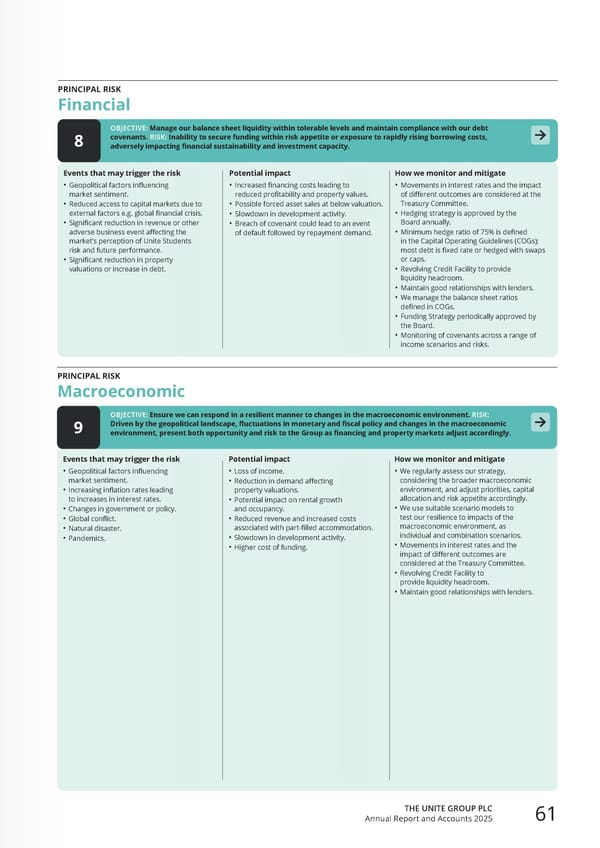
Events that may trigger the risk • Geopolitical factors influencing market sentiment. • Reduced access to capital markets due to external factors e.g. global financial crisis. • Significant reduction in revenue or other adverse business event affecting the market’s perception of Unite Students risk and future performance. • Significant reduction in property valuations or increase in debt. Potential impact • Increased financing costs leading to reduced profitability and property values. • Possible forced asset sales at below valuation. • Slowdown in development activity. • Breach of covenant could lead to an event of default followed by repayment demand. How we monitor and mitigate • Movements in interest rates and the impact of different outcomes are considered at the Treasury Committee. • Hedging strategy is approved by the Board annually. • Minimum hedge ratio of 75% is defined in the Capital Operating Guidelines (COGs); most debt is fixed rate or hedged with swaps or caps. • Revolving Credit Facility to provide liquidity headroom. • Maintain good relationships with lenders. • We manage the balance sheet ratios defined in COGs. • Funding Strategy periodically approved by the Board. • Monitoring of covenants across a range of income scenarios and risks. 8 OBJECTIVE: Manage our balance sheet liquidity within tolerable levels and maintain compliance with our debt covenants. RISK: Inability to secure funding within risk appetite or exposure to rapidly rising borrowing costs, adversely impacting financial sustainability and investment capacity. PRINCIPAL RISK Financial Events that may trigger the risk • Geopolitical factors influencing market sentiment. • Increasing inflation rates leading to increases in interest rates. • Changes in government or policy. • Global conflict. • Natural disaster. • Pandemics. Potential impact • Loss of income. • Reduction in demand affecting property valuations. • Potential impact on rental growth and occupancy. • Reduced revenue and increased costs associated with part-filled accommodation. • Slowdown in development activity. • Higher cost of funding. How we monitor and mitigate • We regularly assess our strategy, considering the broader macroeconomic environment, and adjust priorities, capital allocation and risk appetite accordingly. • We use suitable scenario models to test our resilience to impacts of the macroeconomic environment, as individual and combination scenarios. • Movements in interest rates and the impact of different outcomes are considered at the Treasury Committee. • Revolving Credit Facility to provide liquidity headroom. • Maintain good relationships with lenders. OBJECTIVE: Ensure we can respond in a resilient manner to changes in the macroeconomic environment. RISK: Driven by the geopolitical landscape, fluctuations in monetary and fiscal policy and changes in the macroeconomic environment, present both opportunity and risk to the Group as financing and property markets adjust accordingly. PRINCIPAL RISK Macroeconomic 8 9 THE UNITE GROUP PLC Annual Report and Accounts 2025 61
 Home for Success: Unite Students Annual Report 2025 Page 62 Page 64