
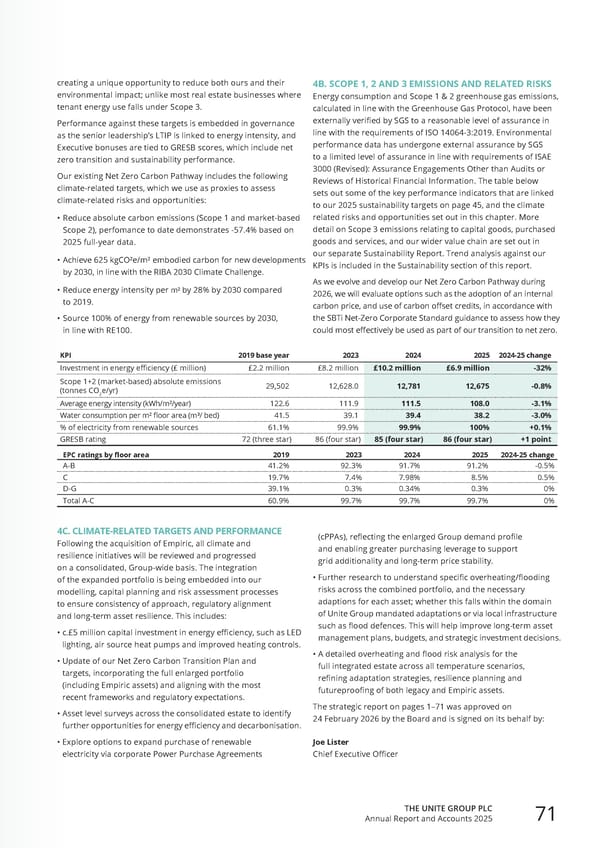
KPI 2019 base year 2023 2024 2025 2024-25 change Investment in energy efficiency (£ million) £2.2 million £8.2 million £10.2 million £6.9 million -32% Scope 1+2 (market-based) absolute emissions (tonnes CO 2 e/yr) 29,502 12,628.0 12,781 12,675 -0.8% Average energy intensity (kWh/m²/year) 122.6 111.9 111.5 108.0 -3.1% Water consumption per m² floor area (m³/ bed) 41.5 39.1 39.4 38.2 -3.0% % of electricity from renewable sources 61.1% 99.9% 99.9% 100% +0.1% GRESB rating 72 (three star) 86 (four star) 85 (four star) 86 (four star) +1 point EPC ratings by floor area 2019 2023 2024 2025 2024-25 change A-B 41.2% 92.3% 91.7% 91.2% -0.5% C 19.7% 7.4% 7.98% 8.5% 0.5% D-G 39.1% 0.3% 0.34% 0.3% 0% Total A-C 60.9% 99.7% 99.7% 99.7% 0% creating a unique opportunity to reduce both ours and their environmental impact; unlike most real estate businesses where tenant energy use falls under Scope 3. Performance against these targets is embedded in governance as the senior leadership’s LTIP is linked to energy intensity, and Executive bonuses are tied to GRESB scores, which include net zero transition and sustainability performance. Our existing Net Zero Carbon Pathway includes the following climate-related targets, which we use as proxies to assess climate-related risks and opportunities: • Reduce absolute carbon emissions (Scope 1 and market-based Scope 2), perfomance to date demonstrates -57.4% based on 2025 full-year data. • Achieve 625 kgCO²e/m² embodied carbon for new developments by 2030, in line with the RIBA 2030 Climate Challenge. • Reduce energy intensity per m² by 28% by 2030 compared to 2019. • Source 100% of energy from renewable sources by 2030, in line with RE100. 4B. SCOPE 1, 2 AND 3 EMISSIONS AND RELATED RISKS Energy consumption and Scope 1 & 2 greenhouse gas emissions, calculated in line with the Greenhouse Gas Protocol, have been externally verified by SGS to a reasonable level of assurance in line with the requirements of ISO 14064-3:2019. Environmental performance data has undergone external assurance by SGS to a limited level of assurance in line with requirements of ISAE 3000 (Revised): Assurance Engagements Other than Audits or Reviews of Historical Financial Information. The table below sets out some of the key performance indicators that are linked to our 2025 sustainability targets on page 45, and the climate related risks and opportunities set out in this chapter. More detail on Scope 3 emissions relating to capital goods, purchased goods and services, and our wider value chain are set out in our separate Sustainability Report. Trend analysis against our KPIs is included in the Sustainability section of this report. As we evolve and develop our Net Zero Carbon Pathway during 2026, we will evaluate options such as the adoption of an internal carbon price, and use of carbon offset credits, in accordance with the SBTi Net-Zero Corporate Standard guidance to assess how they could most effectively be used as part of our transition to net zero. 4C. CLIMATE-RELATED TARGETS AND PERFORMANCE Following the acquisition of Empiric, all climate and resilience initiatives will be reviewed and progressed on a consolidated, Group-wide basis. The integration of the expanded portfolio is being embedded into our modelling, capital planning and risk assessment processes to ensure consistency of approach, regulatory alignment and long-term asset resilience. This includes: • c.£5 million capital investment in energy efficiency, such as LED lighting, air source heat pumps and improved heating controls. • Update of our Net Zero Carbon Transition Plan and targets, incorporating the full enlarged portfolio (including Empiric assets) and aligning with the most recent frameworks and regulatory expectations. • Asset level surveys across the consolidated estate to identify further opportunities for energy efficiency and decarbonisation. • Explore options to expand purchase of renewable electricity via corporate Power Purchase Agreements (cPPAs), reflecting the enlarged Group demand profile and enabling greater purchasing leverage to support grid additionality and long-term price stability. • Further research to understand specific overheating/flooding risks across the combined portfolio, and the necessary adaptions for each asset; whether this falls within the domain of Unite Group mandated adaptations or via local infrastructure such as flood defences. This will help improve long-term asset management plans, budgets, and strategic investment decisions. • A detailed overheating and flood risk analysis for the full integrated estate across all temperature scenarios, refining adaptation strategies, resilience planning and futureproofing of both legacy and Empiric assets. The strategic report on pages 1–71 was approved on 24 February 2026 by the Board and is signed on its behalf by: Joe Lister Chief Executive Officer THE UNITE GROUP PLC Annual Report and Accounts 2025 71
 Home for Success: Unite Students Annual Report 2025 Page 72 Page 74