
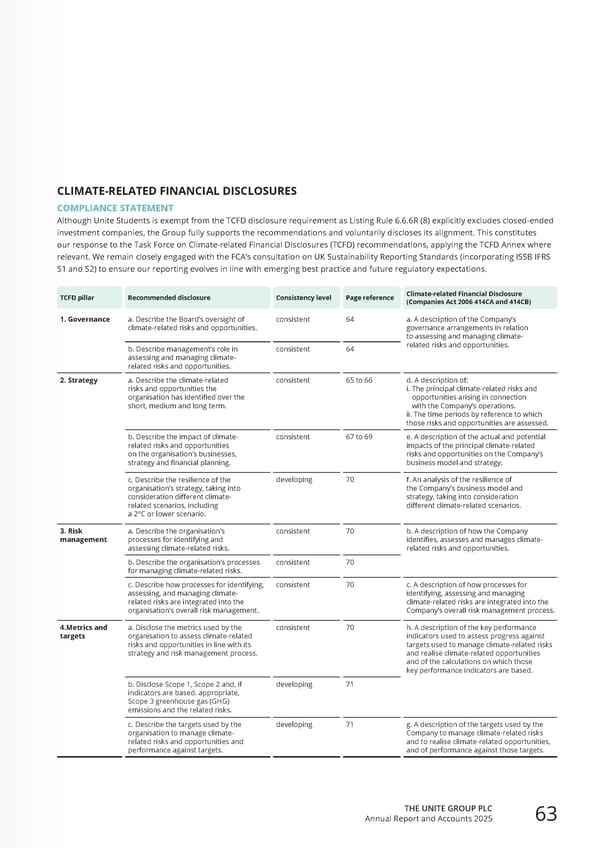
CLIMATE-RELATED FINANCIAL DISCLOSURES COMPLIANCE STATEMENT Although Unite Students is exempt from the TCFD disclosure requirement as Listing Rule 6.6.6R (8) explicitly excludes closed-ended investment companies, the Group fully supports the recommendations and voluntarily discloses its alignment. This constitutes our response to the Task Force on Climate-related Financial Disclosures (TCFD) recommendations, applying the TCFD Annex where relevant. We remain closely engaged with the FCA’s consultation on UK Sustainability Reporting Standards (incorporating ISSB IFRS S1 and S2) to ensure our reporting evolves in line with emerging best practice and future regulatory expectations. TCFD pillar Recommended disclosure Consistency level Page reference Climate-related Financial Disclosure (Companies Act 2006 414CA and 414CB) 1. Governance a. Describe the Board’s oversight of climate-related risks and opportunities. consistent 64 a. A description of the Company’s governance arrangements in relation to assessing and managing climate- related risks and opportunities. b. Describe management’s role in assessing and managing climate- related risks and opportunities. consistent 64 2. Strategy a. Describe the climate-related risks and opportunities the organisation has identified over the short, medium and long term. consistent 65 to 66 d. A description of: i. The principal climate-related risks and opportunities arising in connection with the Company’s operations. ii. The time periods by reference to which those risks and opportunities are assessed. b. Describe the impact of climate- related risks and opportunities on the organisation’s businesses, strategy and financial planning. consistent 67 to 69 e. A description of the actual and potential impacts of the principal climate-related risks and opportunities on the Company’s business model and strategy. c. Describe the resilience of the organisation’s strategy, taking into consideration different climate- related scenarios, including a 2°C or lower scenario. developing 70 f. An analysis of the resilience of the Company’s business model and strategy, taking into consideration different climate-related scenarios. 3. Risk management a. Describe the organisation’s processes for identifying and assessing climate-related risks. consistent 70 b. A description of how the Company identifies, assesses and manages climate- related risks and opportunities. b. Describe the organisation’s processes for managing climate-related risks. consistent 70 c. Describe how processes for identifying, assessing, and managing climate- related risks are integrated into the organisation’s overall risk management. consistent 70 c. A description of how processes for identifying, assessing and managing climate-related risks are integrated into the Company’s overall risk management process. 4.Metrics and targets a. Disclose the metrics used by the organisation to assess climate-related risks and opportunities in line with its strategy and risk management process. consistent 70 h. A description of the key performance indicators used to assess progress against targets used to manage climate-related risks and realise climate-related opportunities and of the calculations on which those key performance indicators are based. b. Disclose Scope 1, Scope 2 and, if indicators are based. appropriate, Scope 3 greenhouse gas (GHG) emissions and the related risks. developing 71 c. Describe the targets used by the organisation to manage climate- related risks and opportunities and performance against targets. developing 71 g. A description of the targets used by the Company to manage climate-related risks and to realise climate-related opportunities, and of performance against those targets. THE UNITE GROUP PLC Annual Report and Accounts 2025 63
 Home for Success: Unite Students Annual Report 2025 Page 64 Page 66