
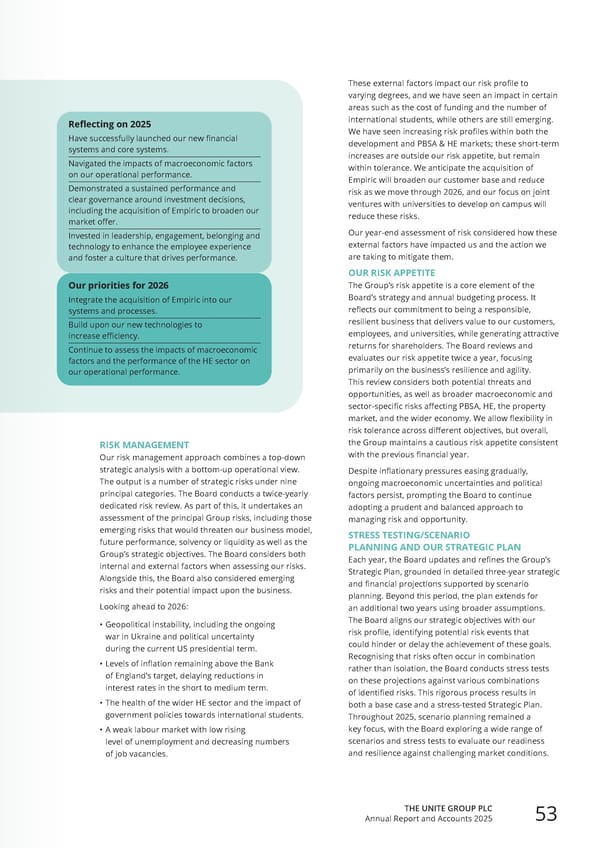
These external factors impact our risk profile to varying degrees, and we have seen an impact in certain areas such as the cost of funding and the number of international students, while others are still emerging. We have seen increasing risk profiles within both the development and PBSA & HE markets; these short-term increases are outside our risk appetite, but remain within tolerance. We anticipate the acquisition of Empiric will broaden our customer base and reduce risk as we move through 2026, and our focus on joint ventures with universities to develop on campus will reduce these risks. Our year-end assessment of risk considered how these external factors have impacted us and the action we are taking to mitigate them. OUR RISK APPETITE The Group’s risk appetite is a core element of the Board’s strategy and annual budgeting process. It reflects our commitment to being a responsible, resilient business that delivers value to our customers, employees, and universities, while generating attractive returns for shareholders. The Board reviews and evaluates our risk appetite twice a year, focusing primarily on the business’s resilience and agility. This review considers both potential threats and opportunities, as well as broader macroeconomic and sector-specific risks affecting PBSA, HE, the property market, and the wider economy. We allow flexibility in risk tolerance across different objectives, but overall, the Group maintains a cautious risk appetite consistent with the previous financial year. Despite inflationary pressures easing gradually, ongoing macroeconomic uncertainties and political factors persist, prompting the Board to continue adopting a prudent and balanced approach to managing risk and opportunity. STRESS TESTING/SCENARIO PLANNING AND OUR STRATEGIC PLAN Each year, the Board updates and refines the Group’s Strategic Plan, grounded in detailed three-year strategic and financial projections supported by scenario planning. Beyond this period, the plan extends for an additional two years using broader assumptions. The Board aligns our strategic objectives with our risk profile, identifying potential risk events that could hinder or delay the achievement of these goals. Recognising that risks often occur in combination rather than isolation, the Board conducts stress tests on these projections against various combinations of identified risks. This rigorous process results in both a base case and a stress-tested Strategic Plan. Throughout 2025, scenario planning remained a key focus, with the Board exploring a wide range of scenarios and stress tests to evaluate our readiness and resilience against challenging market conditions. RISK MANAGEMENT Our risk management approach combines a top-down strategic analysis with a bottom-up operational view. The output is a number of strategic risks under nine principal categories. The Board conducts a twice-yearly dedicated risk review. As part of this, it undertakes an assessment of the principal Group risks, including those emerging risks that would threaten our business model, future performance, solvency or liquidity as well as the Group’s strategic objectives. The Board considers both internal and external factors when assessing our risks. Alongside this, the Board also considered emerging risks and their potential impact upon the business. Looking ahead to 2026: • Geopolitical instability, including the ongoing war in Ukraine and political uncertainty during the current US presidential term. • Levels of inflation remaining above the Bank of England’s target, delaying reductions in interest rates in the short to medium term. • The health of the wider HE sector and the impact of government policies towards international students. • A weak labour market with low rising level of unemployment and decreasing numbers of job vacancies. Reflecting on 2025 Have successfully launched our new financial systems and core systems. Navigated the impacts of macroeconomic factors on our operational performance. Demonstrated a sustained performance and clear governance around investment decisions, including the acquisition of Empiric to broaden our market offer. Invested in leadership, engagement, belonging and technology to enhance the employee experience and foster a culture that drives performance. Our priorities for 2026 Integrate the acquisition of Empiric into our systems and processes. Build upon our new technologies to increase efficiency. Continue to assess the impacts of macroeconomic factors and the performance of the HE sector on our operational performance. THE UNITE GROUP PLC Annual Report and Accounts 2025 53
 Home for Success: Unite Students Annual Report 2025 Page 54 Page 56