
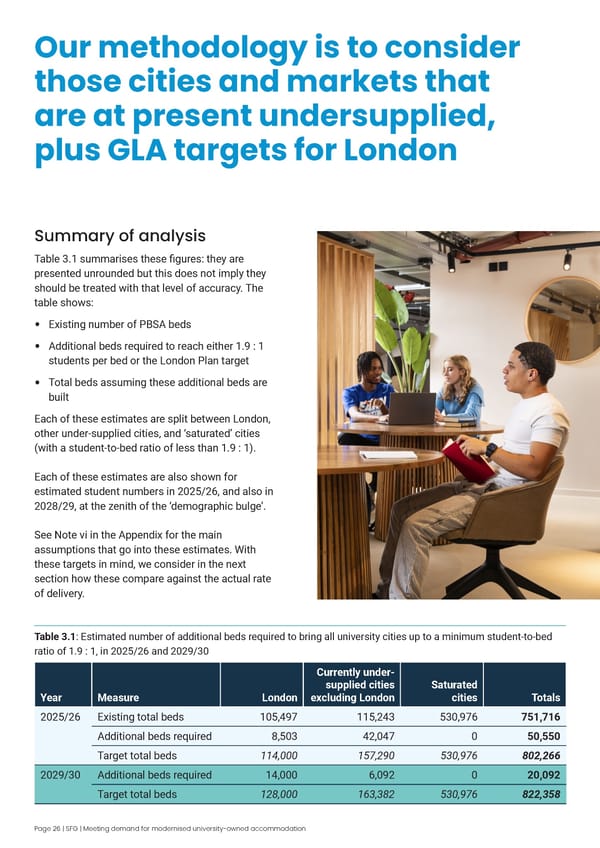
Our methodology is to consider those cities and markets that are at present undersupplied, plus GLA targets for London Summary of analysis Table 3.1 summarises these figures: they are presented unrounded but this does not imply they should be treated with that level of accuracy. The table shows: • Existing number of PBSA beds • Additional beds required to reach either 1.9 : 1 students per bed or the London Plan target • Total beds assuming these additional beds are built Each of these estimates are split between London, other under-supplied cities, and ‘saturated’ cities (with a student-to-bed ratio of less than 1.9 : 1). Each of these estimates are also shown for estimated student numbers in 2025/26, and also in 2028/29, at the zenith of the ‘demographic bulge’. See Note vi in the Appendix for the main assumptions that go into these estimates. With these targets in mind, we consider in the next section how these compare against the actual rate of delivery. Table 3.1 : Estimated number of additional beds required to bring all university cities up to a minimum student-to-bed ratio of 1.9 : 1, in 2025/26 and 2029/30 Year Measure London Currently under- supplied cities excluding London Saturated cities Totals 2025/26 Existing total beds 105,497 115,243 530,976 751,716 Additional beds required 8,503 42,047 0 50,550 Target total beds 114,000 157,290 530,976 802,266 2029/30 Additional beds required 14,000 6,092 0 20,092 Target total beds 128,000 163,382 530,976 822,358 Page 26 | SFG | Meeting demand for modernised university-owned accommodation
 Meeting demand for modernised university accommodation Page 27 Page 29