
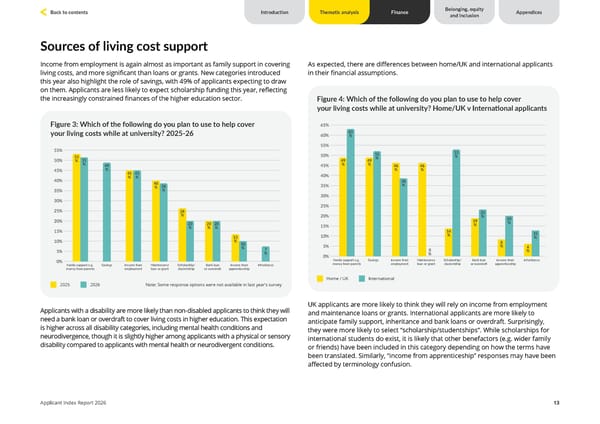
13 Income from employment is again almost as important as family support in covering living costs, and more significant than loans or grants. New categories introduced this year also highlight the role of savings, with 49% of applicants expecting to draw on them. Applicants are less likely to expect scholarship funding this year, reflecting the increasingly constrained finances of the higher education sector. Appendices Introduction Finance Thematic analysis Applicant Index Report 2026 Figure 3: Which of the following do you plan to use to help cover your living costs while at university? 2025-26 2025 2026 0% 25% 30% 35% 40% Family support e.g. money from parents Savings Income from employment Maintenance loan or grant 15% 10% 5% 20% Scholarship/ studentship Bank loan or overdraft 45% 55% Income from apprenticeship 50% Inheritance 53 % 51 % 49 % 45 % 45 % 40 % 38 % 26 % 20 % 13 % 10 % 7 % 20 % 20 % Sources of living cost support As expected, there are differences between home/UK and international applicants in their financial assumptions. Figure 4: Which of the following do you plan to use to help cover your living costs while at university? Home/UK v International applicants Home / UK International 0% 25% 30% 35% 40% Family support e.g. money from parents Savings Income from employment Maintenance loan or grant 15% 10% 5% 20% Scholarship/ studentship Bank loan or overdraft 45% 55% 65% Income from apprenticeship 60% 50% Inheritance 49 % 63 % 49 % 52 % 46 % 38 % 46 % 0 % 14 % 53 % 19 % 23 % 8 % 20 % 6 % 13 % UK applicants are more likely to think they will rely on income from employment and maintenance loans or grants. International applicants are more likely to anticipate family support, inheritance and bank loans or overdraft. Surprisingly, they were more likely to select “scholarship/studentships”. While scholarships for international students do exist, it is likely that other benefactors (e.g. wider family or friends) have been included in this category depending on how the terms have been translated. Similarly, “income from apprenticeship” responses may have been affected by terminology confusion. Belonging, equity and inclusion Applicants with a disability are more likely than non ‑ disabled applicants to think they will need a bank loan or overdraft to cover living costs in higher education. This expectation is higher across all disability categories, including mental health conditions and neurodivergence, though it is slightly higher among applicants with a physical or sensory disability compared to applicants with mental health or neurodivergent conditions. Back to contents Note: Some response options were not available in last year’s survey
 Unite Students Applicant Index 2026 Page 12 Page 14