
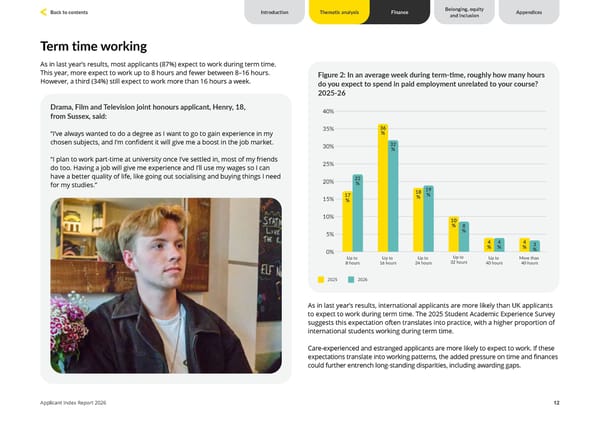
12 As in last year’s results, most applicants (87%) expect to work during term time. This year, more expect to work up to 8 hours and fewer between 8–16 hours. However, a third (34%) still expect to work more than 16 hours a week. Term time working Appendices Introduction Finance Thematic analysis Applicant Index Report 2026 Figure 2: In an average week during term-time, roughly how many hours do you expect to spend in paid employment unrelated to your course? 2025-26 2025 2026 0% 5% 10% 15% 20% 25% 30% 35% 40% Up to 8 hours 17 % 22 % Up to 16 hours 36 % 32 % Up to 24 hours 18 % 19 % Up to 32 hours 10 % 8 % Up to 40 hours 4 % 4 % More than 40 hours 4 % 3 % Drama, Film and Television joint honours applicant, Henry, 18, from Sussex, said: “I’ve always wanted to do a degree as I want to go to gain experience in my chosen subjects, and I’m confident it will give me a boost in the job market. “I plan to work part ‑ time at university once I’ve settled in, most of my friends do too. Having a job will give me experience and I’ll use my wages so I can have a better quality of life, like going out socialising and buying things I need for my studies.” As in last year’s results, international applicants are more likely than UK applicants to expect to work during term time. The 2025 Student Academic Experience Survey suggests this expectation often translates into practice, with a higher proportion of international students working during term time. Care‑experienced and estranged applicants are more likely to expect to work. If these expectations translate into working patterns, the added pressure on time and finances could further entrench long‑standing disparities, including awarding gaps. Belonging, equity and inclusion Back to contents
 Unite Students Applicant Index 2026 Page 11 Page 13