
Up to US: The Unite Group Sustainability Report 2025
This report by Unite Students focuses on sustainability initiatives and corporate responsibility for the year 2025.
THE UNITE GROUP PLC Sustainability Report 2025
Approach Foreword by Joe Lister, CEO 3 Our approach to sustainability 4 An approach shaped 5 by stakeholders 2025 highlights 6 Progress Young people 8 Local communities 10 The environment 15 Our colleagues 22 Governance 27 Social impact 28 Looking forward 29 Appendices 30 THE UNITE GROUP PLC | Sustainability Report 2025 2 Up to US This report provides insight into our approach to sustainability and our ambition to make a positive impact for young people, communities, the environment and our colleagues. Annual Report INTRODUCTION YOUNG PEOPLE COMMUNITIES OUR COLLEAGUES THE ENVIRONMENT APPENDICES LOOKING FORWARD
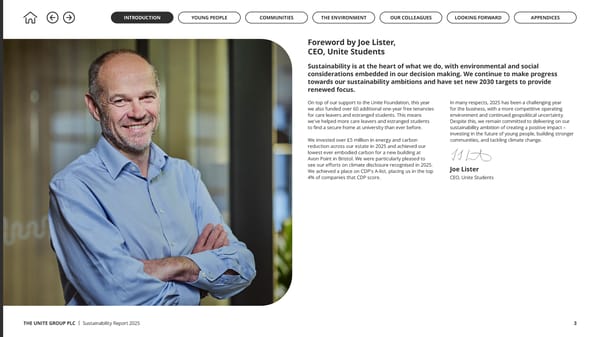
THE UNITE GROUP PLC | Sustainability Report 2025 3 Foreword by Joe Lister, CEO, Unite Students Sustainability is at the heart of what we do, with environmental and social considerations embedded in our decision making. We continue to make progress towards our sustainability ambitions and have set new 2030 targets to provide renewed focus. On top of our support to the Unite Foundation, this year we also funded over 60 additional one-year free tenancies for care leavers and estranged students. This means we've helped more care leavers and estranged students to find a secure home at university than ever before. We invested over £5 million in energy and carbon reduction across our estate in 2025 and achieved our lowest ever embodied carbon for a new building at Avon Point in Bristol. We were particularly pleased to see our efforts on climate disclosure recognised in 2025. We achieved a place on CDP's A-list, placing us in the top 4% of companies that CDP score. In many respects, 2025 has been a challenging year for the business, with a more competitive operating environment and continued geopolitical uncertainty. Despite this, we remain committed to delivering on our sustainability ambition of creating a positive impact – investing in the future of young people, building stronger communities, and tackling climate change. Joe Lister CEO, Unite Students INTRODUCTION YOUNG PEOPLE COMMUNITIES OUR COLLEAGUES THE ENVIRONMENT APPENDICES LOOKING FORWARD
This is a modal window.
THE UNITE GROUP PLC | Sustainability Report 2025 4 Our approach to sustainability For more than a decade, we’ve been focusing on creating a Home for Success and that purpose remains as important today as ever. Our strategic business objectives can only be achieved if we maintain focus on sustainability. Our investors expect us to manage and adapt to the environmental and social issues that pose a significant risk or opportunity, whether it is our commitment to climate transition and energy efficiency, reporting and disclosure, or compliance and fire safety. Access to the finance and investment we need to grow and succeed depends on managing sustainability issues. An environment where colleagues can be themselves, are valued and supported to grow, with a diverse range of people that reflect the communities we work in. This means listening to our colleagues and providing them with the tools, training and opportunities to do their best work, and recognise performance and create an workplace where people really belong. A sustainable place to live, somewhere our residents can call home that helps them to reduce their environmental impact and form lasting responsible living habits. This means investing in our properties to reduce energy and water consumption, improve waste and recycling and cut carbon emissions, while also supporting their wellbeing and providing an environment where they can succeed. INTRODUCTION YOUNG PEOPLE COMMUNITIES OUR COLLEAGUES THE ENVIRONMENT APPENDICES LOOKING FORWARD
THE UNITE GROUP PLC | Sustainability Report 2025 5 Our sustainability framework We’ve updated our sustainability framework, calling it Up to US, to help provide focus and clarity on our ambitions and helps colleagues across our entire business to see how we can contribute to create a positive impact for young people, communities, the environment and our colleagues. FOCUS AREA 1. Helping our residents thrive at university 2. Championing inclusion and success for disadvantaged student groups 3. Providing early career enhancement and development opportunities FOCUS AREA 1. Contributing to local communities 2. Impactful volunteering and charity partnerships 3. Supply chain social impacts FOCUS AREA 1. Transitioning to net zero carbon operations and developments 2. Cutting energy, water, resource use and waste 3. Working with suppliers to reduce supply chain impact FOCUS AREA 1. A diverse, future-ready workforce that’s clear on purpose 2. Support and growth opportunities that are right 3. A values-led culture shaped by our people, where every voice matters THE ENVIRONMENT Achieve Platinum in Investor in People Gold Award achieved 2030 2025 £3.05 million £15 million invested in supporting young people by 2030 2030 2025 3,894 hours 15,000 hours volunteered to support good causes in our local communities 2030 2025 6.5% 10% cut in operational energy consumption by 2030 2030 2025 Championing inclusion, wellbeing and success for those in Higher Education. Making a real contribution where we operate. Tackling climate change and reducing our environmental impact. Creating a diverse and inclusive workplace where people feel valued, supported and empowered to grow, knowing they belong. OUR COLLEAGUES COMMUNITIES YOUNG PEOPLE INTRODUCTION YOUNG PEOPLE COMMUNITIES OUR COLLEAGUES THE ENVIRONMENT APPENDICES LOOKING FORWARD
Over the past five years, we have continued to listen and learn through open engagement and honest conversations to ensure our approach to sustainability remains fresh and relevant. THE UNITE GROUP PLC | Sustainability Report 2025 6 An approach shaped by stakeholders Our approach to sustainability is shaped by the voices which matter most, our stakeholders – our residents, university partners, colleagues, investors, supply chain partners, and national and local government. Our first detailed sustainability materiality assessment was completed in 2020, as detailed on page 3 of our 2023 Sustainability Report: This is an exercise we are in the process of repeating in readiness for the forthcoming UK Sustainability Reporting Standards S1 and S2. Over the past five years, we have continued to listen and learn through open engagement and honest conversations to ensure our approach to sustainability remains fresh and relevant. We’re operating in a world that’s constantly changing - macroeconomic turbulence, shifting political priorities, and new regulations. This makes it more important than ever to maintain focus on sustainability. We are evolving our approach to meet emerging sustainability reporting requirements; managing increasing exposure to climate- related risk which influences asset values and liquidity; showing university partners and local authorities we are serious about net zero and social sustainability, and creating a business which our current and future colleagues are proud to work for, because we take these responsibilities seriously. These insights remind us why sustainability is at the heart of our ambition, our strategy, and the way we do business. We’re committed to listening, learning, and leading – so we can create positive change for young people, local communities, our colleagues and the environment. 2023 Sustainability Report INTRODUCTION YOUNG PEOPLE COMMUNITIES OUR COLLEAGUES THE ENVIRONMENT APPENDICES LOOKING FORWARD
THE UNITE GROUP PLC | Sustainability Report 2025 7 2025 highlights Care Leaver Covenant first PBSA to sign this Government-backed initiative. Guarantor trial so care-experienced young people can apply for accommodation without a guarantor. 60 extra free tenancies for care experienced and estranged young people for a year. 120 Resident Ambassadors across our accommodation. 36% employee volunteering to make a positive impact in local communities. 73 charities and good causes supported across the country. Community partnerships renewed long-term leases with two key partners in London. New corporate power purchase agreement zero carbon energy for 5 years. New recycling facilities rolled out across all properties. Operational energy intensity reduced by 3.1% per square metre. Highest ever employee engagement scored 75, up from 74 in 2024. More women in leadership & management up by 0.4% to 39.1%. Belonging score of 75, up from 74 in 2024. YOUNG PEOPLE COMMUNITIES THE ENVIRONMENT OUR COLLEAGUES Key achievements in 2025 Signed Care Leaver Covenant Achieved CPD’s A-list rating Retained Real Living Wage accreditation Retained IIP Gold INTRODUCTION YOUNG PEOPLE COMMUNITIES OUR COLLEAGUES THE ENVIRONMENT APPENDICES LOOKING FORWARD
THE UNITE GROUP PLC | Sustainability Report 2025 8 Championing inclusion, wellbeing and success for young people in higher education. Flagship target: By 2030, £15 million invested in supporting young people Young people £3.05 £15m 2030 2025 INTRODUCTION YOUNG PEOPLE COMMUNITIES THE ENVIRONMENT APPENDICES LOOKING FORWARD OUR COLLEAGUES
THE UNITE GROUP PLC | Sustainability Report 2025 9 Young people We’re committed to championing inclusion, wellbeing and success for young people in higher education. We want students to consider us as a place they call home, rather than just an accommodation provider. To help achieve this, we focus on three key areas: • Helping our residents thrive at university, as they transition to independent living. • Championing inclusion and success for disadvantaged student groups, throughout their higher education experience and beyond, through our research and action which improves access, participation and inclusion, with a special focus on supporting care leavers. • Providing early career enhancement and development opportunities, through high quality student internships and industrial placements and our sector-leading Resident Ambassador programme. Underpinning these is an ambition to invest £15 million by 2030 in supporting young people, including: • Donations to the Unite Foundation. • Equivalent value of the donations we make in kind (e.g. free accommodation, summer programmes, free/peppercorn rents to tenant organisations using our buildings). • Costs of our resident wellbeing provision to support health and wellbeing during the year, including central resident experience team overheads, training and programmes delivered in year. Our key ambitions and targets Ambition 2023 2024 2025 Actual Progress Maintain support to the Unite Foundation £1.8 million 1.9 million £1.9 million On track 100% of properties to have Resident Ambassadors 85% 91% 94% +3% INTRODUCTION YOUNG PEOPLE COMMUNITIES OUR COLLEAGUES THE ENVIRONMENT APPENDICES LOOKING FORWARD
THE UNITE GROUP PLC | Sustainability Report 2025 10 Young people Helping our residents thrive at university University is more than just a place to study. For many young people it is where they transition to independent living, make lifelong friends and build skills for life. We’re passionate about providing accommodation where our residents can grow within an inclusive community and where help is on hand when they need it. Our Support to Stay framework is a structured, holistic approach to wellbeing and conduct, designed to help our teams spot challenges early and provide the right support, at the right time, in coordination with our university partners. This year, we’ve improved this support by building these processes into our case management system, so colleagues can easily identify students at risk and intervene quickly. Alongside this, our Prepare to Stay initiative and Quick Start Guides help students feel confident and supported. These resources sit alongside our Community Living Guides and tailored pre-arrival support for those with additional needs. This year, we launched our Key Moments campaign, to help students develop good habits in: • Personal safety and wellbeing • Fire safety • Financial wellbeing • Recycling, using heating wisely, saving water and reducing energy use. We also believe supporting our employees to support students is just as important. So, we have enhanced our workshops and skills sessions using real-world scenarios. These are equipping colleagues with the tools and confidence to handle some of the most challenging conversation topics. University is more than just a place to study. For many young people it is where they transition to independent living, make lifelong friends and build skills for life. INTRODUCTION YOUNG PEOPLE COMMUNITIES OUR COLLEAGUES THE ENVIRONMENT APPENDICES LOOKING FORWARD
THE UNITE GROUP PLC | Sustainability Report 2025 11 Young people Championing inclusion and success for disadvantaged student groups With university partners, we provide structured support which starts even before students move in. Through our pre-arrival disclosure form, students share needs or concerns, from equipment requests and emotional support to animal companions and early arrivals. This is particularly valuable for neurodivergent students as it helps them transition smoothly into independent living. Through the Unite Foundation, the charity we founded in 2012, we are continuing to support care leavers and estranged students by providing a record number of free tenancies. To celebrate signing the Care Leaver Covenant in 2025, we have given 60 students free one- year tenancies during the 2025/26 academic year. This is in addition to the 70 students who received rent free accommodation for up to three years through the Unite Foundation accommodation scholarship. Each year we commission research and the insights from studies, such as Living Black at University or our research into neurodivergent student experiences, are woven into our events, welcome activities and Quick Start Guides. Our annual Applicant Index survey helps us understand the needs and expectations of each incoming cohort, so we can continuously evolve our offer. We actively share our work across the sector, collaborating to shape best practice and drive positive change. Providing early career enhancement and development opportunities Each year, young people gain work experience with us, developing many of the skills that matter to future employers. This approach also introduces talented young people into our organisation, helping us shape our business and inspire new initiatives. In 2025, we provided nine industrial placements and eight summer internships through the Interns Foundation. Our Resident Ambassador Programme also employs around 120 young people a year to organise social activities and foster connection, community and belonging in our accommodation. The ambassadors reflect the diversity of our residents and act as a trusted collective voice. We guarantee interviews for care-experienced and estranged students when recruiting to these roles to make sure such voices are heard and represented. Each year, young people gain work experience with us, developing many of the skills that matter to future employers. INTRODUCTION YOUNG PEOPLE COMMUNITIES OUR COLLEAGUES THE ENVIRONMENT APPENDICES LOOKING FORWARD
THE UNITE GROUP PLC | Sustainability Report 2025 12 Communities Making a real contribution to the communities we operate in. Flagship target: By 2030, 15,000 hours volunteered to support local communities 3,894 hrs 15k hrs 2030 2025 INTRODUCTION YOUNG PEOPLE COMMUNITIES THE ENVIRONMENT APPENDICES LOOKING FORWARD OUR COLLEAGUES
THE UNITE GROUP PLC | Sustainability Report 2025 13 Local communities Making a real contribution where we operate. To help achieve this we focus on three key areas: • Contributing to local communities, through local community projects and partnerships. • Delivering impactful employee volunteering and charity partnerships such as with the Unite Foundation. • Managing our supply chain social impacts, such as human rights, wellbeing and the Living Wage. Our key ambitions and targets Ambition 2023 2024 2025 Actual Progress All teams achieve a Positive Impact award of Bronze or higher 24% Bronze 52% Silver 24% Gold 0% Bronze 40% Silver 60% Gold 0% Bronze 23% Silver 77% Gold On target Participation in volunteering 22% 31% 36% +3% INTRODUCTION YOUNG PEOPLE COMMUNITIES OUR COLLEAGUES THE ENVIRONMENT APPENDICES LOOKING FORWARD
THE UNITE GROUP PLC | Sustainability Report 2025 14 Local communities Impactful volunteering, 15,000 hours target Since 2018, every employee has been given the chance to volunteer for a day a year. We are keen to encourage more to take part in our volunteering programme so have set a new target of 15,000 hours of volunteering by 2030. In our first year since setting this target, we’ve collectively volunteered 3,894 hours, which is a 36% participation rate. Community projects Our teams support 42 charities and community groups across the country with long-term, strategic community projects. Year on year, more colleagues choose to get involved through our Positive Impact awards programme. In 2025, a record number received Gold awards, recognising their support. Community spaces One of the most significant ways we create social impact is by dedicating spaces within our buildings for community use. All new developments, including those which opened in 2025, now incorporate spaces for use by local charities or community groups. This includes two projects which were recently completed – Avon Point in Bristol and Burnet Point in Edinburgh. Long-term leases have been renewed with two of our most successful community partnerships in London - the Mahadevi yoga therapy charity which works with children and adults with special needs, and Streets of Growth , a community organisation in Tower Hamlets. Fundraising and charity match Our charity match scheme boosts each employee’s fundraising by up to £250 a year. For donations above £100, we also give an extra £100 to the Unite Foundation. In 2025, we gave a total of £11,269 to 19 charities through match funding, including another £2,347 to the Unite Foundation, in addition to our ongoing support through the funding of accommodation scholarships. We also continued our partnership with the British Heart Foundation, making donations of clothes and homeware in 2025 worth £353,472 via donation points within our buildings. Supply chain social impacts We care about the social impact of our supply chain. Our Supplier Code sets out how we assess our suppliers and what we expect from them. In 2025, we introduced additional checks for all suppliers as part of both our onboarding and tender processes. This includes giving preference to suppliers signed up to the Living Wage Foundation. We take modern slavery seriously and actively look for signs of risk within our supply chain. Each supplier is vetted to assess their understanding and processes. In 2025, we launched a modern slavery training programme for our employees. Where we believe there could be greater risk, we delve deeper and put in place additional vetting and monitoring. For example, we do this over the summer period when we employ thousands of cleaners to prepare our properties for a new cohort of students. Case Study: Mentoring programme Our University Partnerships team has been working with the charity, Student Minds, to develop a mentoring programme, supporting Student Minds employees with professional skills through one-to-one mentoring. “I’ve learnt a lot from my mentor and having regular mentoring sessions has challenged me to think more regularly about areas I want to develop and acting on them” – Mentee After a successful first year of mentorship, the programme will be continuing in 2026. We are keen to encourage more employees to take part in our volunteering programme so have set a new target of 15,000 hours of volunteering by 2030. INTRODUCTION YOUNG PEOPLE COMMUNITIES OUR COLLEAGUES THE ENVIRONMENT APPENDICES LOOKING FORWARD
THE UNITE GROUP PLC | Sustainability Report 2025 15 The environment Tackling climate change and reducing our environmental impacts. Flagship target: By 2030, 10% cut in operational energy consumption 6.2% cut 10% cut 2030 2025 INTRODUCTION YOUNG PEOPLE COMMUNITIES THE ENVIRONMENT APPENDICES LOOKING FORWARD OUR COLLEAGUES
THE UNITE GROUP PLC | Sustainability Report 2025 16 The environment We are committed to tackling climate change and reducing our environmental impacts. We do this by focusing on the areas where we have the most significant opportunities to reduce damage to the environment, including: • Transitioning to net zero carbon operations and developments, including cutting energy use, decarbonising our energy supply and reducing supply chain emissions in line with SBTi validated carbon targets. • Cutting energy, water, resource use and waste across our operations. • Reducing supply chain environmental impacts through engagement, joint plans and product selection. Our key ambitions and targets Ambition 2023 2024 2025 Actual Progress 56% reduction in Scope 1 & 2 (market-based) emissions (tonnes CO 2 e), by 2030 vs. 2019 base year 57.2% 56.7% 57.0% On track 28% reduction in average operational energy intensity (kWh/m 2 ), by 2030, vs. 2019 base year 8.7% decrease 9.1% decrease 11.9% decrease Behind Achieve 625 kgCO 2 e/m 2 of total embodied carbon (A1-A5, B1-B5, C1-C4) for new developments by 2030, in line with RIBA 2030 climate challenge 801 694 768 & 603 On track Our energy performance targets are aligned with CRREM 1.5DegC pathway (V1) for multi-family residential accommodation. Our 2030 carbon reduction target is fully validated by the SBTi. We have committed to purchasing 100% renewable electricity under the RE100 scheme. INTRODUCTION YOUNG PEOPLE COMMUNITIES OUR COLLEAGUES THE ENVIRONMENT APPENDICES LOOKING FORWARD
Transitioning to net zero carbon Our efforts to tackle climate change have been recognised with a place on CDP’s coveted A-list. CDP is the world’s only independent environmental disclosure system and our A rating places us in the top 4% of around 25,000 companies that CDP score for levels of climate disclosure. Building on this success, we are working to update our Net Zero Carbon Pathway and extend our ambition beyond our current 2030 target in line with the latest frameworks and guidance on net zero carbon. Operations Our ambition to transition to net zero is set out in our Net Zero Carbon Pathway, which continued to guide our progress throughout 2025. Under our all-inclusive billing model, we are responsible for purchasing all electricity, gas and heat consumption in our buildings, including in tenant areas. This makes energy use in our buildings both a significant operating cost and major source of scope 1 and 2 emissions. Building on previous years’ experience, 2025 saw us invest £6.9 million in energy efficiency improvements including solar PV, heating controls and improved LED lighting, which are expected to deliver a c.2% reduction in annual consumption, saving c. £600k per year. This falls slightly short of our original investment target of £12m in a year, due to the increasing cost of finance and prioritisation of investment in other essential work including cladding remediation. Looking ahead, we will continue to focus our investment on the opportunities that will deliver the largest energy and carbon reductions. Over the last four years, we’ve purchased 175GWh of zero carbon energy direct from a windfarm in Scotland via our corporate power purchase agreement (cPPA) – that’s enough to power the average UK home for over 64,000 years, or drive an electric car 35,000 times around the world. As this arrangement came to an end in 2025, we’ve signed a new cPPA with a solar farm in the south of England, which is expected to provide around 30% of our annual electricity from late 2026 onwards. THE UNITE GROUP PLC | Sustainability Report 2025 17 The environment Building on previous years’ experience, 2025 saw us invest £6.9 million in energy efficiency improvements including solar PV, heating controls and improved LED lighting, which are expected to deliver a c.2% reduction in annual consumption, saving c. £600k per year. INTRODUCTION YOUNG PEOPLE COMMUNITIES OUR COLLEAGUES THE ENVIRONMENT APPENDICES LOOKING FORWARD
Development Construction activity is our largest source of Scope 3 emissions so remains a key area of focus. Recently completed schemes - Avon Point in Bristol and Burnet Point and Court in Edinburgh - have both pushed the boundaries of what we can achieve. Avon Point achieved upfront embodied carbon of 508kgCO 2 e/m 2 (A1-A5) based on an update to the Stage 4 LCA model using as-built information for key building materials. This is 12% lower than the current UK Net Zero Carbon Building Standard 2025 limit of 580kgCO 2 e/m 2 . Burnet achieved an even lower upfront embodied carbon of just 466kgCO 2 e/m 2 (A1-A5) against a target of 580kgCO 2 e/m 2 . This was accomplished through a combination of structural efficiencies, including the use of reclaimed steel piling which saved around 90% of the carbon compared to traditional piling, high levels of low carbon cement replacement, and low carbon timber and aluminium composite windows. This marked our first scheme to undergo a full as-built LCA, with only building services utilising benchmark data in lieu of a full TM65 assessment. This is something that Unite Students will be looking to implement again in future as we align with the UK NZCBS. As well as reduced embodied carbon, both Burnet and Avon Point have been designed and constructed to surpass the latest building regulations for energy performance. This means we have pushed building fabric performance and efficiencies of systems beyond any previous Unite Students development. As part of this, we have installed granular submetering, covering key building services and individual flats so that we can carry out detailed post occupancy evaluations to understand better than ever before how our buildings perform. THE UNITE GROUP PLC | Sustainability Report 2025 18 The environment Case study: Net Zero Carbon Buildings Standard Unite Students' development team and supply chain have supported the development of the UK Net Zero Carbon Buildings Standard (NZCBS) in 2025. Developed by the industry for the industry, the NZCBS will be a universal definition of net zero and will enable the construction industry to robustly prove that built assets align with the UK’s carbon and energy budgets. Two of our flagship projects, Hawthorne House (in construction) and Meridian Steps (detailed design), were submitted to the UK NZCBS pilot programme utilising the draft guidance. By testing the standard against the live projects, we were able to feedback to the development team on the applicability of the assessment in terms of data collection, performance levels and process. Not only did this support the development of the standard for the full version (to be released in early 2026) but also enabled us to gain greater understanding of the standard in preparation for future pipeline schemes. INTRODUCTION YOUNG PEOPLE COMMUNITIES OUR COLLEAGUES THE ENVIRONMENT APPENDICES LOOKING FORWARD
Cutting energy, water, resource use and waste Efficient heating Throughout 2025 our Operations, Central Estates and Sustainability teams have been focusing on improving day to day energy and water efficiency in our buildings. Leveraging the investment already made in Prefect IRUS smart networked heating controls, we’ve updated guidance, policy and student communications to encourage residents to use the in-built heating rather than leaving their own plug-in electric heaters running - each of which can use an extra £1,000 of energy and emit c.800kg of additional CO 2 e per year. Waste and recycling We’ve replaced multiple regional waste contractors with a single new national partner, bringing improved data and service, and a single simplified approach to recycling for all sites’ commercial waste and c.70% of sites’ student waste collections. As part of these improved arrangements, new recycling bins have been installed in every flat, with better signage and infrastructure such as central bin stores. These changes ensure compliance with UK Simpler Recycling Regulations, enhance the resident experience and are driving greater engagement. These improvements have simplified communication on recycling, particularly for overseas students unfamiliar with UK practices. This has helped deliver a 3.8 point increase in the Recycling and Environmental Facilities section of the Global Student Living Index, bringing us closer to our Platinum ambition. Like - for - like water consumption increased by 3.3% in 2025, despite our continued focus on reducing water waste, including by raising awareness with students of the importance of conserving water and reporting faults. A single faulty toilet cistern running continuously after flushing can waste up to 130,000 litres of water a year, and throughout 2025 we invested c.£1 million in repairing leaking toilets, taps and showers. While our teams identify and address issues during routine maintenance and inspections, early reporting from residents remains essential. We will continue to prioritise this through 2026, encouraging residents to report leaks promptly so we can take action sooner and make further progress in reducing water waste. THE UNITE GROUP PLC | Sustainability Report 2025 19 The environment Case study: Reuse stations This summer we launched a new Reuse Station initiative. Throughout check-out and Summer Support, our operations teams collected items residents left behind that could be put to good use by our new in-coming residents. During our six-week welcome period for new students in Autumn 2025, our Resident Ambassadors and Student Experience teams hosted over 40 in- property Reuse Station events, providing new residents with an opportunity to give preloved cookware, homeware, furniture and other essentials a second lease of life. Now a national initiative, properties such as this one in Durham have run reuse events for a number of years. We’ve replaced multiple regional waste contractors with a single new national partner, bringing improved data and service, and a single simplified approach to recycling for all sites’ commercial waste and c.70% of sites’ student waste collections. INTRODUCTION YOUNG PEOPLE COMMUNITIES OUR COLLEAGUES THE ENVIRONMENT APPENDICES LOOKING FORWARD
Reducing supply chain environmental impacts We have been working with our supply chain partners to better understand and reduce the environmental impacts of the products and services we procure. We have focused on Scope 3 products and services procured through our operations, particularly product categories and suppliers with the highest carbon impact. We are improving the information we use to inform procurement decisions aiming to move away from a single overall intensity-factor based calculation for Scope 3 emissions calculations. As a first step, we plan to use industry specific spend-based metrics linked to suppliers SIC (standard industrial classification of economic activities). Ultimately, we would like to obtain actual emissions data from our suppliers, either as a pro rata share of their total emissions based on spend, or based on a specific calculation of emissions for products or services provided. We have been evaluating tools to help us improve Scope 3 reporting and reduction, as well as wider supply chain environmental and social performance. Alongside this work, we’ve continued to focus on opportunities to reduce supply chain environmental impacts, so that routine tenders and product selection consider the most relevant environmental impacts and opportunities. For example, we’ve worked with our furniture suppliers to build in supply chain circularity which will extend the useful life of products by introducing re-use, refurbishment and recycling. Other initiatives include a supplier take-back and recycling scheme on mattresses, so that any containing persistent organic pollutants (POPs) are segregated and disposed of via approved routes. By revising our paint specification to reduce VOCs and move to a bulk paint system, we have also reduced the waste of paint and paint cans. THE UNITE GROUP PLC | Sustainability Report 2025 20 The environment Case study: Supplier day In April we hosted our annual supplier day with more than 80 of our most important suppliers, where we explored our vision, strategy and sustainability ambitions. The day produced vital insight which is helping us find ways to reduce our supply chain environmental impact. INTRODUCTION YOUNG PEOPLE COMMUNITIES OUR COLLEAGUES THE ENVIRONMENT APPENDICES LOOKING FORWARD
Energy performance certificates Over the last few years, we’ve made great progress on improving EPC ratings via a combination of capital investment, operational management changes, and improvements to the data quality and accuracy of information used to calculate EPCs. As a result, we are fully compliant with current EPC Minimum Energy Efficiency Standards (MEES) of E or higher that took effect in 2023, and on track to meet future targets of a C from 2028 and B from 2030. 2025 EPC Ratings by floor area THE UNITE GROUP PLC | Sustainability Report 2025 21 The environment EPC Rating Number of assets % by floor area A 3 5.8% B 155 85.4% C 23 8.4% D 7 0.1% ESOS We have complied with the requirements of the Energy Saving Opportunity Scheme (ESOS) Phase 4 and have published our annual report via the Government’s MESOS online platform. INTRODUCTION YOUNG PEOPLE COMMUNITIES OUR COLLEAGUES THE ENVIRONMENT APPENDICES LOOKING FORWARD "We were particularly pleased to see our efforts on climate disclosure recognised in 2025. We achieved a place on CDP's A-list, placing us in the top 4% of companies that CDP score."
THE UNITE GROUP PLC | Sustainability Report 2025 22 Our colleagues A diverse and inclusive workplace where people feel valued, supported and empowered to grow – knowing they truly belong. Flagship target: By 2030, achieve Investor in People Platinum Gold Award achieved Investor in People Platinum 2030 2025 INTRODUCTION YOUNG PEOPLE COMMUNITIES THE ENVIRONMENT APPENDICES LOOKING FORWARD OUR COLLEAGUES
THE UNITE GROUP PLC | Sustainability Report 2025 23 Our colleagues We’re working to create a diverse and inclusive workplace where people feel valued, supported and empowered to grow – knowing they truly belong. To help achieve this we focus on three key areas: • Shaping a diverse, future-ready workforce that’s clear on purpose, powered by the right people, and driven by smart decisions. We call this being fit for the future. • Unlocking the full potential of our people by providing support, learning and development that’s right for who they are, the role they’re in and where they’re going. This will help us to unlock people’s potential. • Creating a values-led culture shaped by our people, where every voice matters and belonging isn’t just something we strive for, but it’s who we are. This is about evolving our culture. During 2025, we’ve evolved our ambition and updated the metrics we use to track progress in this area. For consistency, the table below shows both our metrics before and after this change. Some definitions have been updated (for example changes to the leadership populations considered for our gender and ethnicity targets) meaning pre and post 2025 metrics are not directly comparable. Our key ambitions and targets up to the end of 2025 Ambition 2023 2024 2025 Actual Progress 65% of leadership and management population hired internally 73% 81% 73% -8% 40% women in senior leadership by end of 2025 28% 37% 35% -2% 10% ethnic minority representation in management and senior leadership by end of 2025 8% 7% 9% +2% Our key ambitions and targets from 2025 onwards Ambition 2023 2024 2025 Actual Progress Employee engagement 70 74 75 +1 % Women in leadership and management n/a 38.7% 39.1% 0.4% % Ethnic minority in leadership and management n/a 5.0% 6.8% 1.8% How our people feel about their opportunities to grow and develop n/a 64 63 -1 Our belonging score 68 74 75 +1 Retention rate 79% 81% 77% -4 INTRODUCTION YOUNG PEOPLE COMMUNITIES OUR COLLEAGUES THE ENVIRONMENT APPENDICES LOOKING FORWARD
THE UNITE GROUP PLC | Sustainability Report 2025 24 Fit for the future This is about shaping a diverse, future-ready workforce that’s clear on purpose, powered by the right people and driven by smart decisions. When our colleagues feel they belong, we all thrive together, which is why we have put greater effort into building belonging and measuring the impact of this over the past three years. In 2025, we identified where and how belonging should look in our work and how it shapes the way we do things, so that outcomes truly reflect the needs of our people. We’ve also redefined what success should look like in terms of the representation of marginalised groups. By widening our definition of senior leadership to include senior managers, we’ve been able to understand where barriers still exist and track progress. This helps us create opportunities for everyone, ensuring our journey is inclusive and our ambitions are shared by all. Working towards IIP Platinum We’ve continued working towards Investors in People, Platinum accreditation, ahead of being re-assessed in 2026. This work includes the launch of: • Enhanced recognition and reward as part of our updated operational bonus scheme. • New values alongside a behavioural framework. • New manager essentials learning, supporting leaders to be their best. We continue to demonstrate we’re listening to and supporting our employees through the employee forum and networks, and by using our employee engagement survey to develop focus areas that are relevant to our people. Our colleagues Case study: Shaping outcomes for women The Unite Women’s Network has channelled energy into two key workstreams: women’s health and career opportunities. Panel conversations on topics such as fertility challenges, menopause and other menstrual health conditions have promoted greater awareness of the impact these conditions can have on wellbeing and inclusion. Network Chair, Lara Alfarisi said: “Creating spaces where women could openly share their experiences felt meaningful. Hearing people connect with those stories and feel seen reminded me why these conversations matter.” The network has also started to examine the barriers to career progression by studying data and learning from the lived experiences of network members. In 2026, focus will shift to find practical solutions so that progression is more visible and achievable. INTRODUCTION YOUNG PEOPLE COMMUNITIES OUR COLLEAGUES THE ENVIRONMENT APPENDICES LOOKING FORWARD
THE UNITE GROUP PLC | Sustainability Report 2025 25 Evolve our culture Creating a values-led culture shaped by our people, where every voice matters and belonging isn’t just something we strive for, but it’s who we are. We’re proud of the progress we’ve made in amplifying employee voice. Over the past two years, our employee engagement score has risen, reflecting a growing sense of connection and belonging. Around 480 colleagues are actively involved in one or more of our five employee networks, showing the strength of our communities and our shared appetite to shape our culture together. Every network now benefits from executive sponsorship, ensuring senior leaders are actively listening, supporting and championing each network. Following our Culture Audit in 2024, we shaped a new set of values, created with our people and reflecting who we are, what we celebrate, and where we want to grow. In 2025, we launched these and rolled them out via three missions: • Mission 1 sparked curiosity and excitement, building awareness across the business. • Mission 2 deepened our understanding of what our values mean and how we can live them everyday. • Mission 3 is now embedding our values through ongoing initiatives and recognition, such as our annual Stars Awards. Our colleagues Case study: Bringing new values to life To help bring our values to life we launched the Goldilocks Model, a simple way to show what’s ‘not enough’, ‘just right’ and ‘too much’. Jordan Lewis, Cardiff General Manager, said “The Cardiff team delivered a creative and engaging interpretation of the Goldilocks message, capturing the team’s attention and sparking genuine engagement. Through laughter and shared enjoyment, the message resonated far more effectively than a traditional video or slide deck, ensuring everyone clearly understood the purpose and intent behind the model.’ Values cupcakes in Manchester. INTRODUCTION YOUNG PEOPLE COMMUNITIES OUR COLLEAGUES THE ENVIRONMENT APPENDICES LOOKING FORWARD
THE UNITE GROUP PLC | Sustainability Report 2025 26 Unlock people’s potential Unlocking the full potential of our people by providing support, learning and development that’s right for who they are, the role they’re in and where they’re going. Since launching our Academy in 2022, we’ve made great strides in shaping a learning and development offer that helps our people grow, thrive and lead. In 2025 we added a new, key component to this with the launch of our brand-new Academy platform; a single, intuitive space to learn, grow, explore, and track progress. It’s home to everything from 1:1s and performance enablement conversations, to curated learning journeys. Through 2026 we’ll continue to build this out and help our teams unlock their full potential. Our colleagues INTRODUCTION YOUNG PEOPLE COMMUNITIES OUR COLLEAGUES THE ENVIRONMENT APPENDICES LOOKING FORWARD
THE UNITE GROUP PLC | Sustainability Report 2025 27 Good governance We have a clear and robust framework of governance covering all material aspects of our business activity that helps ensure long-term sustainability from an environmental, social and commercial perspective. Our policies and processes ensure we operate with integrity and transparency in line with our values. The Board is responsible for promoting the long-term sustainable success of Unite Students, with the Sustainability Committee specifically overseeing the implementation of our sustainability framework and performance against sustainability targets and ambitions – more details can be found in the Sustainability Committee report in our Annual Report, authored by Dame Shirley Pearce, who chairs our Sustainability Committee. Governance in review The stakeholder engagement section in our Annual Report details how the Board engaged with key stakeholders and measured their views, along with the outcomes of this engagement. At the time of publication, we were also finalising an updated materiality assessment to ensure our overall sustainability strategy remains focused on the most important issues. This is a ‘single materiality’ assessment in line with the requirements of UK SRS S1 and S2 rather than a full double materiality requirement that would be required were we subject to EU CSRD. We do nonetheless consider the non- financial impact of our operations, as exemplified by our sustainability ambition to make a positive impact across four key areas. As a FTSE 250 company listed on the London Stock Exchange, we are subject to the requirements of the UK Corporate Governance Code 2018 (the Code). You can read further details on how we have complied with the Code in our Annual Report. We are firmly opposed to slavery and are dedicated to understanding its risks and ensuring it does not occur within our business or supply chain. To reinforce this commitment, we updated our Supplier code and Modern Slavery Statement during the reporting period, strengthening the requirements we place on suppliers around minimum legal age of employment and compliance with local laws on working hours and overtime. It also aligns with our Real Living Wage policy, requiring suppliers to pay at least the minimum wage and encouraging them to adopt and adhere to Living Wage principles. You can view our Modern Slavery Statement and other policies on our website. Risks and opportunities Sustainability related risks and opportunities are managed via our Group’s risk management process and recorded on the Principal Risk Register. More details can be found in the Risk Management section of our 2025 Annual Report. Reporting and disclosure A summary of our environmental and social performance metrics can be found at Appendix 1, and Appendix 2, which contain our disclosure in line with the European Public Real Estate Association Sustainability Best Practice Reporting Guidelines (EPRA sBPR) and in 2024 we retained our Silver award under the EPRA sBPR. We disclose sustainability data to the Global Real Estate Sustainability Benchmark (GRESB) and retained our 4-star GRESB rating in 2025 for Standing Assets and Green Star designation and earning a 5-star rating for new developments. Our GRESB scorecard is available at: Our 2025 Annual Report and Accounts contains our mandatory energy consumption and greenhouse gas (GHG) emissions reporting in line with the Companies Act 2006 (Strategic Report and Directors’ Reports) Regulations 2013 and the Companies (Directors’ Report) and Limited Liability Partnerships (Energy and Carbon Report) Regulations 2018, and in accordance with the Streamlined Energy and Carbon Reporting (SECR). Our Annual Report and Accounts also contains our climate related risk statement in line with The Companies (Strategic Report) (Climate-related Financial Disclosure) Regulations 2022, the Department for Energy Security & Net Zero’s mandatory guidance and HM Treasury’s TCFD-aligned guidance, and the requirements of the Financial Conduct Authority’s UK Listing Rule 9.8.6(R)8(TCFD). We are outside of scope of EU CSRD reporting. We expect to comply with forthcoming UK Sustainability Reporting Standard S1 and S2 as and when required. Our Suppliers Our Modern Slavery Statement Policies and Documentation Annual Report and Accounts 2025 Dame Shirley Pearce chairs our Sustainability Committee INTRODUCTION YOUNG PEOPLE COMMUNITIES OUR COLLEAGUES THE ENVIRONMENT APPENDICES LOOKING FORWARD
THE UNITE GROUP PLC | Sustainability Report 2025 28 Social impact We have been working with the B4SI framework to strengthen how we understand, measure and communicate our social impact. In 2025, we have been improving the quality of our data and working on moving beyond describing activities and inputs, to better demonstrate outcomes and impacts. Using a structured framework throughout all community focused activity enables us to understand the impact of diverse activities, assess their effectiveness and demonstrate the value they create. The tables below summarise relevant metrics that aim to quantify the social impact achieved in year. The data is drawn predominantly from our Positive Impact programme, where teams initiate local community projects designed to make a tangible difference. By applying the B4SI framework, we gain valuable insight into the outcomes achieved for both the organisations we support, and the team members involved. For example participants reported significant improvements in job-related skills and positive change in behaviour/attitude as a direct result of community projects. Impacts on organisations 2024 2025 Improved existing or provide new services/products 20 21 Increased their profile 4 11 Spent more time with clients 8 10 Employ more staff/volunteers 11 12 Improved management systems 4 9 Impacts on employees 2024 2025 Improved job-related skills 76 162 Improved their personal wellbeing 180 127 Positive change in behaviour/attitude 128 198 Progress has been made in measuring the effects on both our employees and the organisations they support, highlighting opportunities to focus activities in areas that create meaningful impact. During 2026 we will evaluate how we report our social impact to ensure a balanced approach. Our goal is to accurately represent our commitment to supporting young people, local communities and our employees, while prioritising areas where we create the biggest impact. INTRODUCTION YOUNG PEOPLE COMMUNITIES OUR COLLEAGUES THE ENVIRONMENT APPENDICES LOOKING FORWARD
THE UNITE GROUP PLC | Sustainability Report 2025 29 Look forward to 2026 Ultimately making a positive impact for young people, local communities, the environment and our colleagues helps make Unite Students a Great Place to Live, Work and Invest, and as we look forward to 2026 this remains as important as ever. To ensure we remain on track with our transition to net zero, we’ll be updating our ambition and plans to align with the latest frameworks and standards, and setting new longer term goals beyond our current 2030 target. We will also be looking in more detail at our physical climate risk exposure to ensure our buildings and operations remain resilient in the face of a changing climate. Welcoming Empiric to the Unite Group will bring new challenges and opportunities, as we integrate their portfolio into our climate transition plans while learning from the approach they’ve pursued so far to help ensure the best possible outcomes. As well as continuing to improve our assets energy performance, we will continue to look at how we decarbonise our energy supply, and hope to sign further cPPAs during 2026, building stronger links than ever between the energy we use and sources of renewable generation. With our longstanding support to the Unite Foundation and as the first PBSA provider to sign up to the Care Leaver Covenant, we’ll keep looking for, and acting on, opportunities to support care experienced and estranged young people, as well as other marginalised student groups, not just through university but as they move into work. Finally, we’ll continue to build on the launch of our new values in 2025 and the focus on being a great place to work, strengthening our Culture Matters employee forums and expanding the development opportunities and support we provide to colleagues across the business. Ultimately making a positive impact for young people, local communities, the environment and our colleagues helps make Unite Students a Great Place to Live, Work and Invest, and as we look forward to 2026 this remains as important as ever. INTRODUCTION YOUNG PEOPLE COMMUNITIES OUR COLLEAGUES THE ENVIRONMENT APPENDICES LOOKING FORWARD
THE UNITE GROUP PLC | Sustainability Report 2025 30 In the appendices, we provide fuller details of the data we disclose on sustainability for reporting purposes. Appendices INTRODUCTION YOUNG PEOPLE COMMUNITIES THE ENVIRONMENT APPENDICES LOOKING FORWARD OUR COLLEAGUES
THE UNITE GROUP PLC | Sustainability Report 2025 31 Appendix 1 Environmental performance data Expanding on our mandatory SECR disclosure in our Annual Report, the tables set out detailed energy, water and carbon data for our baseline year and most recent three years’ data. 2019 base year 2023 2024 2025 ESTATE DATA Data Data Change vs 2019 base year Change vs prior year Data Change vs 2019 base year Change vs prior year Data Change vs 2019 base year Change vs prior year Year end bed numbers 73,990 70,747 -4.4% 2.1% 68,068 -8.0% -3.8% 65,587 -11.4% -3.6% Pro rata bed numbers 73,240 70,277 -4.1% -2.9% 69,292 -5.3% -1.3% 66,986 -8.5% -3.3% Pro rata floor area (m 2 ) 1,931,148 1,947,292 0.8% 1.7% 1,925,218 -0.3% -1.1% 1,857,883 -3.8% -3.1% 2019 base year 2023 2024 2025 ENERGY & WATER USE Consumption Consumption Change vs 2019 base year Change vs prior year Consumption Change vs 2019 base year Change vs prior year Consumption Change vs 2019 base year Change vs prior year Natural gas Absolute (kWh) 57,414,070 56,121,430 -2.3% -4.6% 58,836,198 2.5% 4.8% 55,332,232 -3.6% -6.0% Relative to bed numbers (kWh/bed) 783.9 798.6 1.9% -1.7% 849.1 8.3% 6.3% 826.0 5.4% -2.7% Relative to floor area (kWh/m 2 ) 29.7 28.8 -3.1% -6.1% 30.7 3.2% 6.4% 29.8 0.2% -2.9% Electricity Absolute (kWh) 167,593,224 149,704,305 -10.7% -0.8% 144,685,326 -13.7% -3.4% 132,165,870 -21.1% -8.7% Relative to bed numbers (kWh/bed) 2,288.3 2,130.2 -6.9% 2.1% 2,088.0 -8.8% -2.0% 1,973.1 -13.8% -5.5% Relative to floor area (kWh/m 2 ) 86.78 76.9 -11.4% -2.4% 75.4 -13.1% -1.9% 71.1 -18.0% -5.7% Renewable electricity As % of overall electricity purchased 61.1% 99.9% 38.9% 0.1% 99.99% 38.9% 0.1% 100.0% 38.9% 0.0% Heat Absolute (kWh) 11,775,682 12,090,049 2.7% 3.6% 10,261,075 -12.9% -15.1% 13,084,885 11.1% 27.5% Relative to bed numbers (kWh/bed) 160.8 172.0 7.0% 6.7% 148.1 -7.9% -13.9% 195.3 21.5% 31.9% Relative to floor area (kWh/m 2 ) 6.10 6.2 1.8% 1.8% 5.3 -12.3% -13.8% 7.0 15.5% 31.7% INTRODUCTION YOUNG PEOPLE COMMUNITIES OUR COLLEAGUES THE ENVIRONMENT APPENDICES LOOKING FORWARD
THE UNITE GROUP PLC | Sustainability Report 2025 32 2019 base year 2023 2024 2025 ENERGY & WATER USE Consumption Consumption Change vs 2019 base year Change vs prior year Consumption Change vs 2019 base year Change vs prior year Consumption Change vs 2019 base year Change vs prior year TOTAL ENERGY (gas + electricity + heat) Absolute (kWh) 236,782,977 217,915,784 -8.0% -1.6% 213,782,599 -9.7% -1.9% 200,582,987 -15.3% -6.2% Relative to bed numbers (kWh/bed) 3,233.0 3,100.8 -4.1% 1.4% 3,085.2 -4.6% -0.5% 2,994.4 -7.4% -2.9% Relative to floor area (kWh/m 2 ) 122.6 111.9 -8.7% -3.2% 111.5 -9.1% -0.4% 108.0 -11.9% -3.1% Water Absolute (m 3 ) 3,037,827 2,746,922 -9.6% -16.5% 2,727,824 -10.2% -0.7% 2,558,389 -15.8% -6.2% Relative to bed numbers (m 3 /bed) 41.5 39.1 -5.8% -14.1% 39.4 -5.1% 0.7% 38.2 -7.9% -3.0% Relative to floor area (m 3 /m 2 ) 1.6 1.4 -10.3% -17.0% 1.4 -9.6% 0.8% 1.4 -12.5% -3.2% Appendix 1 2019 base year 2023 2024 2025 GREENHOUSE GAS EMISSIONS Emissions Emissions Change vs 2019 base year Change vs prior year Emissions Change vs 2019 base year Change vs prior year Emissions Change vs 2019 base year Change vs prior year Total Scope 1 emissions Absolute (tonnes CO 2 e) 10,669 10,410 -2.4% -4.5% 10,914 2.3% 4.8% 10,266 -3.8% -5.9% Relative to bed numbers (tonnes CO 2 e/bed) 0.146 0.148 1.7% -1.7% 0.158 8.1% 6.3% 0.153 5.2% -2.7% Relative to floor area (kg CO 2 e/m 2 ) 5.5 5.3 -3.2% -6.1% 5.7 3.0% 6.4% 5.5 0.0% -2.9% Total Scope 2 emissions (location based) Absolute (tonnes CO 2 e) 44,910 33,172 -26.1% 6.3% 31,800 -29.2% -4.1% 25,687 -42.8% -19.2% Relative to bed numbers (tonnes CO 2 e/bed) 0.613 0.472 -23.0% 9.5% 0.459 -25.2% -2.8% 0.383 -37.5% -16.4% Relative to floor area (kg CO 2 e/m 2 ) 23.3 17.0 -26.7% 4.6% 16.6 -28.7% -2.7% 13.8 -40.5% -16.6% Total Scope 2 emissions (market based) Absolute (tonnes CO 2 e) 18,833 2,218 -88.2% 8.1% 1,867 -90.1% -15.8% 2,409 -87.2% 29.0% Relative to bed numbers (tonnes CO 2 e/bed) 0.257 0.032 -87.7% 11.3% 0.027 -89.5% -14.6% 0.036 -86.0% 33.5% Relative to floor area (kg CO 2 e/m 2 ) 9.8 1.1 -88.3% 6.3% 1.0 -90.0% -14.6% 1.3 -86.7% 33.2% INTRODUCTION YOUNG PEOPLE COMMUNITIES OUR COLLEAGUES THE ENVIRONMENT APPENDICES LOOKING FORWARD
THE UNITE GROUP PLC | Sustainability Report 2025 33 Appendix 1 2019 base year 2023 2024 2025 GREENHOUSE GAS EMISSIONS Emissions Emissions Change vs 2019 base year Change vs prior year Emissions Change vs 2019 base year Change vs prior year Emissions Change vs 2019 base year Change vs prior year Total Scope 1+2 emissions (location based) Absolute (tonnes CO 2 e) 55,579 43,582 -21.6% 3.5% 42,715 -23.1% -2.0% 35,953 -35.3% -15.8% Relative to bed numbers (tonnes CO 2 e/bed) 0.7589 0.6201 -18.3% 6.6% 0.616 -18.8% -0.6% 0.537 -29.3% -12.9% Relative to floor area (kg CO 2 e/m 2 ) 28.8 22.4 -22.2% 1.8% 22.3 -22.6% -0.5% 19.4 -32.8% -13.1% Total Scope 1+2 emissions (market based) Absolute (tonnes CO 2 e) 29,502 12,628 -57.2% -2.5% 12,781 -56.7% 1.2% 12,675 -57.0% -0.8% Relative to bed numbers (tonnes CO 2 e/bed) 0.4028 0.1797 -55.4% 0.4% 0.1844 -54.2% 2.6% 0.1892 -53.0% 2.6% Relative to floor area (kg CO 2 e/m 2 ) 15.3 6.48 -57.6% -4.1% 6.66 -56.4% 2.7% 6.82 -55.3% 2.4% Total verifiable Scope 3 emissions Absolute (tonnes CO 2 e) 15,134 13,350 -11.8% -4.0% 13,196 -12.8% -1.2% 12,079 -20.2% -8.5% Relative to bed numbers (tonnes CO 2 e/bed) 0.207 0.190 -8.1% -1.2% 0.190 -7.8% 0.2% 0.180 -12.7% -5.4% Relative to floor area (kg CO 2 e/m 2 ) 7.8 6.9 -12.5% -5.6% 6.9 -12.2% 0.3% 6.5 -17.0% -5.5% Total non-verifiable Scope 3 emissions Absolute (tonnes CO 2 e) 133,145 71,525 -46.3% -15.4% 60,970 -54.2% -14.8% 69,922 -47.5% 11.5% Relative to bed numbers (tonnes CO 2 e/bed) 1.8 1.0 -44.0% -12.9% 0.9 -51.6% -13.5% 1.0 -42.6% 15.3% Relative to floor area (kg CO 2 e/m 2 ) 68.9 36.7 -46.7% -16.8% 31.8 -53.9% -13.5% 37.6 -45.4% 15.1% Total of verifiable and non-verifiable Scope 3 emissions Absolute (tonnes CO 2 e) 148,279 84,876 -42.8% -13.8% 74,166 -50.0% -12.6% 82,000 -44.7% 8.0% Relative to bed numbers (tonnes CO 2 e/bed) 2.0 1.2 -40.3% -11.2% 1.1 -47.1% -11.4% 1.2 -39.5% 11.7% Relative to floor area (kg CO 2 e/m 2 ) 76.8 43.6 -43.2% -15.2% 38.7 -49.6% -11.3% 44.1 -42.5% 11.5% INTRODUCTION YOUNG PEOPLE COMMUNITIES OUR COLLEAGUES THE ENVIRONMENT LOOKING FORWARD APPENDICES
THE UNITE GROUP PLC | Sustainability Report 2025 34 Appendix 1 2019 base year 2023 2024 2025 GREENHOUSE GAS EMISSIONS Emissions Emissions Change vs 2019 base year Change vs prior year Emissions Change vs 2019 base year Change vs prior year Emissions Change vs 2019 base year Change vs prior year Breakdown of total scope 3 emissions by category 1 - Purchased goods and services (tonnes CO 2 ) 11,530.23 6,241.58 -45.9% -8% 6,127.56 -46.9% -2% 3,700.39 -67.9% -40% 2 - Capital goods (tonnes CO 2 e) 99,678.71 38,973.00 -60.9% -26% 24,282.00 -75.6% -38% 38,696.64 -61.2% 59% 3 - Fuel and energy-related activities (not included in Scopes 1 or 2) (tonnes CO 2 e) 11,519.84 11,880.04 3.1% -2% 11,680.53 1.4% -2% 10,748.01 -6.7% -8% 5 - Waste generated in operations (tonnes CO 2 e) 3,634.81 5,851.71 61.0% 14% 5,851.71 61.0% 0% 1,871.12 -48.5% -68% 6 - Business travel (tonnes CO 2 e) 418.32 432.08 3.3% -14% 590.88 41.3% 37% 403.89 -3.4% -32% 7 - Employee commuting (tonnes CO 2 e) 2,975.00 2,975.00 0% 0% 3,102.67 4% 4% 3,102.67 4% 0% 11 - Use of sold product (tonnes CO 2 e) 4,004.38 0% 0% 4,955.05 n/a -14% 13 - Downstream leased assets (tonnes CO 2 e) 18,522.31 18,522.31 0% 0% 18,526.48 0% 0% 18,522.31 0% 0% INTRODUCTION YOUNG PEOPLE COMMUNITIES OUR COLLEAGUES THE ENVIRONMENT LOOKING FORWARD APPENDICES
THE UNITE GROUP PLC | Sustainability Report 2025 35 Appendix 2 Sustainability data reporting line with EPRA sBPR The table below sets out further details on our sustainability performance aligned with the European Public Real Estate Association’s Sustainability Best Practice Reporting guidelines (EPRA sBPR). EPRA SBPR Overarching Recommendations Organisational boundaries and basis of reporting This disclosure, and all data and information reported in Unite Students Annual Report and Sustainability Report, covers 100% of assets owned by The Unite Group plc, and all assets under operational control during the reporting period, including all purpose built student accommodation properties, built-to-rent properties and head offices regardless of equity share or ownership. All Unite Group properties and operations are subject to the same governance and policies including but not limited to: Sustainability, Health and Safety, HR, Conduct etc. Unite Students' PBSA buildings operate all-inclusive billing model that means student tenants do not pay for their energy, which means Unite Students purchase all electricity, gas, district heat and water directly, so all carbon emissions associated with energy consumed by residential tenants contribute to our scope 1 and scope 2 emissions not our scope 3 emissions. In summary, 100% of building energy and water consumed in PBSA properties is "landlord obtained". Arrangements in BTR properties may differ, and emissions associated with tenant's energy use in those properties will contribute to the relevant category of scope 3 emissions. Data coverage As Unite Students purchase 100% of electricity, gas and heat consumed across 100% of our PBSA properties direct under central group contracts. This includes all landlord and tenant (student resident) areas' consumption. The vast majority of energy consumption data reported and used to calculate scope 1 and 2 emissions is from energy meters or billing. Where that is not available (either due to metering faults, non-half-hourly supplies, queries etc) then consumption has been estimated in line with budget which is based on prior year's consumption. Details of the % split of consumption data by source (metering, billing or estimate) is set out in the relevant sections of this report. Note that Head Office energy consumption and water consumption constitutes c.0.06% of overall reported consumption and scope 1 and 2 emissions and c.0.1% of overall reported water consumption. Energy data reported, and corresponding emissions, are actual as-consumed, and have not been adjusted or normalised for any factors in any way (e.g. for weather, occupancy levels, or any other factors). Data reported in this section covers 100% of student accommodation including resident and landlord areas, and all head office consumption, and includes 100% of energy and water consumption, 100% of Scope 1, 2 and 3 emissions, 100% of commercial waste. Third party assurance All energy, water and scope 1 and 2 emissions data reported has been subject to third party assurance to a limited level in line with ISAE3000, and also subject to third party verification to a reasonable level in line with ISO14064:2014 by SGS UK ltd. A copy of the corresponding opinion statements can be found online here: www.unitegroup.com/sustainability/policies-documentation-2 Intensity metrics Where EPRA require data to be reported as an intensity figure as well as an absolute figure the most operationally relevant metric has been used. For PBSA buildings this is per-bed, i.e. total consumption is divided by the number of lettable bedrooms in the total portfolio during the reporting period (bed numbers for any asset acquired or sold during the reporting period are calculated using the pro rata number of beds based on the proportion of the year that asset was in scope), as this is used for other internal operational performance metrics, and as the unit-of sale, and so allows for comparison between buildings and between years. For BTR buildings this is per-unit, i.e. total lettable units regardless of potential occupancy of that unit. Floor area is also used as it is a widely used metric across real estate, and does have some relevance externally for allowing compassion between different real estates sectors. Segmental analysis (by property type, geography) 100% of Unite Group's assets are located in the UK. The vast majority of Unite Group's assets (by value, floor area and number of assets) are PBSA, although Unite Group also own a single BTR properties. Finally Unite Group also occupy two small head offices, housing c.300 employees. Given the differences between PBSA and BTR in density, occupancy patterns, tenancy length, energy purchasing model etc, it is logical to break our overall data out into these categories. Location of EPRA Sustainability Performance Measures in company report Further information is available in the main body of this Sustainability Report, and in our Annual Report and Accounts Sustainability Review and Climate Risk sections. INTRODUCTION YOUNG PEOPLE COMMUNITIES OUR COLLEAGUES THE ENVIRONMENT LOOKING FORWARD APPENDICES
THE UNITE GROUP PLC | Sustainability Report 2025 36 Appendix 2 EPRA Sustainability Performance Measures – Environment EPRA SBPR PERFORMANCE MEASURE Data FY2025 reporting commentary Third party assurance Elec-Abs: Total electricity consumption Overall total 2025 132,166 MWh/yr 100% renewable electricity used with all grid supplied electricity either REGO (UK Renewable Energy Guarantee of Origin Certificate) backed (zero carbon under GHG Protocol Corporate Reporting rules for market-based scope 2 emissions) or derived from a windfarm in Scotland supplying, via a corporate Power Purchase Agreement (cPPA) which is also REGO backed. While this cPPA came to and end in September 2025, we have signed a new 5 year cPPA with a new-build solar farm that commences in 2026. Reported data includes 100% of energy consumed across assets either owned or under operational control including all tenant energy use, landlord areas and head office use. While we have solar photovoltaics installed on some properties, these are located "behind the meter" and sized such that they do not export to the grid, and at present are not currently sub-metered so generation cannot be reported. 100% of electricity we purchase is backed by REGOs is linked to renewable sources, however it is supplied via the UK National Grid, and for period September 2024 to August 2025 UK Grid Mix average included 3.9% contribution from nuclear. Like-for-like uses the same data set but considers only properties in operation for the entirety of 2024 and 2025 as per EPRA sBPR guidance. Reported data is predominantly actual-metered consumption, and further details are set out in this report. A 5% reduction in like- for-like consumption (a 6.2% reduction in absolute consumption) from 2024 to 2025 reflects the energy saving impact of capital investment in energy efficiency through 2024 (c.£10m) and 2025 (c.£7m) as well as improvements in operational energy management practices. There is also some contribution from slightly lower occupancy levels during final quarter of 2025. Absolute energy consumption reduced furthest still due to impact of disposals in 2025. Energy consumption data including absolute consumption, year on year change and intensity, are externally verified by SGS to a reasonable level in line with ISO 14064-3:2019 and externally assured to a limited level of assurance in line with ISAE 3000 (Revised) by SGS. SGS’s opinion statements can be viewed on our website: www.unitegroup.com/ sustainability/policies- documentation-2 Operational properties (PBSA) 2025 131,125 MWh/yr Operational properties (BTR) (landlord areas only) 2025 391 MWh/yr Head offices 2025 650 MWh/yr Elec-LfL: Like-for-like total electricity consumption Overall total 2024 128,458 MWh/yr 2025 122,033 MWh/yr Operational properties (PBSA) 2024 128,030 MWh/yr 2025 121,642 MWh/yr Operational properties (BTR) 2024 428 MWh/yr 2025 391 MWh/yr Head offices 2024 Both offices moved in year so like for like comparison not possible 2025 INTRODUCTION YOUNG PEOPLE COMMUNITIES OUR COLLEAGUES THE ENVIRONMENT LOOKING FORWARD APPENDICES
THE UNITE GROUP PLC | Sustainability Report 2025 37 Appendix 2 EPRA Sustainability Performance Measures – Environment EPRA SBPR PERFORMANCE MEASURE Data FY2025 reporting commentary Third party assurance DH&C-Abs: Total district heating & cooling consumption Overall total 2025 13,085 MWh/yr Includes all district heat supplied energy consumed across the portfolio including that used by tenants. Heat is provided by 3rd parties outside of our operational control, and due to legacy contractual arrangements and a lack of engagement from suppliers, we have no data as to the energy source and so assume 100% is from non-renewable sources (e.g. gas CHP) which are outside of our operational control. No nuclear power element. Reported data includes 100% of energy consumed across assets either owned or under operational control including all tenant energy use, landlord areas and head office use. Like-for-like uses the same data set but considers only properties in operation for the entirety of 2024 and 2025 as per EPRA sBPR guidance. Reported data is predominantly billed consumption, and further details are set out on in this report. District heat consumption increased due to demand and legacy supply contracts that make it very difficult to reduce consumption due to take or pay clauses as well as technical challenges. A significant increase in district heat consumption is linked to operational challenges in improving and maintaining district heat, legacy commercial terms that make efficiency improvements financially prohibitive, and a lack of control of aspects such as overall system efficiency. Energy consumption data including absolute consumption, year on year change and intensity, are externally verified by SGS to a reasonable level in line with ISO 14064-3:2019 and externally assured to a limited level of assurance in line with ISAE 3000 (Revised) by SGS. SGS’s opinion statements can be viewed on our website: www.unitegroup.com/ sustainability/policies- documentation-2 Operational properties (PBSA) 2025 13,085 MWh/yr Operational properties (BTR) 2025 - MWh/yr Head offices 2025 - MWh/yr DH&C-LfL: Like-for-like total district heating & cooling consumption Overall total 2024 10,261 MWh/yr 2025 12,899 MWh/yr Operational properties (PBSA) 2024 10,261 MWh/yr 2025 12,899 MWh/yr Operational properties (BTR) 2024 - MWh/yr 2025 - MWh/yr Head offices 2024 - MWh/yr 2025 - MWh/yr INTRODUCTION YOUNG PEOPLE COMMUNITIES OUR COLLEAGUES THE ENVIRONMENT LOOKING FORWARD APPENDICES
THE UNITE GROUP PLC | Sustainability Report 2025 38 Appendix 2 EPRA Sustainability Performance Measures – Environment EPRA SBPR PERFORMANCE MEASURE Data FY2025 reporting commentary Third party assurance Fuels-Abs: Total fuel consumption Overall total 2025 55,332 MWh/yr 100% of this fuel use is non-renewable and is grid supplied natural gas. Reported data includes 100% of energy consumed across assets either owned or under operational control including all tenant energy use, landlord areas and head office use. Like-for-like uses the same data set but considers only properties in operation for entirety of 2024 and 2025 as per EPRA sBPR guidance. Reported data is predominantly actual-metered consumption, and further details are set out in this report. Gas consumption reduced by 3.7% in like for like terms (6.7% in absolute terms) due to deployment of air-source heat pumps to replace gas boilers, as well a focus on improving plant room efficiency and controls where gas boilers remain, as well as some changes in occupancy. Energy consumption data including absolute consumption, year on year change and intensity, are externally verified by SGS to a reasonable level in line with ISO 14064-3:2019 and externally assured to a limited level of assurance in line with ISAE 3000 (Revised) by SGS. SGS’s opinion statements can be viewed on our website: www.unitegroup.com/ sustainability/policies- documentation-2 Operational properties (PBSA) 2025 53,078 MWh/yr Operational properties (BTR) 2025 2,241 MWh/yr Head offices 2025 13 MWh/yr Fuels-LfL: Like-for-like total fuel consumption Overall total 2024 55,984 MWh/yr 2025 53,889 MWh/yr Operational properties (PBSA) 2024 54,025 MWh/yr 2025 51,648 MWh/yr Operational properties (BTR) 2024 1,959 MWh/yr 2025 2,241 MWh/yr Head offices 2024 Both offices moved in year so like for like comparison not possible 2025 Energy-Int: Building energy intensity Operational properties (PBSA) 2025 2,960 kWh/bed/yr Sum total of electricity + district heat + natural gas consumption divided by floor area for PBSA, (pro rata treatment of acquisitions/ openings/ disposals). BTR intensity cannot be calculated as residents purchase their own electricity directly so no data is available. Operational properties (PBSA) 2025 107 kWh/m 2 /yr Operational properties (BTR) n/a Head offices 2025 1.8 kWh/FTE head- office employee GHG-Dir-Abs: Total direct green house gas (GHG) emissions (Scope 1) Overall total 2025 10,266 metric tonnes CO 2 e/yr Scope 1 emissions, calculated in accordance with the GHG protocol and using natural gas consumption data and UK DEFRA/DESNZ emissions factors. Includes all emissions across the whole Unite Students portfolio including tenant energy use, heating for BTR and office heating. Further details of emissions can be found in Appendix 1 of this report. Emissions fell by 5.9% vs prior year driven by a reduction in gas use following deployment of air-source heat pumps, improved gas boiler, CHP and BMS controls, and disposal of assets in year. INTRODUCTION YOUNG PEOPLE COMMUNITIES OUR COLLEAGUES THE ENVIRONMENT LOOKING FORWARD APPENDICES
THE UNITE GROUP PLC | Sustainability Report 2025 39 Appendix 2 EPRA Sustainability Performance Measures – Environment EPRA SBPR PERFORMANCE MEASURE Data FY2025 reporting commentary Third party assurance GHG-Indir-Abs: Total indirect greenhouse gas (GHG) emissions (location based Scope 2) Overall total 2025 25,687 metric tonnes CO 2 e/yr Scope 2 location based emissions, calculated in accordance with the GHG protocol using grid electricity consumption data and district heating consumption data and relevant UK DEFRA/DESNZ emissions factor. Includes all emissions across the whole Unite Students portfolio including tenant energy use but not tenant electricity in BTR as this is separately metered and outside our operational control. Further details of emissions can be found in Appendix 1 of this report. Emissions fell by 19.2% vs prior year driven by reduction in energy following deployment of energy efficiency measures, some changes in occupancy patterns, a reduction in UK grid electricity emissions factor, and disposal of assets in year. Energy consumption data including absolute consumption, year on year change and intensity, are externally verified by SGS to a reasonable level in line with ISO 14064-3:2019 and externally assured to a limited level of assurance in line with ISAE 3000 (Revised) by SGS. SGS’s opinion statements can be viewed on our website: www.unitegroup.com/ sustainability/policies- documentation-2 GHG-Indir-Abs: Total indirect greenhouse gas (GHG) emissions (market based Scope 2) Overall total 2025 2,409 metric tonnes CO 2 e/yr Scope 2 location based emissions, calculated in accordance with the GHG protocol using supplier’s contractual emissions factor, consumption data and district heating consumption data and relevant UK DEFRA/DESNZ emissions factor. Electricity across the portfolio has zero emission factor as 100% REGO backed. Includes all emissions across the whole Unite Students portfolio including tenant energy use but not tenant electricity in BTR as this is separately metered and purchased by tenants and so is outside our operational control therefore scope 3 category 13. Emissions fell by 0.8% vs. prior year as although significant reductions were achieved in electricity and gas use, district heat consumption increased significantly due to challenges improving controls and elements of district heating schemes hardware and controls being outside of our control due to legacy contractual arrangements and limited financial viability of efficiency improvements. GHG-Int: Greenhouse gas (GHG) emissions intensity (Scope 1 + LOCATION based scope 2) Overall total 2025 536.7 kg CO 2 e/bed/yr Intensity based on relevant operational denominator (pro rata treatment of acquisitions/ openings/ disposals). 19.4 kg CO 2 e/m 2 /yr GHG-Int: Greenhouse gas (GHG) emissions intensity (Scope 1 + MARKET based scope 2) Overall total 2025 189.2 kg CO 2 e/bed/yr 6.8 kg CO 2 e/m 2 /yr INTRODUCTION YOUNG PEOPLE COMMUNITIES OUR COLLEAGUES THE ENVIRONMENT LOOKING FORWARD APPENDICES
THE UNITE GROUP PLC | Sustainability Report 2025 40 Appendix 2 EPRA Sustainability Performance Measures – Environment EPRA SBPR PERFORMANCE MEASURE Data FY2025 reporting commentary Third party assurance Water-Abs: Total water consumption Overall total 2025 2,558,389 m 3 /yr All water consumed is metered municipal mains water supply for domestic use (sanitary and cooking use). Data reported Includes all water consumed across the portfolio at all PBSA assets owned or under operational control, including all tenant water use (all water consumed is purchased by landlord). Like-for-like uses the same data set but considers only properties in operation for entirety of 2024 and 2025 as per EPRA sBPR guidance. Reported data is predominantly actual-metered consumption, and further details are set out in this report. Consumption fell by 6.2% s prior year in absolute terms driven by some site improvements in water efficiency, changing occupancy, and disposal of assets in year. Like for like consumption increased by 3.3% fell by overall impact of disposal of assets in year, and increased leaks. Water consumption data including absolute consumption, year on year change and intensity, are externally assured to a limited level of assurance in line with ISAE 3000 (Revised) by SGS. SGS’s opinion statements can be viewed on our website: www.unitegroup.com/ sustainability/policies- documentation-2 Water-LfL: Like-for-like total water consumption Overall total 2024 2,330,490 m 3 /yr 2025 2,408,287 m 3 /yr Water-Int: Building water intensity Overall total 2025 38.4 m 3 /bed/yr Intensity based on data above and appropriate operational denominator (pro rata treatment of acquisitions/ openings/ disposals) for PBSA assets. 1.4 m 3 /m 2 /yr Intensity based on data above and floor area (pro rata treatment of acquisitions/ openings/ disposals) for PBSA assets. INTRODUCTION YOUNG PEOPLE COMMUNITIES OUR COLLEAGUES THE ENVIRONMENT LOOKING FORWARD APPENDICES
THE UNITE GROUP PLC | Sustainability Report 2025 41 Appendix 2 EPRA Sustainability Performance Measures – Environment EPRA SBPR PERFORMANCE MEASURE Data FY2025 reporting commentary Third party assurance Waste-Abs: Total weight of waste by disposal route Overall total Anaerobic digestion 121.3 tonnes/yr (42.2%) This data is for commercial waste generated by our management, maintenance and housekeeping activities. Student resident generated domestic waste is disposed of separately, either collected by the local authority municipal waste collection or by a local waste contractor, meaning we have less or no control or visibility over it. During 2025 we switched from 3 regional waste management partners to one single waste management partner for all commercial waste across our properties. For the first time this provides consistent data which we will use to establish a baseline and set targets. We also implemented new in-flat recycling arrangements across all properties to align with new UK Simpler Recycling requirements including dry mixed recycling, general waste and, where contractors collect it, food waste. Our sites typically produce domestic-like waste from basic property management, housekeeping and day to day maintenance activity, and there are no major sources of hazardous waste. This is generally limited to e.g. batteries, WEEE (electrical appliances), and fluorescent tubes. Due to the changes in arrangement (different waste streams and data boundaries) from 2024 to 2025, a like-for-like comparison is not possible in this reporting period, but we hope to be able to report this in future. These changes also mean it is not possible to compare data previously reported for 2024 with 2025. Waste data is not independently verified or assured during the reporting period, this is due to significant changes to our waste management practices including the mobilisation of a new single waste management contractor. In addition as some of our sites are served by local authority municipal collections rather than paid-for collections, we do not received full data on waste quantities or recycling rates for all sites. We are working to improve data quality and coverage through 2026. Energy from waste 138.1 tonnes/yr (48.1%) Green waste composting 1.0 tonnes/yr (0.4%) Recycling, closed-loop - tonnes/yr (0.0%) Recycling, open loop 26.7 tonnes/yr (9.3%) Waste-LfL: Like-for-like total weight of waste by disposal route Overall total n/a INTRODUCTION YOUNG PEOPLE COMMUNITIES OUR COLLEAGUES THE ENVIRONMENT LOOKING FORWARD APPENDICES
THE UNITE GROUP PLC | Sustainability Report 2025 42 Appendix 2 EPRA Sustainability Performance Measures – Environment EPRA SBPR PERFORMANCE MEASURE Data FY2025 reporting commentary Third party assurance Cert-Tot: Type and number of sustainably certified assets Operational properties (PBSA) BREEAM New Construction 17.3% Excellent BREEAM New construction figures cumulative. Not subject to 3rd party assurance. 5.2% Very Good 0.4% Good Whole building commercial Energy Performance Certificate (EPC) ratings 5.8% A As % of total floor areas 85.4% B 8.4% C 0.3% D 0.0% E-G Operational properties (BTR) BREEAM New construction 0.0% Excellent As a % of total asset value. No BTR constriction carried out in 2025 and Unite Students has only acquired 1 BTR. 0.0% Very Good 0.0% Good Domestic EPCs for individual dwellings 0.0% A As % of total floor area - only 1 BTR property in the portfolio 0.6% B 98.8% C 0.6% D 0.0% E-G INTRODUCTION YOUNG PEOPLE COMMUNITIES OUR COLLEAGUES THE ENVIRONMENT LOOKING FORWARD APPENDICES
THE UNITE GROUP PLC | Sustainability Report 2025 43 Appendix 2 EPRA Sustainability Performance Measures - Social EPRA SBPR PERFORMANCE MEASURE Data Third party assurance Diversity-Emp: Employee gender diversity Board: 60.0 : 40.0 % Male:Female Details of gender breakdown at different levels in the business can be found in the Sustainability Performance Review section of our Annual Report. Not subject to 3rd party assurance. Management: 65.2 : 34.8 % Male:Female All other employees: 53.3 : 46.7 % Male:Female Diversity-Pay: Gender pay ratio Whole company 12.6% Mean pay gap Data is for year ending 5 April 2025, in line with UK mandatory Gender Pay Gap reporting. Our full gender pay gap report can be found online at: www.unitegroup.com/wp-content/uploads/2021/03/Unite-Students-2024-Gender-Pay- Gap-Report-final.pdf although this statutory reporting operates across a different time period (Apr-Mar) than our annual reporting cycle (Jan-Dec) so is not directly comparable. Not subject to 3rd party assurance, but reported in our 2025 Annual Report and Accounts that is subject to mandatory 3rd party audit. 6.5% Median pay gap Management 32.0% Mean pay gap 15.0% Median pay gap All other employees 4.0% Mean pay gap 8.0% Median pay gap Emp-Training: Training and development Per FTE: 19.6 Average hours A total of 39,314 hours of training were delivered in 2025, with over 25,535 instances of e-learning training course being delivered. Not subject to 3rd party assurance. Emp-Dev: Employee performance appraisals 80% Percentage of employees All employees set annual objectives with their line manager based on our company strategy and their team’s annual priorities. These are then reviewed together during quarterly My Impact conversations, alongside individual performance feedback and regular discussions on personal development and career goals. Not subject to 3rd party assurance. Emp-Turnover: New hires and turnover Total employee headcount 2,125 The nature of Unite Students operational roles mean operational turnover makes a significant contribution to these figures. In addition a restructure and reorganisation of our head office functions in 2025 further contributed to the employee turnover and new hire rates in year. Not subject to 3rd party assurance. Total number of new employee hires 610 Total rate of new employee hires 29% Total number of employee turnover 521 Total rate of employee turnover 24% INTRODUCTION YOUNG PEOPLE COMMUNITIES OUR COLLEAGUES THE ENVIRONMENT LOOKING FORWARD APPENDICES
THE UNITE GROUP PLC | Sustainability Report 2025 44 Appendix 2 EPRA Sustainability Performance Measures - Social EPRA SBPR PERFORMANCE MEASURE Data Third party assurance H&S-Emp: Employee health and safety RIDDOR injury frequency rate 0.1 per 100,000 hours worked Further details of our approach to managing health and safety can be found in our Annual Report and Accounts, including in the Board Health & Safety Committee Report on page 110. Note that lost day rate is not available due to data availability and changes to systems in year. Not subject to 3rd party assurance. Minor injury frequency rate 4.7 per 100,000 hours worked Work related fatalities 0.0 incidents Injury rate (RIDDOR + minor Injury) 4.8 per 100,000 hours worked Lost day rate Data not available H&S-Asset: Asset health and safety assessments 100% Percentage of assets Fire: An independent third party undertakes annual fire safety risk assessments of all properties in line with regulations and fire standards. Any gaps are collated and managed through to completion based on a risk rating. Greater Manchester Fire and Rescue service have been appointed as our primary authority to consult with on all fire safety matters. Asbestos: Properties are assessed for any asbestos containing materials (ACM) to manage in line with the UK Control of Asbestos Regulations (CAR) 2012. If present, a programme of mitigation is introduced by a third-party independent contractor who is responsible for safe and compliant remediation or removal and disposal in compliance with all appropriate legislation. Building mechanical assets: Building services are maintained in line with current regulation. e.g. passenger and goods lifts are covered under UK Lifting Operations and Lifting Equipment Regulations (LOLER). Equipment is subject to periodic thorough examination and inspection by competent third-party contractors. All remedial action identified within the report are managed through to completion. Building electrical assets: Our safety procedures align with relevant legislation i.e. The Electricity at Work Regulations and The Provision and Use of Work Equipment Regulations, to ensures we cover all UK statutory requirements to manage danger arising from working on/near, testing, or operating electrical equipment and systems. Gas safety: We have responsibilities under the Gas Safety (Installation and Use) regulations to undertake safety inspections on all gas appliances and associated equipment, to ensure gas fittings and flues are maintained in a safe condition. Gas appliances are serviced at least annually and maintain the record of the gas safety checks. Not subject to 3rd party assurance. INTRODUCTION YOUNG PEOPLE COMMUNITIES OUR COLLEAGUES THE ENVIRONMENT LOOKING FORWARD APPENDICES
THE UNITE GROUP PLC | Sustainability Report 2025 45 Appendix 2 EPRA Sustainability Performance Measures - Social EPRA SBPR PERFORMANCE MEASURE Data Third party assurance H&S-Comp: Asset health and safety compliance - Incidents Zero incidents under UK H&S Legislation and under English, Welsh and Scottish Fire Legislation. Not subject to 3rd party assurance. Comty-Eng: Community engagement, impact assessments and development programmes 100.0 Percentage of assets 100% of new build properties will undergo a community engagement and impact assessment programme during design and construction. During operation, the Unite Students teams operating the properties are responsible for engaging with and maintaining relations with local community stakeholders including local authorities, Higher Education partners, local community groups, local emergency services and relevant local charities etc. All properties are required as a bonus metric to complete a community impact project, working with a chosen local community group or charity to understand local needs and drive real positive social impact. 57% of assets achieved a Gold award as part of our Positive Impact local community engagement programme. This requires the building management teams to conduct a long-term community project in their local area which include strategic objectives and an approach to measuring impact. 43% of assets achieved a Positive Impact Silver award by providing ad hoc support to charities and community stakeholders through fundraising, volunteering and in-kind donations. It should be noted that Positive Impact is linked to the teams managing the assets not the assets themselves. Not subject to 3rd party assurance. INTRODUCTION YOUNG PEOPLE COMMUNITIES OUR COLLEAGUES THE ENVIRONMENT LOOKING FORWARD APPENDICES
THE UNITE GROUP PLC | Sustainability Report 2025 46 Appendix 2 EPRA Sustainability Performance Measures - Governance EPRA SBPR PERFORMANCE MEASURE Data Third party assurance Gov-Board: Composition of the highest governance body Number of Executive Board members 2 See pages the Governance Section of our 2025 Annual Report and Accounts for more details on composition of the Board. Tenure and membership data reported here is as reported in our 2025 Annual Report and Accounts, with Board composition as of 31 December 2025. The number of Non-Executive Board members is 8 including the Chair. Not subject to 3rd party assurance, but reported in our 2025 Annual Report and Accounts that is subject to mandatory 3rd party Audit. Number of Non-Executive Board members 8 Number of Non-Executive Board members who are independent 6 Average tenure of governing body 6.3 years Number of independent/ Non-Executive Board members with competencies relating to environmental and social topics: 4 Three Non- Executive Directors sit on the Sustainability Committee and have competencies relating to environmental and social topics. In addition our Non- Executive Director for Workforce Engagement also sits on our Employee Forum and has competencies on social topics. Gov-Select: Nominating and selecting the highest governance body See commentary Board appointments, succession plans and diversity are set out in the Governance section of our 2025 Annual Report and Accounts, including the Nomination Committee's report. Gov-CoI: Process for managing conflicts of interest See commentary Details are set out in the Directors' conflicts of interest section of our Directors' Report. INTRODUCTION YOUNG PEOPLE COMMUNITIES OUR COLLEAGUES THE ENVIRONMENT LOOKING FORWARD APPENDICES
THE UNITE GROUP PLC | Sustainability Report 2025 47 Appendix 3 Summary of sustainability targets and metrics The table below sets out further details on our sustainability performance with regard to our KPIs across the impact areas outlined in the report. Ambition Performance IMPACT AREA Target Metric 2023 2024 2025 Target Actual Target Actual Target Actual Young people Maintain support to the Unite Foundation £ invested in initiatives supporting young people each year n/a £1.8 million n/a £1.9 million n/a £1.9 million 100% of properties to have Resident Ambassadors % of properties that have a Resident Ambassador during the academic year 100% 85% 100% 91% 100% 94% Communities All teams achieve a Positive Impact award of Bronze or higher Positive Impact award rating for community project work 100% Bronze or higher 24% Bronze 52% Silver 24% Gold 100% Bronze or higher 0% Bronze 40% Silver 60% Gold 100% Bronze or higher 0% Bronze 23% Silver 77% Gold Participation in volunteering Proportion of employees participating in volunteering 10% 22% 20% 31% 25% 36% The environment Reduce Scope 1+2 emissions in line with SBTi validated carbon target, 56% reduction by 2030 by 2019 Scope 1+2 (market based) emissions (tonnes CO 2 e), vs 2019 base year -20.4% -55.4% -25.5% -56.8% -30.5% -75.0% Source 100% renewable electricity by 2030, in line with our RE100 commitment % of electricity from certified renewable sources 75% 100% 79% 100% 82% 100% EPC A rating for all new builds % of new builds completing in reporting period with EPC A rating 100% 100% 100% 100% 100% 100% BREEAM Excellent for all new builds BREEAM Design Stage and/or Post Completion rating for new developments completing in reporting period 100% Pending final certification 100% Pending final certification 100% Pending final certification 28% reduction in operational energy intensity by 2030 vs. the 2019 base year in line with CRREM V2UK Multi-Family 1.5 DegreeC pathway Estate wide average operational energy intensity (kWh/m 2 ), vs 2019 base year 118.5 111.9 110.5 111.5 103.1 108.0 Reduce water wastage and consumption Estate wide average operational water intensity (m 3 /bed/yr) 40.0 39.1 40.0 39.4 40.0 38.2 Achieve 35kWh/m 2 of operational energy intensity for new developments by 2030 in line with RIBA 2030 climate challenge As designed operational energy consumption, kWh/m 2 <60 87 <60 69 <60 65 Achieve 625kgCO 2 e/m 2 of embodied carbon for new developments by 2030 in line with RIBA 2030 climate challenge New development embodied carbon at Practical Completion, kgCO 2 e/ m 2 , for new developments completing in reporting period <800 801 <800 694 <800 768 & 603 INTRODUCTION YOUNG PEOPLE COMMUNITIES OUR COLLEAGUES THE ENVIRONMENT LOOKING FORWARD APPENDICES
THE UNITE GROUP PLC | Sustainability Report 2025 48 Appendix 3 Ambition Performance IMPACT AREA Target Metric 2023 2024 2025 Target Actual Target Actual Target Actual Our colleagues Improve employee engagement Score from externally delivered employee survey n/a 70 n/a 74 79 by 2030 75 Increase % of women in leadership and management % of Grade A, B and C roles filled by women n/a n/a 40.0% 38.7% 40% by 2030 39.1% Increase % of ethnic minority in leadership and management % of Grade A, B and C roles filled by colleagues from ethnic minority group n/a n/a 10% 5.0% 10% by 2030 6.8% Improve opportunities to grow and develop Score for how our people feel about their opportunities to grow and develop, from externally delivered employee survey n/a n/a n/a 64 72 by 2030 63 Improve belonging Score from externally delivered employee survey n/a 68 n/a 74 77 by 2030 75 Improve retention rate Retention rate n/a 79% n/a 81% 82% by 2030 77% Reduce accident frequency rate Operational RIDDOR frequency rate Reduce 0.3 Reduce 0.2 Reduce 0.1 Operational minor injury frequency rate Reduce 4.7 Reduce 3.7 Reduce 2.7 Total operational injury frequency rate Reduce 5 Reduce 3.9 Reduce 2.8 INTRODUCTION YOUNG PEOPLE COMMUNITIES OUR COLLEAGUES THE ENVIRONMENT LOOKING FORWARD APPENDICES
The Unite Group plc 1st Floor, Welcome Building Avon Street Bristol BS2 0PS +44 (0) 117 302 7000 www.unitegroup.com www.unitestudents.com