
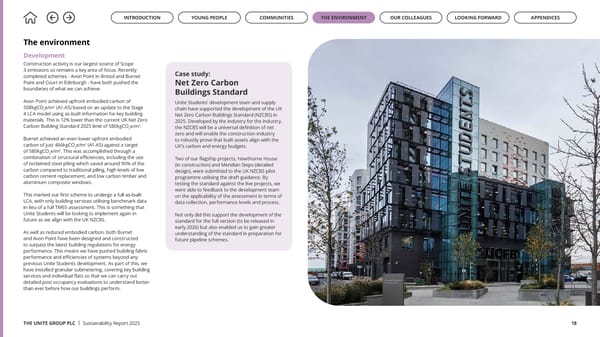
Development Construction activity is our largest source of Scope 3 emissions so remains a key area of focus. Recently completed schemes - Avon Point in Bristol and Burnet Point and Court in Edinburgh - have both pushed the boundaries of what we can achieve. Avon Point achieved upfront embodied carbon of 508kgCO 2 e/m 2 (A1-A5) based on an update to the Stage 4 LCA model using as-built information for key building materials. This is 12% lower than the current UK Net Zero Carbon Building Standard 2025 limit of 580kgCO 2 e/m 2 . Burnet achieved an even lower upfront embodied carbon of just 466kgCO 2 e/m 2 (A1-A5) against a target of 580kgCO 2 e/m 2 . This was accomplished through a combination of structural efficiencies, including the use of reclaimed steel piling which saved around 90% of the carbon compared to traditional piling, high levels of low carbon cement replacement, and low carbon timber and aluminium composite windows. This marked our first scheme to undergo a full as-built LCA, with only building services utilising benchmark data in lieu of a full TM65 assessment. This is something that Unite Students will be looking to implement again in future as we align with the UK NZCBS. As well as reduced embodied carbon, both Burnet and Avon Point have been designed and constructed to surpass the latest building regulations for energy performance. This means we have pushed building fabric performance and efficiencies of systems beyond any previous Unite Students development. As part of this, we have installed granular submetering, covering key building services and individual flats so that we can carry out detailed post occupancy evaluations to understand better than ever before how our buildings perform. THE UNITE GROUP PLC | Sustainability Report 2025 18 The environment Case study: Net Zero Carbon Buildings Standard Unite Students' development team and supply chain have supported the development of the UK Net Zero Carbon Buildings Standard (NZCBS) in 2025. Developed by the industry for the industry, the NZCBS will be a universal definition of net zero and will enable the construction industry to robustly prove that built assets align with the UK’s carbon and energy budgets. Two of our flagship projects, Hawthorne House (in construction) and Meridian Steps (detailed design), were submitted to the UK NZCBS pilot programme utilising the draft guidance. By testing the standard against the live projects, we were able to feedback to the development team on the applicability of the assessment in terms of data collection, performance levels and process. Not only did this support the development of the standard for the full version (to be released in early 2026) but also enabled us to gain greater understanding of the standard in preparation for future pipeline schemes. INTRODUCTION YOUNG PEOPLE COMMUNITIES OUR COLLEAGUES THE ENVIRONMENT APPENDICES LOOKING FORWARD
 Up to US: The Unite Group Sustainability Report 2025 Page 17 Page 19