
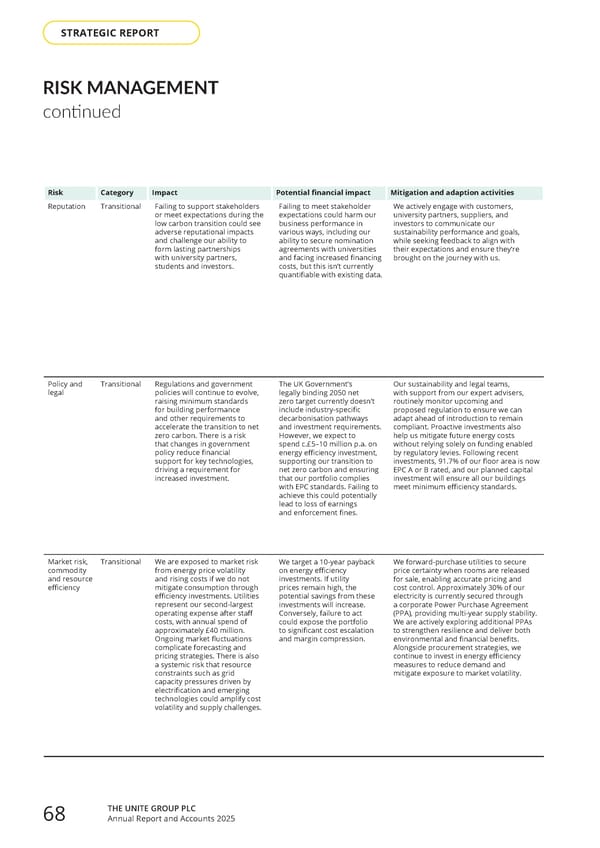
RISK MANAGEMENT continued Risk Category Impact Potential financial impact Mitigation and adaption activities Reputation Transitional Failing to support stakeholders or meet expectations during the low carbon transition could see adverse reputational impacts and challenge our ability to form lasting partnerships with university partners, students and investors. Failing to meet stakeholder expectations could harm our business performance in various ways, including our ability to secure nomination agreements with universities and facing increased financing costs, but this isn’t currently quantifiable with existing data. We actively engage with customers, university partners, suppliers, and investors to communicate our sustainability performance and goals, while seeking feedback to align with their expectations and ensure they’re brought on the journey with us. Policy and legal Transitional Regulations and government policies will continue to evolve, raising minimum standards for building performance and other requirements to accelerate the transition to net zero carbon. There is a risk that changes in government policy reduce financial support for key technologies, driving a requirement for increased investment. The UK Government’s legally binding 2050 net zero target currently doesn’t include industry-specific decarbonisation pathways and investment requirements. However, we expect to spend c.£5–10 million p.a. on energy efficiency investment, supporting our transition to net zero carbon and ensuring that our portfolio complies with EPC standards. Failing to achieve this could potentially lead to loss of earnings and enforcement fines. Our sustainability and legal teams, with support from our expert advisers, routinely monitor upcoming and proposed regulation to ensure we can adapt ahead of introduction to remain compliant. Proactive investments also help us mitigate future energy costs without relying solely on funding enabled by regulatory levies. Following recent investments, 91.7% of our floor area is now EPC A or B rated, and our planned capital investment will ensure all our buildings meet minimum efficiency standards. Market risk, commodity and resource efficiency Transitional We are exposed to market risk from energy price volatility and rising costs if we do not mitigate consumption through efficiency investments. Utilities represent our second-largest operating expense after staff costs, with annual spend of approximately £40 million. Ongoing market fluctuations complicate forecasting and pricing strategies. There is also a systemic risk that resource constraints such as grid capacity pressures driven by electrification and emerging technologies could amplify cost volatility and supply challenges. We target a 10-year payback on energy efficiency investments. If utility prices remain high, the potential savings from these investments will increase. Conversely, failure to act could expose the portfolio to significant cost escalation and margin compression. We forward-purchase utilities to secure price certainty when rooms are released for sale, enabling accurate pricing and cost control. Approximately 30% of our electricity is currently secured through a corporate Power Purchase Agreement (PPA), providing multi-year supply stability. We are actively exploring additional PPAs to strengthen resilience and deliver both environmental and financial benefits. Alongside procurement strategies, we continue to invest in energy efficiency measures to reduce demand and mitigate exposure to market volatility. THE UNITE GROUP PLC Annual Report and Accounts 2025 68 STRATEGIC REPORT
 Home for Success: Unite Students Annual Report 2025 Page 69 Page 71