
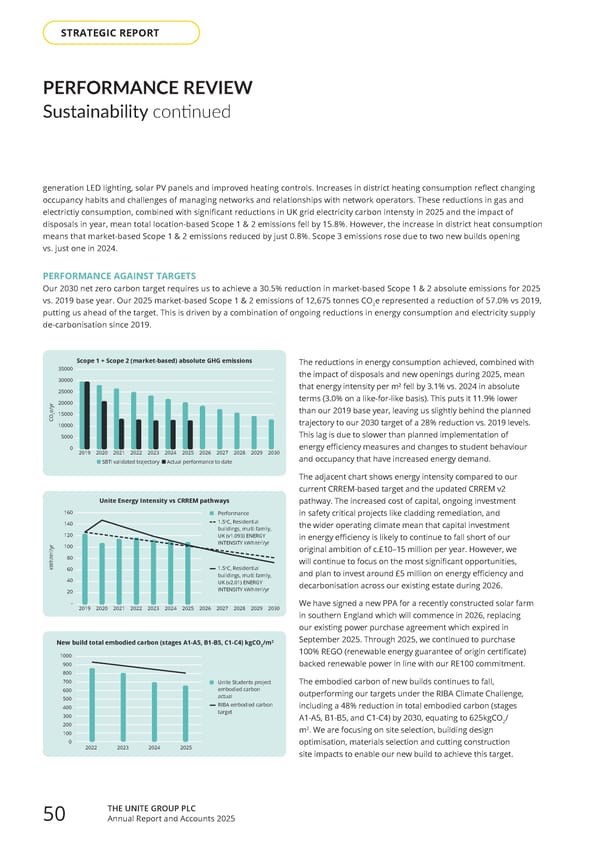
PERFORMANCE REVIEW Sustainability continued PERFORMANCE AGAINST TARGETS Our 2030 net zero carbon target requires us to achieve a 30.5% reduction in market-based Scope 1 & 2 absolute emissions for 2025 vs. 2019 base year. Our 2025 market-based Scope 1 & 2 emissions of 12,675 tonnes CO 2 e represented a reduction of 57.0% vs 2019, putting us ahead of the target. This is driven by a combination of ongoing reductions in energy consumption and electricity supply de-carbonisation since 2019. The reductions in energy consumption achieved, combined with the impact of disposals and new openings during 2025, mean that energy intensity per m² fell by 3.1% vs. 2024 in absolute terms (3.0% on a like-for-like basis). This puts it 11.9% lower than our 2019 base year, leaving us slightly behind the planned trajectory to our 2030 target of a 28% reduction vs. 2019 levels. This lag is due to slower than planned implementation of energy efficiency measures and changes to student behaviour and occupancy that have increased energy demand. The adjacent chart shows energy intensity compared to our current CRREM-based target and the updated CRREM v2 pathway. The increased cost of capital, ongoing investment in safety critical projects like cladding remediation, and the wider operating climate mean that capital investment in energy efficiency is likely to continue to fall short of our original ambition of c.£10–15 million per year. However, we will continue to focus on the most significant opportunities, and plan to invest around £5 million on energy efficiency and decarbonisation across our existing estate during 2026. We have signed a new PPA for a recently constructed solar farm in southern England which will commence in 2026, replacing our existing power purchase agreement which expired in September 2025. Through 2025, we continued to purchase 100% REGO (renewable energy guarantee of origin certificate) backed renewable power in line with our RE100 commitment. The embodied carbon of new builds continues to fall, outperforming our targets under the RIBA Climate Challenge, including a 48% reduction in total embodied carbon (stages A1-A5, B1-B5, and C1-C4) by 2030, equating to 625kgCO 2 / m 2 . We are focusing on site selection, building design optimisation, materials selection and cutting construction site impacts to enable our new build to achieve this target. generation LED lighting, solar PV panels and improved heating controls. Increases in district heating consumption reflect changing occupancy habits and challenges of managing networks and relationships with network operators. These reductions in gas and electrictiy consumption, combined with significant reductions in UK grid electricity carbon intensty in 2025 and the impact of disposals in year, mean total location-based Scope 1 & 2 emissions fell by 15.8%. However, the increase in district heat consumption means that market-based Scope 1 & 2 emissions reduced by just 0.8%. Scope 3 emissions rose due to two new builds opening vs. just one in 2024. 35000 30000 25000 20000 15000 10000 5000 0 2019 2020 2021 2022 2023 2024 2025 2026 2027 2028 2029 2030 SBTi validated trajectory Actual performance to date Scope 1 + Scope 2 (market-based) absolute GHG emissions CO 2 e/yr 2019 2020 2021 2022 2023 2024 2025 2026 2027 2028 2029 2030 2022 2023 2024 2025 Unite Energy Intensity vs CRREM pathways New build total embodied carbon (stages A1-A5, B1-B5, C1-C4) kgCO 2 /m 2 kWh/m 2 /yr 160 140 120 100 80 60 40 20 - 1000 900 800 700 600 500 400 300 200 100 0 Performance 1.5 o C, Residential buildings, multi family, UK (v1.093) ENERGY INTENSITY kWh/m 2 /yr 1.5 o C, Residential buildings, multi family, UK (v2.01) ENERGY INTENSITY kWh/m 2 /yr Unite Students project embodied carbon actual RIBA embodied carbon target THE UNITE GROUP PLC Annual Report and Accounts 2025 50 STRATEGIC REPORT
 Home for Success: Unite Students Annual Report 2025 Page 51 Page 53