
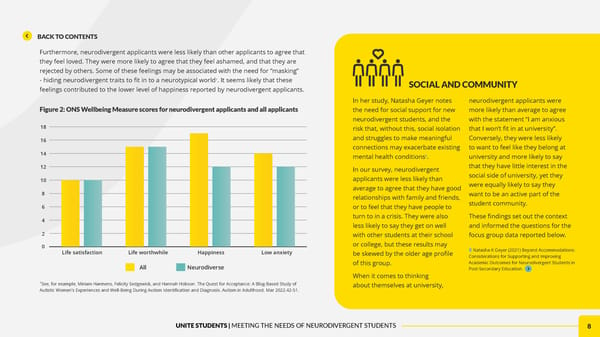
BACK TO CONTENTS 8 UNITE STUDENTS | MEETING THE NEEDS OF NEURODIVERGENT STUDENTS Furthermore, neurodivergent applicants were less likely than other applicants to agree that they feel loved. They were more likely to agree that they feel ashamed, and that they are rejected by others. Some of these feelings may be associated with the need for “masking” - hiding neurodivergent traits to fit in to a neurotypical world 7 . It seems likely that these feelings contributed to the lower level of happiness reported by neurodivergent applicants. In her study, Natasha Geyer notes the need for social support for new neurodivergent students, and the risk that, without this, social isolation and struggles to make meaningful connections may exacerbate existing mental health conditions 8 . In our survey, neurodivergent applicants were less likely than average to agree that they have good relationships with family and friends, or to feel that they have people to turn to in a crisis. They were also less likely to say they get on well with other students at their school or college, but these results may be skewed by the older age profile of this group. When it comes to thinking about themselves at university, neurodivergent applicants were more likely than average to agree with the statement “I am anxious that I won’t fit in at university”. Conversely, they were less likely to want to feel like they belong at university and more likely to say that they have little interest in the social side of university, yet they were equally likely to say they want to be an active part of the student community. These findings set out the context and informed the questions for the focus group data reported below. SOCIAL AND COMMUNITY 7 See, for example, Miriam Harmens, Felicity Sedgewick, and Hannah Hobson. The Quest for Acceptance: A Blog-Based Study of Autistic Women’s Experiences and Well-Being During Autism Identification and Diagnosis. Autism in Adulthood. Mar 2022.42-51. 8 Natasha K Geyer (2021) Beyond Accommodations: Considerations for Supporting and Improving Academic Outcomes for Neurodivergent Students in Post-Secondary Education. Life satisfaction 2 4 6 8 10 12 14 16 18 0 Life worthwhile Happiness Low anxiety Figure 2: ONS Wellbeing Measure scores for neurodivergent applicants and all applicants All Neurodiverse
 Neurodivergent Students Report Page 7 Page 9