
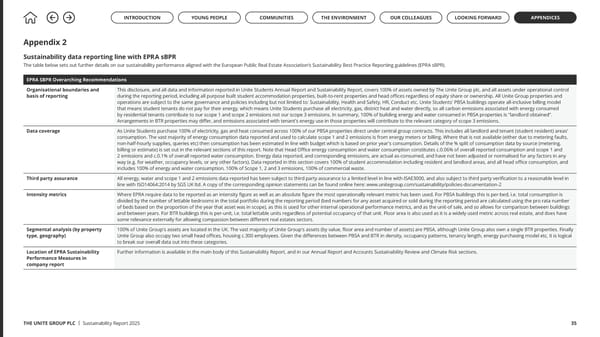
THE UNITE GROUP PLC | Sustainability Report 2025 35 Appendix 2 Sustainability data reporting line with EPRA sBPR The table below sets out further details on our sustainability performance aligned with the European Public Real Estate Association’s Sustainability Best Practice Reporting guidelines (EPRA sBPR). EPRA SBPR Overarching Recommendations Organisational boundaries and basis of reporting This disclosure, and all data and information reported in Unite Students Annual Report and Sustainability Report, covers 100% of assets owned by The Unite Group plc, and all assets under operational control during the reporting period, including all purpose built student accommodation properties, built-to-rent properties and head offices regardless of equity share or ownership. All Unite Group properties and operations are subject to the same governance and policies including but not limited to: Sustainability, Health and Safety, HR, Conduct etc. Unite Students' PBSA buildings operate all-inclusive billing model that means student tenants do not pay for their energy, which means Unite Students purchase all electricity, gas, district heat and water directly, so all carbon emissions associated with energy consumed by residential tenants contribute to our scope 1 and scope 2 emissions not our scope 3 emissions. In summary, 100% of building energy and water consumed in PBSA properties is "landlord obtained". Arrangements in BTR properties may differ, and emissions associated with tenant's energy use in those properties will contribute to the relevant category of scope 3 emissions. Data coverage As Unite Students purchase 100% of electricity, gas and heat consumed across 100% of our PBSA properties direct under central group contracts. This includes all landlord and tenant (student resident) areas' consumption. The vast majority of energy consumption data reported and used to calculate scope 1 and 2 emissions is from energy meters or billing. Where that is not available (either due to metering faults, non-half-hourly supplies, queries etc) then consumption has been estimated in line with budget which is based on prior year's consumption. Details of the % split of consumption data by source (metering, billing or estimate) is set out in the relevant sections of this report. Note that Head Office energy consumption and water consumption constitutes c.0.06% of overall reported consumption and scope 1 and 2 emissions and c.0.1% of overall reported water consumption. Energy data reported, and corresponding emissions, are actual as-consumed, and have not been adjusted or normalised for any factors in any way (e.g. for weather, occupancy levels, or any other factors). Data reported in this section covers 100% of student accommodation including resident and landlord areas, and all head office consumption, and includes 100% of energy and water consumption, 100% of Scope 1, 2 and 3 emissions, 100% of commercial waste. Third party assurance All energy, water and scope 1 and 2 emissions data reported has been subject to third party assurance to a limited level in line with ISAE3000, and also subject to third party verification to a reasonable level in line with ISO14064:2014 by SGS UK ltd. A copy of the corresponding opinion statements can be found online here: www.unitegroup.com/sustainability/policies-documentation-2 Intensity metrics Where EPRA require data to be reported as an intensity figure as well as an absolute figure the most operationally relevant metric has been used. For PBSA buildings this is per-bed, i.e. total consumption is divided by the number of lettable bedrooms in the total portfolio during the reporting period (bed numbers for any asset acquired or sold during the reporting period are calculated using the pro rata number of beds based on the proportion of the year that asset was in scope), as this is used for other internal operational performance metrics, and as the unit-of sale, and so allows for comparison between buildings and between years. For BTR buildings this is per-unit, i.e. total lettable units regardless of potential occupancy of that unit. Floor area is also used as it is a widely used metric across real estate, and does have some relevance externally for allowing compassion between different real estates sectors. Segmental analysis (by property type, geography) 100% of Unite Group's assets are located in the UK. The vast majority of Unite Group's assets (by value, floor area and number of assets) are PBSA, although Unite Group also own a single BTR properties. Finally Unite Group also occupy two small head offices, housing c.300 employees. Given the differences between PBSA and BTR in density, occupancy patterns, tenancy length, energy purchasing model etc, it is logical to break our overall data out into these categories. Location of EPRA Sustainability Performance Measures in company report Further information is available in the main body of this Sustainability Report, and in our Annual Report and Accounts Sustainability Review and Climate Risk sections. INTRODUCTION YOUNG PEOPLE COMMUNITIES OUR COLLEAGUES THE ENVIRONMENT LOOKING FORWARD APPENDICES
 Up to US: The Unite Group Sustainability Report 2025 Page 34 Page 36