
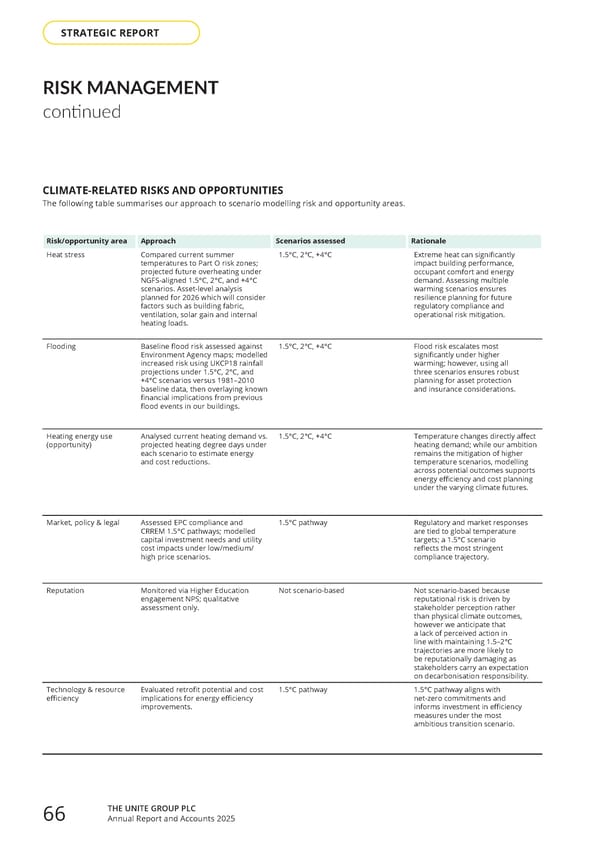
CLIMATE-RELATED RISKS AND OPPORTUNITIES The following table summarises our approach to scenario modelling risk and opportunity areas. RISK MANAGEMENT continued Risk/opportunity area Approach Scenarios assessed Rationale Heat stress Compared current summer temperatures to Part O risk zones; projected future overheating under NGFS-aligned 1.5°C, 2°C, and +4°C scenarios. Asset-level analysis planned for 2026 which will consider factors such as building fabric, ventilation, solar gain and internal heating loads. 1.5°C, 2°C, +4°C Extreme heat can significantly impact building performance, occupant comfort and energy demand. Assessing multiple warming scenarios ensures resilience planning for future regulatory compliance and operational risk mitigation. Flooding Baseline flood risk assessed against Environment Agency maps; modelled increased risk using UKCP18 rainfall projections under 1.5°C, 2°C, and +4°C scenarios versus 1981–2010 baseline data, then overlaying known financial implications from previous flood events in our buildings. 1.5°C, 2°C, +4°C Flood risk escalates most significantly under higher warming; however, using all three scenarios ensures robust planning for asset protection and insurance considerations. Heating energy use (opportunity) Analysed current heating demand vs. projected heating degree days under each scenario to estimate energy and cost reductions. 1.5°C, 2°C, +4°C Temperature changes directly affect heating demand; while our ambition remains the mitigation of higher temperature scenarios, modelling across potential outcomes supports energy efficiency and cost planning under the varying climate futures. Market, policy & legal Assessed EPC compliance and CRREM 1.5°C pathways; modelled capital investment needs and utility cost impacts under low/medium/ high price scenarios. 1.5°C pathway Regulatory and market responses are tied to global temperature targets; a 1.5°C scenario reflects the most stringent compliance trajectory. Reputation Monitored via Higher Education engagement NPS; qualitative assessment only. Not scenario-based Not scenario-based because reputational risk is driven by stakeholder perception rather than physical climate outcomes, however we anticipate that a lack of perceived action in line with maintaining 1.5–2°C trajectories are more likely to be reputationally damaging as stakeholders carry an expectation on decarbonisation responsibility. Technology & resource efficiency Evaluated retrofit potential and cost implications for energy efficiency improvements. 1.5°C pathway 1.5°C pathway aligns with net-zero commitments and informs investment in efficiency measures under the most ambitious transition scenario. THE UNITE GROUP PLC Annual Report and Accounts 2025 66 STRATEGIC REPORT
 Home for Success: Unite Students Annual Report 2025 Page 67 Page 69